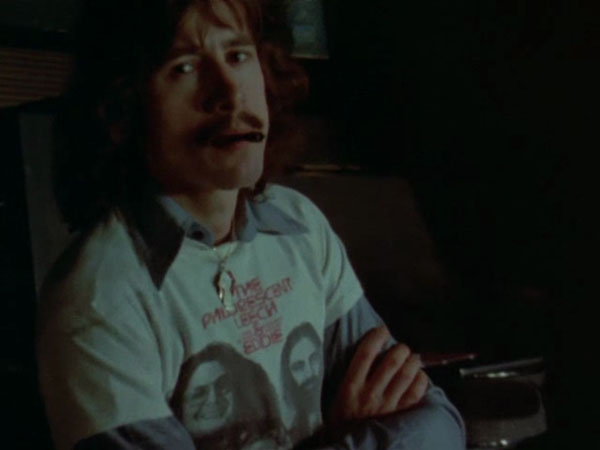
Carlos (2010, Olivier Assayas)

Wire! The Feelies! A long three-part series/feature about a so-called terrorist who operated by a strict moral code can’t help but get compared to Soderbergh’s Che, but the strong use of quality 1970′s and 80′s music throws a Marie Antoinette comparison into the mix.

Watched in nice widescreen over netflix streaming on the TV. Despite its epic length, the movie felt small and far away. Lots of political and historical touchstones that I didn’t recognize, because I have no education or sense of history. Carlos’s motives weren’t clearly explained (something about the Palestinian Struggle), nor were his origins (“It’s no longer Ilich. It’s Carlos”). But his battles, his public terrorist acts, his relationships, hideouts and escapes are all laid out in glorious detail. I’m generally a fan of Assayas films, but didn’t connect with this one at all. I’m thinking netflix is to blame.

Edgar Ramirez can’t be blamed anyway, was magnetic, as they say, as Carlos.

The movie was so long, and petered out in such an energy-depleting way, that I can’t bring myself to write a whole lot or even to read a bunch of articles. So I took to D. Hudson’s great notebook summary and cut out three points I would’ve made if I’d given it more thought (or took better notes).

G. Andrew:

Certainly, the film doesn’t feel anything like television. It’s shot in Scope, boasts the fleet way with narrative, camera movement and cutting that are characteristic of Assayas at his best and has a sense of scale, depth and seriousness of purpose that is essentially cinematic.

M. Dargis:

He lacks substance. He doesn’t have much to say, and his rhetoric gets cruder as the years pass (as does his treatment of women). He’s a man of action, not ideas. Mr Assayas, by contrast, is a director of ideas. … Carlos isn’t Che slogging through the jungle for the cause: Carlos is a mercenary, a thug.

T. McCarthy:

One element that vividly pops out from the film’s vibrant fabric are the numerous scenes in which government officials from Arab and Eastern bloc countries directly order, sponsor or otherwise facilitate terrorism and mayhem in other nations…. I can’t recall ever seeing scenes quite like these in any movie, and they are bracing.

Buy from Amazon:
Carlos (Criterion Blu-ray)

Tags: , , , , , ,

Comments

Boarding Gate (2007, Olivier Assayas)

Assayas’s idea of a good, fun b-movie, except he forgot the “good” and the “fun.”

Asia Argento used to do demeaning sex work for powerful businessman Michael Madsen in order to turn him on and steal business secrets, and now after years she is back. Long push-pull dialogue segments prep us for twisty psychological intrigue, but nothing is ever especially twisty. Oh wait, Madsen has a big-money disagreement with Alex Descas (scientist/vampire-boyfriend in Trouble Every Day) but that couldn’t possibly be important. Asia pulls a gun and kills Madsen, planned by her new boyfriend Carl Ng, whose wife Kelly Lin (Zu Warriors, ex-wife/cop in Mad Detective) is in on the plot.

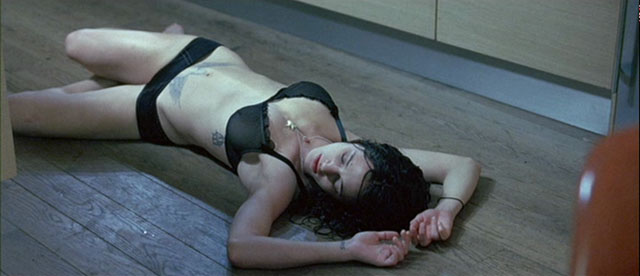
Girls still faint in movies:
image

But will Kelly really let Asia get away with the crime and leave with her husband? No, well, yes, sort of. Shocker: Alex Descas shows up at the end. It was his idea to kill Madsen! None of the surprises are surprising and none of the tension is tense… Demonlover had more twists in its last five minutes than this one can manage in ninety. If I’d seen this when it first came out I might have skipped Summer Hours, which would have been a mistake. Guess Assayas can be inconsistent but still makes great films.

image

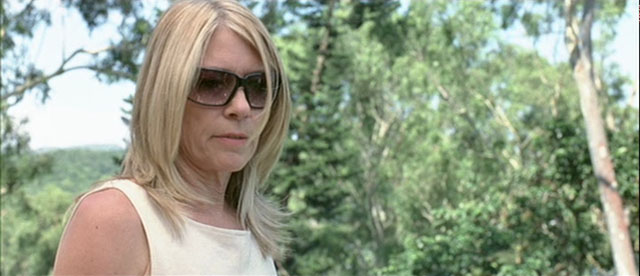
It might hurt Michael Madsen’s feelings to be cast in what the director calls a b-movie, but he’s not any good, nor is Sonic Youth’s Kim Gordon as a Hong Kong crime boss, and even Asia isn’t giving a knockout performance. I’d think Kelly Lin stole the show if there was much of a show to steal. Turns out most critics agreed with me – I didn’t re-check the reviews, probably got this confused with Go Go Tales in thinking it was well-loved.

image

Truth 24FPS agrees:

The project must have seemed promising, at least on paper – a globe trotting thriller with kinky sex, drug deals gone awry, murder, double and triple crosses, gun fights. But the film comes across as tepid, warmed over trash, and strangely, contains none of the kinetic forcefulness of the Hong Kong films Assayas champions. Assayas’ view of the world can at least partially be gleaned from his casting choices – an Italian who speaks French and English, with American and Chinese lovers, who travels from Paris to Hong Kong and eventually encountering a crime boss played by an indie rock icon. … The first half of the film consists of [Argento & Madsen] squaring off in increasingly repetitive encounters, with a kind of will they or won’t they do it sexual tension (answer: who cares?).

Asia Argento only liked the movie thiiiis much:
image

Dissent from G. Kenny:

His mastery of the camera and his always innovative approach to setting are constant, knotty pleasures; the Paris of the film’s first half is as alien to our recieved ideas of Paris as Godard’s Alphaville was, while his Hong Kong is a crumbling labyrinth where the only clues about which corner to turn are provided by cell phone rings.

image

But my favorite comment is from a forum poster on Premiere: “It made me want to punch Asia Argento in the face, but that would probably turn her on.”

Tags: , , ,

Comments

Summer Hours (2008, Olivier Assayas)

The highlight for me here was Edith Scob. I only know her as the virgin Mary in Bunuel’s The Milky Way forty years ago, but she was totally recognizable as the deathbed matriarch here. I mean, yeah Juliette Binoche is always good, but Charles Berling (Scob’s costar in Ruiz’s Comedy of Innocence) was more the star here (and blonde L’Enfant star Jérémie Renier played their brother).

I heard this was a great movie, but right before it started I realized what I’d gotten myself into… an acclaimed family-secrets drama – surely another underwhelming handi-cam video a la A Christmas Tale or Rachel Getting Married. But no, fortunately this was the kind of filmmaking I can get behind, everything in order, with shaky cameras and close-ups only where necessary. Kind of surprising, really, that the director of hyperkinetic Irma Vep and Demonlover makes a classical-style family drama, but I’d seen Clean so I wasn’t too amazed. Another thing compared to the other recent dramas is that everything is supremely understated in this. Its themes are obvious, but they don’t come out in big emotional climaxes. The big payoff shot, Berling’s daughter framed in front of the family home, telling her boyfriend that she’s kinda sad that her grandmother is dead and the place is being sold, is tear-free and quickly interrupted and didn’t really hit me until a few minutes later in the parking lot.

Opening scene has three siblings at their mother’s house with Berling & Renier’s wives and kids (Binoche is too much the high-powered businesswoman to have time for a husband or kids), Scob talking privately about what will happen to the house and her possessions after she dies. Next scene a few months later, predictably, she is dead and the kids spend the rest of the movie deciding what to do with her house and possessions. It’s decided pretty easily that everything will be sold and the loyal servant (Isabelle Sadoyan, also a servant in Blue) will be dismissed, so there’s not much conflict, more the family members coming to terms with the property sale, the kids becoming the oldest living generation in their family.

Tags: ,

Comments

To Each His Cinema, part 1 (2007)

A program of shorts that played at the 2007 Cannes Film Festival to mark its 60th anniversary. Pretty terrific bunch of 3-5 minute shorts by possibly the best group of directors ever assembled… worth watching more than once. Each is about the cinema in some way or another, with a few recurring themes (blind people and darkness, flashbacks and personal stories). Katy watched/liked it too!

First half of shorts (second half is here):

Open-Air Cinema by Raymond Depardon
image

One Fine Day by Takeshi Kitano, continuing his self-referential streak.
image

Three Minutes by Theo Angelopolous is a Marcello Mastroianni tribute starring the great Jeanne Moreau.
image

In The Dark by Andrei Konchalovsky
image

Diary of a Moviegoer by Nanni Moretti
image

The Electric Princess Picture House by Hou Hsiao-hsien
image

Darkness by the bros. Dardenne
image

Anna by Alejandro González Iñárritu
image

Movie Night, the first of two gorgeously-shot outdoor movie starring chinese children, by Zhang Yimou.
image

Dibbouk de Haifa, annoying business by Amos Gitai.
image

The Lady Bug by Jane Campion.
image

Artaud Double Bill by Atom Egoyan.
image

The Foundry, comic greatness by Aki Kaurismäki.
image

Recrudescence, stolen cell-phone bit by Olivier Assayas.
image

47 Years Later very self-indulgent by Youssef Chahine.
image

Tags: , , , , , , , , , , , , , , , , , , , , , ,

Comments

Clean (2004, Olivier Assayas)

Maggie Cheung won best actress at Cannes in May 2004, and it didn’t open here till June 2006, then left in a week. I was busy that week so rented it, damn it all.

Maggie’s rocker husband ODs in a hotel room and she’s off to prison for a few months. The rocker’s Nick-Nolte dad watches the kid while she’s away. She uses all her old connections to try to get back on track, ending up with a bunch of crap jobs and a vague hope for a future in music, while Nick is dealing with his dying wife and a grandkid turned against his mom. Maggie sort of lets Nick down at the end, but he doesn’t throw it in her face. Interesting characters, great looking movie.

Tags: ,

Comments