The Armando Iannucci Shows (2001)

Sadly there was only one season, but I guess he tackled every major issue that humanity faces in these eight episodes (Time, Reality, Work, Twats), so why make more? Aired in September 2001 so I imagine it could have been overlooked. I have no idea if it was, though, since here practically all British television is overlooked. I sought this out after loving Iannucci’s In The Loop. Still looking forward to The Thick of It and Time Trumpet.

All vaguely thematically-tied sketch comedy, a la the first two seasons of Mr. Show, mostly (but not limited to) starring Armando as himself, or his stand-up persona.

A poem from the show:

As she grimly walked away
“I’m leaving you,” she said
And I had nothing new to say
Like the second album by Portishead


30 Rock seasons 3 & 4

Remained funny/good over two more seasons. Less stand-alone-episodic, more season-long plot threads. Until netflix gets more episodes, there’s no other show we can easily agree to watch together – contenders have included Parks & Rec, Louie, Slings & Arrows and Arrested Development.

New writers & directors: Steve Buscemi (!), Todd Holland (director of the Fred Savage classic The Wizard), Ron Weiner (writer of one of my favorite Futurama episodes), Tricia Brock (made a 2004 Fred Willard movie), 15-year SNL writer Paula Pell, and the show’s music composer directed an episode.

Oh, the guests!
The cast of Night Court, Oprah (my favorite guest spot), J. Aniston, Steve Martin, Peter Dinklage, John Lithgow, Alan Alda, the Beastie Boys, Jon Glaser, Betty White, the voice of Gilbert Gottfried, Al “should not be allowed on television” Gore, Buzz “ditto” Aldrin, James Franco, Will Ferrell and Matt Damon, and semi-regulars Elaine Stritch, Salma Hayek, Jon Hamm, Michael Sheen and Juliane Moore.

Katy’s first pick for Westerns month was this, the most acclaimed Western of all. We both liked it very much, though I’m probably not qualified to proclaim its greatness or otherwise. For one thing, it’s not all Citizen Kane-y, shouting its own greatness to the heavens, just a cheap-looking, charming flick (reportedly, Welles loved it). Story by Ernest Haycox (Canyon Passage, Union Pacific), screenplay by Ford regular Dudley Nichols (also Bringing Up Baby and Scarlet Street – I like this guy). Remade in the 60’s with Ann-Margret, Bing Crosby and Slim Pickens, then in the 80’s with Highwaymen Willie, Kris, Johnny and Waylon. I would kinda love to see both remakes. Ford also made two Henry Fonda movies this year, including Young Mr. Lincoln.

Bunch of people who do not belong together are crammed into the stage to Lordsburg through dangerous Indian territory and their military escort has vanished. The long-dreaded attack comes, but they’re saved last-minute by the cavalry, and everyone learns a little something about each other. Lots more humor than I expected, too. It’s hardly a dry, stodgy classic. It’s hardly realistic either – you never forget that it’s a movie (in fact, sometimes it feels like a stage play).

John Wayne (in his star-making role after flying under-radar for his last hundred movies) shows up late, out for revenge on some guys who killed his brother, watched closely by Marshall Curley (George Bancroft, star of those Josef von Sternberg movies Criterion just put out). It seems weird now that Claire Trevor (Dark Command, Key Largo, that 60’s remake of Pickup on South Street) was first-billed in this. She’s a hottie haunted by her dark past (as a “saloon girl,” it seems, not a prostitute) and shunned by the right and proper other girl, pregnant Lucy (Hollywood short-termer Louise Platt of Street of Chance, Spawn of the North) who’s trying to meet up with her husband.

There’s an uptight crooked banker named Gatewood (Berton Churchill, the villainous senator in Judge Priest) who gets arrested upon arrival, after irritating everyone the entire way, and for comic relief, nerdy whiskey salesman Peacock (appropriately named Donald Meek, also of You Can’t Take It With You, Peter Ibbetson, Return of Frank James) and the seriously drunk Doc Boone (Thomas Mitchell, who won an oscar for this, also with major parts in Mr. Smith Goes to Washington, Gone with the Wind, Only Angels Have Wings and The Hunchback of Notre Dame – all this same year!). The doc sobers up just long enough to deliver Lucy’s baby halfway through the trip, becoming everyone’s hero. I can’t tell if gentleman gambler Hatfield (John Carradine, who was playing Robert Ford in the Jesse James films around the same time) is a hero or not, dying in the attack (somebody had to) before he could blast Lucy in the head to spare her from Indian capture. And I loved coachman Andy Devine, whom Katy immediately pegged as the voice of Friar Tuck in Robin Hood. And oh yeah, when they get into town, lawman Curley lets Ford blow away his opponents then escape with Claire Trevor.

D. Cairns:

Stock types, but Nichols and Ford and the cast make them fresh by letting them bounce off one another in surprising ways. Character change elevates Stagecoach far above The Hurricane, where the cardboard figures blow in the wind but don’t bend. Nearly everybody in Stagecoach is either developed or transfigured during the adventure. Snooty Lucy transcends the prejudices of her upbringing via her growing respect for Dallas, and even the timid Mr. Peacock gains a little force. A family man, he is more able to assert himself after Lucy’s baby is born, even if nobody pays much attention. Curley, meanwhile, thanks to his exposure to that noble outlaw the Ringo Kid, abandons his rigid service to the law so a higher justice can be done. … Throughout the film, the Apaches are an anonymous threat, Geronimo a mere renegade with no motivation supplied. It’s the least nuanced portrayal of Indians in any of Ford’s classic westerns, though his relations with the Navajo extras were very warm—he even had a medicine man on retainer to arrange photogenic cloud formations for his camera.

We watched it on crummy netflix streaming, not on the gloriously restored, feature-rich new Criterion-edition blu-ray, so I have no supporting materials.

A very late entry for…

Initiated by Shadowplay

Le final film de Jean Renoir, made for television when the director was in his mid-70’s, eight years after his last theatrical picture The Elusive Corporal. Some tinges of bitterness, of sadness and despair, but as always Jean is finally generous and life-affirming, closing with a whole town roaring laughter, making me laugh in response.

But first, Renoir minimizes expectations. Away from the monumental cinema screen (which he often conflated with a theatrical stage), now working for television, he envisions a diminished stage, a tiny theater, and so presents short stories instead of one long work.

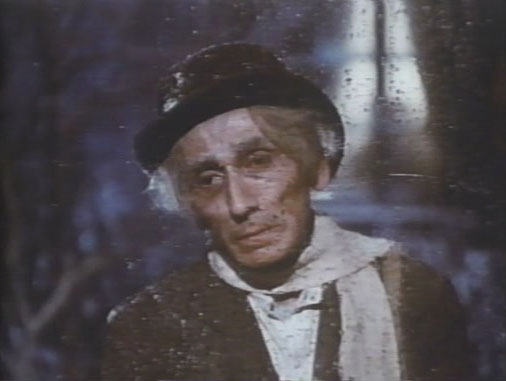
A rich loudmouth (Roland Bertin of The Model Couple, The Hairdresser’s Husband), in a move imitated by Lars Von Trier for The Five Obstructions, pays a homeless guy to watch his friends’ Christmas feast through the restaurant window. Some of his guests are bummed, so they flit off elsewhere, leaving this guy outside making restaurant patrons nervous until the maitre d’ pays him in food and wine to buzz off. The bum (Nino Formicola) brings the food to his girlfriend (singer Milly, in The Conformist the same year) under a bridge – they celebrate the holiday talking together (but not eating) then lie down and freeze to death with happy smiles on their face. A weird holiday fable, and a circular one for Renoir, who’d filmed The Little Match Girl (with much window gazing and freezing to death) over forty years prior.

Gaze from outside:

Gaze from inside:

As with the concept of the “petit theater” itself, the next episode can be seen as a cranky old-timer’s refusal to accept modern technology, but in both cases he suffuses his premise with humor, downplaying the crankiness in favor of amusement. It’s the most comedic and musical of the pieces, featuring a Greek choir of townsfolk, a painting that changes expression, and cartoonishly fun acting.

Marguerite Cassan (my favorite actor of the same year’s La Rupture – mother of the husband-gone-mad) wants only an electric floor buffer, and bullies her husband about it until the next-door neighbor, an electric floor buffer sales rep, overhears and comes over to demo the product. Unfortunately, Cassan’s poor husband (Pierre Olaf of Camelot) slips on the ultra-smooth floor and dies. She remarries a man with a stronger will (Jacques Dynam, who played buffoon inspector Juve’s second-in-command in the 1964 Fantomas) who insists she not run the machine while he’s home. She disobeys and he hurls it out the window, so she hurls herself out the window. That’s two Renoir stories in a row that end in demise.

M. Cassan giving the silent treatment to first husband:

M. Cassan giving the silent treatment to second husband:

Part Three is a musical interlude featuring Jeanne Moreau (the same year she was/wasn’t in Orson Welles’s The Deep) singing “When Love Dies.” Incredibly, the producers of the VHS copy I watched decided not to subtitle the song.

The final segment was my favorite. Duvallier (Fernand Sardou), a well-loved retired captain, resides happily in his big house with his young wife (Francoise Arnoul, lead girl in French Cancan) and a lovestruck maid (the rarely seen Dominique Labourier, a few years before starring in Celine and Julie Go Boating), spending his days in town playing bowls (a similar game to bocce). All is bliss until the wife is discovered to be sleeping with a friend of his, then it’s tears all around. Duvallier ponders the situation, asking townsfolk for advice, while the friend first decides to leave town (him: “He loves you”, Mrs. Duvallier: “Yes, but only when I’m happy. When I’m unhappy I upset him, and if you leave I’ll be unhappy.”) then proposes a duel. But Duvallier decides it’s best for everyone to stay happy, to live as they have been, and so the trio goes into town for a game of bowls. It’s the most cheerful movie about infidelity that I’ve ever seen.

Final bow:

On one hand, I really want to see the G.I. Joe movie (since I used to watch all the cartoons) and Supernova (since it’s a legendarily troubled sci-fi with F.F. Coppola involvement) and many other, even worse movies. On the other hand, time is precious and I take my movie watching seriously. So I find The Last Ten Minutes to be a happy compromise – in one guilty-pleasure hour, I kill six potentially trashy time-wasting movies, at an average savings of 89%, or over 13 hours per ten movies! What a deal.

G.I. Joe: The Rise of Cobra (2009, Stephen Sommers)
Ah, what’s happening?! General Hawk (Dennis Quaid) looks concerned. A stealth bomber was shot with green smokey special effects and Ripcord (Marlon Wayans) escaped alive. People are referring to “joes” and their “hoo-rah” when they get excited is of course “yo joe!”. Maybe they should’ve gotten rid of those parts. Cobra Commander and Destro (I never thought of him as Scottish) are off doing creepy villain stuff and saying lines like “you and what army?” The visuals look slick as shit, though. Why is Duke (Channing Tatum of Public Enemies) so young? Mild sequel set-up, Jonathan Pryce-as-president coda, and it looks like I missed all the Storm Shadow scenes. Movie looks totally bearable overall. In a few years I look forward to G.I. Joe: The Wrath of Golobulus then G.I. Joe: Beyond Thunderdrome.

Horsemen (2009, Jonas Akerlund)
Why is General Hawk (Dennis Quaid) putting Zhang Ziyi in prison, and what does it have to do with the apocalypse? Oh of course baddies are after his family and are luring him to an abandoned building… that is way more boring than the apocalypse. Quaid’s son (Lou “Thumbsucker” Pucci) is hanging Ichi The Killer/Hellraiser style over a stage saying some boringness about neglectful parenting while Quaid is chained up watching. And every Saw sequel said the same thing. Why don’t our parents worry about us? Why don’t our parents worry about us? From the director of nothing and the writer of Doom.

Supernova (2000, Walter Hill)
James Spader in a Leviathan diving suit fought a badass white guy who I don’t recognize until rescued by Angela Bassett. The ship’s computer warns us about “ninth-dimensional matter.
Karl gets extremely blown up, but I wouldn’t call it a supernova. I don’t think Angela Basset has a shirt on. Ah there’s the supernova – neato. After going warp-speed while nude and hugging, Basset-Spader have gone all The Fly and swapped eye colors and now she’s pregnant – that never happens when people beam up together on Star Trek. Interesting pedigree, this movie – from pseudonymed director Walter “The Warriors” Hill with uncredited help by Francis Ford Coppola.

John Q (2002, Nick Cassavetes)
Denzel… shoots himself in the head! But the safety was on. Transplant heart for Denzel’s insurance-less dying child is arriving. The police arrest a False Denzel while the real one sneaks around in hospital scrubs, but Robert Duvall is on to the plot. Is this really what heart transplants look like? So simple and clean, like the Operation game. Montage of people telling us America may have a national health-care problem. A blatant message movie, then. Look, James Woods! I thought it didn’t seem terrible overall until a cringey final shot.

Hollow Man 2 (2006, Claudio Fäh)
Was Hollow Man even successful? Invisible Christian Slater (the poor man’s Invisible Kevin Bacon) indirectly kills a suited guy who’s tracking him via infrared scanner. Oh wait, dialogue tells me that was actually Invisible Peter Facinelli of the Twilight series… Slater is now trying to murder Laura Regan until Facinelli shows up. Invisible Man fight in the rain ends with a shovel stuck into Slater. From the writer of all sorts of unnecessary sequels, from Hellraiser: Hellworld to Dracula 2000, from Pulse 3 to Prophecy 5.

Surrogates (2009, Jonathan Mostow)
Short movie. Evil James Cromwell, inventor of the surrogate system, surprises Bruce Willis with a gun. Ooh, in the future we have light-up staircases. Crom “uploaded a virus into the system” to kill all the surrogates, but a fat guy excitedly shouts some key commands at a blonde chick, then shots are fired and all the robot surrogates in the world fall down. So whoever she was (Bruce’s wife?) she saved all of humanity from a life of surrogate slavery, waking them from, one might say, the Matrix in which they lived. From the director of sad sequel Terminator 3.

A belated entry for…

Initiated by Shadowplay

“This war’s gonna have a head on it”

Frank Tashlin’s final film as director is a Bob Hope picture, appropriate since Hope gave Tashlin his big break into live-action directing in the first place with Son of Paleface. Tashlin was only 59 when this came out, younger than Hope, but would only live a few more years. It’s a shame to have lost him so young, since his style kept changing with the times – would’ve been a trip to see a Tashlin picture in the 1980’s. From The Girl Can’t Help It to Caprice, Tash’s films have seemed very of-their-time – until this one, which feels stodgy and old-fashioned.

Why is this? My guess is old buddy Bob Hope. The credited writers are responsible for some TV episodes and the goofy crystalline sci-fi flick The Monolith Monsters but this has Hope written all over it. It wants to be a comedy, but it can’t make any jokes at the military’s expense – not in ’68 with Hope a political right-winger who probably spent more time than any other entertainer performing for U.S. troops. It’s more consistent a story than most Tashlin movies but it lacks all the good gags – the best jokes are the couple that Hope makes at the expense of his beloved partner Bing Crosby – and any comic momentum is killed at the end with a dry ten minutes of flag waving. So you could say it fails as a comedy since it pulls so many punches, or more generously, that it’s a light military drama with a bit of humor.

Hope’s buddy Calvin Coolidge Ishamura, played by Mako of Conan the Destroyer and Pacific Heights – the movie is very tolerant of Japanese-Americans, if not Japanese-Japanese.

Makeshift beer fridge:

The premise is simple: the Japs sunk a boat delivering beer to the army/navy base and Hope schemes to recover it, following the tides to find drifts of beer cars which he passes out to friends and hides from others. Not caring much about military matters, I didn’t realize until late that there’s a whole army vs. navy rivalry on the base (or is it two bases?) which would’ve cleared up some mysteries – like friendly, clean-looking (but with spooky eyes) lieutenant Jeffrey Hunter (below with Hope), don’t know if he’s a rival, a superior, or just a buddy. This turned out to be a late film for Jeffrey Hunter (also Jesus in King of Kings) as well – his career was cut short by a fatal stroke the following year.

The other allowable topic for comedy besides beer is girls. The group sends for nurses, imagining a team of sexy young girls arriving on the island, but all they get is a wild-haired Phyllis Diller, my favorite person in the movie. Hope gets a flashback-provoking love interest in the form of Gina Lollobrigida (of Dassin’s The Law), and I already can’t remember what Mylène Demongeot (of those 1960’s Fantomas movies) was doing there.

The new nurses: imagined

The new nurses: actual

Tashlin has to sneak in one line about television – something about reruns, I forget the context, and he manages to close the picture on a Tashlinesque piece of live-action cartoonery, Hope pulling a captured submarine with his rowboat. I assume there’s a metaphor there.

Watched this the same night as The Social Network. They both currently rank in the top 150 movies of all time according to IMDB voters, who have no sense of history. I cringed when I saw Aronofsky’s handheld follow-cam from The Wrestler, but he didn’t overdo that stuff this time. He’s always had a knack for filming deteriorating human bodies and creating sustained intensity through editing and music – plenty of opportunity for both in a story about a ballet dancer going mad. Mila “Extract” Kunis was just as good as Natalie Portman. Barbara Hershey (as Portman’s mom) and Winona Ryder (as the washed-up dancer Portman replaces) round out the cast – apparently a very female picture, though it didn’t feel like one. Will Darren ever make a movie in which nobody dies (or suffers massive trauma, whatever) at the end?

Do I detect an Inland Empire influence?

Too bad the song “Black Swan” wasn’t in the movie, but it couldn’t have made a bigger impact than it did over the ending of A Scanner Darkly.

I avoided this because I don’t much care about Facebook, but after it started winning every major year-end award I thought again. Besides, I’ve seen every other David Fincher movie in theaters, so why stop now? And I kinda loved it. What’s strange is that the stylistic flourishes I love in Fincher’s films (didn’t love so much in The Benjamin Buttons) were missing from this one – except in the great scene of the Winklevoss brothers’ big race, a wordless high-energy montage scored to a Reznor version of In the Hall of the Mountain King (better known by me as the Tetris song). Otherwise, Fincher’s style seems to disappear, simply supporting the brilliant writing (Aaron Sorkin, Charlie Wilson’s War) and acting (Jesse Eisenberg of Zombieland, Andrew Garfield of Imaginarium of Dr. Parnassus, Justin Timberlake of Southland Tales and Armie Hammer, who recently played Harrison Bergeron).

Timberlake:

April 2024: Rewatched the first 20 minutes while reading Adam Nayman’s Fincher book.

Rooney Mara and her Jack Johnson 2003 tour poster:

A catalog-style entry for…

Initiated by Shadowplay

Not just a late film, but a whole compendium of late films: a catalogue of works by Orson Welles during his last twenty years, assembled with stylish fun by Silovic and Oja Kodar, very entertaining and informative. All these years I’ve read Jonathan Rosenbaum championing the late, unreleased works of Welles, I still haven’t been clamoring to see them – I figured I’ve got enough things to watch. But now that I’ve had a taste, the clamoring begins.

It starts, naturally, with magic and stage shows – this wonderful bit of duck hypnosis which I played again and again.

Then Orson’s 1975 acceptance speech for his AFI lifetime achievement award, at which he presented scenes from The Other Side of the Wind.

P. Bog as actor:

Oja introduces herself, says she wants to combat the public opinion that Orson idly spent his time doing voiceovers and liquor commercials, but she only fuels the opinion that he couldn’t finish projects at the end because he was easily distracted by newer, shinier projects. Sure, some of it was sheer bad luck, mostly finance-related, but also the negatives of Merchant of Venice going missing.

That unlabeled can holds the original cut of Ambersons:

Scenes from Filming The Trial are shown, a good opportunity for Welles to speak for himself out of character (or, more accurately, in character as himself).

Oja discusses the great trailer for F For Fake (his final completed feature) and shows half of the trailer, then rifles through paintings and sketches he made.

Monologue readings from Moby Dick: filmed solo performance of select scenes before water-shadowed backdrops. Supposedly the rushes have been edited together and screened in Germany and New York. Please feel free to send them here next.

Don Quixote, which he spent 30 years trying to complete. I haven’t seen Jesus Franco’s version, but despite all the public whining about it, it’s probably better than nothing. Franco had no access to some of the footage, which has since aired on television (and therefore on youtube).

A Winston Churchill-related comedy sketch piece in silhouette, and an embarrassing bit at a hammy tailor shop – these are possibly part of the compilation piece known as London, also edited in Germany. I wonder if the Germans would care to release a DVD.

With tailors Charles Gray (of Dearden’s Man in the Moon and a couple of Bond movies) and Jonathan Lynn (director of Clue, My Cousin Vinny):

A trailer for The Deep, a thriller set on a couple of boats in the middle of the ocean, featuring Jeanne Moreau.

Footage shot for Merchant of Venice. The film was almost completed when part of it went missing.

A desperately lonely-looking Welles performing the missing monologue outdoors on a windy evening.

“I think acting is like sculpture, in other words it’s what you take away from yourself to reveal the truth of what you’re doing that makes a performance … There is no such thing as becoming another character by putting on a lot of makeup.” – spoken by Welles, but similar to what Renoir says in that short with Gisele Braunberger.

More projects: The Orson Welles Show (featuring The Muppets, and available on video):

The Dreamers, which I know little about:

Overall a very useful little doc, which unsurprisingly got me fired up to watch more Welles movies (and to finally read that recent Welles book by Rosenbaum). Unfortunately my follow-up feature, Linklater’s Me and Orson Welles, was much less enlightening.

Afterwards I scouted around online, having a Late-Welles scavenger hunt. I came up with a couple interesting bits. First, a piece of Vienna, as it aired on the Arte channel – a segment of the 1969 One Man Band project. Seems like an unexceptional travelogue, featuring a man who feeds birds, a montage of quick zoom-ins on different cakes (also shown in the Silovic/Kodar doc). A caped and hatted Orson walks through the city scenery, visits a ferris wheel and comments on the Third Man soundtrack, then he and Mickey Rooney perform a magic trick with Senta Berger (of Major Dundee, The Terror of Dr. Mabuse).

Ten minutes of silent screen tests and still photography in preparation for Merchant of Venice, compiled by the Italians – not especially enlightening except to get another look at those long-nosed Eyes Wide Shut masks. I wonder how these tests got out while the film itself remains under wraps:

Another entry for…

Initiated by Shadowplay

There’s classic Jimmy Stewart (The Philadelphia Story, Shop Around the Corner and those Capra flicks), mid-life Hitchcock/Preminger Jimmy Stewart, and the ripe-for-retirement late Jimmy Stewart of Airport ’77 and The Magic of Lassie. But this film stands alone in featuring a post-retirement Jimmy Stewart.

IMDB trivia page says:

James Stewart said that he and his wife were vacationing at a game preserve in Kenya when they came across the filmmakers shooting this picture. He said he was persuaded to make a short appearance, speaking a few lines, because he thought it would help to promote wildlife conservation. “Never did understand what it [the film] was all about”, he said. “I did it on a whim.”

Jimmy Stewart feeds a hawk

And he does only speak a few lines, but that makes him a pretty major character in a movie where nobody speaks more than a few lines. Early on, the filmmakers announce their intention to feature a narrative, introducing a man (Philip Sayer of a couple British miniseries, who managed to die eight years before Stewart) in search of help after his plane crashes in the desert, but then they let us watch a girl named Maya romp with wild animals for another thirty minutes before anything else happens. Worryingly, the slender story wasn’t improvised by some actors who stumbled into a wildlife shoot, as it seems to have been, but was rather written by Hana’s old collaborator, legendary avant-garde filmmaker Terayama Shuji (Grass Labyrinth, Emperor Tomato Ketchup). Also worryingly, the “special effect” used to show Sayer’s plane crashing into a tree seemed to have been achieved by actually crashing a plane into a tree. It’s hard to tell if the dialogue was improvised, or if it was written for children, or if everything got simplified because of language barriers: a Japanese crew in Kenya with American, British and Italian lead actors, plus “Kathy” as Maya, no idea where she’s from.

(to be read flatly with a vague smile, revealing no emotion)
“Grandfather, the zebras and the gazelles are having babies again.”
“Ah, that means you’ll have a lot more friends now.”
“Yes, I have so many animal friends now, and I’ve got you, grandfather.”

But enough about story and dialogue. The filmmakers don’t care about it, so why should we? If you remove your expectations of “a Jimmy Stewart movie” or even “a decent film that makes a lick of sense,” it has its own pleasures. Stewart and his granddaughter Maya live in a thatched house with no doors or windows (a rhino wanders inside at one point) and spend their days playing with the wildlife and caring for their adopted pets, including a monkey and a grey thing I don’t even know what to call (they named it Tiki), which makes a “sknt!” noise that cannot be real. These two pets are treated as major characters. We get a better sense of Tiki’s personality than Jimmy Stewart’s (notice I don’t use his character name – I’m not sure that he has one). And I could think of worse ways to spend two hours than watching the beautiful Maya prance about, intercut with wonderfully shot Kenyan nature footage.

Tiki and his monkey friend:

But if Maya’s playful solo scenes recall the early Pocahontas scenes in Malick’s The New World (unfortunately set to what sounded like electro-symphonic versions of Abba songs), the effect is lost when she opens her mouth. It’s very possibly the directors’ fault (you never know), but she and Sayer and his fiancee Eleonora Vallone sure come out looking like lousy actors. Stewart, however, gets showcase scenes for his acting skills – a couple of raging anger moments, and a climactic emotional story told to Sayer about the accidental death of his son, Maya’s father, in a mine explosion. He also really comes to life, with a warm glow in his eyes revealing the depths of his love for nature, during a short speech about dung beetles. Since Stewart isn’t in the movie long enough to get to know him, these scenes don’t mesh well with his other personas in the film (benevolent nature-loving grandfather/mean old curmudgeon), lending credence to Stewart’s claim that he never understood the plot.

An actor, acting:

Oh yeah, the plot. So, since Sayer has amnesia after his plane crash, there’s nowhere he needs to be, so decides to stay with the hot (but chaste in a children’s-movie way) Maya, gaining the family’s trust by braving a snake-cutaway to rescue some cute creature from a hole it had fallen into, and comforting Maya after Jimmy Stewart’s easily-predicted death (actually I thought it was just as likely he’d wander off set and return to his vacation as stay long enough to shoot the death scene). Then, over an hour into the movie it switches to unsubtitled Japanese and I’m lost for a while. Lions behead some gazelles, tens of wildebeest and zebras drown on-camera in a horrible flood (making me pray it was not a children’s movie), some guy is killing “koala birds” with explosives, and there is a montage of animals yawning. Then rich fancy-girl Erika, the fiancee of the crash victim, sets out in her own plane to find him. Sayer somehow gets caught in a brush fire and a native (the movie calls them “the nomads”) walks him out safely. Erika catches up with the young couple and shoots Sayer with a dart gun in frustration when he won’t join her, then pisses off, leaving him in peace with Maya.

Erika at left, with the worst jumpsuit/upholstery combination in human history:

The movie doesn’t have a wildly good reputation online. J. Sharp:

With this overly precious would-be epic the director seems to be so cowed by his subject, the raw beauty of the Kenyan savannah and its denizens, that the end result resembles little more than a protracted holiday slide-show display. … It seems strange that Hani seems so content to dwell on such superficial trimmings, not only given his impressive track record in the 60s, but also that he’d previously been in Kenya to film The Song of Bwana Toshi shortly after the country had achieved independence from Britain. Bwana Toshi had dealt with the cross-cultural encounters of a Japanese geological engineer with the local community in which he is sent to work, and at least addressed such issues as expatriate-local relationships and the misunderstandings that arise due to the cross-purposes of the parties involved. In Africa Story there’s barely a black face in sight.

This was last fiction film to date by Susumu Hani, a Japanese New Wave director of the 50’s and 60’s. Co-director Simon Trevor specializes in camerawork for films shot in Africa – he worked on Gorillas in the Mist, White Hunter Black Heart and Out of Africa.

Midnight Eye has the scoop:

Susumu Hani’s career began with documentaries about youth and shifted into pseudo-documentary dramas, climaxing with Nanami, one of the greatest masterpieces of Japanese film. Although his work proves he had a profound understanding of human psychology, Hani was becoming increasingly disillusioned with humanity, which may explain why he abandoned human subjects in favor of making nature documentaries for NHK. It’s best to keep that in mind while watching this film, because at this late stage in his career, Hani seems to be completely uninterested in human drama. Instead of focusing on developing the characters, Hani chooses to simply incorporate more nature footage than the story will allow.

The vertical lines were supposed to be slimming: