Stylish and well shot Miike gangster film from the same year as Dead or Alive Final and Sabu. Jump cuts galore, and a badass tone that outdoes Outrage. Based on a Fukusaku film from the 70’s – Miike’s first remake? He’s done a couple more lately, with 13 Assassins and Harakiri.

Ishimatsu (Goro Kishitani, lately in Like a Dragon and Crows Zero) is already a violent sociopath when he enters yakuza life, recruited from his dishwashing job after saving the boss man Sawada (Shingo Yamashiro of the original Graveyard of Honor) from an assassination attempt. Fond of murder and rape, he fits right in, but his new bosses don’t realize just how much of a loose cannon he’ll be.

Ishi in his element:

He’s locked up early on after an assignment to kill a guy who stirred up trouble in a gambling parlor, and in prison makes friends with scar-faced Imamura. Also at some point he gets rape victim Harumi Inoue (star of Freeze Me) to marry him. After a misunderstanding when Ishi wants his money right fucking now and thinks the godfather (who is at the dentist) is avoiding him, he whups everyone’s ass, and cracks the skull of middle man Yuwada (Renji Ishibashi, below, always receiving dentist-related injuries in movies, played the mob boss who got shoddy oral surgery from Kitano in Outrage).
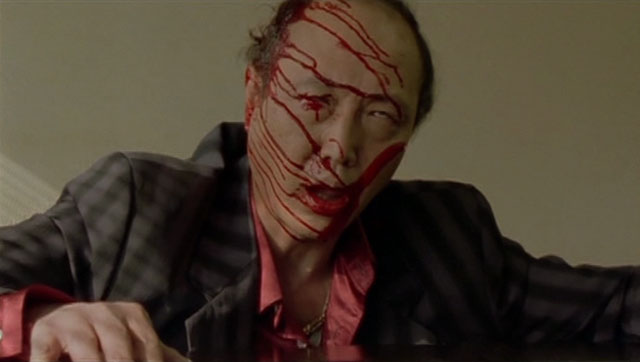
This is bad for sure, and it’s possible that Ishi could run some damage control or do some kind of penance, but he wants his fucking money, busts into the boss’s house and shoots Sawada, who was reaching for the cash to pay Ishi. Oops, another misunderstanding, and now Ishi stays on the run, sheltered by his friend Imamura.

I think this is Imamura, but a second scar-faced character was placed in the movie to confuse me:
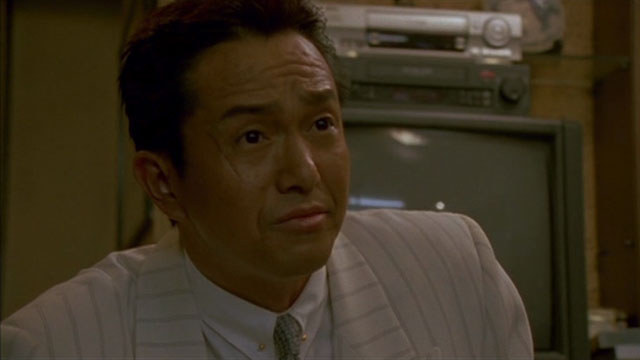
A detective (Rikiya Yasuoka of Tampopo) gets involved. Goons beat up Ishi’s wife and he wails on their faces with a metal pipe. Another misunderstanding and Ishi stabs his friend. Yakuzas panic, fingers are cut off, tear gas is fired, and finally he lets himself be captured, later knocking out a guard in prison then climbing a tower and jumping to his death, unleashing a typically Miike-overkill rainstorm of blood.

B. Sachs:

What makes it different from most of its forebears is that Takashi Miike works to avoid any intimations of a narrative arc. Instead of setting up a pattern of hubris and comeuppance, Miike organizes the film as an accumulation of detail, with a special preoccupation with how things work: the way yakuza from different families forge alliances, how a prisoner can give himself salmonella to get into the infirmary, how the body reacts to heroin. For all the instructive, caught-in-the-moment observation, though, it is a frighteningly amoral film, less an object lesson in criminal psychopathology than an attempt to meet that psychopath on his level.

Ishi makes his “escape” from prison:

“Do you think that we Hollanders who threw the sea out of our country will let the Germans have it? Better the sea.”

Pressburger’s first producer/director credit after a decade of writing in the movies – including Powell’s 49th Parallel, The Spy In Black and Contraband. Shot by Ronald Neame and edited (as was 49th Parallel) by David Lean. Early on were some wondrous airborne shots of the city below lit up by bombs and anti-aircraft fire – I couldn’t tell if it was stock footage or superior special effects.

A pip of a war thriller, more exciting than 49th Parallel. After a British bomber is shot down over Holland, the soldiers (who all parachuted to safety) have to find their stray comrade, contact the resistance and make their way to the border, nearly getting caught a bunch of times.

Note nazi officer silhouette in the organist’s mirror:

Sure, all the guys have different jobs and hobbies and personalities, but the movie is pretty story-driven, so I didn’t get strong enough individual impressions to tell them all apart and remember who was who – figuring most of this out from IMDB. Older guy George, rear gunner, was the villain in The 39 Steps. I recognized Eric Portman from A Canterbury Tale. Hugh Williams (who later starred in Pressburger’s solo film Twice Upon a Time) was an actor in civilian life, so gets dressed as a woman when they hide out in church with the villagers. Front gunner Bernard Miles was in The Man Who Knew Too Much remake. Pilot Hugh Burden played in Ghost Ship and Blood from the Mummy’s Tomb, and Emrys Jones (the stray Bob, a soccer player) appeared in The Small Back Room.

The bailed-out men are found immediately by children who report them to Pamela Brown (I Know Where I’m Going, Tales of Hoffmann). She surprisingly makes them prove their identities to make sure they’re not nazi spies trying to entrap the resistance leaders, then smuggles them (via the costumes and the church) on to priest Peter Ustinov (voice of Prince John) then on to Googie Withers (of Night and the City) who gets them to a boat at great personal risk – in fact, I’m not sure how she gets out alive at the end. Somewhere along the way they come across Bob at a soccer game, natch, and Ustinov squares off against nazi sympathizer Robert Helpmann (Red Shoes, Tales of Hoffmann). During their boat escape, one (George?) is shot, but in the epilogue they’re all alive, well and flying missions again – target: Berlin.

Also watched:
An Airman’s Letter to His Mother (1941, Michael Powell)

…which was exactly that – a letter written to be delivered in case of his death, then delivered when he died. One of those super-patriotic messages, which was published in all the papers and filmed by Powell, I guess in order to reach cinemagoers who don’t read the papers.

I tried to watch Violent Cop, but apparently if you rent a DVD, copy it to watch later, and then “later” lasts a decade, the disc won’t read anymore. Bummer, that. Didn’t think this would pair as well with Outrage, but I put it in anyway.

Shigeru (Kurodo Maki, later the computer-hacking straight man in Miike’s Detective Story) is a young, deaf, space-cadet garbage man who picks up a surfboard from the side of the road, repairs it and tries it out. A neighbor girl with big ears follows and watches. Two soccer kids first mock then copy him, while the regular surf bum kids watch him slowly improve and he gets the attention of the owner of a surf shop. He’s not some kind of surf hero though, just a quiet kid with a hobby, who gets reasonably good before he disappears into the waves one day, leaving the big-eared girl to send his surfboard out with the tide like a burial at sea.

Kitano’s third movie as writer/director, defying expectations after a couple of gangster flicks. IMDB’s claims that he got his painterly sense of composition and started caring about asthetics after his accident in ’94 is clearly bogus. This has got some slightly rough editing, and is more visually minimalist than Dolls or Fireworks, but the same artistic sensibility is clearly there. Ends with a real nice montage of outtakes and extra shots.

A gangster movie without any music or drama or fun – just a series of straightforward, low-key backstabbings and double-crossings, dry as can be. Its like Kitano, after being ignored for his previous trilogy (which I loved), is saying “you all want me to make violent gangster movies, fine” and making one without any excitement, like when fame-weary rock bands play self-mocking versions of the hit single they’ve grown to hate. Or maybe Kitano’s style has always been like this, and since it’s been a decade since I’ve watched Fireworks or Sonatine, I just can’t remember what they were like.

Takeshi, back in his element:

The plot just barely matters anyway. The yakuza chairman oversees families Ikemoto/Otomo, Murase and Sano-kai, all of whom want to advance their stations, but the chairman pits them against each other instead. In the end, simply everyone is dead except for Beat’s cop acquaintance and Kato (Tomukazu Miura of M/Other), former assistant to the head boss, now presumably the new boss himself. Makes me laugh that a sequel has been announced.

guy on the right is Ryo Kase of the new Gus Van Sant movie:

Supposedly Kitano’s character has a girlfriend or wife (Yuka Itaya of Sad Vacation), but really, women barely exist in this movie. As far as creatively violent attacks go, I had to look away when Kitano (on orders from his boss, Jun Kunimura of Kill Bill and Audition) performed amateur dental surgery on Murase (Renji Ishibashi, the gangster in Bird People In China, also town mayor in Sukiyaki Western Django) but I liked Murase’s subsequent scenes, looking silently enraged behind a face mask. My least favorite sidetrack was a wide-eyed African diplomat blackmailed to turn his embassy into a gambling hall.

Murase:

Despite the cinemascope ratio, rarely do more than two people appear in the same frame. Maybe that’s an every-man-for-himself visual metaphor. These gangsters are certainly more solitary than, for instance, the ones in Johnny To’s Exiled.

“If you wake a sleeping beauty, you run the risk of being awakened yourself”

Robert is a melancholy cipher who lives in a mansion with two women, who seem alternately to be his maid, his landlady, his lover. At a carnival he sees an exhibit where a sleeping young woman is on display. You can pay her slimy keeper (who is not too good with his spiel, despite years of practice), a dollar to see her, another dollar to kiss her, and an undisclosed sum for something more after hours. Robert (also called Troy, who knows why) pays $20,000 to keep her and bring her home, another white person to float identity-free in the mansion, like The Dreamers with less explicit sex (but some serious nudity in one cheerleading scene towards the end).

Strangely enough, I was looking for a different movie about mysteriously empty-headed white people in a large house when I found this one. Eduardo de Gregorio, a co-writer of Celine and Julie Go Boating, reunited some of that film’s cast for his companion piece, set within the fiction house but without Rivette’s two interlopers. It’s called Surreal Estate, and I remembered it’s from the mid-70’s, so when I saw “Dream Castle (1973)” I assumed I was watching the Gregorio movie with a different title translation… then almost turned it off when I realized my mistake… until Richard Pryor’s name appeared in the credits.

Our hero Troy leaves the house sometimes to play sax at a bar (presumably not an influence on the split-identity sax-blowing Bill Pullman of Lost Highway) and hang out with his friend Pryor. So, Pryor is our connection to the outside world, but not to “reality,” exactly, because there is something wrong with him. He is either mental or drunk, or just trying to play his scenes way too energetically to make up for the langour around him. I appreciate it, but the movie won’t let him get away with this, and finally kills him (he coughed once, an hour earlier, the movie’s old-fashioned idea of foreshadowing).

The Sleeping Beauty (Tisa Farrow, sister of Mia, later star of Zombie) gets acclimated in the house, but I’m never clear on the residents’ relationships, or even whether she ever finally hooks up with Robert/Troy (Zalman King, director of Wild Orchid and The Red Shoe Diaries). She’s not some fairy-tale symbol of purity – at one point making loud sex noises with Scarlett (Carol White, star of Poor Cow) to fool Troy (he only ends up looking vaguely depressed). Anyway there’s some pretending to enter her into a convent in the end, but finally Troy puts her back to sleep and goes on tour with the carnival, displaying her as the sleeping beauty.

Apparently I had this because it was on Rosenbaum’s top-thousand list under the title Some Call It Loving (my least favorite of its titles). Director James Harris was a producer on Kubrick’s early films, also made a Wesley Snipes actioner, a Richard Widmark/Sidney Poitier thriller and a couple of James Woods movies. The cinematographer’s biggest movie was probably Carrie.

Watched as an AVI file transferred from a VHS tape which was recorded over another program. When this movie got slow and quiet (which it did often) I’d hear that old, mostly-erased program whispering through the soundtrack and try to imagine what it might be. It might be my tape copy and not the original film, but the whole thing looks like a shabby TV movie – maybe on cable, which accounts for the porny vibe I get from the girls (speaking of which, have I mentioned the nude cheerleading performance at the end?).

I can’t say the actors are bad because I expect they’ve been asked to perform like blank robots. The movie has its own idea of poetic pacing, but without the talent of an Epstein or even a Rohmer to back it up. Overall not terrible, kept me guessing, anyway.

A strangely excellent movie – beautifully shot and performed. It’s very straightforward, plot-wise. The central mystery is set up in the first scene (taking place at Cafe Exposition, populated by extras filling each other in on backstory), and the movie spends the rest of its runtime dropping hints as to the solution to the central mystery, until finally even people like me, who don’t try to guess the endings to movies, know very well what’s going to happen. The NY Times considered it obvious enough to reveal the answer outright in their original review. But somehow that didn’t keep me from loving the movie, more than Perceval to be sure. One complaint: the title made Katy think of the Marquis de Sade, and made me think of The Story of O – so the movie should have been far sexier than it was.

The story was written in the early 1800’s and set in Germany, so of course Rohmer makes a German film that looks like it is happening in the early 1800’s, with a Barry Lyndon level of attention to light and costume. The Marquise (Edith Clever of a couple Hans-Jurgen Syberberg movies) is rescued from Russian marauders by their commander Bruno Ganz (not long before starring in Herzog’s Nosferatu). She is given sleeping pills after her ordeal, and the family is ever grateful to Ganz. Thing is, he’s now strangely, hurriedly insistent on marrying the Marquise, and she soon realizes she is pregnant.

Bruno makes an awesome entrance:

It becomes increasingly obvious to the viewer that Ganz knocked her up while she slept from the pills and is trying to run damage control, but this never occurs to the Marquise or her family until he admits it in the final scene. Instead, her mother tries to pin it on faithful servant Leopardo, while her father shuts his ears and bans her from setting foot in the house again.

Rohmer himself stands distractingly against the wall:

A super talky movie, of course, but possibly my favorite so far of Rohmer’s. Intertitles and fade outs at the end of scenes provide what little stylization is allowed into the movie. It’s funny to me that in the last line of the movie the marquise calls Bruno an angel – he and the actor playing her brother (Otto Sander) would later co-star as angels in Wings of Desire and Faraway So Close.