“I failed to die again, and now I’m alone.”

When I have the time, I’d like to watch and enjoy more movies by Ozu and Naruse, by Kurosawa and Masumura, Shindo and Imamura. Oshima is the only one I feel I ought to study. The movies are fun to watch and enjoy like the others, but I feel like I immediately need to see them again and figure out what they are up to. This one was at least more of a story (like Empire of Passion) than a political abstraction (like Death By Hanging), but still crazy enough that I’m sure I missed a lot.

Shino:

Matsuko:

It took a while to figure this out, but here goes. Eisuke (Kei Sato, male lead in Onibaba but looking more brutal/evil here) is the “high-noon” rapist/killer terrorizing Japan. Two women are irrationally in love with him: his wife Matsuko (Oshima regular Akiko Koyama), a teacher, and a young girl named Shino. Eisuke had “rescued” Shino when she tried to die with her boyfriend Genji (Rokko Toura, “Television” in Japanese Summer: Double Suicide) who knows how long ago, and now feels free to rape her anytime. When he’s finally caught and sentenced, the two women go into the woods to die together by poison, but Shino awakens, still alive.

The High-Noon Killer:

Tragic Genji:

I guess it’s not that hard to figure out the story after all, but I was distracted by the ridiculously great/nuts camerawork and editing for at least the first half.

A straightforward rebellious-youth/romantic drama. Should’ve watched this with Katy, but I didn’t think Masumura would be her style. It’s one of Masumura’s earliest films, from the writer of Mizoguchi’s Story of the Last Chrysanthemums.

Hiroshi Kawaguchi and Hitomi Nozoe would also star together in Giants and Toys:

Moody Kinichi’s dad is accused of election fraud, will need 100k yen in fines. While visiting dad in jail, Kinichi runs across Akiko who’s also visiting her dad, also needs 100k. Their moms aren’t around – the boy’s wants nothing to do with the family anymore, is a jeweler or something, and the girl’s is in a sanatorium with TB. Akiko’s family friend, a famous painter, has a playboy son who sees his chance to buy her (even blatantly phrasing it that way) now that she’s in need.

Kinichi with mom: Aiko Mimasu, in Street of Shame the previous year

So it sounds like the movie could be a sordid drama about sad poor people, but it’s not that at all. Mostly it’s a light romance between the two heavy-hearted kids – at the racing track, the beach, a piano bar. Kinichi seems somewhat reckless at first, but he’s a good, responsible kid, finally gets the money from his mom, tracks down the girl (there’s extra drama when he loses her address) and gives it to her.

In smaller roles, the boy’s jailed dad (“Lawmakers are the crooks. Until the law changes, I’ll go to jail after every election”) is Eitaro Ozawa of Assassination and The Crucified Lovers, and the girl’s sad, sick mom is Sachiko Murase, star of Kurosawa’s Rhapsody in August.

Super colorful and energetic movie – I probably liked this more than his acclaimed Branded To Kill. Very good music, all bendy strings and gunshot percussion.

Green Maya (the typecast Yumiko Nogawa of Story of a Prostitute and Pleasures of the Flesh) joins a group of color-coded prostitutes in postwar Japan – purple Mino (Kayo Matsuo of Tattooed Life), yellow Roku, and red leader Sen. Ofuku wears white so you know she’s not gonna last, then black Machiko is the next to go, each accused of the crime of giving it away for free.

Maya:

Sen:

Machiko with Jo:

The four have a good thing going, living together in a delapidated building and scaring away all competition – until puffy-cheeked fugitive Jo Shishido (returning from Youth of the Beast) arrives to shake things up, barging in and joining the group. He sleeps with Machiko, then Maya (causing discord and some whipping), but he also steals and slaughters a cow (providing much food and cash) and amuses them with his post-traumatic stress war anecdodes, so he’s allowed to stay.

Mino:

Roku:

Chico:

Maya seduces a priest (Chico Roland, the jazz-hating fugitive soldier in Black Sun) driving him mad. But ultimately she falls hard for Jo. “You’re the first man I’ve ever loved. For the first time, I’ve felt human, but now I’ll get kicked out of here. The moment I become a real woman, I’m an outcast.” But when they try to run away together, he’s killed and she’s left roaming.

Remade in ’77. The same writer did Story of a Prostitute, unsurprisingly.

When Maya is stripped of her green clothes and whipped, the whole image is shrouded in green:

Spaced season 1 (1999)

Watched this for the umpteenth time. Still great. The episode where their dog Colin is stolen was better than I remembered. Two episodes with strong Brian plots – one where they all go clubbing, and one featuring Brian’s ex-partner Vulva – are masterpieces.

Pegg & Frost are apparently in the new Tintin movie. Jessica Stevenson/Hynes (Daisy) I don’t see nearly often enough, but she was in Burke & Hare at least. Julia Deakin (landlady Marsha) is in Down Terrace and Hot Fuzz. Mark Heap (basement neighbor Brian) has been in twenty series I’ve never heard of (including Stressed Eric and How Do You Want Me, which sound good) plus Jam and Brass Eye and Big Train. Katy Carmichael (Twist) is not in a helluva lot, I’m afraid.

Plus appearances by Bill Bailey (at the comic shop), Peter Serafinowiz (Darth Maul, also in Look Around You and Running Wilde) and Michael Smiley (Kill List) as Pegg’s raver friend.

Screenwipe season 4 (2007)

Another blur of Screenwipe. This one covers lying in reality TV (and all TV), more on having a career in TV starting from the bottom, and some shows I can hardly believe exist like Street Doctor. Commentary on the credit-squeeze and the 24-hour news cycle. Last season surprised me with a mean Ken Russell joke – who was alive and well when the show aired, but had just died when I watched it – and this one followed up with an Amy Winehouse joke. Best of all, the show culminated with Charlie Brooker holding his own mock elimination competition meta-show.

2011 Wipe

After season five, the Screenwipe series went away but Brooker returns annually for a year-recap special. I watched the latest with Katy to expose her to the greatness of Brooker’s commentary in a slightly more relevant manner than watching old episodes of Screenwipe. She thought it was alright, but thought it’d be a half hour long so spent the latter half waiting for it to end. Arab Spring, Charlie Sheen, Rupert Murdoch (with an excellent Adam Curtis history segment), the London riots, and of course plenty of television. It’s like catching up on a year’s worth of The Daily Show all at once.

Oh, what’s this – shows called Gameswipe, Newswipe, and How TV Ruined Your Life and a new one called Black Mirror – must look for those.

Parks & Recreation season 3 (2011)

Even better than the last season, partially thanks to the addition of Adam Scott (the new boring guy now that Brendanawicz is gone) and Rob Lowe. The Harvest Fest is a success, Tom starts a bunch of failed businesses and brands with his buddy Jean-Ralphio, and April and Andy get married.

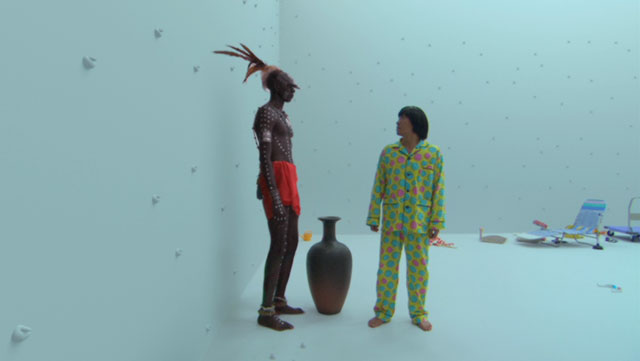
This was everything I hoped it’d be when I heard the vague plot outline. Japanese man wearing loud pajamas wakes up in an all-white room covered in switches. Whenever he presses a switch, something new appears in the room. Meanwhile a Mexican wrestler named Escargot Man prepares for a match. How will these two stories come together?

It gets weirder, of course. The switches are angel penises. The man gets a ton of useless stuff, plus sushi (but no soy sauce). He’s somewhat frustrating to my organized mind because he doesn’t try every switch or hit them in any organized manner. But the stakes are raised when he finds a floor switch that opens a door out of the room – just for a few seconds.

Maybe my favorite part: he has a large pot, and unlimited sushi, so he fills the pot with sushi to weigh down the switch. But it’s too full to lift. So he laboriously starts pulling bits of sushi back out of the pot with chopsticks, when he hits a button that causes an African man to jog into the pot, breaking it in half.

More intricate escape attempts. He finds the exit door has a combination lock (the combo is written on the African man’s head) and a key lock. The key appears on a timer, as does a rope from the sky, so there’s a plan involving swinging and grabbing and running. The man doesn’t talk out his ideas – instead we get wonderful comic-book montages as he envisions what he’s going to do next.

But sometimes he hits the wrong switch and this happens.

Plan is carried out, but he’s stuck. The door is unlocked, without enough room to open, and he can’t get back into the main room. Passage of time marked by red sushi turning brown. He finds a sliding panel and a new room of switches – this time when he hits them, things happen in the world outside that he’s not aware of. Frustrated, he flicks one switch over and over – one that causes the Mexican wrestler’s neck to extend and deliver a knockout headbutt to whoever’s closest.

The man ascends a tower of penis switches… to the final room.

Patriotism (1966, Yukio Mishima)

Wow. Silent film in the Noh style, no dialogue or effects, just long, scrolling intertitles and a scratchy Wagner record on the soundtrack.

Very simple story – Mishima adapting and minimizing his own story, directing, starring, hand-writing the title cards, etc. Lt. Takeyama’s buddies attempted to overthrow the government. Their rebellion will soon be put down, and he’ll be expected to help kill his friends, so he comes home to his lovely young wife, they have super sex then commit ritual suicide together. Some cool superimpositions in the beginning, and a nice final shot where their bodies appear in a raked sandbox – but the whole movie is excellent-looking.

T. Rayns:

Mishima’s idiosyncratic reading of “patriotism” is underscored by the kakemono scroll that hangs on the back wall of the stage. The two Chinese characters read “Shisei” (or “Zhicheng” in Chinese), which means “wholehearted sincerity” and carries implications of faith and devotion. Mishima deliberately chose a scratchy 78 r.p.m. recording of Tristan und Isolde for the soundtrack because it was made in 1936, the year in which Patriotism is notionally set.

Spacy (1981, Takashi Ito)

Ten minutes of re-cut recursion. At the south end of a gymnasium the camera spies a photo taken from the north end. It travels towards the photo, photo fills the frame, we’re back at the north end, spying a photo on the south end. Etc., but to an immense degree, with photos all over from different angles, including one on the floor. The bloops and the bleeps all over the soundtrack provided by Yosuke Inagaki.

Box (1982, Takashi Ito)

A box encapsulates the sky, then a town plaza, spinning around in different ways that would seem extremely frustrating and laborious to animate in pre-computer days. Some more recursion, rushing into a wall that turns into a side of the box. The recursion here seems like the camera is anxiously trying to break out of the box, whereas in Spacy it seemed more like it was having a laugh, free to travel endlessly. I shouldn’t have watched so soon after Spacy because I got tired of watching the box spin around. Much better music this time, synthscapes by Inagaki.

Venus (1990, Takashi Ito)

I moved forward a few years to find something new. First, a mother and son with their faces erased, photography in motion, then more zooming the camera around in 3D space, more frames within frames. These are cool but I can’t watch them all in a row. Silent. Around the four-minute mark I turned on the deinterlacer – did that make the film freak out, or was it going to freak out anyway?

Ako (1965, Hiroshi Teshigahara)

Some friends take the car for a night out. The car is kind of a lemon – or the driver just hasn’t learned proper maintenance – but they make it to dinner and bowling, and drive around aimlessly for a while. Other than one boy’s unwanted advance on a girl while retrieving water for the radiator, it’s a dreamy night of freedom for all involved. The sometimes-synch sound gets processed to turn the ambient sounds into spacey effects. Flashes of dialogue from elsewhere in the night get edited in as narration of thoughts. And the main girl has flashbacks to her day job at a bakery/factory. Parts may look documentary-style, but it’s definitely a planned film with non-doc drama – a light short released as part of an anthology the same year as Teshigahara’s Woman in the Dunes.

Memory (1964, Osamu Tezuka)

Like those anthology shorts by Tex Avery that start with a topic and come up with as many easy jokes as possible in eight minutes, only this one was more bizarre and less predictable – at the end, at least, which has future/alien creatures remembering humans as toiler-worshippers.

Drop (1965, Osamu Tezuka)

Cute cartoon of a thirsty man on a life raft trying to get a drop of water from his sail rigging. I don’t read much French, but I think the end gag is that he has floated into a freshwater river.

Catalogue of Memory (1977, Shuji Terayama)

Color: a man writes a letter, mails it along with a pencil and self-addressed envelope to England.
Black and white stills: Woman receives, sends the pencil back in his envelope.
Color: He retrieves the pencil and continues his work, which we could read, if we could read Japanese.
Light piano noodlings and a ticking clock on the soundtrack

The Eraser (1977, Shuji Terayama)

Snapshots are torn, or overlaid with a radiating translucent pattern. A hand drags an eraser over the image, leaving only shimmering video noise. Great soundtrack: percussion, strings and whispering voices. No dialogue. A naked guy throws up in a vase? A blind woman turns into a blind soldier. I think this is the kind of thing people imagine when you say “experimental film.” I don’t mean that to be derogatory – it’s my favorite Terayama short so far.

The Reading Machine (1977, Shuji Terayama)

A tiny book, a massize book that requires a machine to operate, and many normal sized books. Somebody walks with a book attached to his face. This one has at least as much nudity as The Eraser, but unfortunately also has intertitles that I can’t read. Drawings, little staged scenes, cutting illustrations out of a book, welding, burning, crossing-out. Finally the reading machine: a stationary bike operating a page turner. Not as exciting as the last one, but the music is still good.

So that’s three Terayama shorts from the same year which focus on, respectively, a pencil, an eraser, and books – all using different techniques.