After a funeral, Natasha is angry with everyone alive, quits her job and pisses off people in the street. After forty minutes of this, the movie-in-a-movie ends and Olga, its lead actress, comes on stage to complete audience indifference. “I’m already sad and tired from work. I’d like to have fun, listen to some music instead of watching such movies.”

Destructive tendencies in the film-in-a-film:

Narcoleptic Nikolai is in the audience. He’s a schoolteacher along with round, blonde Irina. To be truthful, that’s about all I can be sure of. Plenty else happens in the movie, but I’m not sure to whom, and for what reason. It’s kind of a comedy, but seems to be serious underneath. The title seems appropriate (asthenia: abnormal physical weakness or lack of energy). You could also have called it Everybody Is Unbearable. Very talky, with wall-to-wall chatter in half the scenes, languid in others.

Nikolai:

Irina attempts “strangers in the night”:

Won a prize at Berlin. The distributor calls it an “impressionistic portrait of the USSR reaching the end of its tether.” Senses calls it a “demented masterpiece,” and goes on to note: “it is interesting to note that while the rest of the world celebrated the fall of communism, the reaction of the people actually living under Soviet rule wasn’t as simple; people felt very confused, and their overall behaviour was – and still is – reminiscent of the asthenic syndrome of the film, alternatively violent and repressed. Even though Asthenic Syndrome was made during the period of glasnost, Muratova once again managed to alienate the authorities. It had the dubious honour of being the only film banned during that period.”

J. Rosenbaum:

It’s a film that alternately assaults you and nods off — usually without warning and often when you’re least expecting it. Mean-spirited and assertive one moment, narcoleptic and in complete denial the next, it bears an astonishing resemblance to the disconcerting rhythm of contemporary public life.

D. Auerbach:

If you don’t know that perestroika is seen as the source of millions of deaths stemming from deregulation, corruption, and crime, the melancholy and despair that fill The Asthentic Syndrome seem disconnected from a particular cause: what is Muratova critiquing, exactly? . . . Knowing the context reveals the emotion behind the puzzling surface.

Not an actual movie, but an admirable simulacrum. Abrams imagines a mid-80’s Spielberg adventure, complete with teenage protagonists each with a couple sympathetic personal details, aliens and intrigue (“Do not speak of this or else you and your parents will die,” says Glynn Turman, who was also the first casualty in Spielberg-produced Gremlins), likeably honest small-towners and evil shadowy government conspiracy. That’s actually the thing I liked most about the movie, watching it the same week as the politically shady Contagion. Abrams puts his unique directorial stamp on the material (just kidding – he simply floods it with lens flares).

I found a shot of the kids without lens flare:

Glynn Turman:

Kid named Joe is helping made a zombie movie with friends, who recruit his crush Alice (Elle Fanning, tiny Cate Blanchett in The Benjamin Buttons). With names like Joe, Alice and their buddy Preston, sometimes it seems like this was written as a 1940’s movie then changed at last minute. Joe’s mom died in a factory accident caused indirectly by Alice’s dad, Joe’s dad (Kyle Chandler of Katy’s football show) is the town cop, Charles (the super-8 director) has a thing for Alice – these are our token character details, the Stand By Me half of the big-budget action movie. Seems that a vindictive alien escaped from gov’t captivity when Turman drove his pickup truck onto train tracks causing an outrageously overdone crash, which throws train cars into the air like in a Transformers flick but doesn’t kill Turman or fully destroy his truck. Shadowy gov’t agent Nelec will finish the poor guy off before being dispatched by the alien, who proceeds to loot the area of all wiring, engines and other metal bits to construct a vessel home, finally turning the town water tower into a Katamari Damacy electro-magnet.

Runaway dog map:

The kid’s sentimental locket is Katamari-bound:

On the surface this was terrific, an expertly plotted thriller, more tensely captivating than any of the Ocean’s movies, with terrific music and excellent editing. But after giving it some thought and pitting it against Super 8, Contagion is starting to feel like slimy propaganda. The bad guy in the movie is Jude Law’s blogger, supposedly a whistleblowing, truth-seeking outsider but actually a treasonous scam-artist, eager to sell out. Government agents working for the CDC (headed by Laurence Fishburne) and some local labs (headed by Elliott Gould) are the good guys – not just good but angelic. They sacrifice themselves, working extremely hard and always putting others ahead – Fishburne gives his own dose of the long-awaited vaccine to the child of poor CDC janitor John Hawkes (because in Atlanta all our janitors are white guys), Jennier Ehle uses herself as a vaccine test subject to speed the process, and Kate Winslet dies trying to discover the virus’s source. So most of the way through the movie when some anti-government protesters appear outside the CDC, the viewer has automatic hatred for them. What sort of mindless malcontents would protest against these selfless public servants?

Heroes behind the scenes, Ehle and Martin:

Hero Fishburne with regular non-hero Hawkes:

The emotional Minnesota civilian center of the movie is Matt Damon, whose dead cheatin’ wife Gwynyth Paltrow was patient zero (as amusingly illustrated at the end of the movie). Marion Cotillard is a CDC researcher gently kidnapped in China by Chin Han, held for (fake) vaccine ransom. Bryan “Malcolm’s Dad” Cranston works for FBI I think. Demetri Martin, strangely, is Jennifer Ehle’s coworker. Soderbergh and writer Scott Burns (The Informant, Bourne Ultimatum) should’ve been hired for those 9/11 movies, or some kind of corporate response film to the Occupy movement (if anyone in power felt that Occupy required a response).

Jude Law in puffy suit:

Happily this was more Role Models than The Ten, a conventional-looking comedy full of State alumni and good writing. Only the second Jennifer Aniston movie I’ve seen (and unfortunately the first wasn’t Leprechaun). She and State/Wain regular Paul Rudd are a married couple who flee New York for Atlanta and stay with Rudd’s asshole brother Ken Marino and his drunk wife, then end up at a commune. Aniston hooks up with sellout Justin Theroux, while Rudd can’t manage to score with Malin Akerman, but since it’s a comedy, the married couple pulls through.

As per Role Models and Wet Hot American Summer, the movie freely uses hacky old plot points (slimy land developers are trying to tear down the commune) and messes with them (the commune would be safe if Alan Alda, hilarious as the only remaining member of the commune’s original founders, could remember where he put the deed). I enjoyed all the background cameos by Craig Wedren, Joe Lo Truglio as a nudist winemaker, overenthusiastic Kerri Kenney, Todd Barry as Rudd’s coworker in the city, and David/Michael/Michael as TV commentators.

Katy liked it too, pointed out that the title is off-base.

Great little indie movie, don’t know why I remember disliking it. Tracy Johns (her only other role was New Jack City) is Nola Darling, who strings three guys along without committing to any, finally dumps them all to stay independent. Tommy Hicks (Daughters of the Dust) is Jamie, who’d seem like a perfect man except that he keeps trying to make her settle down. John Terrell is an arrogant rich guy, and Spike (Mars Blackmon, great character names) is an immature joker, and Nola’s lesbian friend Raye Dowell is after her as well. Spike’s relatives make appearances (Bill plays Nola’s dad, Joie is her roommate).

Spike’s feature debut, with nice b/w cinematography by Ernest Dickerson, except when Tommy gives Nola a musical dance number for her birthday, shot in color.

Red-haired Simin wants to leave Iran for unspecified (possibly so this movie would not get banned) reasons and take her 11-year-old daughter Termeh (Sarina Farhadi, the director’s daughter), but Simin’s husband Nader won’t leave, has to take care of his senile father. So she wants a divorce to carry out her plan without him.

Intrigue: the new maid Razieh is doing a shitty job watching Nader’s father. When he comes home and sees dad on the floor, tied to the bed and barely breathing, he shoves her out the door – then she and her husband Hodjat sue him for causing her miscarriage. Razieh and Hodjat aren’t a completely unsympathetic couple. He keeps pointing out that he’s less educated than Nader, and has anger issues, so doesn’t stand a chance in legal debate. But his wife turns out to be lying – she was hit by a car while chasing Nader’s escaped father, which caused her miscarriage. Nader isn’t a mean guy, keeps offering a settlement, but Razieh is trying to paint him as a criminal. After the whole ugly court battle is settled, the divorce is still on, and Termeh has to choose which parent she’ll live with, cue the credits.

Good drama, and interesting look at the Iranian legal system (their interrogator is Babak Karimi, an editor who worked on Tickets and Secret Ballot).

I found out about this due to the Greenaway short (also called Act of God, also about people’s experiences with lightning) included on the DVD, then was intrigued to discover that the feature is Baichwal’s follow-up to the great Manufactured Landscapes. Landscapes got to piggyback off its photographer subject’s artworks and visual ideas. This one is an interview documentary, so Baichwal and her cinematographer/husband were on their own to create meaningful enough images to justify the film, and I think they succeeded. And the storytelling definitely succeeded. I’ve never been afraid of lightning before, and now it’s all I think about.

A man in Ontario tells of a camping trip years ago, everyone stunned and scattered by a lightning strike, one kid had his insides burned right out. A man in France who won’t show himself on camera built a museum of lightning-struck objects. An ex-soldier in Vegas had his life changed by a strike through the telephone, opened a clinic for dying veterans. Three kids killed and others injured from a hilltop strike in Mexico. And, connecting these stories of powerful electricity hitting the human body, musician Fred Frith improvs while being hooked to brainwave machines, measuring the electrical impulses he uses when creating. He invents some wonderful storm-music at the end. Baichwal and husband filmed most of the lightning in the movie (and there’s a ton of it), set out to make a film about randomness and meaning, hence the Frith bookends.

Act of God (1980, Peter Greenaway)

Baichwal said she tried cross-cutting between segments but it didn’t work, so she lets each story stand on its own. Greenaway, of course, does not – he breaks up the questions and lightning-strike descriptions into categories (time of day/year, height of subject, etc), sorts them, and interrupts with bursts of Michael Nyman music. He’s also less natururalistic, arranging interview subjects into amusing compositions, including one person struck through the phone line who tells her story through a handset. Unless IMDB is messing with me, his DP later directed Surf Nazis Must Die. The short makes efficient use of its 25 minutes, but it wouldn’t have made much of an impact had I not watched the longer, calmly frightening feature beforehand.

The Loneliness of the Long-Distance Singer (1974, Chris Marker)

It’s not a short (an hour long), but I have little to say about it, so this is a short entry. The movie’s probably of more interest to fans of Yves Montand’s singing career than of Marker’s filmmaking or their shared politics. Marker focuses on Montand’s rehearsals for an upcoming concert benefitting Chilean refugees and he cuts to clips from the concert itself, and clips from Montand’s political films (Z, The Confession, The War Is Over).

Shot by the IMDB-credited Pierre Lhomme (Mr. Freedom, Army of Shadows) as well as Jacques Renard (Celine & Julie Go Boating) and Yann Le Masson. A nicely put-together little movie, but more like your standard fly-on-wall doc mixed with a celebrity personality piece than Marker’s usual style. Montand is passionate about the details, but it’s not my kind of music so I’m not sure what he’s going for. M. Legrand was involved somehow.

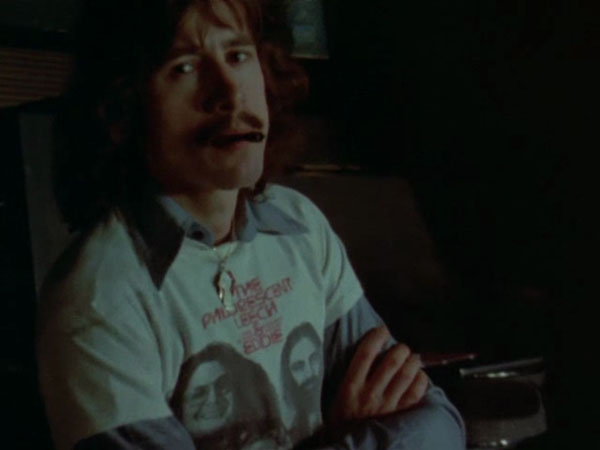
Some dude on the sidelines sports a Flo & Eddie shirt:

Lady Blue Shanghai (2010, David Lynch)

Plays like a total Inland Empire outtake (or Darkened Room 2). A confused Marion Cotillard calls security on an expensive handbag (the short was commissioned as a handbag advertisement) found in her room. She grabs it and half-remembers some alternate-existence romantic rooftop chase scene, featuring herself, an attractive man from Shanghai, and an expensive handbag.

My Wrongs 8245-8249 and 117 (2002, Chris Morris)

An unstable Paddy Considine is left in charge of the dog, but can’t manage it. Dog dies, Paddy ends up at the pond screaming at ducks. Nice Warp-sounding music from the director. I enjoyed it.

Mermaid (1964, Osamu Tezuka)

Katy likes when I show her movies I haven’t already watched, then criticizes this one for being depressing and My Wrongs for being unfunny. None of Tezuka’s shorts have been sad before (well, Male has a murder scene), so how was I to know? A re-run of Haanstra’s Glas was better-received. This one’s a 1984/freedom-of-thought parable about a boy who catches a fish and imagines its a mermaid, until the thought police imprison him and try to brainwash away his imagination so he’ll see the fish as a fish. Naturally it ends with the boy freeing his fish and either becoming a merman or drowning himself.

The Uneasy Three (1925, Leo McCarey)

A Hal Roach short starring Charley Chase as a wannabe thief who, with his girl and her brother, pretends to be a musical trio to gain entry to a high-society party and steal a valuable brooch. That’s such a generic-sounding description that now I can’t recall if I wrote it or I copy/pasted it from somewhere. Anyway, they successfully fake being musician/entertainers and frame the real musicians for the crime.

Bull Montana, harpist:

Winston Tong en studio (1984, Olivier Assayas)

A studio recording of a silly-sounding song. I missed the vocalist’s interview in French, but enjoyed Jah Wobble’s rant against commercialism. Also liked the filmmakers’ sound mix, keeping bits of the last take in the mix over the interview, dialing up and down the backing music while Tong is singing. Besides Assayas it’s got Nicolas Klotz (La Blessure, La Question Humaine) editing.

Hokusai: An Animated Sketchbook (1978, Tony White)

Tony, an assistant on Richard Williams’ A Christmas Carol brings acclaimed Japanese woodcut artist Hokusai’s drawings wonderfully to life for a five-minute short. Not having any previous Hokusai exposure myself, I can’t tell which drawings are his and which are interpreted by White. Teshigahara had also made a short doc on Hokusai, and a few years after this Kaneto Shindo would make a feature with the great English-language title Edo Porn.

Endangered Species (2006, Tony White)

I found Tony’s other short on YouTube – a eulogy for the lost art of hand-drawn animation, made in collaboration with Roy Disney. So ol’ Walt is championed at the expense of his competitors at Warner Bros. Also parodied: Roger Rabbit, Fritz the Cat, Beavis & Butthead, artistic diversity, and corporations that would cruelly try to control independent animators and diminish their freedom. Seems weird that a pro-Disney film would be against huge companies. Seems to have mixed feelings about Pixar, and tags Hayao Miyazaki as animation’s hope for the future.

I watched this and The Naked Spur building up to Emory’s 35mm screening of Mann’s T-Men, which I then missed. Oh well. These were excellent, so I’ll have to catch up with T-Men and the others eventually.

A perhaps less-wooden-than-usual Gary Cooper gets a train ticket, is asked his name and destination by two different people and gives them different answers. So we know something is up (turns out he’s a still-wanted ex-badman). But Gary has reformed, is now the inordinately earnest Gary we all know and love, so he’s not lying to talky card-shark Arthur O’Connell when he says he’s headed to Fort Worth with cash raised by an entire town to hire a schoolteacher. Arthur introduces him to saloon singer Julie London, says she’d make a fine teacher, but then the train is robbed, Gary’s money is stolen, and Gary, Julie and Arthur find themselves on foot.

Julie and Arthur in happier times:

Fortunately, this all took place a short walk away from Gary’s old hideout, where his half-crazy uncle Lee Cobb (baddie of Thieves’ Highway) still reigns over a crude bunch of dangerous dimwits, including Gary’s real asshole cousin Jack Lord. Gary is treated as a prisoner/possible-accomplice, Julie as a sex slave, and Arthur is finally just shot (so is Jack Lord).

Cooper, trapped by Lord (left) and Dano:

Gary talks his way into helping with a bank heist, but mute Royal Dano (the Kid’s henchman in Johnny Guitar, later Gramps in House II) comes along and gets himself killed – so now Gary’s got to pick off the rest of the gang as they come for him (that’d be John Dehner, who played Pat Garrett to Paul Newman’s Kid the same year, and Robert Wilke, the foreman in Days of Heaven) before facing off against his uncle Cobb, who I’m surprised was able to leave the house and ride into town.

Cooper vs. Cobb:

Gary’s got his money back, and rides off with Julie London. But besides the money and the schoolteacher plan, Gary was also not lying about having a wife and kids back home. So they can’t be together, but Julie says she’s happy with the unrequited thing, and they get their unique doomed-romance version of the ride-into-sunset.

J. Rosenbaum:

Man of the West is shot in CinemaScope, yet it’s initially hampered by the shallow dramatic space associated with television. This effect is made worse by the casting, which pairs the stagiest of stage actors (Cobb) with the most cinematic of movie actors (Cooper). But Mann is canny enough to turn these limitations to his advantage whenever he can, offering sly notations about Link’s physical discomfort on the train and using a long, tense scene inside the farmhouse to create claustrophobia before sending the characters outdoors for virtually the remainder of the picture. Once again, the hero is a dialectical contradiction, both regressing toward an unbearable past and making an anguished effort to break free from it — the struggle ultimately engendering hatred, violence, pain, and humiliation, and revealing boundless evil.

Royal Dano vs. the ghost town: