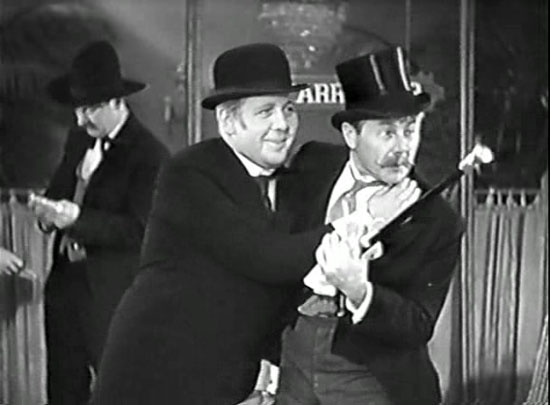
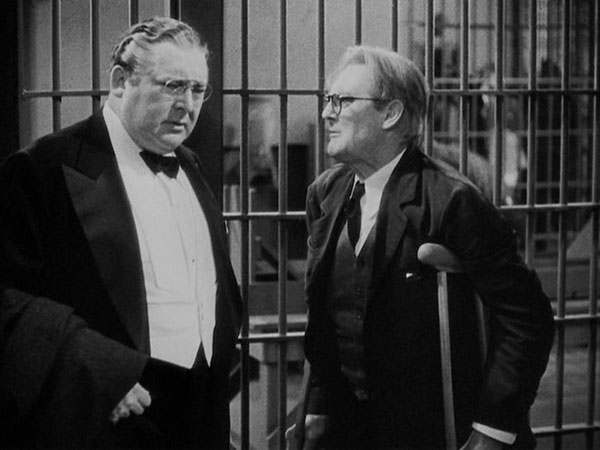
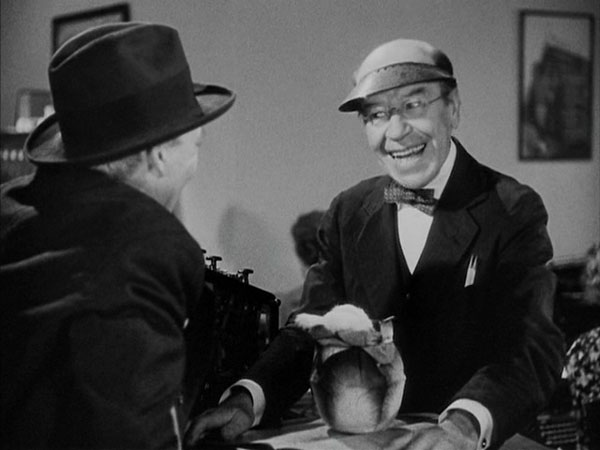
My first mid-30’s silent film. Chaplin’s Modern Times doesn’t count, and the Russian Happiness was two years earlier. Japan still had union narrators in theaters, so their cinema stayed silent longer than most.

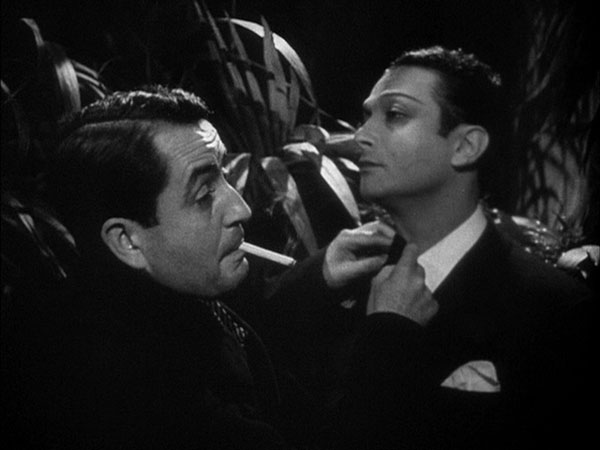
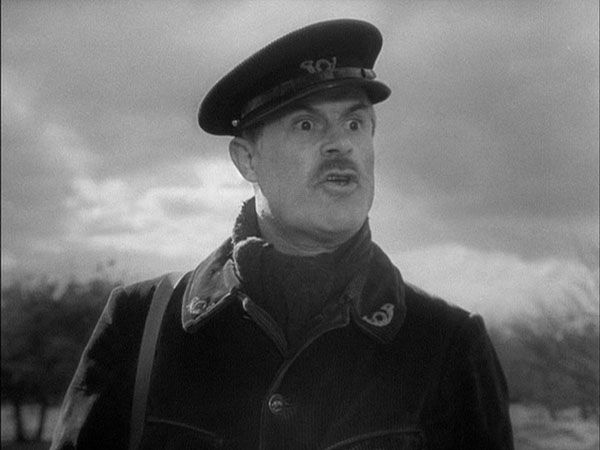
Traveling actor Kihachi brings his troupe to the town where his ex-girl and illegitimate son live. K. has made himself scarce, sending money whenever he can, so the boy (Shinkichi, now 20) could grow up without the burden of a no-good father, and whenever Kihachi’s in town he stays with the mother and sees the boy.

Kihachi’s current woman in the troupe suspects something is up, finds out the story through bribery and sets up younger girl Otoki to go after the boss’s son. The two fall in love, and Kihachi tries to break it up, leading to the revelation that he is Shinkichi’s father. Meanwhile, constant rain means the troupe can’t perform, and finally they’re out of work long enough to have to sell off their stuff and break up. After an emotional climax, the young lovers stay behind, and Kihachi and his girl make up at the train station, heading off to form a new troupe.

Great movie, slow-building, ends up as emotional and true-feeling as the other Ozus I’ve seen. I ought to watch at least one per year. They are refreshing. Kihachi somehow stays sympathetic even though he hits everyone in the movie at some point. That’s just how he communicates, I suppose. Definitely different kinds of families here than in Tokyo Story or Equinox Flower.

This was something like Ozu’s thirtieth movie, and it’s said to be the beginning of his mature style. It’s an uncredited remake of Hollywood’s oscar-winning part-talkie The Barker from 1928, which was also remade twice in Hollywood (with Clara Bow in ’33 and Betty Grable in ’45).

Half these actors had been in Ozu’s Passing Fancy the year before. The kid had later roles in Kon Ichikawa and Seijun Suzuki movies, and his father appeared in Ozu’s own 1959 color remake Floating Weeds. Maybe Katy will watch that with me next year – Masters of Cinema’s N. Wrigley calls it the most beautiful Ozu film.

Katy wanted to close out 1930’s Month with something Great, an acknowledged classic, something she is supposed to have seen but hasn’t, so I picked the one-time Greatest Film of All Time, Rules of the Game.

An amazing looking film indeed, with some fabulous, intricate staging. Some character, actor and plot notes before I forget them yet again:

image

from left to right:
1 Andre the pilot (Roland Tautain, played “the sailor” in Lang’s Liliom) just completed some impressively long news-making flight in order to impress Christine.
2 Octave (Jean Renoir, in his final role as a film actor. He wouldn’t make another film in France until The Golden Coach 14 years later). Friend to all, father figure and wannabe-lover to Christine, a short-lived fantasy. He turns darker (along with everything else) towards the end, realizing he’s a comic figure leeching off his rich friends, goes off to make a belated attempt to be self-sufficient.
3 Robert (Marcel Dalio, had appeared in Renoir’s Grand Illusion and would later have smallish parts in films by Hawks, Fuller (China Gate), Huston and Wyler), very rich but insecure, likes noisy mechanical inventions, has a gorgeous wife in Christine but also a long-standing affair (which he is trying to break off) with Genevieve (Mila Parély, would play one of Belle’s selfish sisters in Jean Cocteau’s Beauty and the Beast).
4 Austrian Christine (played by Austrian Nora Gregor, had been a star in the 20’s and 30’s, starring in Carl Dreyer’s Michael, killed herself ten years after Rules of the Game only having appeared in one movie since), a bit naive, thinks she belongs with Robert and that Andre is just a friend, until she catches Robert with Genevieve and it shakes her up.

image

Robert (right) with his “double”, Marceau the poacher (Julien Carette, my favorite actor in the group. He also appeared in the previous three Renoir films, later died from smoking in bed). Marceau wants respectability, gets hired by Robert as an indoor servant, but that doesn’t work out so well, goes off on his own at the end.

image

Christine again (left) with servant/friend Lisette (Paulette Dubost, was in Truffaut’s The Last Metro forty years later, also a couple by Max Ophuls in the 50’s), who is more devoted to Christine and her own position than she is to husband Edouard Schumacher (below). She’s Christine’s lower-class double, married to one man but wanting another.

image

Gaston Modot (Edouard) had been in films since 1909 and would keep it up till the 60’s, appearing in one of Renoir’s final films The Testament of Doctor Cordelier (and previously in Elena and Her Men, Grand Illusion and a couple others), also The Lovers and Children of Paradise. Even cooler, he played the main guy in L’Age d’Or. Edouard is jealous for his wife for good reason, since she’s happy to flirt with Marceau. He blasts through the house with his shotgun aiming for Marceau, later teams up with Marceau and aims for Octave, whom he suspects of hooking up with Lisette in the greenhouse. But due to costume changes he doesn’t realize it’s Andre with Christine in the greenhouse, and Edouard kills Andre.


Katy was disappointed, and disputes it being the greatest film of all time. Personally it’s only my third-favorite of the six Renoir films I’ve seen. I do love it, but I wonder about the best-film-ever label (recently surpassed by the new Batman on the all-time lists, actually), so let’s go to the DVD extras.

Ah, my old nemesis P.Bog reads the commentary, but it was written by Alexander Sesonske.

Renoir called it “a frivolous story” shot to avoid talking about the war… about “a rich, complex society where we are dancing on a volcano.”

Of André Jurieux’s radio speech in the opening scene: “His angry charge of disloyalty violates the rules of the game from the very start.”

Critics cried that Renoir cast an Austrian actress and a French jew to represent the French aristocracy.

“In a society of sharp class distinctions, Octave appears as a classless character.”

Plot shows two matched sets of husband/wife/lover/mistress and interceding friend:
1. Robert/Christine/Andre/Genevieve – Octave
2. Edouard/Lisette/Marceau/Christine(?) – and maybe Octave again.

Initially “The servants seem more sensitive to impropriety than their masters.”

“Those who know Renoir films may recognize a familiar figure, for Marceau is the incarnation of that nature god or pan figure who often graces those films from Tire-au-flanc in 1928 on. In a world where nothing is natural, it only appropriate that the nature god should appear as a little poacher in disguise and be pursued with deadly intent by a gamekeeper… But his influence remains the same. When he appears, erotic influences stir in human hearts. That these impulses are destructive rather than creative becomes one more Renoir comment on the corruption of this world.”

I’m gonna get this out of the way:
“It’s like Kafka meets Lovecraft in Ingmar Bergman’s Nosferatu!”
Criterion can feel free to quote me on the upcoming blu-ray edition of Vampyr.

Not an official 1930’s Month selection since I watched it by myself while Katy was enjoying reality TV in the other room. I don’t have a hella lot to say about this movie other than it is a masterpiece of mood and weirdness, a slow, trippy phantom dream of a vampire flick. Love how three of my favorite movies are by Dreyer and those three are almost nothing alike.

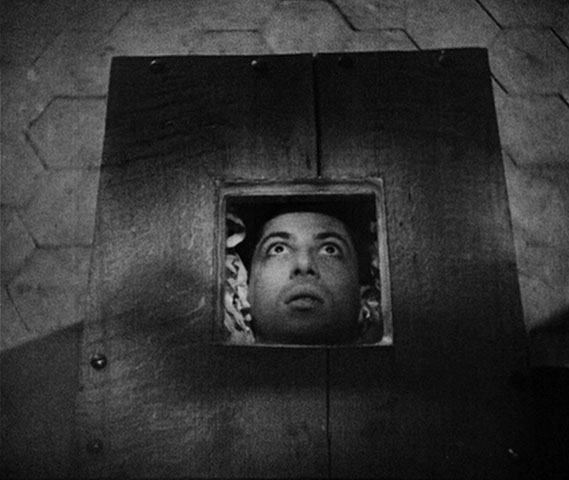
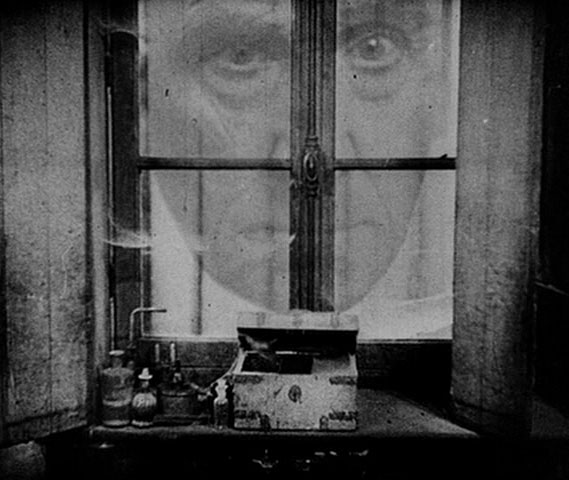
Allan Gray, dreamer and occultist, drifts into town, gets a room, starts seeing weird things right away. Old guy comes in, gives Allan book on vampires, says “she must not die” then goes home and dies himself. “She” is probably one of his two daughters, Leone, who gets bitten. With help of the frozen-faced other daughter, blank-faced Allan goes off into the world of shadows… but unlike most movie heroes, he never actually does anything. The thankless house servant discovers that the lead vampire is a woman named Marguerite Chopin so he opens her tomb and stakes her, releasing the spirit of the dead father whose ghostly head scares the doctor’s henchman into falling down the stairs, while Allan himself is busy having out-of-body experiences while his body is carted off in a coffin. The death of the vampires fixes everything, Leone wakes up happy and Allan and Gisele stroll together into the sunlight as the doctor drowns in flour, trapped in the mill by the house servant. If that doesn’t all make sense, well, I don’t think a straightforward storyline was the point of this film.

an evil doctor drowning in flour:
image

Assorted gems from the Tony Rayns commentary:

What Vampyr has in common with Penelope: distributor shelved it for a year before release (Tony didn’t phrase it that way).

Main dude who played Allan Gray was no actor, but a fashion journalist, a rich baron who financed the movie. “I think Dreyer makes astute use of his blankness in this role.”

Allan Gray as a blank-faced corpse:
image

Allan Gray as a blank-faced ghost:
image

On the film’s style: “it’s full of disjunctions; it’s full of unorthodox editing, unorthodox framing and unorthodox cutting. None of it fits together in the way that one has come to expect classical storytelling in film to do… constant dislocations.” Has a lot to do with subjectivity, opening titles introduce Allan Grey as an occultist, a dreamer. Film came hard on the heels (eww) of L’Age d’Or and Blood of a Poet – indie weirdo films were briefly in fashion in Paris at the time.

At the nineteen minute mark – “etc., rendering indistinct and uncertain the offscreen spaces of the film,” he’s still going on about how weird a film it is. Like I know.

Lead vampire Marguerite Chopin talking with the Doctor (who may also be a vampire) around 19:30 is the first scene not directly witnessed by Allan Gray, but by an animated skull on the dresser. Hmmm. Allan himself is out with “the grave undigger and the world of shadows,” awesome.

Like The Passion of Joan of Arc, made up of many short shots, also many close-ups, but Joan was extremely planned, each detail carefully chosen, Vampyr by contrast is a very cluttered film, but every detail counts. Reading that again, I’m not sure that I see the difference he’s talking about.

Sybilla Schmitz (below) who plays daughter Leone (one of the only pro actors here) had a small part in Pabst’s Diary of a Lost Girl – her real-life story of morphine addiction was the prototype for Fassbinder’s story Veronika Voss.
image

Three choice quotes:

– “It’s almost like a Mike Leigh film in a sense in that people are passing cups of tea.”
– “It’s a kind of anti-Griffithian cross-cutting – but let’s not get too film-theoretical about this.”
– “He’s informing himself how to slay vampires. This, needless to say, is more than seven tenths of a century before Joss Whedon and Buffy. The modus operandi for slaying a vampire hasn’t changed all that much.”

Commentary mentions why Vampyr was a long-coming follow-up to Joan of Arc (legal/financial battles), but why was it over a decade before Dreyer’s next proper film, the hugely excellent Day of Wrath? Oh, IMDB says everyone hated Vampyr so he went back to being a journalist after that. Also there’s whole documentaries on the DVD so I should not blame the commentary for lack of stuff.

His spirit released, the old man’s head seeks vengeance:
image

Cast/crew photo. I think that’s Dreyer on the left with his hand up. Dig how Allan Grey stays in character, haha
image

Didn’t know that Pál “Lonesome” Fejös did a remake of Fantômas – it came out the same year as this and featured the actor who played the murdered master of the house in Vampyr (Maurice Schutz, below, also of Passion of Joan of Arc).
image


From the Casper Tybjerg doc/essay:

He pronounces it sorta like “Vam-pure”. I’d been wondering.

Dreyer: “I just wanted to make a film different from all other films”

All films shot on actual locations. Movie was shooting as early as April 1930.

Art director Hermann Warm also worked on Caligari, some early 20’s Murnau films, and Lang’s Destiny.

Two overtly Christian scenes were removed before the film’s release. And German censors had him tone down the staking scene and remove some shots from the drowning-in-flour scene – they’re restored in this documentary.

image

Great comedy, funny, I loved the hell out of it. Katy liked too.

Ruggles (large-faced auteur Charles Laughton) is a butler for the Earl of Burnstead (Roland Young: Topper in Topper and Uriah Heep in David Copperfield). The Burnstead family and the Ruggles family have been in the same Earl/butler relationship for centuries. Along comes the American New Rich to shake things up: wild-west Egbert (Charlie Ruggles, still recognizable by his eyes over the thick mustache) and his haughty wife Effie, who win Ruggles in a card game and move him from Paris to Red Gap, Washington, USA. Egbert treats Ruggles as a buddy rather than a servant and keeps calling him “colonel”, so when they arrive in Red Gap, Ruggles is mistaken for an important guest in Egbert and Effie’s house, and Effie has to keep up the charade to avoid embarrassment. Ultimately there’s no escaping embarrassment for stuck-up Effie, and Ruggles takes advantage of the goodwill he’s acquired in town and the sense of freedom imbued by the American West to open his own (assumed successful) restaurant, cuddle (implied) with his sweetie (also implied) boot his rival out the building, and get publicly applauded at the end.

Ruggles is a great character. He’s not exactly the typical stuffy butler who gradually learns to relax – he seems from the start to have an inner life, and he adjusts relatively easily from selfless servant to personable entrepreneur. Overall much funnier class commentary than in The Rules of the Game, yet you don’t hear Cahiers du cinema all calling this the best film ever made. Based on a play and filmed a few other times, including a silent with E. Everett Horton as Ruggles, and in technicolor with Bob Hope and Lucille Ball. McCarey directed this soon after a Marx bros. movie and before a Harold Lloyd movie. Appropriately, we watched it soon after a Marx bros. movie and before a Harold Lloyd movie (neither one by McCarey, sorry bud).

character Ruggles (left) with actor Ruggles (right):
image

Besides being a great director, Charles Laughton was in everything from Whale’s The Old Dark House to Kubrick’s Spartacus. Silent star turned successful comedy/drama character actress Zasu Pitts is Ruggles’ dark-haired love interest, and Leila Hyams (also a silent star, best known for playing the nice girl in Freaks) is a blonde singer, a hot young society gal. I wanna say that Lucien Littlefield (Scandal Sheet, The Bitter Tea of General Yen) played the asshole who tried to keep Ruggles down.

Made in the middle of Capra’s streak of sincere, goodhearted dramas, a couple years before he ramped up for the war propaganda machine. I was excited to see this because I love Robbie Fulks’ song about loving Jean Arthur, but I didn’t end up loving the movie’s Jean Arthur more than I love the song Jean Arthur. Maybe Robbie was watching A Foreign Affair, or Shane, or a different Capra film.

A corporate-greed movie, pretty funny for a self-important serious-issues drama, but still feels a tad long and obvious. Jimmy Stewart is in love with his secretary Jean Arthur, but their parents disapprove. Jimmy’s very rich & proper dad owns the huge business of which Jimmy is vice-president, and Jean’s dad (Lionel Barrymore) is a giddy eccentric who lives in a house where everyone does whatever they please (which mostly means dancing and making fireworks). Ends up in jail, then in court, with Barrymore’s lifestyle on trial. Can the stuffy rich people learn to lighten up just a bit, and can the nutty eccentrics learn to conform just a bit, so that their star-crossed lover children can be happy? Of course!

Lionel Barrymore is swell as the good-hearted old commie, but better is Donald Meek as a formerly repressed corporate bookkeeper who goes to live in Barrymore’s house, gleefully inventing and exploding things. Also cool is Russian dance instructor Mischa Auer (seen almost twenty years later in my second-to-last screenshot in Mr. Arkadin) whose strict manner clashes comically with the rest of the Barrymore house.

Lionel Barrymore (right, of Tod Browning and Lubitsch movies, later in Duel in the Sun and Key Largo) shames Edward Arnold (left, in the movies since 1916, played Webster in The Devil and Daniel Webster)
image

Donald Meek is charmed by Lionel Barrymore:
image

Small-headed Mischa Auer with God’s Jean Arthur.
image

The movie is so nihilistic and immoral, I wonder if it counts as pre-code comedy, if it would’ve been allowed three years later. Aha, IMDB says there are some bits that were lost in ’35 during a post-code re-edit, including the meaning/punchline behind the guys delivering blocks of ice to the apartment of the “college widow”.

I didn’t even know there was a straight-man Marx Brother: Zeppo, here playing Groucho’s son, a student who has spent twelve years at college hanging out with the “college widow” (apparently a common term back then after Archie Mayo’s 1927 movie The College Widow, which Horse Feathers is partly parodying).

Director McLeod (who also made comedies with Cary Grant, WC Fields, Bing Crosby, Bob Hope and Harold Lloyd) did a fine job taking strings of unrelated scenes and jokes and stitching them together into what passes for a movie. The mad energy and nonstop jokes still make it a highly successful comedy. None of the four credited writers bear the name of Marx, so I wonder how much the Marx Bros. brought to the table besides acting. No real sense in a plot summary, since the movie itself doesn’t seem to give a damn for plot. No sense in recounting the jokes either, cuz it’s a goddamned fun flick and I’d rather forget most of it so I’ll enjoy it as much the next time.

One of my new favorite movies, utterly beautiful images with a stunning restoration on the MoC DVD. I was sure that this movie would be exoticizing the islanders enough to make it unwatchable around Katy, but I showed it to her anyway, and it turned out pretty well for us.

image

Matahi and Reri are in love, when a ship bearing aged messenger Hitu arrives with a note saying Reri is to be sent to another island and kept as their sacred virgin. So Matahi runs away with her, washing up on a capitalist island where they live peacefully for a while, Matahi not realizing that he is running up a massive debt because nobody ever explained the money system to him. When he sees that they won’t let him leave, he braves the shark-infested waters to find a valuable pearl that will buy their freedom, but while he’s gone Hitu takes Reri, and Matahi drowns chasing after their boat. Sad movie!

image

Tidbits from the very good commentary by R.D. Smith and “the” Brad Stevens: Robert Flaherty directed and shot the opening fishing scene, then Murnau removed him from the project, finding his direction of drama unsatisfying. Floyd Crosby (would go on to shoot tons of MST3K fare and X: The Man With X-Ray Eyes), who worked with Flaherty on White Shadows in the South Seas, took over the camera. Story is a retelling of the Garden of Eden myth. Visual motif of descent grows increasingly darker. Contrast between motion and stillness. Islanders paddling furiously towards giant ship, their vibrant humanity vs. the faceless ship (called Moana!) which seems from afar to be guiding itself, on which sits Hitu, surrounded by stillness. The ship brings a spreading plague as surely as the one in Nosferatu. Heterosexual couple threatened by a powerful individual, theme present in most Murnau movies – in this case, central relationship is more sexual + physical than in the others. Tabu is unprecedented in Murnau, having a character attempt to oppose fate – unsuccessfully, “gives the film much of its tragic quality.” When they escape to the larger island and meet white-influenced civilization, similar to the pure-country vs. corrupt-city themes in Sunrise and City Girl. Murnau didn’t like intertitles, used none in this movie except for diegetic writings, all of which hold negative connotations.

Related, should try to find sometime: Island of the Demons / Black Magic by Walter Spies and Friedrich Dalsheim.

Hitu:
image

Matahi:
image

Reri:
image

image

Watched this the same month as Trouble In Paradise, not having guessed how connected the two would be – the book/script of Stavisky even mentions that they stole shot ideas from Paradise. This one seems like a correction to the other, set during the same year with some of the same reference points (such as Trotsky) but here the upper-class gentleman thief is revealed to be a sham, and rather than escaping at the end to start over with his true love, the thief ends up dead, his widow in prison. The final shot is the chauffeur (of the period Rolls they drive everywhere) placing a bouquet of white flowers for her outside the prison.

Bright and lively music by Stephen Sondheim (who had already won three Tony awards in the 70’s) kept the doomed inevitability away until it was too late. Sondheim had already won three Tony awards in the 1970’s by the time Stavisky came out. It’s one of the very few times he’s written music (more than one song, anyway) for films – the other cases were Warren Beatty’s Reds (another movie featuring Trotsky!) and Dick Tracy.

image

Another story by Jorge Semprún, who wrote the exile-themed The War Is Over. One of Stavisky’s associates (Juan Montalvo, a slimy guy who hits on Arlette but can provide Serge with lots of money) was funding the attempted coup in Spain which led to the Spanish Civil War. In researching the film Semprun found that the same police inspector (named Gardet in the movie) assigned to watch over Leon Trotsky in France was also assigned to report on Stavisky, so Trotsky’s exile was written into the movie, as witnessed by a kid named Michel Grandville. The movie is bookended with Trotsky – first arriving in France, beginning his exile from Russia, and at the end after the Stavisky scandal, being moved further into exile, far from Paris, his political influence feared by the conservatives. Stavisky himself is a Russian Jew in exile – so there are a few connections to the previous film.

The paperback book says it “represents the final scenario” for the shooting of the film, and the intro by Richard Seaver addresses something I had wondered about after reading The War Is Over and believing that Semprun’s script was shot word-for-word with very little added by Resnais: “Once the subject is established, the writer does an initial draft, or treatment, after which writer and director discuss it scene by scene, often line by line, in excruciating detail, until the distinction between writer and director blurs or disappears.” So in fact the books by Semprun represent the collaborative vision of he and Resnais – my beloved auteur is no longer in peril.

The real Serge Alexandre Stavisky was involved in ever-larger finance fraud and was connected with people high up in French government, and when this was made public in January 1934 it led to riots, deaths (incl. the semi-suicide of Stavisky himself), trials for his friends and widow (all acquitted the following year) and political upheaval. Not knowing much about French politics, the Wikipedia articles are hard to follow, but it seems the ultra-conservatives tried to overthrow the leftists in power – eventually one leftist resigned, a conservative replaced him, and somehow socialists ended up in power.

Belmondo, a decade after Pierrot le fou and still looking the same:
image

Jean-Paul Belmondo as Stavisky/Alexandre is dazzling, a con-man with absolute confidence in himself. Arlette is his glamorous wife, and he’s surrounded by associates, some complicit in his underhanded dealings like assistant Borelli and Serge’s in-pocket doctor (Michael “Thomas” Lonsdale) who keeps declaring Stavisky unfit to stand trial for a six-year-old fraud offense… and some are just content to spend time with Stavisky, enjoying his company and not asking questions, like friend Baron Raoul (an outstanding Charles Boyer).

Arlette: Anny Duperey’s debut was seven years earlier in Godard’s Two or Three Things I Know About Her.
image

The book says “Barol Raoul’s looks, gestures, diction and bearing are those one would expect a baron to possess in those films where barons play a part.” That’s hilarious… I hope those are the character notes they gave to Charles Boyer.

This was French superstar Boyer’s second-to-last film. I saw him as the star of Fritz Lang’s not-so-good Liliom. He is the second actor I’ve seen lately (after Maurice Chevalier) claimed to be the inspiration for Pepe le Pew.
image

As Stavisky’s right-hand man, beloved character actor Francois Périer of Nights of Cabiria, Orpheus, Le Samourai, also narrated some Chris Marker films. From the book: “Albert Borelli’s face is impassive, but he has a sharp eye. He is a man of few words but not of few thoughts.”
image

No wonder I had trouble with inspectors Bonny and Boussard – it’s complicated. Boussard arrested Stavisky years ago, and a couple years afterwards Serge became Boussard’s “informant” – actually Serge pays Boussard to keep an eye on things inside the police department, and the informant thing is just a front so they can meet. Bonny has it out for Serge, hires the blackmailer who comes to the theater during auditions to extort money from Stavisky by threatening to expose his past, and later engineers the police raid during which Stavisky shoots himself. Plus I always have to look hard to tell which Inspector is which, since they look and dress the same.

Inspectors Boussard (left, Marcel Cuvelier, also played an inspector in The War Is Over) and Bonny (right, Claude Rich, star of Je t’aime, je t’aime):
image

Bad Boy Bonny:
image

Michel Grandville (Jacques Spiesser of The Man Who Sleeps and Black and White in Color) and Erna Wolfgang (Silvia Badescu), who auditions for a part at Stavisky’s theater (he reads with her, playing a ghost – see quote below):
image

Lonsdale, after “Serge Alexandre” tells him to get rid of Stavisky and his problems: “The person he once was has become someone else: a ghost he despises. But a ghost who worries him.” And later: “To understand Stavisky sometimes you have to forget files. You have to dream of him and to imagine his dreams.”

Dream doctor Michel Lonsdale:
image

Gérard Depardieu got his break as a star just two months earlier. Here he has one scene as an excited young inventor trying to get Stavisky to invest in his product:
image

And back to Erna Wolfgang. I just liked this shot.
image

One more look at Thomas:
image

I wasn’t in love with the movie after I watched it, seemed like a really well-done portrayal of a controversial man with great acting and an over-complicated plot, but reading the book afterwards cleared up all the characters and the structure of the whole thing, and thinking back on the story, acting and photography, I’m now liking this better than The War Is Over. Nobody here is a good guy – not even Bonny, who goes against police corruption but for personal & political reasons – but the movie doesn’t judge them, or go into the details of the scandal. It just gets inside their characters and shows where the scandal came from, how one guy’s belief that he could fake his way into the upper echelon ended up shaking the country.

image

I always feel like I’m missing something when I watch a movie by one of the Great Classic Hollywood Auteur Directors like Hawks. But I didn’t worry about it much this time… worried instead about the mild sexual undertones of a movie where the leading man is helping search for the leading woman’s kitty, while she is helping search for his bone. No wonder they fall in love completely unprovoked in the final scene.

Grant is a timid professor working on his dinosaur skeleton, engaged to marry an uptight girl, and Hepburn is a completely free, intelligent but breezily unaware-acting rich socialite determined to keep Grant occupied enough that he can’t get married. They were both wonderful in this, and the writing is super, and it’s a joy to watch, but as Katy pointed out, it’s a little TOO screwball. Grant stutters nervously and Hepburn talks over everybody and there’s just no stopping or even slowing down. It’s a blessing that there’s no incidental music cluttering up the soundtrack further. So it’s a bit tiring to watch, but still a magnificent comedy.

IMDB says the movie was a flop, and Hawks and Hepburn both lost jobs because of it. A missed reference to The Awful Truth, and I can’t believe neither Katy nor I noticed that George was the same dog as Mr. Smith in that movie. Grant and Hepburn were both terrific, and Charlie Ruggles (again playing a major) was funnier than in the Lubitsch pictures. Also good: a monocled german named Fritz (Fritz Feld played bit character parts in hundreds of movies) and Aunt Random (80 year old May Robson). Among the Hawksian favorite themes (via Senses of Cinema) found in the movie: nicknaming (KH starts calling CG Mr. Bone), screwing with gender conventions (KH has the more masculine, take-charge character) and social norms.

Wikipedia says it was (arguably) the “first work of fiction, aside from pornography, to use the word gay in a homosexual context.”

Didn’t learn a terrible lot from P.Bog’s audio commentary, but gained a greater appreciation for the movie just by watching (actually listening) to it again, with Peter going on about how great everything is. One gem: “It’s easier to watch on a big screen because you see it bigger.”