A happy result of my French Film Hiatus is that I’m getting around to seeing some English-language movies I’ve put off for a long time. This one is particularly long-awaited, part of my decade-spanning quest to see Every Fritz Lang Film. I announced the end of the quest a year and a half ago with The Return of Frank James, but actually I still had this one and Harakiri to go, I just didn’t know where to find them.

This is Lang’s version of the same story Renoir filmed as La Bete humaine, with the writer of Clash By Night and cinematographer of In a Lonely Place, and his two lead actors from the previous year’s The Big Heat. It was a prime year for noir, and this movie acts like noir, but I’m not sure that it counts… after all, the hero gets a happy ending and only the bad people get punished. So it’s more like Shockproof than Clash By Night.

Gloria shouldn’t smoke inside – it’s bad for the birds.
image

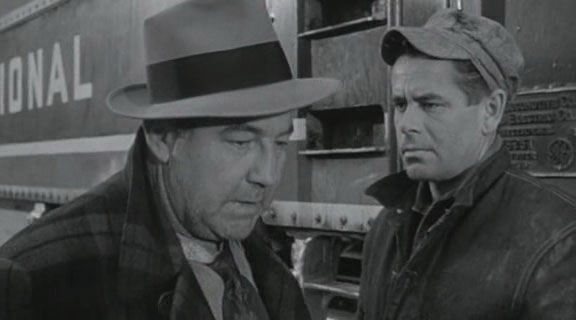
Glenn Ford, who I couldn’t pick out of a lineup right now, plays a railman returned from the Korean War. Nervous, pinched-voiced fatale Gloria Grahame (Bogart’s neighbor in In a Lonely Place) is the dame he falls for. Then there’s a dichotomy of gruff middle-aged guys: Broderick Crawford (of The Black Cat and Born Yesterday) is Gloria’s mean, jealous, drunk, murderous husband, and Edgar Buchanan (later of Ride The High Country) is a kind friend and landlord to our man (with a daughter who’s hot for Glenn).

Glenn and Broderick:
image

Gloria’s husband murders her (ex?) lover in a train car and makes her watch, keeping the note she wrote the lover to lure him into the train as protection so she won’t turn him in. Although if he wanted this protection to be more effective, he would’ve had her write the guy’s name on the letter… this note could’ve been addressed to any of her lovers.

The incriminating (?) note:
image

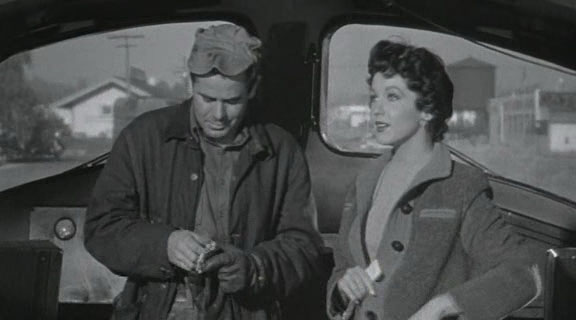
Now tied to a husband she no longer loves (he also beats her – have I mentioned?) Gloria seduces Glenn and gets him to agree to murder the husband so they can run off together. Edward G. Robinson would’ve gone through with it, but Glenn Ford does not, telling off Gloria, who promptly blows up at her husband on another train and gets killed by him. Glenn ends up with his friend Edgar Buchanan’s underage daughter, to everybody’s delight.

Glenn and the good girl:
image

At the emotional height of a movie where sleazy characters are having secret meetings and lots of off-camera sex, and Gloria Grahame’s sharp, pointy breasts are poking right out of her sweater, in the background we can see that she and her husband have separate beds, and so America’s morals are safely upheld. Reminds me of the scene of The 40 Year Old Virgin I caught on cable today where every kind of sex is loudly discussed but the word ‘shit’ is safely bleeped.
image

A British comedy starring stiff, beefy American Gregory Peck (Robert Osbourne explained that American actors could reap tax benefits from working abroad a few months a year), based on a Mark Twain story, an early film work by the man who would become the Criterion-celebrated director of Hopscotch and other films I know nothing about.

Penniless Peck is given the titular note by two hyper-rich pranksters (IMDB says that in 2002 dollars, we’re talking about a hundred million bucks) who have a bet that he can/can’t live for a month solely on the appearance of wealth without ever cashing the check (or, presumably, getting a job). Peck hires a mute weightlifter to help him out, gets some suits and a swanky hotel, and falls for a young noblewoman (Jane Griffiths, of not much else). A few close calls and but Peck makes it through the month and presumably gets the job (worth somewhat less than a hundred million bucks) and the girl.

More jokes about not paying your tailor, twenty years after the Lubitsch movies. Not paying your tailor is hilarious to the British! A pretty good light movie. Katy and Jimmy enjoyed it more than Hamlet Goes Business.

“Don’t waste your time in the so-called real life.”

image

One of my new favorite movies! Rivette must’ve dug this one, being about theatrical performances bleeding into real life, with characters and camera always behind and in front of screens and fences, sheets and curtains.

An Italian theater company arrives “in a Spanish colony of Latin America” in the early 1700’s and attempt to build a theater and make a living amongst locals who care more about bullfighting. Camilla, the lead actress of the group (Anna Magnani in an amazing, vibrant performance) entertains the affections of three fans: the local star bullfighter, the viceroy (who offers her the titular coach) and troupe member Felipe, who wants to settle down in the wilds of America. With the threat of duels, revolution, prison and worse, Camilla contrives a way out, donating her coach to the church and retreating back behind the curtain, letting all three men off the hook. Movie (this version of it, anyway) is in English, with a wild mix of accents.

In interview, Renoir says he was highly concerned with color (it is brilliant – see shot above), with Anna’s wonderful acting, with being able to change the script and with playing around with the nature of acting, on the stage and in real life.

Renoir: “My principal collaborator on this film was the late Antonio Vivaldi. I wrote the script while listening to records of his music, and his wit and sense of drama led me on to developments in the best tradition of the Italian theater.”

image

Andrew Sarris: “To claim, as reviewers at the time did, that Renoir had failed to produce a convincing narrative, is to scorn Matisse and Picasso for not painting plausible pictures.”

Andre Bazin: “Renoir directs his actors as if he liked them more than the scenes they are acting and preferred the scenes which they interpret to the scenario from which they come. This approach accounts for the disparity between his dramatic goals and the style of acting, which tends to turn our attention from his aims. The style is added to the script like rich paint liberally added to a line drawing…”

J. Rosenbaum: “As Bazin suggests, the actors are employed as if they were different kinds of paint, freely spilling over the initial designs, but it’s worth adding that the colors are employed on occasion as if they were actors – a splash of yellow or blue in an incidental decor carrying all the allure of a memorable extra.”

Rosenbaum again:

All three films are comic period fantasies in dazzling color, offering a kind of continuous, bustling choreography in which shifting power relations between upper and lower classes and between spectators and performers literally turn the world into a kind of theater. In this respect, they might be said to offer more abstract and less politically anchored versions of the films Renoir made during the thirties. Unlike their predecessors, they’re deliberately removed from real life. And given the sense of political as well as the personal defeat that came with the war and his departure from France, followed by a lengthy period of living in exile, they’re unable to hide a subtle aftertaste of regret lurking behind all that gaiety – a sense that utopia can only be found, if at all, on a soundstage, not in the Popular Front that once meant so much to Renoir. This sadness only occasionally rises to the surface, as in the memorable exchanges between actors Camilla and Don Antonio at the very end: “Felipe, Ramon, the viceroy… disappeared.” “Now they are part of the audience. Do you miss them?” “A little.”

Scorsese says there were versions in Italian and French, and that the ending (which looks like it came from a degraded print) was newly restored in the 90’s.

Don Antonio, leader of the actors group, played by Odoardo Spadaro of Divorce, Italian Style:
image

Rome’s Cinecitta studio was equipped for sync sound recording in the 50’s? You wouldn’t know it from the Italian movies I’ve seen.

A few comic reminders that we’re in the 18th century: “Tomorrow papa is being bled with leeches, the day after I have my purge.”

Cameo by French actor Jean Debucourt as the bishop, of Epstein’s silent Fall of the House of Usher, Cocteau’s Eagle With Two Heads and Max Ophüls’ Madame de…

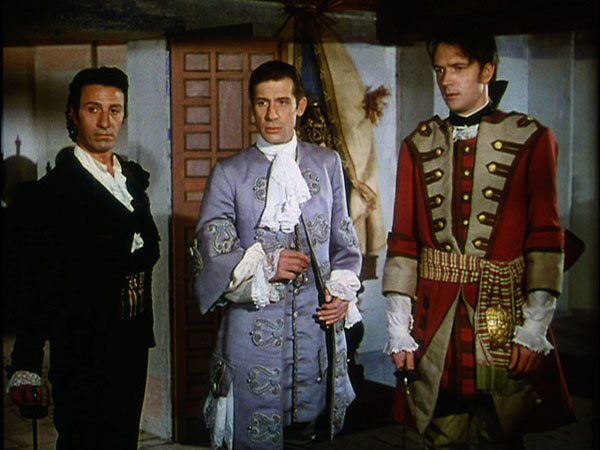
The three men, below from left to right:
– Ramon the bullfighter – Riccardo Rioli, whose film acting career began the year before, and ended the year after with a small part in a Mankiewicz picture.
– The Viceroy – Scottish Duncan Lamont, charming in this, later in Mutiny on the Bounty and Quatermass and the Pit.
– Felipe: American Paul Campbell, who was a beef-and-cheesy enough actor to get himself cast in The Deadly Mantis. He lived long enough to have seen the MST3K version – here’s hoping he did.

image

The great Anna Magnani plays Camilla. Star of Mamma Roma, Bellissima and Rome, Open City, she also beat out Kate Hepburn and three other Americans for the 1955 Oscar for The Rose Tattoo.
image

“Where is truth? Where does the theater end and life begin?”

SEPT 2020: Katy watched this with me… and she liked it!

Silent World by Jacques Cousteau and Louis Malle beat it for the golden palm at cannes, but it took the “human document” award. The film print said “grand prix” but it doesn’t even look like that award was handed out in ’56. The print also calls Ray “Roy”, but those two seem interchangeable by the IMDB. Supposed to be India’s Rashomon, the one that brought Indian film to the world’s attention.

Daunting to watch a movie known for 50 years as a masterpiece… well-illustrated when I walked into the room early and saw a bunch of freshman watching the end of Citizen Kane.

Oooh, my fourth 50’s film in a week. This came out less than a decade after Bicycle Thief, its inspiration, and the year after Senso, La Strada, Seven Samurai and Saga of Anatahan.

Ray’s first film, with great music by then-unknown Ravi Shankar. Rich drama, very moving and awesomely shot. I kind of expected to be underwhelmed, but I loved it (probably more than the film students around me who sighed a lot and started fidgeting and text-messaging towards the end) and maybe even cried a little. Some of the students did too, so there’s hope for them.

Little Apu is born to overburdened mom, underemployed dad, always-in-trouble sister and elderly aunt. Sis’s friend is getting married. Apu goes to school. Dad gets work with the landlord but isn’t paid for months. Sis steals a necklace. Mom fights with aunt while trying to make sure kids are fed and staying out of trouble. One horribly powerful fight scene when, after the necklace dispute, mom drags sis out of the yard by her hair, collapses against the inside of the door while through the wall we can see Sis crying on the other side.

image

The scene is edited and scored with such force, seems like it couldn’t be the work of a first-time film director working before his country even had a proper film industry. Anyway, Sis gets sick and dies right before father comes home from the big city (he’s barely in the film) bearing money and gifts. Death scene (during a horrid rain storm) is at least double what the hair-pull fight scene was, with the music peaking into the scream that we never hear from the mother. In the finale, the family is moving to a new town to start again, Apu finds the necklace and throws it in a lake.

Movie feels like a masterpiece despite my pedestrian plot description.

When looking for screenshots I found this scene that wasn’t in the print we watched. The parents have a rare conversation about their lives and bring up moving out of town for the first time.
image

Ray: “The cinematic material dictated a style to me, a very slow rhythm determined by nature, the landscape, the country. The script had to retain some of the rambling quality of the novel because that in itself contained a clue to the authenticity: life in a poor Bengali village does ramble.”

Ray in ’82: “All artists owe a debt to innovators and profit by such innovation. Godard gave me the courage to dispense largely with fades and dissolves, Truffaut to use the freeze.”

Truffaut walking out in ’56: “I don’t want to see a film about Indian peasants.”

Apu:
image

His sister in the rain, celebrating a short-lived freedom:
image

Outcast auntie:
image

Sad parents:
image

Update, Jan 2010: Katy liked it, but says she saw the sister’s death coming.

So I’ve finally watched The Searchers. For a couple years I’d heard that it was one of The Greatest Films so wanted to see it badly, but then I changed my mind and decided I probably wouldn’t like it because of John Wayne, then I stewed on that for a few years until finally it sat as maybe the movie I’d been meaning to see longer than any other.

All those expectations, and I end up liking it. Worst of all, I thought John Wayne was good, damn it all.

IMDB plot summary: “Ethan Edwards, returned from the Civil War to the Texas ranch of his brother, hopes to find a home with his family and to be near the woman he obviously but secretly loves. But a Comanche raid destroys these plans, and Ethan sets out, along with his 1/8 Indian nephew Martin, on a years-long journey to find the niece kidnapped by the Indians under Chief Scar. But as the quest goes on, Martin begins to realize that his uncle’s hatred for the Indians is beginning to spill over onto his now-assimilated niece. Martin becomes uncertain whether Ethan plans to rescue Debbie…or kill her.”

Jeffrey Hunter (Jesus in King of Kings) is Wayne’s sidekick nephew and Vera Miles (psycho, the wrong man) is the nephew’s love interest. Natalie Wood and her young sister Lana play the kidnapped Debbie. John Wayne’s iconic performance in The Searchers came the same year as one of his most hated roles ever, as Genghis Khan in The Conqueror.

Very meaningful opening shot:
image

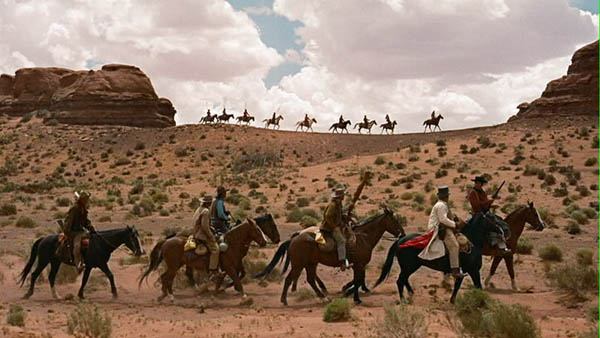
Horses are neat:
image

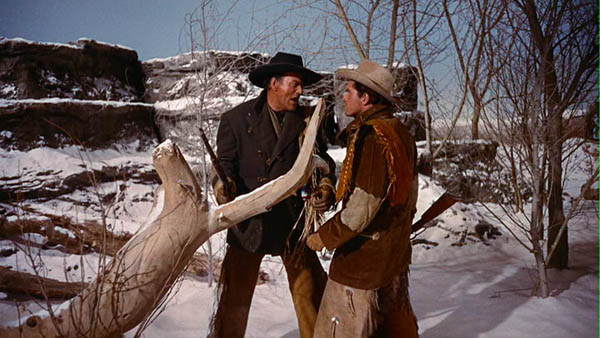
Hunter tries to temper Wayne’s anti-Indian rage:
image

Indians are neat:
image

Very meaningful closing shot:
image

So what’s the new “movie I’ve been planning to see longer than any other”?
Sunset Blvd? Weekend? Nashville? Something I started and never finished like Crumb or Night On Earth? DVDs I bought ages ago like Benjamin Smoke and Henry V? I’m gonna go with Hitchcock’s The Lady Vanishes.

Worst part: at no point did the whole cast sing “guys and dolls… we’re just a bunch of crazy guys and dolls!” The Simpsons has misled me again. It had better not happen again… I wanna hear Lee Marvin sing “gonna paint that wagon / gonna paint it fine / gonna use oil-based paint / ’cause the wood is pine”.

Movie was really good… colorful and fun, full of cops and robbers and action without getting too serious, and swapping off the super-corny dancing segments with some slightly (slightly!) more dignified ones.

Frank Sinatra is a sorta wussy and slimy guy who sets up craps games, Marlon Brando (whyyy cast him in a musical, exactly?) is the tough super-gambler, Jean Simmons (Spartacus, Black Narcissus) is the cute missionary Brando falls for while taking her to Cuba to win a bet, Vivain Blaine (of nothing special) is Sinatra’s off-again actress girlfriend who can’t stand him but wants him to marry her, and Robert Keith (sheriff in The Wild One) is the cop trying to catch everyone involved.

After a buncha fun musical numbers, movie ends with a double wedding, so what else matters, really? Katy liked it too. Good night, everyone.

“Still, it’s very sad.”
“But, my friend, happiness is not a joyful thing.”

Three filmed short stories by Guy de Maupassant, reminding me of Quartet. It wasn’t great and made me not want to seek out any of the author’s books… there it also reminds me of Quartet. Not narrated by the author like Quartet was, since the author is dead, but rather by a sort of author character who shows up as an active participant (the artist’s friend) in part 3.

So, Lola Montes and La Ronde, and even Letter From An Unknown Woman would have been wonderful, but I chose to show Katy Le Plaisir instead and now she thinks I enjoy stodgy period pieces. Sure it had some sparks of life in it, but even the documentary extras on the DVD wanted to talk up the difficulty in finding locations and in making the film rather than giving a reason why people seem to like it. Stanley Kubrick once called it his favorite film, so surely there’s something there.

Movie starts out weird, kicking it into high gear with a creepy-looking masked man dancing gaily at a fancy ball, then quickly passing out. It is discovered that he’s an old man trying badly to recapture his youth and hit on young girls, to his wife’s patient dismay.

Centerpiece segment seems like it wanted to be the entire movie, but wasn’t quite long enough so they tacked on the other two bits… it must be over an hour long, about a whorehouse that the camera can never bring itself to go inside. Fortunately, the whores all come outside, closing up shop to take a trip to the country for an unexpectedly moving wedding, before returning home to the glee of the townsfolk.

Last bit, a model and artist fall for each other, but when things get rough and he might leave her, she tries to kill herself… they end up together forever, she in a wheelchair.

Haven’t seen a Max Ophuls movie yet that takes place in modern day… guy liked to create ornate depictions of times past. Some fantastic shots made the whole thing worth watching, incl. the artist meeting the model in the start of segment 3, and her suicide later, which switches fluidly from an objective to a subjective camera, climbs the stairs with her shadow cast before us then crashes through the window and down.

I am so bad at recognizing people, because Simone Simon played the model and I didn’t know it. Jean Gabin was unmissable as the friend/host in the country in the middle segment at least. Claude Dauphin (President of Earth in Barbarella) was the doctor in the first segment.

“Real diamonds! They must be worth their weight in gold!”

Tony “Joe(sephine)” Curtis and Jack “Jerry/Daphne” Lemmon are musicians on the run from Spats Colombo after witnessing a hit on one Toothpick Charlie, so they dress as women to hide out on tour with an all-girls band in need. Hilarity ensues.

Considering this is One Of The Most Excellent Films In The History Of Film, I found it disturbingly non-excellent.

I mean, great dialogue, and funny jokes, and Marilyn Monroe and all… but really, one of the best movies ever made? It’s on the AFI list, but not on Rosenbaum’s list so I guess not everyone agrees.

I’m sure the sexual jokes and situations were ahead of their time and paved the way for the 20-some cross-dressing comedies that play the Landmark every year.

Really a fine movie… don’t know why I’m so grumpy about it. Gonna leave it alone now.

Second time seen, but first time with proper cinemascope ratio. Imagine this cropped:

image

Interesting to use cinemascope on a picture that mostly takes place on a cramped submarine, actually. Even more interesting that this was one of the first cinemascope films.

Richard Widmark, after both Night and the City and Pickup on South Street, is an experienced former submarine commander who is called back in for a secret mission: to escort a nuclear scientist (who disappeared from the public eye weeks earlier) and his scientist daughter (we don’t find that out until the end) to an island offshore of some bad country (China?) who’s developing a nuclear bomb, which they’ll drop from a plane disguised as a U.S. plane to get us into war with some other bad country (Russia?).

image

Sam Fuller directs in the hard, solid style he’s known for. Movie gets slowed down a couple times by preachy moments and the scientist repeats his line about “each man having their own reasons for living and their own price for dying” about two times too many, but for the most part it’s an engaging 100 minutes with some really good parts. They capture a Chinese fighter and lock him down below, then fake that their own Chinese officer is another captive… beat him up and throw him down with the first guy to get information out with a hidden mic. The evil Chinese catches on and beats the good guy to death with a pipe before the others can stop him. A harsh price to pay for information, but worth it because it leads them to discover the nuclear plot just in time. It’s a badass scene that really sticks out in my memory from the first time I watched this.

image

The good Chinese guy was in Steel Helmet. Widmark is alive and retired, but his co-star Bella Darvi committed suicide at 43. The cinematographer did House of Bamboo and Pickup On South Street and lots of famous late 40’s noir.

image