The End of Sexual Taboos: Homosexuality and Other Variants
“Sexual permissiveness – certainly destructive of established mores – has been an aspect of the ideology of the avant-garde from its inception. For this movement is forever at war with society and its values.” He calls necrophilia “one of the unconquered areas of liberated cinema.”

–
The Bloodthirsty Fairy (1968, Roland Lethem)

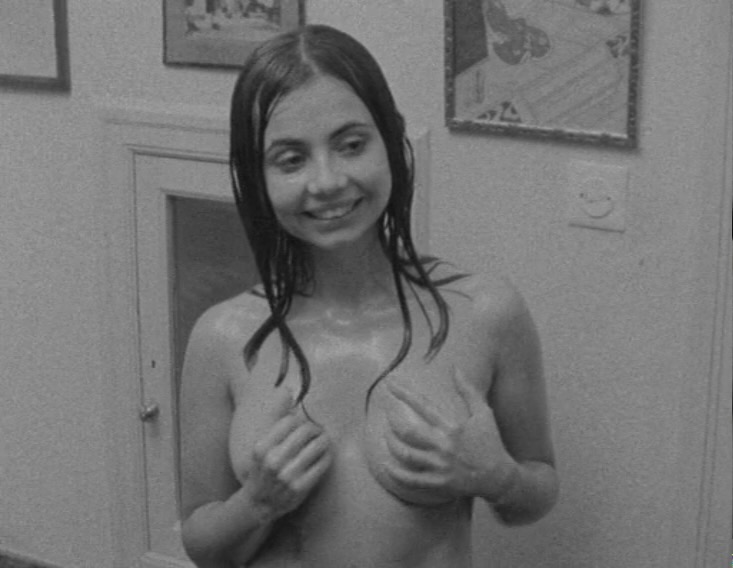
Delivery men unleash the title character, who goes out and beats a man to death, strangles a nun, blinds a boy. She’s collecting severed penises in jars, and they’ve got a metaphorical way of showing her chop a guy’s dick off, which unfortunately involved killing a chicken. I’m not wowed by the church organ soundtrack, and why the nazi credits? Vogel just says “The swastika that opened the film changes into Nixon,” while Lightcone points out nazi stuff in his other films.
–
Fragment of Seeking (1946, Curtis Harrington)

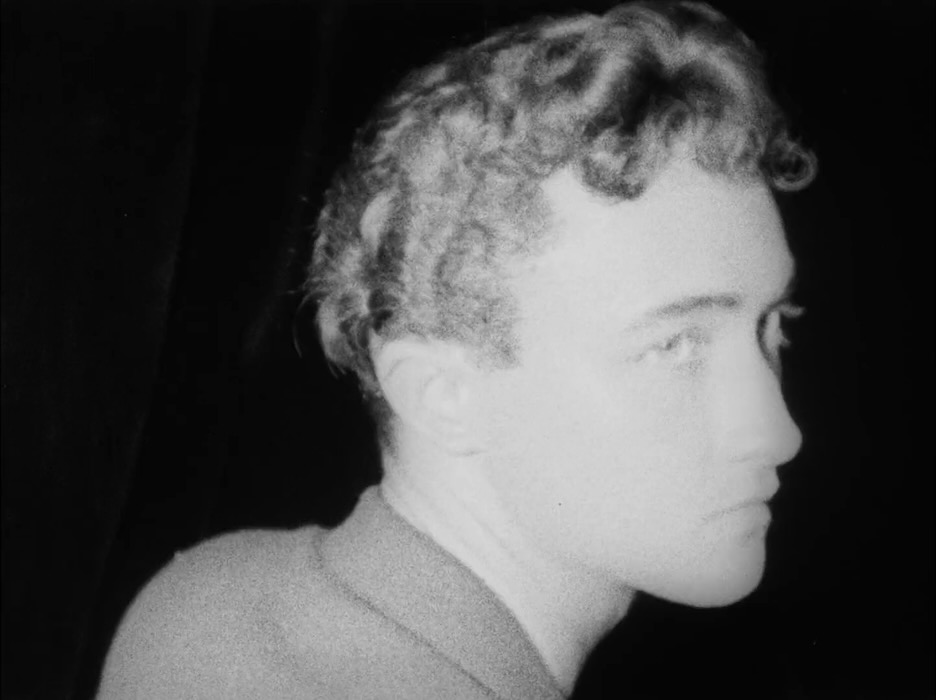
Wow, I was not expecting that. Overdressed Guy creeps around to dramatic music, observing all the women and one smiley man in the vicinity, all sharp compositions. He goes inside and takes off the raincoat, hat and glasses, and wanders into a girl’s room and kisses her – and she becomes a skeleton. He goes back outside, the smiley man is unresponsive and all the women are skeletons. Goes in another door and someone inside slowly turns their head towards him – you expect another skeleton but it’s himself, wearing a wig. My first by Harrington, who seems like a Ken Anger-caliber 1940s weirdo (complimentary).
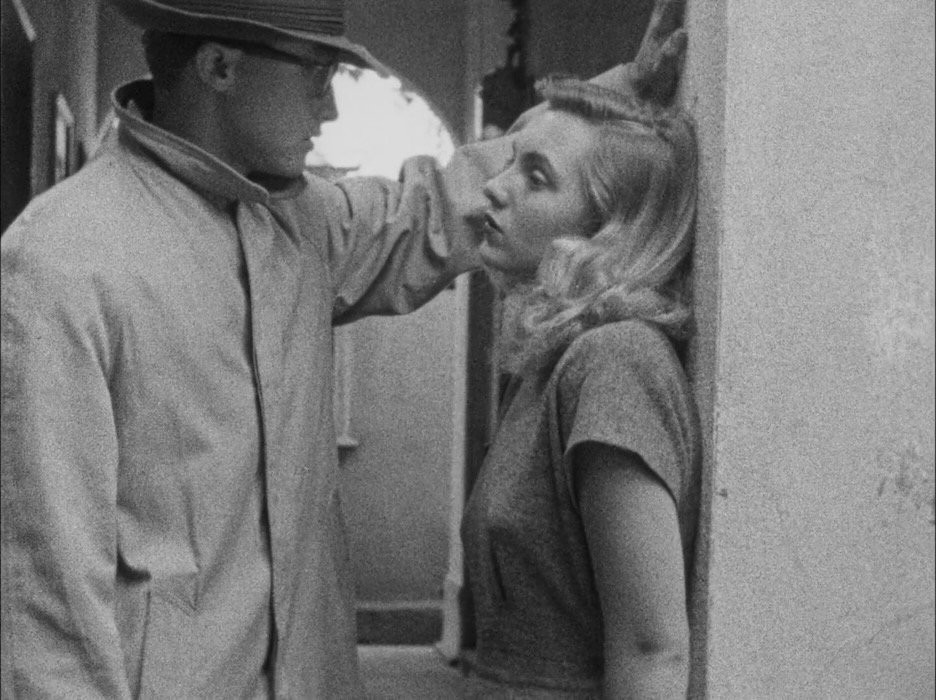
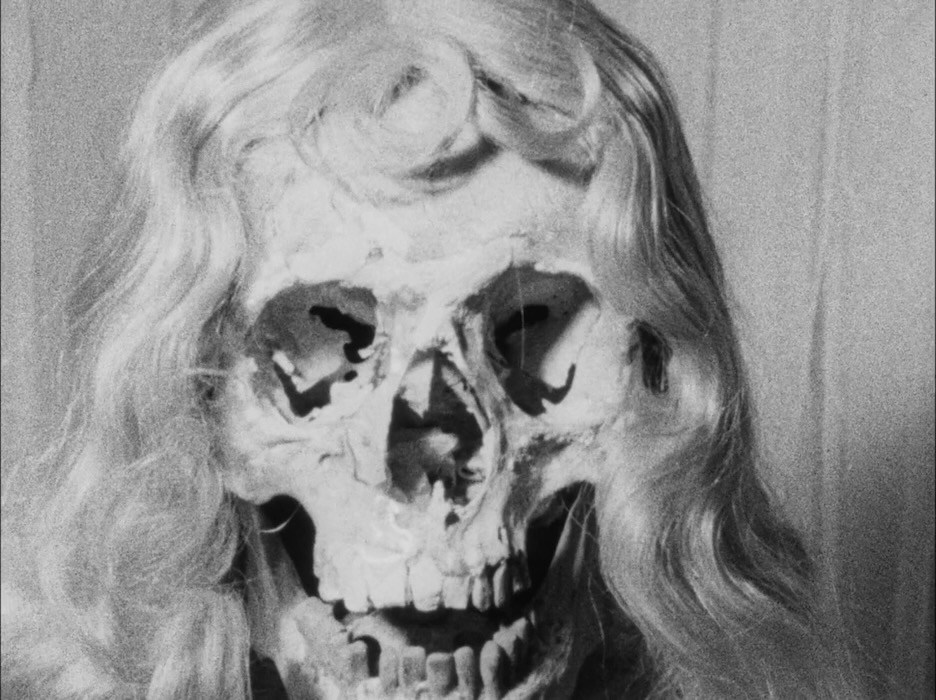
Mouseover to turn your lonely-boy self into your wig self:
image

–
The First Mystery: Birth

It is difficult to believe that until about two decades ago, films of this process were not permitted to be shown publicly. Hollywood provided euphemistic or fraudulent paraphrases of birth, occurring either off-screen (with shots of anxious relatives waiting outside) or confined to the woman’s face, sometimes showing genteel and manageable discomfort; blood or screams were missing, except in the case of “loose women” who had to be made to suffer.

Kirsa Nicholina (1970, Gunvor Nelson)

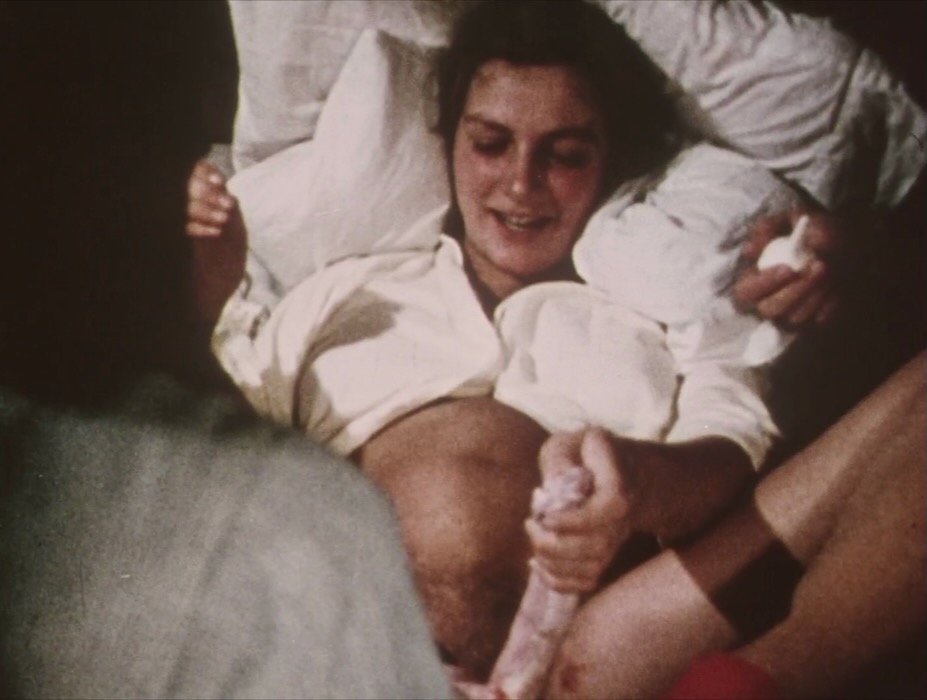
Somewhere out there is a person in their fifties who I just watched being born. Soundtrack is folk music performed by the father, oh no.

Vogel:

As the baby, still half in the mother’s body, begins to emerge, the mother smilingly takes its hand in her own and holds it. This tender gesture would not be possible in a hospital delivery because of drugs and antiseptic precautions. Perhaps, indeed, life should be lived as an open-ended adventure and “security” cast to the winds if we want to become human.
–
The Ultimate Secret: Death

Necrology (1971, Standish Lawder)
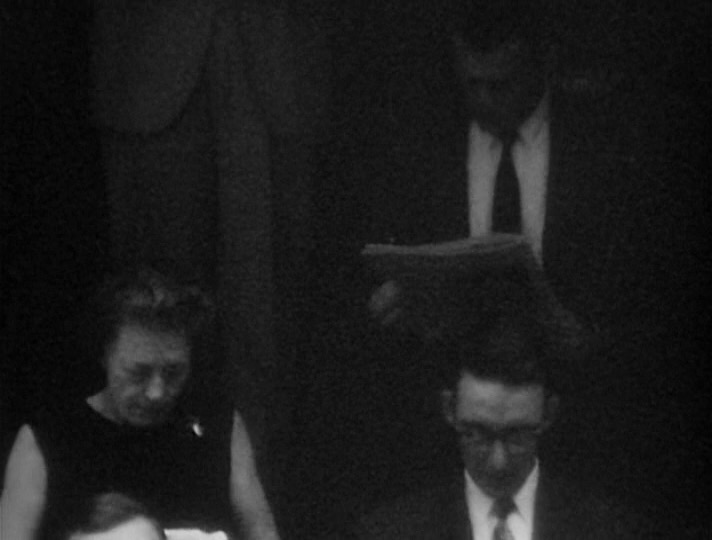
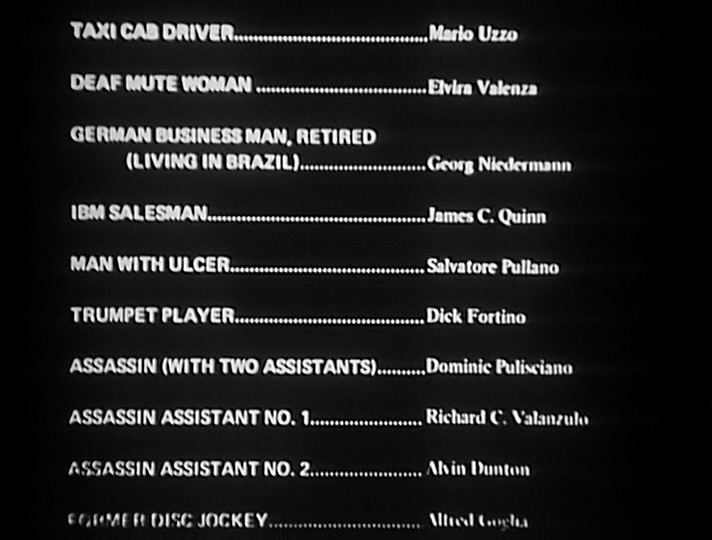
I think he’s filmed a crowd of people on a busy down-escalator and reversed the footage, so it looks like a column of people ascending, facing us. What I thought would be a grim work turns out to be a gag film with joke credits.

Vogel, after commentary decrying the lack of contemporary nazi-made concentration camp documentaries, refers to Necrology’s “endless victims… in unbroken, heart-rending succession, to heaven, hell, or oblivion.”
A teacher attempts to go on holiday, but unfortunately he is the dumbest, drunkest idiot in all Australia. He is Gary “U.S.” Bond of Growing Pains (the Hammer horror, not the comedy series), a Blind Faith fan who hates his job and hates ordinary fuckin’ people. During a train layover in a thriving town, he gets sucked into a game of high stakes heads-or-tails and loses all his vacation money so has to look for work instead of proceeding to the shore. But some locals are very happy to host the stranger and keep him drunk. White-suited Tim’s daughter Janette wants to make out with the newcomer, but he throws up instead. Finally he settles for having a bromance with Donald Pleasance, the only other intellectual in Australia. He never actually wakes in fright, but with twenty minutes left he wakes in disgust. Gary escapes, but continuing to be an idiot he accidentally hitches a ride to the town he just left, then thinks he has to kill Pleasance, or maybe himself. Not a horror movie, it turns out (unless you count the scene where a bunch of kangaroos are shot and stabbed to death), just another in a long line of Australian movies about how it brutally sucks to live in Australia.

How can you hate a country whose only features are cockatoos and drinking?

Color fields, electro-tones, patterned text onscreen, with the main camera action being Canadian farmers. A barn raising is interrupted by color fields. A pig is killed, but then, pigs are portrayed as horrible disgusting creatures (I thought the one playing with the dogs was cute). It’s an ambitious title for an experimental re-edit of your home movies from some months at the cabin, but I’m not mad that I spent the time watching this, and at least it will always be filed alphabetically next to an oscar winner.

Joshua Minsoo Kim in Cinema Scope:

At various moments throughout the film we hear minimal, humming synth tones, which were added because Lock felt he heard such sounds coming from the images themselves … It’s an elegant manoeuvre that is matched by another interesting strategy: graphics (shapes, numbers, a circuit diagram) are overlaid atop images. Formally, these feel in line with works by other Canadian filmmakers like Joyce Wieland and R. Bruce Elder, and they call attention to the surface of the film plane, as if inviting us to view everything as a spectacle behind glass.

The James River Film Society, a mysterious organization which never emails me no matter how many times I submit my address to their subscription link, counterintuitively programmed a pair of hour-long Sublime Frequencies documentaries from director Hisham Mayet at a lovely large theater at noon on a beautiful Saturday, so I came out, along with as many as nine other people.

–
The Divine River: Ceremonial Pageantry in the Sahel (2012)

Short riverboat setup, then it gets right into rocking and boogies down for forty minutes or so, each scene in a new location with a new musician or group. Apparently shot in Mali and Niger, there’s much dance, some cool structures and landscapes, and per the Sublime mission, no English translations or narration or titles. I figured the epic animal slaughter scene would be a good time to hit the restrooms – it’s also weirdly where the movie ended.

–
Oulaya’s Wedding (2017)

More of a straight doc about a particular event, clearly explained to us. Group Doueh is a famed wedding band in Dakhla, a town on a coastline peninsula in Western Sahara, an area bordered by Mauritania and Morocco. The Doueh musicians’ own daughter is getting married, so they’re throwing the biggest party ever and inviting everyone. We get a behind-the-scenes look at the setup and prep in the first few days, then the event itself under a massive tent. Interviews with family and guests (spotlight on the gay male dancers). Plenty of music, so I could keep on bopping in my seat. We’ve long heard that Mdou Moctar and Tinariwen started as wedding bands, so the main attraction here was to see what these weddings are like.

Billed as an essay film, actually a lecture slideshow – literally, with the kachunk slide-change sound. Giraffe trade across the world. Roosevelt drew boos for being a huge animal killer, he is so cancelled. They find ancient artworks and mentions of giraffes in different cultures, tracing their history. Dig the giant rock carving in Niger between a US drone base and foreign-controlled uranium mines. Record of a giraffe gift to the Chinese emperor. Israeli scholars debate whether God (via Moses) intended for giraffes to be eaten, with a follow-up on the presumed origin and final location of the Ark. Exciting return to the place in Kenya where Katy fed a giraffe. Dry German narration. I bet this was great for the woman we met in line who comes to the movies to see views of exotic countries, but it felt to me like a glacial two hours – there must be a more engaging way to get the material across. Pronounced “sir,” more or less. Q&A over zoom, we ditched to get a beer. A guy on lboxd says: “Personally, I had a realization of why girafarig is a psychic type so that was uplifting.” Nona Invie opened on solo keys and vocals, did a Linda Ronstadt cover.

A bloodier, sleazier and more despairing predecessor to Made in Hong Kong, positing that the world is a violent shithole. I’d be completely in favor of this sleazy punk nightmare if someone would please censor the animal torture scenes for me… they’re sticking pins into mice right in the first scene… not sure if throwing the cat out the window Grand Budapest-style was faked. First movie watched in 2024, bad omens for the year to come.

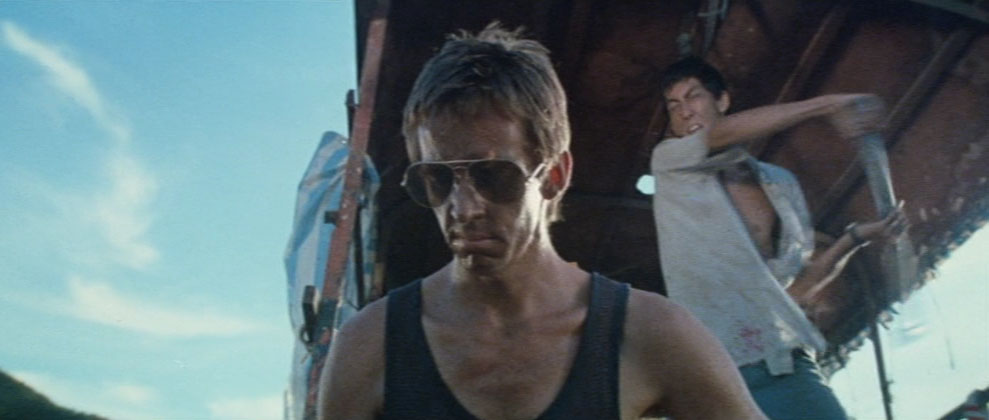
Three boys are experimenting with antisocial behavior by setting off a homemade bomb in a movie theater. They’re followed by witness Wan-chu, malcontent younger sister of a detective (Five Fingers of Death star Lo Lieh), who blackmails them into committing ever-greater crimes. And she is not fucking around, starts by hijacking a bus full of passengers. She steals a lot of money orders from a foreigner, setting off a whole secondary gangster plot (the guy’s exposition buddy tells us they’re “in a deadly business”). Inevitably, Detective Brother gets involved in the gangster case until disciplined by his boss, the most dubbed white guy of all time. The girl dies in the same way as her cat, while all the boys get shot in a climactic cop-gangster shootout, only one surviving, wounded and poisoned and insane.

Mouseover to waste this foreigner:
image

Amazing opening, EO introduced as circus donkey to Sandra Drzymalska, some strong scenes and visuals, finally dribbles to a less amazing ending, Eo being marched to execution.

He’s repoed from the circus and spends some time with a horse breeder… mopes around a petting zoo, escapes after a visit from his former owner… wanders through a wolfy forest into town where he becomes a football team’s mascot then is beaten half to death by rival hooligans… after recovering, he violently refuses to take part in an animal slaughter operation. We were watching Poker Face the same week, and besides the Okja veganism, the two shows share socially awkward truckers getting into serious trouble.

Sexually explicit horror movie filmed in Galicia. The Bride imagines being raped by a closet dweller at her honeymoon hotel, so instead they go to his weirdo family’s place, where instead she fantasizes of joining with Creepy Carmilla and murdering the husband with a dagger that looks like a bathtub faucet handle. She keeps having visions, so I assumed the time he finds Carmilla naked, buried in the sand and breathing through a scuba mask would be one of those, but nope.

Carmilla appears to be the ageless vampire of a family ancestor. By the end, she’s killed a couple locals, and turned the bride and young Carol, who sounds dubbed by someone older. The husband figures it out and does some vampire slaying, but this looks bad to the local authorities.

Who could kill a child?

This guy could:

Main dude was in The Forbidden Photos of a Lady Above Suspicion (whoa) and Beyond Re-Animator. The Bride was a lead in The House That Screamed by Serrador, whose other movie I just watched, and Carmilla costarred with John Hurt and Peter Cushing in The Ghoul.

First I’ve seen by Aranda – his 1960’s proto-giallo Fata Morgana sounds good, and his murder mystery Exquisite Cadaver. The DP worked on Cannibal Apocalypse and Comin’ at Ya and the editor works with Carlos Saura. One of many adaptations of the Irish novel Carmilla – others include the previous year’s Let’s Scare Jessica to Death, Alucarda, the British Vampire Lovers, a Christopher Lee called Crypt of the Vampire, Roger Vadim’s Blood and Roses, and a three season youtube series.

My first-ever Sammo Hung movie. This did have skeletons, a ghost pulling somebody into a mirror, a hopping vampire, an Evil Dead hand rebelling against its body, and a battle between magicians, but it’s really not a horror movie. Rather a comedy action flick: a likeable loser called Big Guts is getting cucked by his wife and set up by his boss, but keeps managing to survive. I can see the Sammo influence on Jackie Chan, using all the props in the room and looking panicked while doing cool moves. Magician Lau (Tai Bo) disapproves of his master’s murderous work-for-hire, kwaidans and protects Sammo, then defeats evil magician Peter Chan Lung. Internet says both magicians were in Enter the Dragon, all my early kung fu movie interests starting to come together. I think one of the Jackie/Sammo collabs like Project A or Dragons Forever should be next. This movie has convinced me that Sammo is cool, but it loses points for bird killing.

I thought it was the Plazadrome screening of part 3 that got me on a Nightmare on Elm Street kick this month, but no, it was probably this: