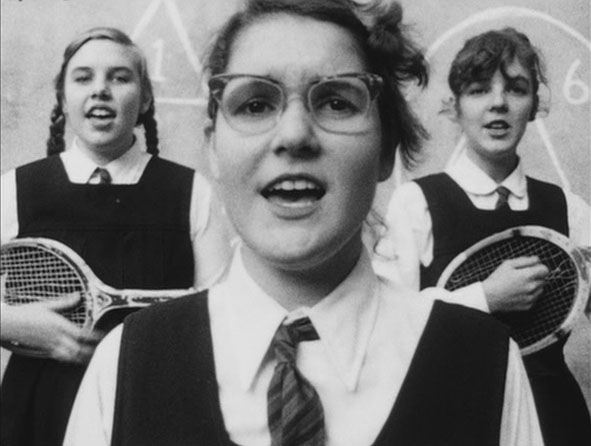
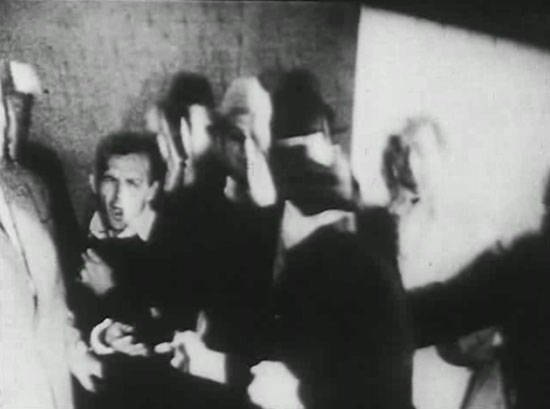
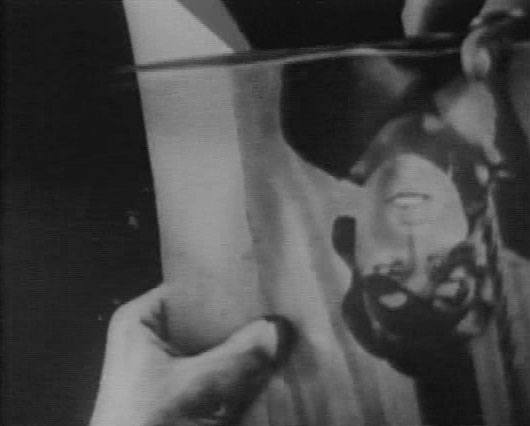
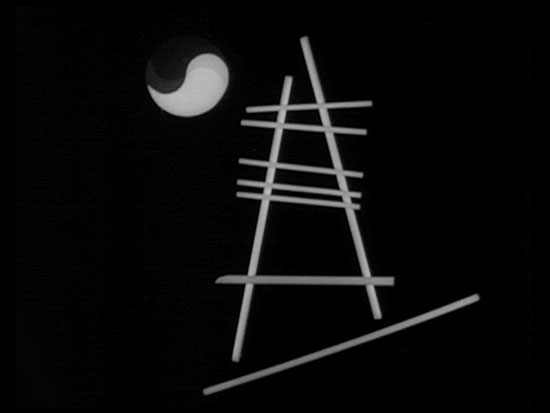
I passed up seeing The Scarlet Empress in 35mm for this, but it was probably worth it [later note after having finally watched The Scarlet Empress: nope].

Meshes of the Afternoon (1943, Maya Deren)
One of the great poetic movies of the 40’s. Love when she’s climbing the stairs, bouncing off the walls as the camera twists from side to side. Love the multiple Mayas sitting at a table in the same shot (technically impressive, too). Love the movement, the plot (avant-filmmakers take note: an actual plot), the look, that iconic shot of Maya at the window.

Fuses (1967, Carolee Schneemann)
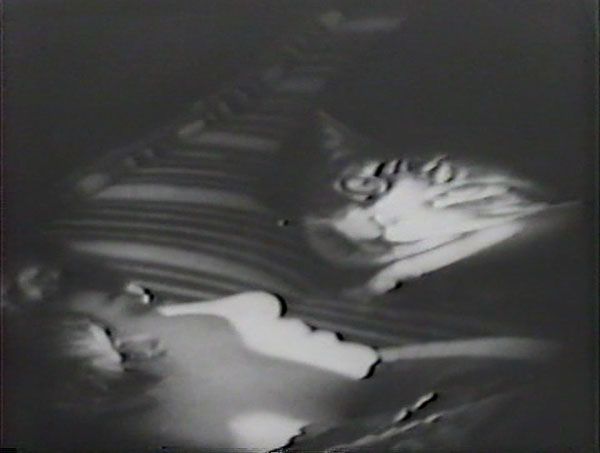
Fairly rapidly-edited shots of director having sex with James Tenney, with other scratched and weathered colored filmstrips superimposed over it. The editing and content are exciting for about ten minutes, but the movie is twenty minutes long, and silent. Girl in front of me tried reading from the reflected light of Tenney’s alarmingly red-tinted penis on the classroom wall, then texted people for a while. I sat wondering why there were so many shots of her cat staring out the window. Maybe it was supposed to be boring, and that was the point. Worth watching on pristine 16mm, glad I saw it, just saying it felt long. Schneemann has few film credits, but they’re in collaboration with Andy Warhol, Yoko Ono and Stan Brakhage. The Brakhage influence can plainly be seen here, and the film process work makes for some wonderful images. This was apparently a reaction to the objectification of women in movies, with Window Water Baby Moving named as an example. The director: “I wanted to see if the experience of what I saw would have any correspondence to what I felt – the intimacy of the lovemaking… And I wanted to put into that materiality of film the energies of the body, so that the film itself dissolves and recombines and is transparent and dense – as one feels during lovemaking.” Won a special jury prize at Cannes.

Reassemblage (1982, Trinh T. Minh-ha)
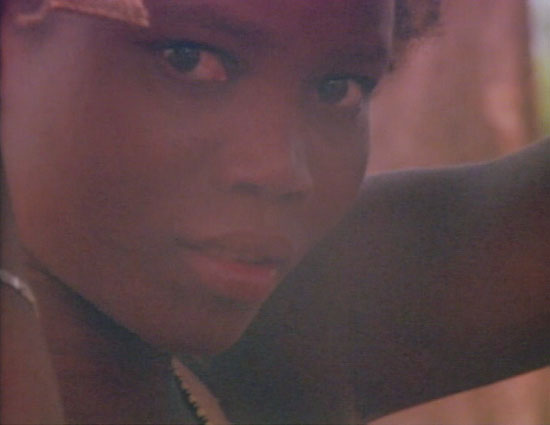
Black with ambient sound. Then shots of a rural scene in Senegal with silence. More shots with narration. More shots with ambient sound. More narration. Eventually, more black. The sound is rarely commenting directly on the visuals, and even the ambient sound rarely seems to line up. Shots of bare-breasted African women, daily chores, kids (two albinos!), youth playing in the river, and so on, with comments about ethnography. The commentary might make sense written down, but as we heard it, all scattered and edited (the sound editing was pretty poor), it seemed to circle around some points without managing to make any. Got nothing against the film, was fine to hang out in Senegal for a while. L. Thielan: “By disjunctive editing and a probing narration this ‘documentary’ strikingly counterpoints the authoritative stance typical of the National Geographic approach.”

Reassemblage:
image

First Comes Love (1991, Su Friedrich)
Pop music by the Beatles, James Brown, Willie Nelson and more, but someone please get this woman a cross-fader – it’s all so abruptly edited. The songs sometimes work really well with the images, though. Image is of four wedding ceremonies, astoundingly woven together into an ethnographic study of heterosexual marriage ceremony, interrupted by a text crawl of all the countries in which homosexual marriage is prohibited (every country but Denmark). Bell & Zryd: “This simple strategy, which contrasts the lush life of heterosexual ritual with the stark legal and constitutional realities of gay and lesbian relationships, reframes the anthropological text with political rigor.” Rigor isn’t something I look for in a movie, but avant-critics love to proclaim it. What rigor! Anyway, would like very much to see more of her work.

Girlpower (1992, Sadie Benning)
I hear the intro feedback of a Sonic Youth song and all is right in the world. Even though this movie (the shortest of the bunch, I expect) is a half-res crap-quality videotape, the music and narration are clear. About the narration – sounds like either a petulant girl or a woman in performance-art mode… an impressionistic video diary of disaffected youth, comfortable with herself but not with society. Aha, Benning was 30 at the time. Lotta shots of the television. Punk film, but with nicer sound editing than the Friedrich, weird. Short, enjoyed it. Ooh, she’s James Benning’s daughter.

Allures (1961, Jordan Belson)
I don’t know Belson very well, but this reminds me of my favorite parts of Norman McLaren and Len Lye, abstract animation set to music. Not frenetic, slow swirls and twirls, overlapped colored light patterns set to sparse music with dark electronic manipulation (composed by Belson and Oscar-nom musician/humorist Henry Jacobs). Must see again.
image
Allures (c) Jordan Belson

Finger-Fan (1982, Linda Christanell)
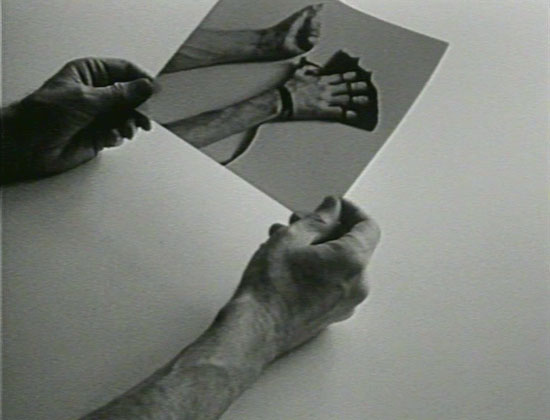
Austrian title is FINGERFÄCHER so I thought I’d get something racy for my lunch hour, but no, we’ve got some hands fanning out some fabric on a table… a finger-fan. Synopsis says “objects tell a random story – objects are bearers of obsessions-issuing energy as fetishes,” which might be badly translated or it might not… with the avant-garde it is hard to tell. Camera shoots some objects and photographs, a mirror re-directs part of the frame, there are some basic stop-motion and optical effects, and I remain unimpressed but lightly amused.
image

La Cravate (1957, Alejandro Jodorowsky)
Glad it was short, I couldn’t have taken much more of that accordian score. Goofy mimes swap heads at the head-swap shop while a guy with a silly tie tries to land a girl. Strong, bright colors. I guess the concept of swapping heads can be kind of dark, but otherwise this is like a kid’s fairytale compared to El Topo. Fun movie.
image

The House With Closed Shutters (1910, DW Griffith)
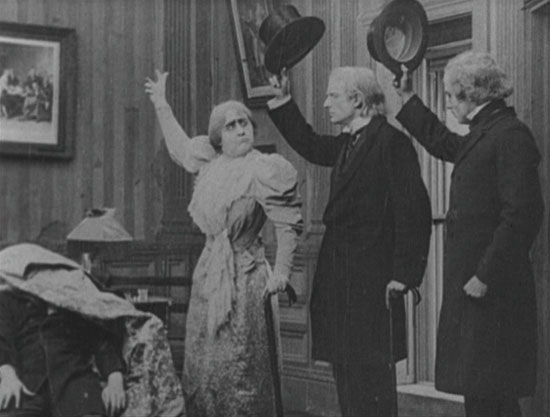
A Dixie-loyal young girl runs a message to the confederate front lines after her supposed-to-be-messenger brother comes home drunk and afraid. When she’s killed (because she was playing like a kid in no man’s land), their mother covers it up by acting like her son was killed and forbidding her “daughter” to ever leave the house or open the shutters. Decades later his old friends walk by the house, he swings the shutters open and dies from the shock.

Dead guy on chair (left) while his mother orders the friends to leave
image

Suspense. (1913, Lois Weber & Philips Smalley)
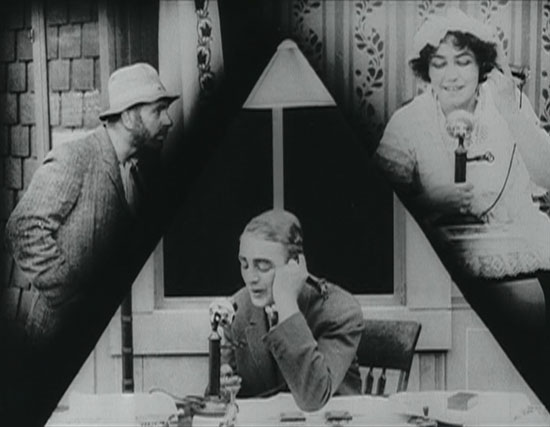
After the servant quits and leaves the key under the mat, a vagabond takes the opportunity to enter the house, eat a sandwich and stab the woman and her baby to death with a knife. Or he would – but she calls her husband who races home from work in a stolen car followed closely by the cops (who, as cops do in silent movies, shoot their guns constantly not worrying about the casual damage they might cause – not to mention that it hardly seems fair to shoot a guy dead for stealing a car). Worth watching for the titular suspense, and the reaction of the guy whose car the husband stole when he finally catches up and sees the wife & baby safe: a big “well whattaya know” shrug to camera and a pat on the husband’s back. Co-director Weber played the wife.

Sweet split-screen:
image

Return of Reason (1923, Man Ray)
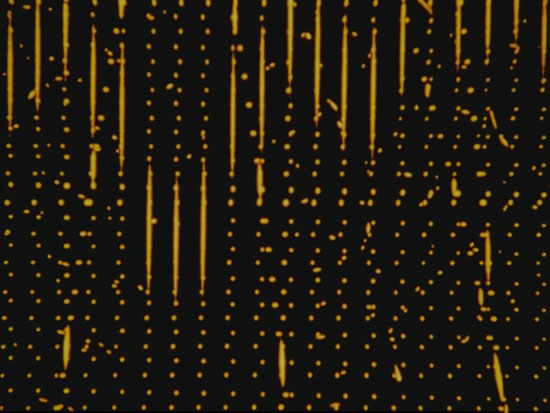
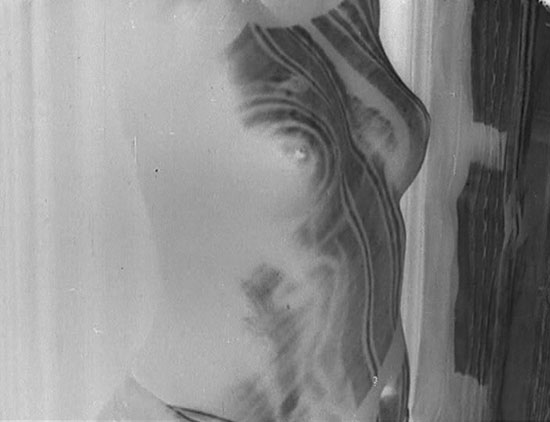
Whirling carnival lights at night, nails and tiny beads exposed directly on the film, a tic-tac-toe structure twirling on a string, all in stark black and white. Ends with negative image of a topless woman with psychedelic light patterns on her body.
image

The Starfish (1928, Man Ray)
A reputedly beautiful woman is shown behind distorting glass. A man holds a starfish in a jar. Terrifying close-up of starfish. Mirrors, split-screens and superimpositions. This is nice – how come poets don’t make movies anymore? Adaptation of a poem by Robert Desnos.

image

image

Emak-Bakia / Leave Me Alone (1926, Man Ray)
Twirling, swirling light patterns, spinning prisms, a girl with painted eyelids (paging Mr. Cocteau), broken dice, a tad of stop motion. The notes say Ray uses ‘all the tricks that might annoy certain spectators,’ and eighty years later he has annoyed me. Or maybe I’ve just watched too many of his movies in a row. I’d seen no films by Man Ray, then poof, I’ve seen half of them. Good stuff.

image

Oooh look, her painted lids are half-closed so you can see all four eyes:
image

The Life and Death of 9413: A Hollywood Extra (1928, Robert Florey & Slavko Vorkapich)
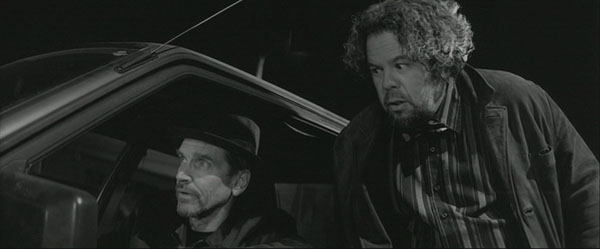
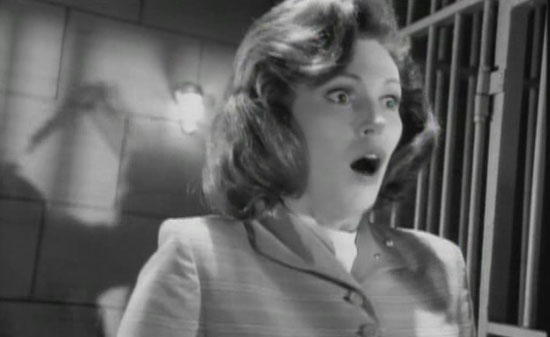
Far and away the greatest of these shorts. Intense shadowy miniatures interspersed with close-up photography of actors tells the story of a young hopeful actor defeated by the ruthless Hollywood star system. After he dies, he rises to heaven, where there is always open casting. A predecessor to Mulholland Dr.? Incredible-looking homemade film, very expressionist-influenced. Florey went on to direct 60+ features before moving to television, Vorkapich edited montage sequences for Hollywood films in the 30’s, and assistant cinematographer Gregg Toland shot Citizen Kane.

image

image

Rhythmus 21 (1921, Hans Richter)
“generally regarded as the first abstract animated film”, wow! Squares of light and dark get bigger/smaller, more complex patterns start to appear, pretty slow movement, never gets outrageously intricate, but if it’s the first film of its kind, it’s a great start.
image

Three Little Pigs (1933, Burt Gillett)
Musical short feat. “Who’s afraid of the big bad wolf” song. Great sound work by Carl Stalling. Uncle Walt did the voice of the brickhouse pig, one of only a couple credited non-Mickey voice roles. OMG, inside the brick house there’s a framed picture of sausage links on the wall with the caption “father”.
image

Mirror of Holland (1951, Bert Haanstra)
Greeeeat movie. He shoots reflections of Holland on the river, then flips the camera so they’re rightside-up. Looks for cool subjects and cool effects off the water. All woodwind and harp music, no narration, gorgeous. Didn’t know there was a golden palm for shorts at Cannes, but this won it.
image

Quiet As Kept (2007, Charles Burnett)
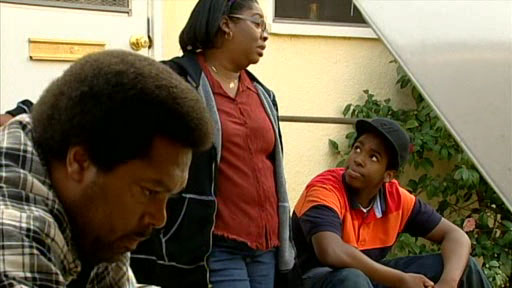
“That little-ass FEMA check sure don’t go very far”
Actors are real actorly, especially the kid (he’s in Ned’s Declassified). Video is real videoey. Script is real good, a sketch about a family of black New Orleans ex-residents post-Katrina, but the movie is ehhh. Oops, All Movie Guide calls it a documentary – bozos. Can’t find anyone talking about this online, probably because when Killer of Sheep came out on DVD, everyone got in line to praise it and didn’t want to look out-of-touch by talking about the not-great shorts it was packaged with.
image

Mr. Frenhofer and the Minotaur (1949, Sidney Peterson)
Distorted film of actors, string music, and voiceover, none of which has anything to do with the other. “To pose, or not to? I love him, I love him not? Or rather, since I love him less already, why not? An old man mad about paint, Frenhofer…” Yep, definitely from the same source as La Belle Noiseuse. “Once upon a time there was an old man who had been painting one painting for ten years. His name was Frenho… for what? … He started looking for a model to compare. All he wanted was the most beautiful woman in the world to prove to himself that his painting was more beautiful than any possible woman.” It’s all in here: Marianne’s man (also a painter) offering up her modeling services, Porbus the art dealer.

The script/narration is pretty swell but I wouldn’t be following if not for having seen the Rivette, and the visual is just nothing to me… a clock, a fencing match, cats, blurry nonsense, movie would be just as good with a black screen. Sorry, Sidney Peterson. Hmmm, at the end a fencer stabs the painter.
image

Eurydice – She, So Beloved (2007, Bros. Quay)
Very underlit ballet. Kinda dull. I preferred The Phantom Museum (and Dracula: Pages from a Virgin’s Diary).
image

Victory Over The Sun (2007, Michael Robinson)
Weirdly shaped monuments and the whispering wind. Would probably help if I could understand what the chanting people are saying. There’s some abstract 3D Animation thrown in. Towards the end goes into sound from some cartoon… Transformers? Some very familiar symphonic music. Pretty nice… I didn’t love it by any means, but I like it better than the disappointing Light Is Waiting.

Waaait, I looked this up online and found all sorts of stuff about it, something about being shot on the former sites of Worlds Fairs, but now I can’t find where I wrote that down.
image

The Wizard of Speed and Time (1979, Mike Jittlov)
Oh My God. This is three minutes of pure joy. Now that I have found this movie, I will watch it always. It’s my new The Heart of the World, using jaw-dropping stop-motion to express pure cinema love. The look is dated, but the music is swell, and Mike is a grinning god.
image

Andy: “Since the early 1960s, Nathaniel Dorsky has been one of the great practitioners of meditative cinema. Projected at the non-standard rate of eighteen frames per second (which he refers to as ‘sacred speed’), Dorsky’s films are an explicit invitation to increase our awareness of moment-to-moment existence and experience a sense of reverence for the visual world.”

Nice program with perfect-quality 16mm prints of four silent twenty-minute shorts. Gotta remember to attend all of Andy’s screenings from now on.

Alaya (1987)
The first one was just shots of sand. Just sand (one special appearance by an insect). No camera movement, but the sand is always moving, blowing in the wind. Goes from wide, wide shots of a huge desert (Death Valley) to extreme super-closeups, the sand crystals looking like boulders on the screen (but boulders that flit about in the breeze). An intensely beautiful movie, my favorite of the bunch.

Triste (1996)
Variations (1998)
The next two were similar to each other, and reminded me of Warren Sonbert (though I couldn’t remember Sonbert’s name until Andy announced that they reminded him of Warren Sonbert). Shots of varying length (8-45 seconds), extremely well-composed, of almost anything Dorsky came across: people, nature, the city. Second one was more exciting, with more quick bursts of shorter shots, and seemed to have a visual theme of seeing, looking, through glass and mirrors. Halfway through the first film the ceiling fan stopped making its rhythmic knocking sound which had made me think of the editing sounds in Zorns Lemma, so I had to imagine my own soundtrack (’twas TV On The Radio for a while). Fun and difficult to try to figure out relations between the shots while watching.

The Visitation (2002)
Then came a discussion, during which Andy talked about film stocks (these were all made on a Bolex, just like Sonbert) and mentioned that of course the second movie was called Triste, which means “sad”, which is why it felt like a lull, edit-wise, between exciting films. There’s all this hidden meaning in these films which the simple likes of ourselves can never understand. I don’t like being made to feel stupid by avant-garde filmmakers so I was determined to assign meaning to every last shot in the bonus fourth movie The Visitation, and I succeeded easily. Visitation = alien invasion. Lots of shots of light from above, and representations of alien bodies (mostly tentacles, via cords and long plant leaves). Aliens have many eyes – we see the eyes, and their view of our world. Ends with a gorgeous shot representing their planetary invasion, two low waves approaching each other over sand, the alien wave easily covering the human wave, but the human wave slowly fighting back at the end, regaining victory. A lot like War of the Worlds.

“A gradual unfolding, an arrival so to speak. I felt the necessity to describe an occurrence, not one specifically of time and place, but one of revelation in one’s own psyche.” -N.D.

Thanks to Andy, I finally had the chance to see one of the most talked-about avant-garde films of all time. While it’s important to talk about experimental film, it’s more important to actually see the damned things – and while anyone can order a copy of Visionary Film for $26.95, it’s nearly impossible to see Wavelength on any given day.

Unfortunately, it’s one of those times (see also The Leopard) when I check out one of the Great Important Works of Cinematic Art and come out less than impressed. I didn’t find the audiovisual experience very enlightening compared to the descriptions I’ve read of the film. Didn’t dislike it (though I came close to disliking the soundtrack) but not an overwhelming experience like Zorns Lemma, either. A few updates to those written descriptions: (1) It’s not a single, continuous zoom a la Last Days – the zoom moves sporadically and the camera slightly changes position from time to time. (2) There’s sound – a sinewave tone that starts low and ends high, with other quieter tones joining it at times and sync sound during the four action scenes. Those action scenes: Woman gets bookshelf delivered, two women listen to “Strawberry Fields Forever”, man dies, girl makes phone call expressing concern that there’s a dead man in her apartment. (3) There’s a twist ending – after zooming the full length of the apartment, the photograph on the wall is of waves in the sea. I get it, ha ha. After reading Sitney and Snow, I see why the movie is interesting, even exciting in theory, but the viewing experience just wasn’t there… wouldn’t want to see it again anytime soon.

P. Adams Sitney: “This is the story of the diminishing area of pure potentiality. The insight that space, and cinema by implication, is potential is an axiom of the structural film.”

Snow: “I wanted to make a summation of my nervous system, religious inklings, and aesthetic ideas. I was thinking of planning for a time monument in which the beauty and sadness of equivalence would be celebrated, thinking of trying to make a definitive statement of pure Film space and time, a balancing of ‘illusion’ and ‘fact,’ all about seeing. The space starts at the camera’s (spectator’s) eye, is in the air, then is on the screen, then is within the screen (the mind).”

Hollis Frampton: dead man:
image

Actors included Joyce Wieland and Hollis Frampton (as the man who dies). Assisted by Ken Jacobs, and sound by Ted Wolff, who unsurprisingly didn’t do any other film sound after this. Snow screws with the camera a bunch: focus, filters, film stocks (supposedly – I hardly noticed), light settings, time of day and lighting inside, etc. My favorite part is one or two frames where the picture on the wall towards which we are slowly zooming is highlit by a sunburst of drawn lines (screenshot below). I’m glad I got to see it anyway, and glad Andy played this and not Warhol’s Empire or something.

image

When I got home, watched WVLNT (2003) and Prelude (2000). The former was a shortened version of Wavelength “for those who don’t have the time” – he cut the movie into three equal parts and superimposed them. Except for the now-intolerable soundtrack, I liked this version much better! There’s much more to look at.

image

Prelude was a cute intro bit from the same Toronto Film Festival that brought us The Heart of the World. It’s hard for me to tell exactly how cute since my copy is such low-quality (think it came from streaming realvideo on the TIFF site), but it seems to be a single camera take, clean picture on a clean set, with unsynched sound edited in all over the place – actors and film crew talking about films in general and the one they are presently inside. This and WVLNT travel a similar road as Snow’s SShtoorrty, with its color-coordinated set, single camera move and superimpositions.

image

Gymnopedies (1965, Larry Jordan)
An egg floats around on different backdrops interacting with various objects, all cut-out animation a la Gilliam or Borowczyk, set to calm piano music. Feels more like a proof of concept than anything else – if there was a narrative present, I didn’t catch it. Cute, though.
image

Lipstick (1999, Pascal Aubier)
Single 6-minute shot beginning under a bed, unsubtitled. Family is getting ready to leave for a trip, the mother is briefly visited by her lover who comes in through the window. Aubier was assistant director on some French New Wave classics in the 60’s, now an actor and a director of (mostly) comic shorts. Liked this a lot (and not only because of the naked dancing), will have to check out more of his stuff.
image

Ark (2007, Grzegorz Jonkajtys)
Iffy-looking 3D animation tells apocalyptic story with a twist ending. Our guy wasn’t really the lead scientist onboard an ark of the last surviving humans searching the oceans for new land, just a crazy old man in a convalescent home. Ha! Bah.
image

Happy-End (1996, Peter Tscherkassky)
Found footage of a couple sitting down for dinner, toasting the camera, drinking… and drinking and drinking! Dancing, drinking, sitting, more drinking. Different days, different clothes, edited together, eventually with scenes superimposed atop each other, a haunted distortion of a French pop song as the soundtrack.
image

Two Solutions To One Problem (1975, Abbas Kiarostami)
Very short with narrator, two kids get in a fight over a torn book. We tally the damages then rewind, and instead of starting a fight, they help repair the book and remain friends. Nice.
image

Blah Blah Blah (2006, Dietmar Brehm)
Liquor bottles. Close-ups of objects with strong textures, overexposed porno, an action film in extreme-fast-forward, long pause on an ashtray, back to the liquor bottles, etc. Audio is a quietly rainy/windy day with a metronome hit every three seconds. Looks like old 8mm or 16mm color with some monochrome sections. Pretty alright, probably better in a theater surrounded by like-minded shorts instead of following up a cute Kiarostami piece.
image

A Girl, She is 100% (1983, Naoto Yamakawa)
Wow, that wasn’t very good at all. They must’ve thought it’d be the simplest Haruki Murakami story to film. Straightforward, with some good still photography and some bad acting by our IMDB-unknown hero, closing with some rockin’ 80’s music.
image

Foutaisies (1989, Jean-Pierre Jeunet)
Young Dominique Pinon with 80’s hair tells us about the things he likes and does not like. Very Amelie-feeling, with Delicatessen opening titles (and Deli‘s lead actress).
image

image

image

The Hitman (2001, Ruben Fleischer)
Mary Lynn Rajskub decides to be a hitman, but her first mark (Paul F. Tompkins) decides not to go through with it and asks her out instead. Just your typical indie comedy short. From the director of Girls Guitar Club, whose film career didn’t take off, I guess.

What Is That (2001, Run Wrake)
Buncha funny animated business involving insects and meat and ringing sounds. Cute, but only three minutes long and pretty inconsequential… not up to Rabbit level. Guess it’s an early work.
image

Film Noir (2005, Osbert Parker)
Awesome, very short. Like Fast Film but slower. Some After-Effects-lookin’ animation combined with models and lots of cutouts – not trying to tell a story, just cool visuals/mood. Ahhh, the internet reveals that it was all created in-camera – impressive!
image

image

image

Banquize (2005, Claude Barras)
Boyer’s French Dictionary: “banquize – heap of floating ice frozen together in close masses.” Might be called Banquise, actually. Simple animation, fat kid wears his snow clothes in summer, dreams of living on banquize and playing with penguins. One day trying to hitchhike there he drops dead from heat/dehydration. Hmm.
image

Herakles (1962, Werner Herzog)
Herzog’s very first film, six years before his first feature. This was really good, and not like anything else I’ve seen by WH. Pretty simple structure so I’ll let wikipedia take it below.
image

The film relates to six of the twelve labours of Heracles. The film starts with shots of young male bodybuilders working out in a gym, posing on a stage and flexing their muscles. Each of the labours are then announced by on-screen text in the form of a question, followed by related scenes of modern challenges intercut with the bodybuilders. The audio track of the film is saxophone jazz and sounds from a gym.

The question “Will he clean the Augean stables?” is followed by scenes of a garbage dump, “Will he kill the Lernaean Hydra?” is followed by a huge line of stopped traffic on a motorway and people walking around outside their cars, “Will he tame the Mares of Diomedes?” is followed by scenes of car racing and several race crashes including a crash into the spectators and shots of the subsequent disaster and piles of bodies, “Will he defeat the Amazonians?” is followed by scores of young women marching in uniform, “Will he conquer the giants?” is followed by shots of rubble of a destroyed apartment building and men in uniform searching the wreckage, “Will he resist the Stymphalian birds?” is followed by jets flying in formation, shooting missiles and dropping bombs on training targets. The last shot of the film is of a bodybuilder’s buttocks as he goes off the stage through the stage curtains.

image

Matta (1985, Chris Marker)
“What I am showing here is no exhibition. It is an appeal: Come and play with me! It’s a very lively game, but nothing happens.” Simple interview with Chilean artist Matta (not surprisingly an Allende supporter), an original member of the surrealist group, talking coherently about his art and all art, human beings, dimension and meaning. Would be nice to get/make a transcript. Would be even nicer to have been able to see the Matta paintings that Marker frames him against, but my video was too low-quality to make out much visual detail.
image

Experimental shorts program at the Nashville Film Festival. Below in italics I’ve quoted their online program notes for each film and added my thoughts in regular text. Unfortunately my memory is very bad and I was neither taking notes nor concentrating on remembering details during the screening, just getting lost in the films, so my thoughts might be wrong or meaningless. I will say it was a cool program, a little saggy in the middle/end but mostly high-quality work, very enjoyable. Most of these were on video, but not the first few I don’t think.

Olivo Barbieri’s Sevilla (06) (Italy 2006,13 min.) is a tale about the perception of Europe in Africa…from the vantage point of an airplane.

Deceptive to call it a “tale” since it’s non-narrative. Also I thought it was from a helicopter – there are helicopter noises on the soundtrack (along with harsh electronic sounds coinciding with some edits, mostly near the beginning and end). I struggled throughout this one to tell if it was out-of-focus, if my eyes had gone funny, or if it’s just supposed to look that way. Didn’t know what city I was ever in, assumed Sevilla, Spain. Whether caused by the focus effect or not, it looked very much like models, a giant, detailed model city, until I’d see traffic moving. Think I liked it, anyway a nice way to start the program. I still remember the percussive music, but I bet I won’t the next time I read this. How to describe music?

Combining live action, stop-frame animation and a kinetic sculpture, Harrachov (Matt Hulse, Joost van Veen, Netherlands 2006, 10 min.) explores the effect of an arcane force that, like a black hole or an immensely powerful electromagnet, exerts a far-reaching and irresistible power upon certain objects and materials, willfully seducing, centralizing and internalizing them.

Junk moves across uninhabited ground towards a sinister shed, pulled by unseen strings, magnets, animated by stop-motion or simply tossed and rolled. Very cool movie, black and white, really brought to life by the great sound effects. We never see the final assembled creation, unless it was obscured in darkness or I blinked and missed it, but it’s shown on the website:
image

In The Drift (Kelly Sears, USA 2008,9 min.), a mysterious disappearance on a space journey gone awry launches the counter-cultural revolution at the end of the 1960s.

Not quite slow-zooms on still 1960’s photos, because slight motion is added to the “photos”. This one had a story and a voiceover, unusual for the program, and the woman next to me whispered “was that experimental?” From the director’s website statement: “The Drift uses frame-by-frame techniques to weave an absurd fable about our country’s unflinching frontierism and the desire to push too far, too fast. Images dug out of thrift store bookshelves and flea market bins are animated to create an alternate take on what really happened behind the face of ground control, the space program, and the American psyche.” A cool little movie about a contagious space-disease, certainly better than The Astronaut’s Wife. The drift theory would probably answer some of Werner Herzog’s questions about the inhabitants of Antarctica.

Sera Sera (John Murphy, USA 2007, 3 min.) sets atomic-bomb-testing footage to a reggae-ized version to hypnotic effect.

Director was in attendance but I had to haul ass to Phantom Love (which it turns out was cancelled, so I could’ve stayed, sorry Mr. Murphy, and sorry also for not being able to remember your film clearly but I do recall that it was short and felt like a good music video and that’s not an insult because I like a good music video). Come to think of it, the music was a trippy “que sera sera” remix. Wait, it’s coming back to me, 60’s footage treated with Tscherkasskian film-off-the-rails effects.

With water imagery as the foundation, Number One (Leighton Pierce, USA 2006,11 min.) engages the experience of elasticity between varying states of mind.

A flowing, sometimes symmetrical composition with a sliver of image in the center, and mirrored or continuous images on the left and right. And sometimes it’s something else entirely. Put me in a happy mood. Can be bought in digital form from the iTunes store.

Dig (Robert Todd, USA 2007, 3 min.) is a constricted frame in agitation, with the sweet music of jackhammers raging throughout – with intermission.

Haha, Mr. Todd, the “sweet music of jackhammers,” I get it. A desperately irritating movie about the annoyance of road construction. Actually, it’s pretty cool visually, rapid-rapid-fire shots of painted road markings spinning and sliding – would watch it again with the sound turned off. This is when people started walking out, about 3-4 per film from now until the end.
image

Kip Masker (Maria Petschnig, Austria 2007, 3 min.) disguises body parts in altered pieces of clothing to create semi-abstract compositions that defamiliarize the human form.

J. Schaffer says: “Soft, strained breathing accompanies the picture, intermixed with the occasional crackling of latex. From the start, I am faced with the task of disentangling the compositions magnified on screen: a hole purposely cut into a white bra with a shoulder muscle swelling over the seams? A white supporter for a packer (a silicone penis), worn the other way around?” And so on. I actually got and appreciated the intention of this film, a rarity for me. People next to me didn’t like it one bit.

The Green Bag/Documentary Happens (Tim Sharp, Austria 2007, 7 min.) is a single take, real-time documentary shot from the terrace of the Circle Hotel restaurant in Gondor, Ethiopia. While it allows a brief look at the density and multiplicity of everyday interactions taking place around the camera, the film also stimulates questions related to defining the essence of what documentary film is as a cultural artifact.

I was mesmerized by a green plastic bag blowing in the wind… dancing with me. Just kidding, I was actually bored to tears by this dull documentary by Wes Bentley, errr Tim Sharp. It stimulated questions like “when will it end?” and “how many more people will walk out?” Movie had a stunt ending: the appearance of a different-colored plastic bag. A different bag! Reminded me very much of Hidden In Plain Sight. Apparently there’s a new trend in filming stuff nobody cares about and calling it an experimental documentary. Paging Andy Warhol…

With super high-speed cinematography, reminiscent of adored science education films from our childhood, gun fetishization is taken to a surrealist extreme in Kogel Vogel (Frederico Campanale, Netherlands 2006, 6 min.).

Gun shoots bullet through glass in super-slo-mo – whoosh! Liked it, but not much there besides art-i-fying those mentioned education films.

In Ariana Gerstein’s 96 (USA 2007, 7 min.), the space between being 90 and 6 is always shifting in this moving picture portrait.

Something about photographs and a little girl? I don’t remember! I think the sensual overload of the next film acted as a memory-blanker.

Daddy I’m Scared (Tijmen Hauer, Netherlands 2006, 4 min.) is an iconoclastic video piece consisting of thirteen different children’s cartoons layered on top of one another, transforming their innocent qualities to an aggressive and mesmerizing inferno of image and sound.

Almost interesting, but the clips don’t seem to be meaningfully combined, just thrown atop each other to form a red-tinted fiery Disney nightmare. I recognized Aladdin by sound and Hunchback by visual. It was short at least.

In Light Is Waiting (Michael Robinson, USA 2007, 11 min.), a very special episode of television’s Full House devours itself from the inside out, excavating a hypnotic nightmare of a culture lost at sea.

The one I’d been looking forward to (and the reason I didn’t wander away unhappily during the green plastic bag doc) didn’t quite live up to expectations. Funnier as described to me than to actually watch. Excerpt of a Full House ep (which Katy remembers) where they drop a TV from a great height turns into SCREAMING BLINKING PAIN turns into a mirrored, folding-in-upon-itself color-tinted noisy nightmare, an extreme slow-mo excerpt from a different episode on some fantasy island (which Katy also remembers). Good move equating Full House with shrieking hell, but not actually much fun to watch. I want some Peter Tscherkassky, please.

NAFF says: “We celebrate their 45th birthday with this meticulously-chosen collection selected and introduced by Canyon Cinema’s executive director Dominic Angerame.” I don’t know what it means to be meticulously chosen. I mean, I assume Dominic is well familiar with Canyon’s films and he might’ve agonized over the selection, wondering how best to artistically and effectively represent his company’s holdings. Anyway, it was a very good selection, but NAFF could’ve been more meticulous with the presentation, misthreading one film which caused delays during which half the audience left early. But let’s face it, half the audience always leaves early during avant-garde film presentations. On with the descriptions… italic text is quoted from NAFF’s descriptions, regular text is from me.

Alone. Life Wastes Andy Hardy (Martin Arnold, Austria 1998, 15 min.), where Arnold remixes several clips of a Mickey Rooney/Judy Garland Andy Hardy film to form an erotic Oedipal musical.

I talked briefly about this one here and here. Seeing again on a giant screen in a nice theater with a packed audience was rewarding. Lots of laughter when people caught onto the oedipal/sexual jokes. Brilliant movie and concept – still one of my favorites.

Autumn Leaves (Donna Cameron, USA 1994, 6 min.), where the splendor and pleasures of autumn are the focus of this richly textured and brilliantly colored paper emulsion film.

I don’t remember it! I know I liked it – I liked all of these, but I do not remember in what specific ways I liked it. A shame, possibly.

China Girls (Michelle Silva, USA 2006, 3 min.), a short composition of women posing for skin tone and color slates used in film leaders that reveal some skin and the aesthetics of their day through film stocks and fashions.

Didn’t love this one, actually – all slates and countdowns and blips and test patterns. I see that stuff at work all day. I mean, yeah they were vintage test patterns with subliminal shots of women with carefully-maintained hairdos. A minute longer might’ve been too much, but this was harmless, probably of interest to someone else.

Delicacies of Molten Horror Synapse (Stan Brakhage, USA 1991, 10 min.), where four superimposed rolls of hand-painted and bi-packed television negative imagery are edited so as to approximate the hypnagogic process whereby the optic nerves resist grotesque infusions of luminescent light.

I mentioned this one previously here. Silent and gorgeous. Audience didn’t rustle around or yawn loudly or start to leave – they liked it too! Some of the multi-layered visuals are television images, and given the “molten horror” title you’d expect something like Light Is Waiting, but thankfully that’s not what you get.

Eaux D’Artifice (Kenneth Anger, USA 1953, 12 min.). Filmed in the gardens of the Villa D’Este in Tivoli, Italy, and accompanied by the music of Vivaldi, Camilla Salvatore plays hide and seek in a baroque night-time labyrinth of staircases, fountains, gargoyles, and balustrades.

Covered this one here. Light through water!

Ellipses (Frédé Devaux, France 1999, 6 min.), where a ripped strip of film is sewed back together following an aesthetic mode, in a celebratory end-of-century apocalypse of positive, negative, super-8, regular-8, black and white, color, saturated and faded found footage.

Oh god, I don’t remember this one either!

Georgetown Loop (Ken Jacobs, USA 1997, 11 min.), a reworking of 1905 footage of a train trip through the Colorado Rockies, where the original image is mirrored side by side to produce a stunning widescreen kaleidoscope effect.

Opens with the original film (discussed here) on the right half of a wide screen, kind of unnerving, then gloriously mirrors it onto the left. Images don’t overlap over themselves like in Light Is Waiting, but vanish into the center line, expanding and contracting, the train’s always-curving motion making it constantly split and merge. But it’s kind of an easy trick, doesn’t seem worth being called a great film, or even very “experimental.” I’m guessing they wanted to show something by big-name artist Jacobs and this was his shortest film?

In Kaleidoscope and Colour Flight (Len Lye, 1935/1938, 8 min.), Len Lye, pioneer kinetic artist, sculptor and experimental filmmaker, painted colorful designs onto celluloid, matching them to dance music.

Zowie wow, these are electric. They start out all hoppin’ jazz, colors and shapes and stripes and light and love, all in fast motion to the beat, then about three minutes in when you least expect it, they hit you with a cigarette ad. More, please!

Psalm III: Night of the Meek (Philip S. Solomon, USA 2002, 23 min.), a meditation on the twentieth century at closing time. Psalm III is a kindertotenlied in black and silver on a night of gods and monsters…

I guess it’s scenes from other films turned grey and treated with a heavy emboss filter. Often no recognizable details, then they’ll emerge suddenly from the murk. We see some nazi imagery at one point, pretty sure I saw Frankenstein a few times, and little Elsie’s balloon from M caught in the power lines. Longish, but nice, enjoyed it. Can’t remember the audio at all.

Wonderful 16mm screening at Emory, but not well-received by the students and regulars who came to be entertained. Silly students and regulars, it is not a university’s job to entertain you!

Scorpio Rising – 1964, Kenneth Anger
Couldn’t remember if I’d seen this before, but of course I have… opening credits bedazzled onto a motorcycle jacket were immediately familiar. Despite the nazi imagery and comparisons between bikers headed for a gay orgy and Jesus and his disciples, I heard no complaints. I think people enjoyed the juxtapositions (well-prepared presenter Andy warned us about ’em in advance) and grooved on the hot 60’s rock radio score (kept hearing “oh I love this song” from behind me).

Lemon – 1969, Hollis Frampton
Lovely film, second time I’ve seen it. Should be shown every year. Only comment overheard: “I don’t know about the second movie. Just a lemon.” Mostly people were quiet about this one. I choose to believe that they were awed into silence, contemplating its light play and imagining possible deeper meanings, and not quietly wondering what they needed to pick up at the grocery store. A movie can feel much longer or shorter than it is. Lemon is supposed to be seven or eight minutes long, but I say it feels like four, five tops.

Zorns Lemma – 1970, Hollis Frampton
(no apostrophe, in tribute to James Joyce’s Finnegans Wake)
Okay, this one feels its length… its exact length, measured second by second.
1) Black screen, voice reads us some children’s poetry, each line beginning with a successive letter of the Roman alphabet (so I=J and U=V) to make 24.
2) The meat of the piece, 24 seconds, one letter per section. First section we see each letter once. Then a word beginning with each letter. Then again (different shots, different words). Again. Again, but X has been replaced by a shaking, roaring fire. Again, with the fire. Again. Again. Again, but Z has been replaced by the ocean, flat horizon, a wave rolling out to sea. Again with the fire and the ocean. Again. 24 letters at 24 frames per second (though it’s 25 seconds if you consider that each alphabet section is followed by a second of black, a shout-out to our PAL-locked buds in Europe who see everything on video a little faster than we do). And on until, some 40 minutes later, each letter has been replaced (C was the last to go). No audio except the groaning and laughter of my fellow filmgoers.
3) Sound and Vision together! A visual cooling-down after part two, two people and their dog walk across a snowy field from bottom of the screen to top as six alternating female voices on the soundtrack read us some philosophical writings about light – at precisely one word per second.
4) The audience members (those who hadn’t walked out) were horrified!

D. Sallitt liked it:

The bizarre experience of taking a test during a movie was completely distracting, so that I absorbed the materiality and the narrativity of the alphabet images only indirectly, during brief rest periods. Somehow this strengthened my investment in the images: I don’t think I would have found the “letter H” guy’s walk around the corner very interesting in itself, but that corner took on mythic spatial qualities for me.

Hahaha, I know what he means about the corner. Of the little movies that replace each letter, seen in one-second increments, some stay pretty much the same (the fire, the tide) and some progress as time passes (someone peels and eats a tangerine, this guy walks towards a corner). Everyone breathes a little sigh of relief when, finally after a half hour, the man disappears around the corner in a one-second bit toward the end. Next bit is just the corner. Next one the man comes back around the corner! Must be considered one of the biggest twist endings in non-narrative avant-garde cinema.

excerpts from S. MacDonald:

Even a partial understanding of Frampton’s films requires a rudimentary sense of the history of mathematics, science, and technology and of the literary and fine arts. … Nowhere is Frampton’s assumption that his viewers can be expected to be informed, or to inform themselves, more obvious than in Zorns Lemma, the challenging film that established Frampton as a major contributor to alternative cinema. Zorns Lemma combines several areas of intellectual and esthetic interest Frampton had explored in his early photographic work and in his early films. His fascination with mathematics, and in particular with set theory … is the source of the title Zorns Lemma. Mathematician Max Zorn’s “lemma,” the eleventh axiom of set theory, proposes that, given a set of sets, there is a further set composed of a representative item from each set. Zorns Lemma doesn’t exactly demonstrate Zorn’s lemma, but Frampton’s allusion to the “existential axiom” is appropriate, given his use of a set of sets to structure the film. Frampton’s longtime interest in languages and literature is equally evident in Zorns Lemma. …

The tripartite structure of Zorns Lemma can be understood in various ways, at least two of them roughly suggestive of early film history. The progression from darkness, to individual onesecond units of imagery, to long, continuous shots. … If the second section of Zorns Lemma is Muybridgian – not only in its general use of the serial, but because the one-second bits of the replacement images “analyze” continuous activities or motions in a manner analogous to Muybridge’s motion studies – the final section is Lumieresque.

As set after set of alphabetized words and their environments is experienced, it is difficult not to develop a sense of Frampton’s experience making the film. The film’s collection of hundreds of environmental words suggests that the film was a labor of love, and an index of the filmmaker’s extended travels around lower Manhattan, looking for, finding, and recording the words.

For most viewers the experience of “learning” the correspondences is fatiguing – especially since the process of watching sixty shots a minute for more than forty-seven minutes is grueling by itself – but the laborious process has been willingly (if somewhat grudgingly) accepted. The experience of learning the correspondences is the central analogy of the second section. It replicates the experience of learning that set of terms and rules necessary for the exploration of any intellectual field.

In a philosophic sense, Grosseteste’s treatise [spoken during the third segment] is an attempt to understand the entirety of the perceivable world as an emblem of the spiritual. And, on the literal level, what Grosseteste describes in the eleventh century is demonstrated by the twentieth-century film image: For a filmmaker, after all, light is the “first bodily form,” which, literally, draws out “matter along with itself into a mass as great as the fabric of the world.”