Endless, rambling bio-pic about a theater producer who always planned bigger shows than he could afford, with enthusiasm that proved contagious to financial backers. Semi-falsely billed as a William Powell/Myrna Loy movie, since she plays his second wife, appearing in the last half hour of the three-hour movie. Good scenes (especially the lavish musical numbers) and acting, but the story is bloated with details from Ziegfeld’s life that just aren’t necessary to the plot or character, starting with an opening scene with his father and a little girl (who returns hours/years later to dance in one of his shows, but so what).

Powell was between The Thin Man and its first sequel. He runs a circus act with strongman Sandow (Nat Pendleton of two Thin Man movies), then marries his star Anna Held (Luise Rainer, winning back-to-back oscars with this and The Good Earth) after moving to Broadway shows. Anna carries her whole show, but Ziegfeld wants to do something bigger (he gives the impression of having a short attention span), so he starts the Follies, a musical comedy variety show that changes every year. Some ups, some downs, he seems washed up then opens four Broadway hits at the same time, then falls broke/sick/dead when the market crashes.

Myrna Loy’s character is Billie Burke, the good witch of The Wizard of Oz, and Frank Morgan (Ziegfeld’s main friend/rival) played The Wizard himself. Surprisingly, Will Rogers was dead and that was a Will Rogers impersonator in his scene.

Written by one of Ziegfeld’s main show writers. Won best picture and actress (Luise Rainer). Frank Capra, The Story of Louis Pasteur and Dodsworth took the rest. Got a semi-sequel in Ziegfeld Girl, also by Robert “Ziegfeld” Leonard with Busby Berkeley (it’s shorter, with Judy Garland = probably a better movie), and the music and comedy revue Ziegfeld Follies, featuring Powell as the dead Ziegfeld.

The movie is divided into sections. Three are adaptations of Mishima novels with autobiographical elements, and they’re tied together with interspersed b/w newsreel-like reenactment of Mishima’s final day (starring Ken Ogata, lead killer in Vengeance Is Mine), with some flashback footage of his youth. It’s an excellent approach to cinematic biography, though I suppose it wouldn’t work on everybody. Philip Glass, who introduced the film at Emory, provides a varied score (less driving lock-grooved than his others).

This would seem like a weird choice for Schrader to follow American Gigolo and Cat People, but he’s apparently a longtime fan of Mishima and of Japanese cinema. His sister-in-law is Japanese and wrote the dialogue. I’m sure he explains all on the Criterion commentary – that DVD has got hours of fab-looking extras.

The Temple of the Golden Pavilion: clubfoot student Koichi Sato pals with stutterer Yasosuke Bando, teaches him to exploit his disability in order to score with chicks. It works, and Miss Universe contestant Hisako Manda gets nude, but this is not to the stutterer’s liking, and he decides to destroy everything that is beautiful.

Kyoko’s House: Young man (Kenji Sawada) becomes obsessed with bulking up through weight training. He finds out his mom is deeply indebted to a dangerous loanshark, so he sells himself to pay his mom’s debts, and the two become locked in a spiraling sadomasochistic relationship ending in double suicide.

Runaway Horses: Pro-Emperor militant cult leader Isao (Toshiyuki Nagashima) plans an attack on the government but they’re arrested before they can carry it out. Isao escapes, kills one of the targets (Jun Negami, who appeared in the Mishima-starring Afraid to Die) on his own, then performs seppuku before the rising sun.

Mishima’s actual words are used as narration, in Japanese by Ken Ogata in the restored version, which is what we saw. English-release narrator Roy Scheider later appeared in Naked Lunch, another movie that mixes a novelist’s biographical details into his work.

Matt Damon is Scott, who gets introduced to Liberace (Lee to his friends) by laid-back mustache dude Scott Bakula in the late 1970’s, beginning an affair/family/employee situation that lasts until Lee (Michael Douglas) finally kicks out Scott in favor of a new, younger, less-drug-addicted, less-contentious boy. It comes full circle from when Scott replaced gloomy pretty-boy Cheyenne Jackson (Danny, the new cast member on 30 Rock) at Lee’s house. Liberace dies of AIDS, but Scott is cut out of the will, Lee’s verbal promises not carrying any legal weight, so Scott writes a tell-all memoir.

Performances are great, storytelling is effective, costumes and period details are spot-on, but it can’t break out of the “bio-pic based on tell-all memoir” genre. A squinty Rob Lowe is the highlight as a plastic surgeon who makes Douglas look younger and Damon look weirder with shiny cheeks. Dan Aykroyd plays Lee’s manager and Debbie Reynolds (Tammy and the Bachelor, Susan Slept Here) his mother. Adapted from Scott’s book by Richard LaGravenese (The Fisher King).

A. Cook: “I don’t know if any other American filmmaker is more inventive right now with choosing where to place the camera, how to frame the image, how to use focus, etc.” I get what he’s saying – in this and Haywire and Contagion I notice unusual editing and shot choices – but the movies’ standard Hollywood storytelling and starpower get in the way. If I was dedicated enough, I might rewatch Haywire paying attention only to its framing and technical qualities, but maybe instead Soderbergh needs more interesting scripts to go with his artistic filmmaking intentions – The Informant being a good example.

“A comic strip in 7 episodes on the life of Richard Strauss 1864-1949” Strauss is played as a power-hungry megalomaniac by Christopher Gable (also of Russell’s Tchaikovsky film The Music Lovers). The film itself is fanciful and alive, and surely one of the best biographic movies I’ve seen.

image

Only two years after 2001: A Space Odyssey, Russell accompanies that film’s big opening song with shots of a caveman who soon runs into religious mania and screaming nuns (both of which would be rampant in The Devils the following year).

image

“Alas, the time is coming when man will give birth to no more stars. The dead end of mankind is approaching.” I could quote every line and display stills from every shot. This seems way too extravagant to be a made-for-public-television movie, and too good to be a long-censored rarity. Only ten years until this can be shown legally despite the Strauss family’s objections, unless copyright law is extended like it always is.

image

We get a love triangle in the box seats at the opera, scenes of Macbeth, Don Quixote, a fun Salome with two lead actresses, and the infamous garden party with the nazis. Yes, the film does feature Strauss giving Hitler a piggyback ride, both of them grinning and playing violins. Various fantasies, both nightmarish (Allied soldiers interrupt Strauss’s innocent mountain vacation and murder his family) and wishful (his glorious music pounds critics into submission).

image

Kenneth Colley (Jesus in Life of Brian) – the only actor to play both Jesus and Hitler?
image

“A life completely away from politics and war – that is what I’ve always longed for.” Ends with a speech by an aged Strauss distancing himself from the nazi party, “There’s no stain on my character. These nazis are criminals, I’ve always known that.” But a minute later complains about “Jewish stubbornness” before catching himself. Russell partly credits Richard Strauss with scenario/dialogue, saying he used the man’s own words in the script. A scathing portrayal.

image

IMDB has incomplete credits. Judith Paris (a nun in The Devils) played Strauss’s wife Pauline, Vladek Sheybal (camp classic The Apple, Russell’s Women In Love) was Goebbels and Imogen Claire (appeared in and choreographed Lisztomania) was one of the two Salomes.

image

Tape number at top of screenshots provided so the BBC can locate their tapes and release this properly. Timecode (below) provided so you can easily find your favorite scenes. Thank me later.

The MBC:

The complete title reveals Russell’s intention to create a satirical political cartoon on the life of the German composer, who Russell saw as a “self-advertising, vulgar, commercial man . . . [a] crypto-Nazi with the superman complex underneath the facade of the distinguished elderly composer.” And, although, according to Russell, “95 percent of what Strauss says in the film he actually did say in his letters and other writings,” many critics and viewers found Russell’s treatment of the venerated composer itself to be vulgar.

Somewhat-funny comedy with some good moments, but mostly made me wonder when it would be over. Did not leave in a good mood, and things only got worse from there.

Tim Meadows was the funniest part. Harold Ramis funny too. Dewey Cox’s love interest is in the American “Office”. Everyone’s favorite scene was Dewey’s meditation with The Beatles: Jason Schwartzmann, Jack Black, Paul Rudd and Justin Long (of “live free die hard”). John C. Reilly good, but not awards-good.

Katy liked the songs.

Another quizzical music biography by Mr. Haynes. Someone said that any of his music movies (“Karen Carpenter Story”, Bowie doc “Velvet Goldmine”) could be titled “I’m Not There”. Dylan is actually there, playing harmonica in close-up at the very very end.

Dylans:

Rimbaud / in interview room giving evasive answers / guy from “Perfume”

Woody / train-hopping authentic-sounding blues kid actually a runaway / Marcus Carl Franklin from “Be Kind Rewind”

Billy / quiet recluse living in a western town of his own imagination / Richard Gere

Robbie / guy playing Dylan in typical hollywood bio-pic / Heath Ledger

Jack / fame-shunning Christian folk singer / Christian (heh) Bale

Jude (also heh) / the well-known “don’t look back” 60’s dylan who cavorts with the Beatles and flippantly defies fan and media expectations / Cate Blanchett in one of my favorite performances of the year

Aaand Charlotte Gainsbourg is Robbie’s estranged wife, who is the heart of the movie, the only character with actual human emotion and understandable actions. She barely belongs except to keep the thing reigned in a little.

Fascinating movie, amazing music (Dylan of course) and b/w/color cinematography (Ed Lachman – The Limey, Far From Heaven, A Prairie Home Companion). Must see again and again.

We rented this on the drive home from “August Rush”. It had a dual purpose: Katy could watch another, hopefully better movie where Jonathan Rhys Meyers sings, and I could try again to join the growing legion of Todd Haynes fans before seeing “I’m Not There”.

Given a second chance (first time it totally lost me), it’s an interesting movie with an awesome look to it. Good music but not my favorite (I never got glam – the music’s not exciting when you take away the clothes). Another thing I noticed this time is how the story is a big ol’ ripoff/tribute to Citizen Kane, with Christian Bale in the reporter/interviewer role.

image

Jonathan RM is an illegal bootleg of David Bowie and Ewan McGregor is a semi-legit Iggy Pop.

Toni Collette (of nothing I’m likely to see except maybe “the dead girl”) plays RM’s wife and I got her confused a lot, and Eddie Izzard (of “across the universe” and his own bad self) is RM’s manager.

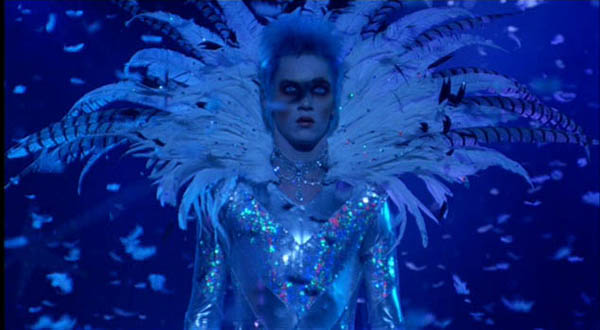
What is going on?, most of the time, still, especially towards the end, but with the lovely glammy visuals, who cares either? RM and Iggy Pop have a hot affair and half-fuel half-wreck each other’s careers, and there’s booze and such. I felt really on top of things while watching this, but just a few days later I’m lost in a drug haze of cool shots and floaty feathers and got nothing to say.

image

image

image

image

image

Dude who looks an awful lot like Leo Dicaprio and will soon star in Speed Racer plays Chris, who abandons his rich dysfunctional family (Marcia Gay Harden: Tim Robbins’ wife in Mystic River, William Hurt: the killer brother in A History of Violence, Jena Malone: Donnie Darko‘s girlfriend) and heads into the wild. Along the way he makes himself a new family, two hippie parents (some dude and Catherine Keener), grandfather Hal Holbrook (star of Creepshow: The Crate), and a sister (the girl from Panic Room). Then he lets them all down by failing to eat properly out in the Alaskan wilderness.

An emotional movie, full of warmth and humanity, but not enough of either for our main character who leaves it all behind to pursue his Alaskan dream. According to the movie/diary he hoped/intended to return before he was sidelined by an impassible river and some poisonous veggies.

Movie walks the line between putting Chris forth as a hero, a role model, a visionary who got a few details wrong vs. a deluded kid whose family drove him to self-destruction, maybe slanted towards the latter. Some quick editing, lots of askew close-ups, foreground in a corner of the frame with something blurry happening in the large looming distance. A strange, interesting look to the movie with artistic intentions to be sure. An ambitious picture, almost all successful. I liked it a lot, but I have to say Grizzly Man still has the edge.

ADDENDUM: thanks to the Golden Globe award nominations, I am now remembering to mention that the Eddie Vedder songs were distracting.

My new hero Nathan Lee of Slate on this movie:

I immediately and powerfully sympathized with the questing hero — I, too, am a privileged young man undergoing an existential crisis! — but as his quest went on (and on and on and on and on), I found myself less and less invested. The trajectory of the movie proved emotionally frustrating but ethically acute: My gradual alienation from the “hero,” our ostensible audience surrogate, was replaced by empathy with all those marvelous supporting characters he encounters on his journey, a set of alternative families he briefly joins then abandons. Into the Wild is a conventional treatment of the same theme contemplated through kaleidoscope in I’m Not There. Both movies celebrate the thrill of personal reinvention while simultaneously attending to the spiritual toll of perpetual escape. Neither film is hagiographic; neither odyssey ends up feeling very heroic. If I’m Not There packed the greater wallop for me, it’s probably because I connect on a deeper intellectual and emotional level to Haynes’ mega-meta technique than Penn’s nostalgic naturalism.

Movie 2 of the Key Sunday Cinema Club. Hated it, skipped the post-movie discussion to sneak into the oscar shorts. Thanks anyway, Katy! Not your fault.

Opens right up with a big damned heavyhanded metaphor, where our boy Wilberforce (his real name, haha, and played by Mr. Fantastic!) stops some white brutes from kicking their black horse out in the rain. Some poignant shit right there. Then a whole movie about racism with only one black person in it follows.

The one black person is Youssou N’Dour in his English feature film debut. We’ve discussed Wilberforce (heh) being Mr. Fantastic (double-heh) and let’s see what else is going on. The young Prime Minister is played by Benedict Cumberbatch (pffffhahaha) who once played Stephen Hawking in a TV movie. Wilberforce eventually marries young Romola Garai (from Vanity Fair and Scoop). In the parliament we’ve got Michael Gambon as a good guy and a very familiar looking Ciaran Hinds and the dude from Infamous as bad guys, and off on his own is Wilberforce’s mentor, a cataract-ridden saintly monkly fella who used to own a slave ship, played by our Albert Finney. Oh wait, and Rufus Sewell plays a leftist with scarecrow-hair who pals around with N’Dour and tries to get Wilderforce to go abolish slavery, which he eventually does, the end.

A very bad script where everyone speaks only in cliches, from the writer of Dirty Pretty Things, which I’ll have to not see. I didn’t know much about Michael Apted before, and I’ll have to not find out more. I’d been trying to forget this, but Terrence Malick produced. There were seven producers, so it’s not a major blow.

Good performances and costume details ignored the silliness of the whole thing. It’s not the absence of black people that bugs me much, since after all, it’s a historical drama that takes place in british parliament. It’s just the extreme fakiness of it all, wilbur making himself physically sick and turning to god and admiring spiderwebs, the way-easy love affair, the bagpipe coda… but I mostly can’t get past the cornbread dialogue. It’s impossible to overstate this: every line is a cliche. IMDB shows that church groups have been getting prerelease screenings, and from the comments, they seem to be eating it up.