“It’s your negative insinuendo!”

Whoops, I accidentally watched two bizarro hyperactive cult movies in a row from the criterion collection (Mr. Freedom and now this). In their words: “Based on Peter Barnes’ irreverent play, this darkly comic indictment of Britain’s class system peers behind the closed doors of English aristocracy. Insanity, sadistic sarcasm, and black comedy—with just a touch of the Hollywood musical—are all featured in this beloved cult classic.”

If there’s one thing you remember about The Ruling Class, it should be to not watch it again. It feels too much like other cult classics: loud, overlong, and funny but in a pained sort of way. O’Toole has a powerful character though and a wildly good performance. He’s Jesus for more than half the movie, then becomes much more dangerous when he starts appearing to be normal.

“How do you know you’re God?”
“It’s simple; when I pray to him I find I’m talking to myself.”

Definitely doesn’t count as a musical, though it has three or four scenes of Dennis Potter-style singalong. Might actually count as a horror. Gets more terrible and less funny as it progresses, closing with a shrill and mighty scream. Kind of good as political satire in that respect… the ol’ Catch-22 approach of drawing ’em in with humor and then unleashing the message, that these are very bad people in important positions of power and they should be stopped.

Lindsay Anderson fave Arthur Lowe is the only actor here who also worked on “Kind Hearts and Coronets”. He’s hilarious as the butler who inherits a fortune from the old Earl, then keeps his job but openly mocks everyone he works for.

I won’t make fun of “Species II” director Medak for this one, since he seems like a good sport, although now I realize he also made that dismal Masters of Horror episode “The Washingtonians”, another way over-the-top, shrill political piece.

Ian Christie:
“In revolting against naturalism, we should not forget that Medak (a refugee from Hungary) and Barnes were in good company. Roeg and Cammel’s Performance (1970) had plunged fearlessly into bravura fantasy… while such otherwise very different filmmakers as Kubrick and Anderson had also forsaken realism in their two great “state of the nation” films of the same period: A Clockwork Orange (1971) and O Lucky Man! (1973). And Medak’s fellow countryman, Peter Sasdy, was leading Britain’s horror specialist Hammer into post-Freudian terrain with Hands of the Ripper (1971), another tribute to the enduring fascination with the Whitechapel murderer.

“There are also some remarkable purely filmic inventions. The image of Dr. Herder embracing the police cut-out silhouette of Lady Claire has an eerie pathos, and the chilling final scream that rings out over the brooding exterior of the Gurney mansion after Jack has stabbed his wife, flushed with his acclaim in the House of Lords, seems to unite the bloody poetry that Hammer aspired to with a real protest against Britain’s decaying aristocratic tradition.

And an interesting connection to “The Trap”, which I’m in the middle of watching, also via Christie:

“R. D. Laing’s account of schizophrenia as essentially family-induced—a logical response to irrational pressures—was proving influential as a counter argument against advocates of ECT and drug treatment; and this is the backdrop to The Ruling Class’ elaborate staging of Jack’s madness and its “cure,” through a surreal confrontation with his opposite, the “electric messiah.”

Katy might have misinterpreted my comment that I hate the characters and don’t like the story but thought the movie was pretty good. Well, I’m not here to expain, only to repeat.

Big wide colorful movie with long motion camera shots, some catchy musical numbers, definitely preferable to the non-musical version of the Pygmalion story.

Audrey Hepburn is the best part as Eliza Doolittle, cute and expressive. She nails the early scenes where she’s gotta howl hideously. Got no problem with actors Rex Harrison (lead actor in Unfaithfully Yours) as the thoroughly unlikeable Henry Higgins or Wilfrid Hyde-White (of The Browning Version, The Third Man, Let’s Make Love) as Henry’s more pleasant colleague, though their non-singing scenes were a little wearisome since I don’t like either one of ’em and I know how it’s all going to end up. More enjoyable (but with less screen time) were Stanley Holloway (of Brief Encounter) as Eliza’s singing, drunken father and Gladys Cooper (of The Pirate and Rebecca) as Henry’s posh mother.

I guess George Bernard Shaw is mostly known for this story, though I wouldn’t know why. Alan Jay Lerner, who made the musical version, also did Camelot, Gigi, Brigadoon, Paint Your Wagon and An American In Paris. Director Cukor did a lotta things, incl. musicals A Star Is Born, Let’s Make Love and Les Girls, and almost directed Gone With The Wind. He won his only Oscar for this movie. Pretty much everyone involved in this was at least nominated, except for Audrey (Julie Andrews, who played Eliza on Broadway but wasn’t offered the movie part, won for Mary Poppins).

Good songs: “why can’t the english learn to speak english”… “i could have danced all night”… “with a little bit of luck”… some lesser ones: “you did it” and “get me to the church on time”.

Funny, at the end Eliza has been “bettered”, become classier, can’t go back to the street where she lived, the flower shops, and (until the final scene) she is miserable for it. And her formerly poor, happy-go-lucky drunken father has come into money unexpectedly and is miserable for it. Second musical I’ve seen in a row (after Hallelujah I’m a Bum) where people get rich and wish they hadn’t.

I get Henry’s character and his lame “i’ve grown accustomed to her face” late realization song, but I don’t get what Eliza’s still doing with him at the end of the film. Not a very romantic romance movie. When it comes to movies about obsessively re-shaping young women, I prefer Vertigo.

A sad ending to Anderson’s famed trilogy that began with If… (which I did not watch this week because Vdrome didn’t get it in) and O Lucky Man! (which I half-remember from watching on tape five years ago – a musical, right?).

If the first of the trilogy mixes “color and black and white as audaciously as it mixes fantasy and reality” and “remains one of cinema’s most unforgettable rebel yells”, according to Criterion, and the second was a fun, “surrealist musical [which] serves as an allegory for the pitfalls of capitalism”, according to the IMDB, then what’s left for this little apocalyptic satire? It feels flat, unfunny and bizarrely plotted, with Malcolm McDowell barely present and not much holding the whole thing together.

image

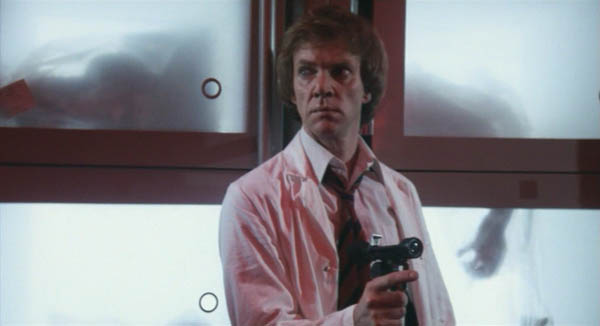
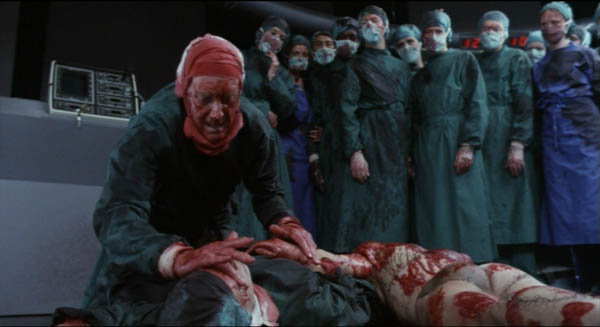
The final scene (after M. McD’s beheading death) features a long dull speech railing against all of human society by a mad scientist (Graham Crowden of O Lucky Man and The Ruling Class) who unveils a computer named Genesis that will somehow solve everything. Before that, McDowell is an ineffectual investigative reporter, with stoned colleagues Mark Hamill (post-Big Red One, pre-Jedi) and Frank Grimes.

image

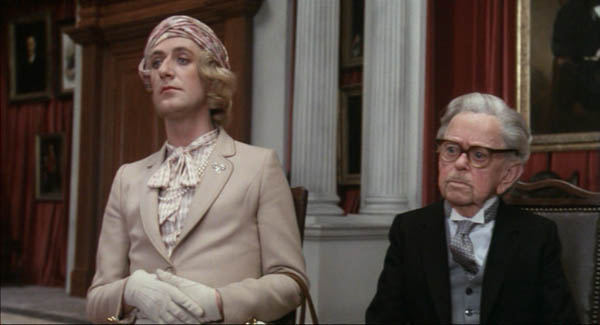
Movie felt sucky at the time, but it had noble intentions, throwing all of British society into the title hospital, staging a joint protest against both the way the country (err, hospital) treats its less-wealthy citizens, and the way it coddles corrupt and brutal foreign dictators. It’s against both the boss who expects too much and the worker who provides too little, it makes a small mockery of the royal family (midget and tranny royal reps) but shows the Queen’s handlers to be resourceful, sneaking her past the mob incognito, it tosses hatred at the labor unions (portrays them as killing patients through negligence and unnecessary regulations) and it throws some police violence, mob rule and frankenstein medical experiments into the mix. The lead actor is actually hospital director Leonard Rossiter, who mostly keeps his composure, except when he murders a striking electrician to turn the hospital’s power back on.

image

Best online source I could find on the film, an unsigned article on britmovie.co.uk site, sums up:

The question posed at the end of the film is ‘Is man intelligent enough to survive?’ The speech concluding the film is not sentimental; it’s much more the speech of an angry rationalist who is appalled and irritated by the stupidity of mankind. He proposes that the only solution is intelligence. But, of course, having made this speech, which most people would agree with, he then proposes a solution that is even crazier and more horrifying than anything the establishment represents. He produces the idea of a disembodied intelligence, this brain we see, which he tells us will be combined into a silicon chip. So, the challenge at the end is a question, If only intelligence can save us how can that intelligence be controlled? The film does say, I hope, that we must mistrust institutions, power, the instincts for power within us, and in that way I think Britannia Hospital is an anarchist film. It puts the responsibility squarely on the individual to develop first the intelligence and the moral awareness by which alone man can control his destiny.

The film’s location manager is quoted as saying “Unlike a lot of directors, [Anderson] doesn’t make films just for money but because he has something to say.” This was clearly a low-budget effort, with big stars (McDowell, Hamill) working for free, and the film had too much of a social conscience to dismiss by saying “ehh, the plot didn’t grip me and McDowell wasn’t in it enough and it was too disjointed” and give it the C- rating it may deserve on the grounds of a pretty poor final product. I’m upgrading to a B- for honorable intentions.

Lead actor (hospital director) Leonard Rossiter would die of a heart attack in 1984, with director Anderson following a decade later.

image

“Masturbating much?”
“Constantly! I have a talking boil on my neck.”

I think I was supposed to watch Withnail & I first, since it’s the one that got all the bonus features on the Criterion disc, but I felt like starting with this one. Somebody I know has warned me about these two movies once… can’t remember who, but anyway I liked this just fine, and will check out Withnail sometime.

image

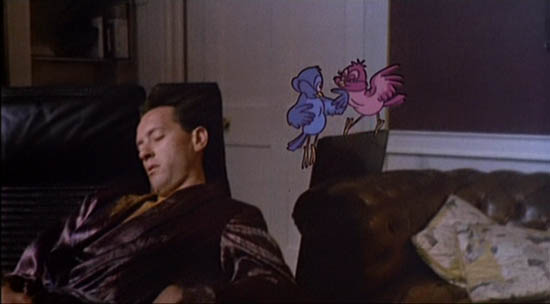
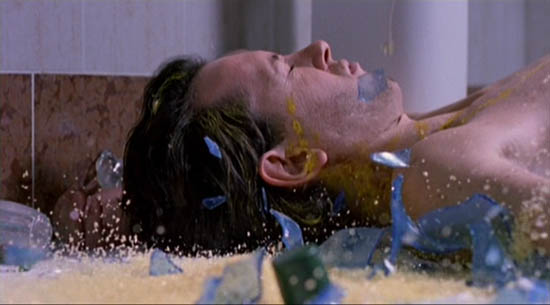
A usually-funny comedy about the advertising business. Dude is high-power ad exec until one troubling assignment to come up with a slogan for a zit cream. He has such trouble that he starts to question the entire practice of advertising… and that’s when a talking boil shows up on his neck, representing his bad ad-man self. It eventually takes over the body (with added mustache) with a good-guy-within boil on HIS neck. A little more gross than the usual angel/devil on your shoulder, but same idea. More anarchist (or communist) speeches (by the good anti-ad-man persona) than in most films. Remember the bizarre animated lovebirds, too.

image

Writer/director Bruce Robinson (also wrote The Killing Fields) put together a good comedy, with an excellent lead performance by Richard Grant (Karaoke, some latter Altmans, and Franz Kafka’s It’s a Wonderful Life).

image

Movie feels not like an advertisement but like a political attack, like a speech, but without the actual speeches interrupting the comic flow of things. Energetic and fun(ny), worth watching for sure.

image

First of three anthology films in which famed author W. Somerset Maugham introduces short films made from his short stories. Each segment is from a different director, but you couldn’t tell… just plays like a classy studio picture all the way through (so that’s the producer’s name up top).

The Facts of Life – dad tells his college son, going to Atlantic City to play tennis, never to gamble, lend money or get involved with women. Son immediately does all three, wins a bundle, goes home with hot girl who steals it in the night. But he saw her and stole it back, accidentally grabbing her entire cash stash along with his winnings.

The Alien Corn – rich kid wants to be concert pianist, makes a deal with his parents and adoring wannabe-girlfriend, he’ll study piano for two years then play and be judged by someone trustworthy – if they say he’s good enough, he’ll devote his life to it, otherwise he has to quit and do something regular. Well he does, and a famous concert pianist comes to the house and tells him he sucks, to the delight of everyone but him.

The Kite – stupid one, dumb guy with awful parents is in jail for abandoning his bitchy wife because she trashed his prize kite. Wife learns to appreciate kites and they’re back together in the end. Katy compared the guy’s awful mother to my mom because Katy is mean.

The Colonel’s Lady – Katy already wrote a long comment about this one – I agree, it’s the only great piece in the bunch.

A pretty alright little movie, full of British people calling each other “old boy” and acting stuffy and proper to each other.

Kind of ruins the Atlanta Film Festival to take a break from their offerings and watch a movie this good.

I don’t know much about Ireland vs. England but it looks like a bad scene. Bros Cillian and Teddy turn to rebellion after being terrorized by brits, then when their guy signs a peace agreement, Teddy joins the new government while Cillian keeps fighting. ‘ventually Ted kills his own brother.

Family vs. country / neighbor vs. neighbor thing plays out very effectively. Movie leaves me with my stomach burning. All shots of countryside are heartbreakingly wonderful. No death is taken lightly. Loach takes his “socialist realism” to a Serious Historical Topic and succeeds hilariously. Best picture at Cannes no duh. I’m only writing so little because I waited too long and have lost some details.

At first, seemed like a not-at-all-interesting re-enactment of the last battle to be fought on British soil, when some Scottish Highlanders attacked to get their leader “restored” to the throne. The highlanders lacked the will, experience, rest, nourishment, preparation, leadership or equipment for victory and were easily defeated.

image missing

But then it gets interesting, as the British soldiers not only defeat the Scots on the field, but chase down all retreaters and kill them, kill their families, and just destroy everything in a brutal rampage. Seemingly even more critical of Britain than The War Game was. Watkins says he intended to draw parallels between the behavior of the British troops and that of US troops in Vietnam, which was going on at the time.

image missing

Grainy and real looking, perfectly shot and acted, Watkins gets his point across easily. Like The War Game, not too long. Funny that the same guy should end up making such long movies (La Commune is 6 hrs, The Journey is over 14 hrs).

image missing

Peter Watkins’ own account of the film: http://www.mnsi.net/~pwatkins/PW_Culloden.htm

I’m starting to think that everyone should see every Peter Watkins movie. Too bad I started Katy on The Gladiators, cuz now she probably won’t wanna see the rest.

A horrifying look at nuclear war. Should’ve been required viewing, but was instead banned from the airwaves for decades. Ho-hum.

image missing

Short and to the point. Not only tells what might happen during a nuclear attack on Britain, but shows it, enacting the attack documentary-style.

Below: a homeowner discusses self-defense.

image missing

A powerfully convincing movie against the bomb. Unfortunately also harshly critical of Britain and its policies, which I’m sure contributed to the film being banned for so long.

image missing

Of course, Watkins’ own notes on the film are essential:
http://www.mnsi.net/~pwatkins/PW_Game.htm

image missing

Katy didn’t watch it, but probably should.

A motion-slideshow travelogue with narration, from the big squares and queen-attended events to the alleys and streams. The camera is always still, except once in a mall going up an escalator, I can’t imagine why.

London 1

Some interesting photography, but mostly full of references I missed and shots of boring stuff. Didn’t enjoy much. Would only recommend for a few funny quotes, most of which are conveniently gathered here anyway. Sure made me not want to visit London.

London 2

EDIT: Oops, I should’ve re-read the Cinema Scope article that got me renting this in the first place. Buncha stuff about Chris Marker and essay films, anyway.