Could See a Puma (2011, Eduardo Williams)

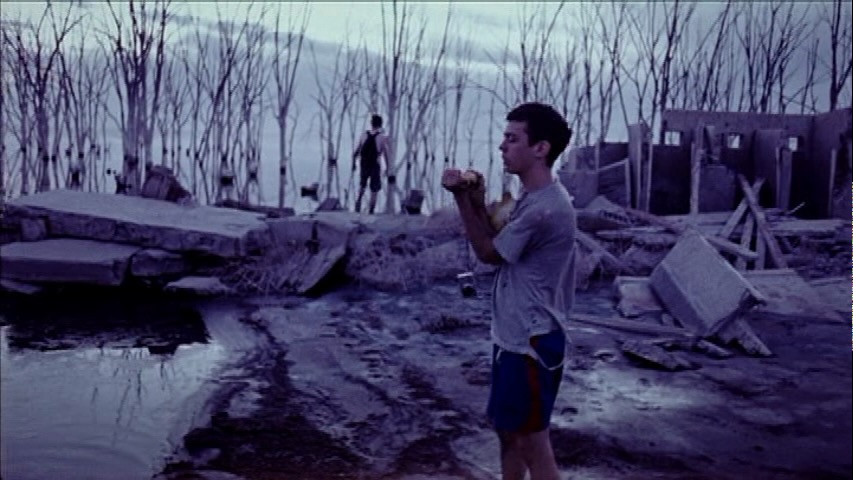
Youths live in the ruins, someone falls and gets hurt. Camera likes to rove around, not getting too close to the action. It’s nice to see that the Human Surge guy’s stylistic weirdness was already in place at this point. A few kids go looking for a medicinal herb, do not see a puma but they do slip into another dimension.

Schody/Stairs (1969, Stefan Schabenbeck)

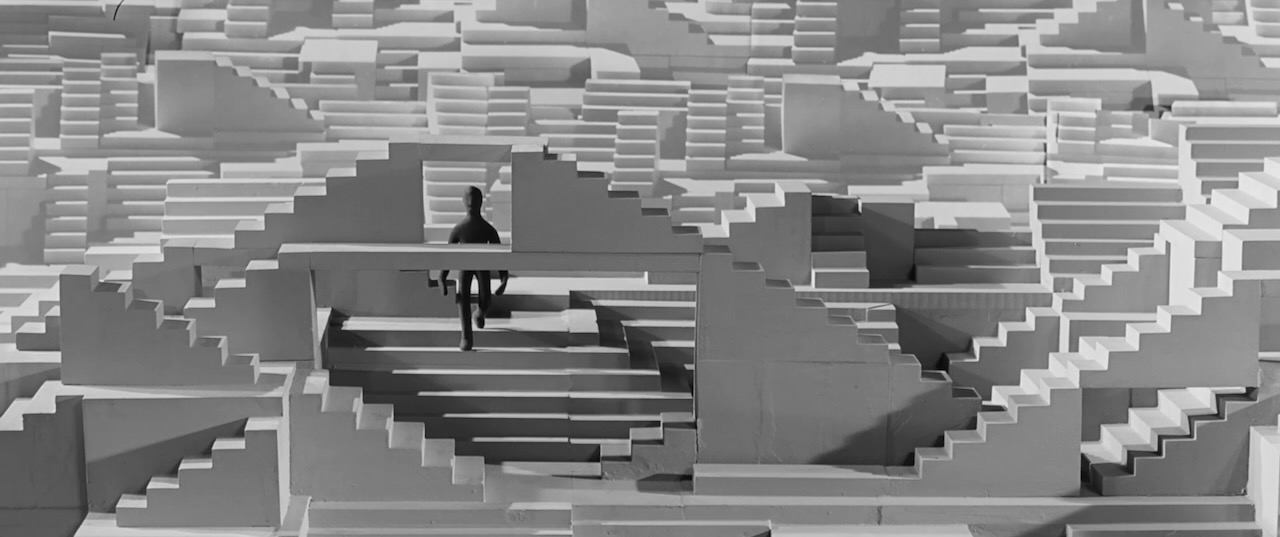
Clay guy comes across a sea of stairs, wanders through, up and up, until he reaches the summit of a long staircase then lies down and becomes another step in the stairs. Polish, of course. Whatever point they’re making about the futility of life, they sure spent a lot of time on stair fabrication and walking animation to make it.

The Heart of the World (2000, Guy Maddin)

This should probably play monthly in every movie theater.


Creature Comforts (1989, Nick Park)

Always assumed I’d seen this before but maybe not. Interviews with zoo patrons restaged as interviews with the clay-mated animals, started a whole trend of these things.
Inspirace (1949, Karel Zeman)

What madman would make a stop-motion film out of glass? Artist in need of inspirado spaces out on a rainy window, dreams a glass fantasy ice skater and the dandelion clown in her pursuit.

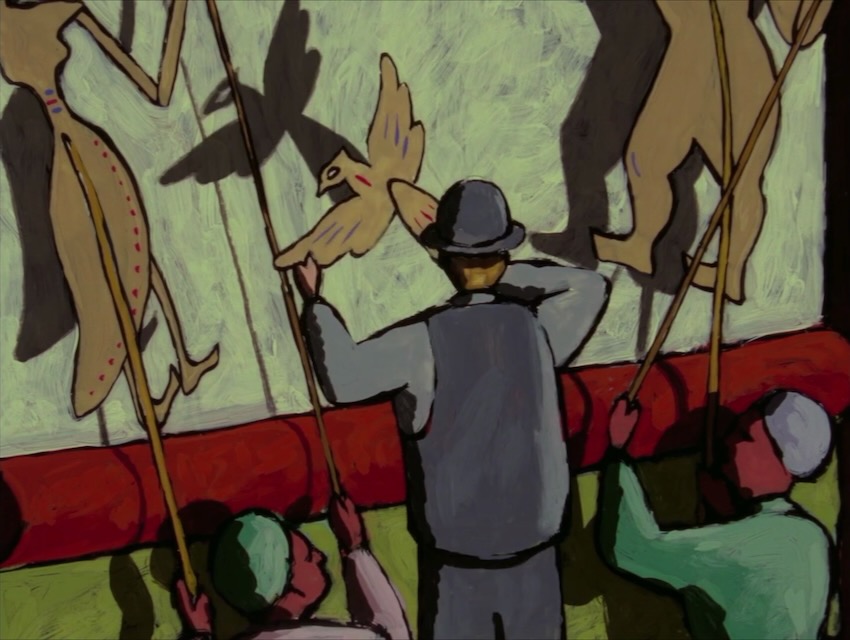
Man Without a Shadow (2004, Georges Schwizgebel)

Swirling dizzy blobby animation. The man has a shadow from the start, so I wasn’t surprised when he sells it to a devil in exchange for the promise of riches and women. But I was surprised when, after women want nothing to do with a shadowless man, he gets a pair of red boots that enable him to leap across the earth, checks out different gatherings, and settles on a shadow theater where he can manipulate the puppets shadowlessly without using rods or strings.

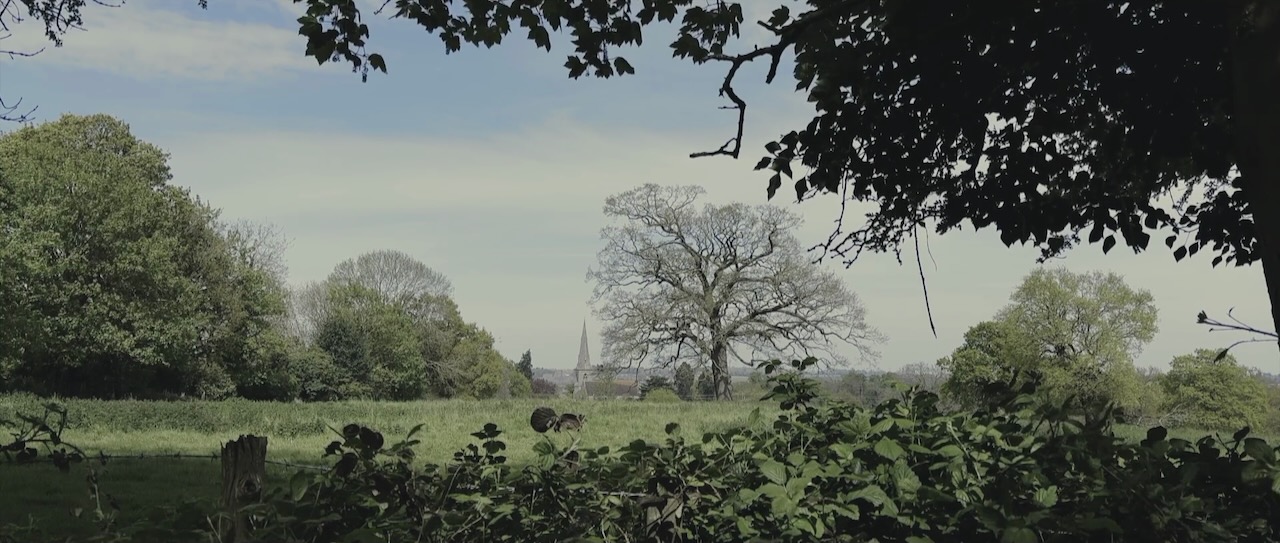
Passing Time (2023, Terence Davies)

Terence reads a poem with that voice of his – rougher than it was in Of Time and the City – the music piece swelling in the background – over a nice shot of some trees.

But Why? (2021, Terence Davies)

I never wrote up this Benediction-era Davies poem, in which two of his stars from that movie swap places/timelines, but I’ve watched it many times and like to quote it when I ascend the stairs, I descend the stairs… but why?

I’ve been liking the still with the parrot from this movie all year – turns out that is its one really cool image, from a rare time when the image mutates and deforms its subjects into digital moosh. Roving fisheye handheld through city streets, following people (are they characters, or just people?). The camera isn’t sure either, and wanders off. Once it stood between two people talking and just spun in circles – Katy hated that. I guess it’s innovative(?), and the cinema contains multitudes, but it’s pretty harsh to watch this the same week as Days of Heaven.

Our people are kids with nothing going on, so it’s not clear why we want to listen to them talk for ages. But then sometimes one of them can fly, and sometimes the camera gets lost or glitches way out. I think I figured out that it’s a spherical google-maps lens, when the kids roll it down a hill at the end – Williams apparently framed the shots in post with a VR headset.

Michael Sicinski calls it:

a film so aggressively forward thinking that it leapfrogs over the concept of a second installment — features characters who enter stations in Peru and exit in Taiwan or Sri Lanka. In addition to creating a world of travel that moves at the speed of thought, an almost physical remapping of the planet, The Human Surge 3 dispenses with ordinary zones of dramaturgy, instead staging lengthy sequences in the middle of the water or on an arduous hill. As Williams melds different space-times into single scenes, even the basic rules of gravity are up for debate. Like living clip-art, people occupy the same location, but cannot possibly share a contiguous environment.

Mostly wanted to watch this so I’d stop getting it confused with Human Flow, but also it has an interesting description, a killer poster, and four-star reviews from some Respected Critics. Maybe re-reading the writeups before watching would’ve helped, since I didn’t enjoy this at all. Smeared handheld shaky cam indifferently follows people around, then follows someone else – three aimless boys with shitty jobs (at least one has been fired) in three different countries. No lighting either, and I’m wondering why this is even a movie, then something amazing finally happens an hour in, when the camera follows a kid peeing and unexpectedly goes inside an anthill, providing a smooth transition to a new segment along with a memorable visual metaphor.

Won a top prize at Locarno (same section as The Challenge, Destruction Babies, Donald Cried). On letterboxd, Autumn responded to the “fascinating visual scheme,” which I looked for but did not detect, Felipe calls “the image texture a true aesthetic weapon,” which I don’t guess I’m a fan of. Vadim raves about the movie’s originality in Filmmaker, Cinema Scope voted it a film of the year, and after reading Leo Goldsmith’s article, I can finally wrap my stupid head around the reasons for everyone’s formal interest. Glenn Kenny in the Times has a more mixed reaction:

A scene of teenage boys engaging in tentative sex play with one another for a webcam show is presented with sufficient flatness of affect to make a viewer suspect that Mr. Williams is also interested in blurring the lines between verisimilitude and tedium. Just when you think you’ve got the movie pegged, it pulls a daring switch of perspective. While the thrill of that little coup is short-lived, it suggests that Mr. Williams may come up with something more substantial with his next feature.