Not the masterpiece I was hoping for based on those great posters, but pretty fun. Action-comedy with good dialogue, likeable actors and timeline-shuffling storytelling that actually works. The action scenes could’ve been shot better, but the music is great. Of course, second half kinda falls apart as the standard series of plot-reveals and final-showdowns all come together.

Tony Hale:

Adventures of Apollo Ape:

Coincidentally I watched this the night Jesse Eisenberg made film-critic-site headlines for saying something mean about film critics. He and Kristen Stewart are local losers in love, but he’s actually a CIA experiment, a super-soldier with erased memory, and she’s his CIA handler who chose to stay by his side. They both seem about 10-15 years too young to be retired CIA super-agents, but I guess Spy Kids exists, so nevermind.

Romance:

Secrets:

CIA dickweed Topher Grace sends killers led by “Laugher” Walt Goggins to exterminate all the ex-super-soldiers, so project head Connie Britton (star of two of Katy’s favorite shows) sneaks over and activates Jesse to defend himself. End result is a lotta people get killed, CIA bigwig Bill Pullman gets called in, and Jesse and Kristen are finally left alone. Also featuring John Leguizamo as Jesse’s weed and fireworks connection and Tony Hale as Connie’s flustered assistant. Written by Max Landis (Deer Woman), who seems to have a good knack for combining the awful with the hilarious. Director Nourizadeh made party-out-of-control movie Project X.

Greece 1963: leftist protesters against a supposedly democratic government invite guest speaker Yves Montand. Then he and another guy from the opposition party (Jean Bouise, Warok in Out 1) are clumsily killed, and it’s a race to see if the prosecuting attorney (My Night at Maud’s star Jean-Louis Trintignant) can uncover witnesses and prove it was a murder conspiracy before government-sympathist thugs kill all the witnesses. My first Costa-Gavras movie since hating Mad City in ’97, and it’s way more exciting than his plot descriptions sound, with quick, responsive camera and editing.

Trintignant kinda wins, manages to prosecute army big-shots and prove they were at least complicit in not helping to protect the murdered men. But this is bad news in the long run as the country spirals into authoritarian rule (which is why the film was shot in Algiers), getting bloody payback in postscript upon the leftists who dared to fight back – except the actual prosecuting attorney played by Trintignant, who’d return to Greece and become president 20 years later.

Montand widow Irene Papas (Mother of the River in Inquietude), standing in front of Clotilde Joano (Chabrol’s Wedding in Blood):

Doomed men in back seat, driven by Bernard Fresson (La Prisonniere, The Tenant), with shotgun Charles Denner (The Man Who Loved Women):

Warok-killer Gerard Darrieu (The Elusive Corporal, Mon Oncle d’Amerique) makes an accurate statement about birds to attorney Trintignant:

Montand-killer Marcel Bozzuffi (Le Deuxieme Souffle, Altman’s Images) tries to sneak past helpful journalist Jacques Perrin (Prince Charming in Donkey Skin):

Informant Jean Daste hides in an Elvis photomat:

Oscars for best editing (have I mentioned the editing? it’s great, with sudden flashbacks in the middle of conversations, illustrating thoughts of the people on screen) and foreign film at the oscars (vs. Midnight Cowboy, Hello Dolly), best film from the USA film critics society (vs. Stolen Kisses, La femme infidele), a couple prizes at Cannes including actor for Trintignant (vs. his own My Night at Maud’s and best-picture winner If…).

Cowritten by Jorge SemprĂșn (The War Is Over), of course, and shot by Raoul Coutard (post-Weekend), also of course. Editor Francoise Bonnot would continue to work with Costa-Gavras as well as Michael Cimino, Roman Polanski (The Tenant) and Julie Taymor. Trying to figure out why C-G has a hyphenated name I came across a MOMA press release saying he added the dash “to create confusion.”

Armond White, throwing out the titles of some movies I should really watch:

Carrying on the tradition of the politically informed films of Francesco Rosi (Salvatore Giuliano, Hands over the City, and The Moment of Truth), which turned recent politics into complex, engrossing cinematic myths, Costa-Gavras would proceed to advance the political thriller toward a popular mode. His work paralleled that of Gillo Pontecorvo (The Battle of Algiers) and Elio Petri (The Tenth Victim, We Still Kill the Old Way, Investigation of a Citizen Above Suspicion), whose political exposĂ©s were also accessible as action films. This trend was distinct from such earnest, earlier cultural movements as Italian neorealism and Russian formalism in that it permitted socially conscious, politically motivated artists to pursue personal causes, infected with the excitement of the era’s post-New Wave aesthetic.

1955 must’ve been a fun year to be at the movies, a heyday of widescreen and color in Moonfleet, Rebel Without a Cause, Lola Montes and even This Island Earth. This one looked great even on my portable player. Watched it about one and a half times, and would watch it again – full of bright color and good jokes and completely forgettable songs (sorry, Dean) and good characters (except for Dean, sorry Dean).

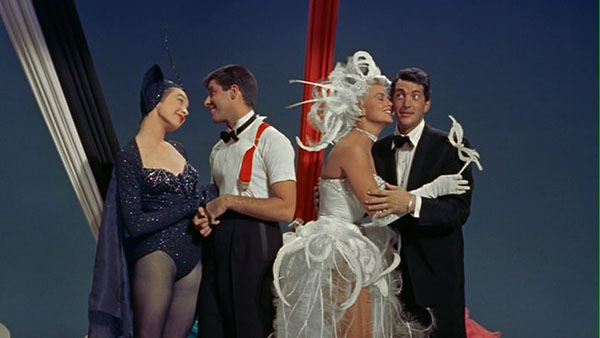
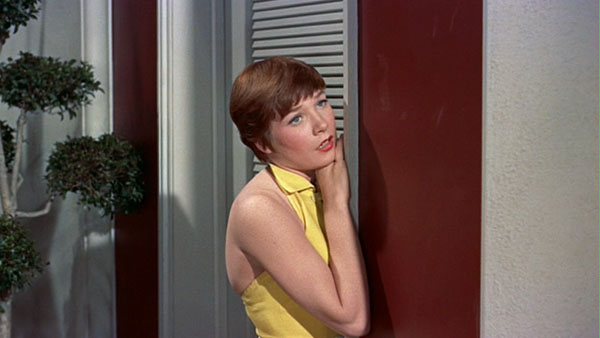
Jerry plays a grown adolescent (big surprise) addled by his addiction to comic books, and Dean is his friend/roommate trying to break into the art world. Dean’s an okay artist but also a ladies’ man in the creepiest, most stalkerish way, and the object of his lusty affection is successful (until she gets fired halfway through) comic artist Dorothy Malone (one year before she stunned in Written on the Wind). Dorothy’s Batgirl model, less hollywood-attractive but with a much cuter smile, is Shirley MacLaine (whose film debut was just one month prior in Hitchcock’s The Trouble With Harry). It’s complicated, but Dean lands a job for Dorothy’s ex-boss drawing super-violent action comics written by Jerry in his sleep (he dreams aloud) the same day Jerry attends a panel as a witness against comics as a corruptive influence on young minds, while Dean tries to get Dorothy as hard as Shirley tries to get Jerry (via an awful music sequence, the low point of the movie). Then totally out of left field, spies and government agents are after Jerry, and the plot gets so mad that I already don’t remember how it’s ties up, except that Dorothy & Jerry give in to their stalker partners and fall into last-minute “love” (a la Cary Grant in Bringing Up Baby) and get married, all in a single few-second shot, the movie’s way of saying “WHEW!”
image

Cameo by George Foghorn Winslow, the kid from Gentlemen Prefer Blondes, nine years old and already halfway through his Hollywood career. I didn’t recognize Jack Elam (I keep doing that… gotta notice him next time I watch Kiss Me Deadly to see what he looked like in the 50’s). Eddie Mayehoff was wonderful as semi-hysterical Mr. Murdock, the somewhat pathetic boss at the comics company with no creative drive or ideas of his own – he appeared in a few other Martin & Lewis movies but sadly not anywhere else. I love how Dean and Jerry take turns doing impressions of his character.

Eddie Mayehoff:
image

Tash made this a couple years after Son of Paleface with Bob Hope, and a couple years before Will Success Spoil Rock Hunter?. I think this was the second to last Lewis/Martin flick – a few years later Dean would be starring in Rio Bravo and Jerry would get into directing with The Bellboy.

So this has got narratives written by dreams, the struggle to be an artist in a corporate world, an appreciation and condemnation of comics, government cold-war idiocy, and more attacks on television (after seeing this and Rock Hunter I think TV is a favorite punching bag of Tashlin’s). TV had already been mentioned as the downfall of the comic industry when this scene came along (right after Dean’s so-glad-to-be-employed song) with Jerry testifying against comics from inside a television (color, no less) while Dean discovers the futility of arguing with TV:
image

The writers have some more fun with comics when Jerry’s love life takes an super/spider-man angle, as he’s in love with Batgirl but not her real-life “secret identity” Shirley MacLaine. Also some terrific bits with mirrors and frames and distortions. Jerry gets to sing most of a song, and in the other room Dean takes off his shirt and pants and sings to himself in the mirror (maybe this was to stall walkouts of female Dean fans who did not come to hear Jerry do the singing). But when Dean’s mirror image starts singing harmonies and looking back at himself in an unwholesome way, Dean splits. The music starts out okay and gets worse – sorry, songwriters Jack Brooks and Harry Warren (“That’s Amore”, “I Only Have Eyes For You”, “We’re in the Money”).

Rosenbaum says: “Five cowriters are credited along with Tashlin, but the stylistic exuberance is seamless, and this film eventually wound up providing the inspirational spark for Jacques Rivette’s late, great New Wave extravaganza Celine and Julie Go Boating (1974)”

Weird 1950’s Thing I Noticed: the want ads are divided into men’s jobs and women’s jobs. Suppose there was a separate page for negro jobs? More likely a whole separate newspaper.

The annual Artists & Models Ball. I’m guessing the kids at SCAD have parties like this all the time.
image

Dean being creepy over Dorothy:
image

Cover your ears, Shirley’s gonna sing:
image

Jerry tries being a model:
image