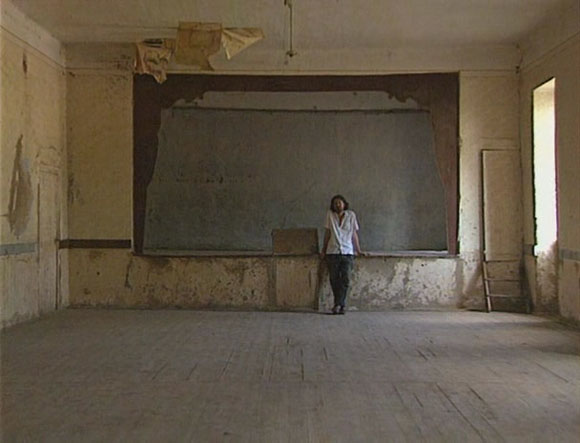
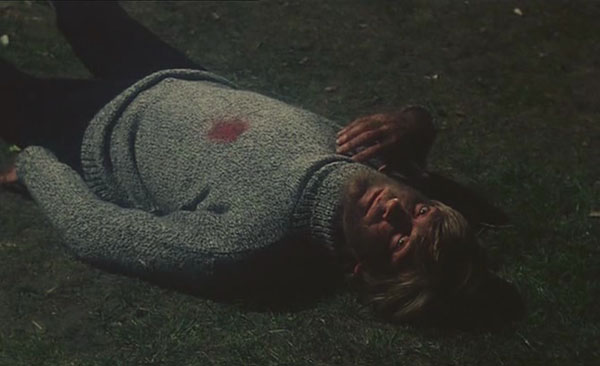
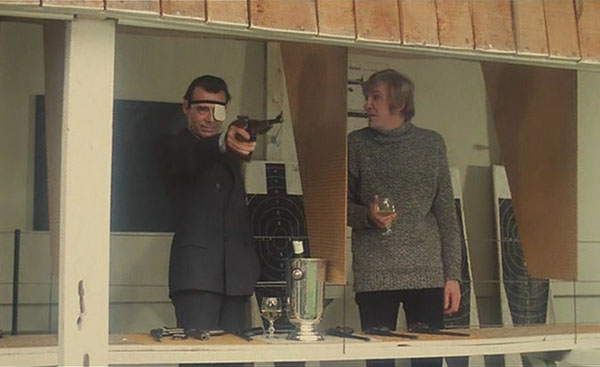
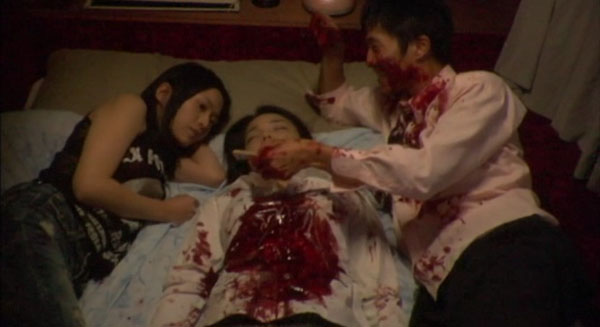
Fabulous action thriller, visually stylish with wild acting and a great, complicated script. According to Masters of Cinema it was the “year’s largest grossing film at the Hong Kong box office.” According to IMDB, it made nearly $5,000 at the U.S. box office. This is why a remake is inevitable (thanks to the producer of Rush Hour, can’t wait).

image

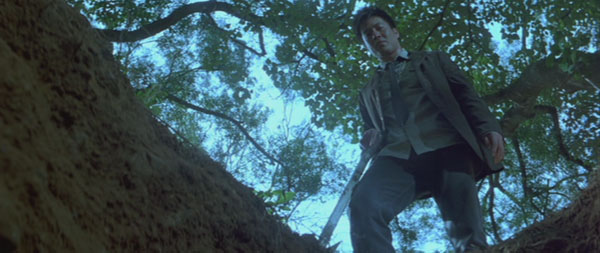
Ho (Andy On of Black Mask 2 and New Police Story) is new on the police force, investigating the disappearance of another officer. Bun (Ching Wan Lau of Black Mask 1 and My Left Eye Sees Ghosts) is the unhinged “mad” detective, actually an ex-detective fired from the force for cutting his ear off but still an utter master of deduction through his unusual methods of instinctually empathizing with killers and victims. It’s part Training Day (crazy partner) and part Silence of the Lambs (dangerous non-cop assisting investigation), except that Bun is a good guy.

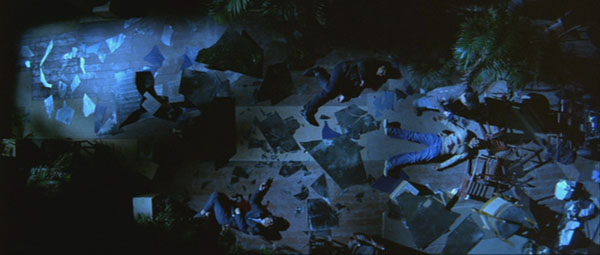
Bun visits a crime scene and imagines himself participating:
image

image

image

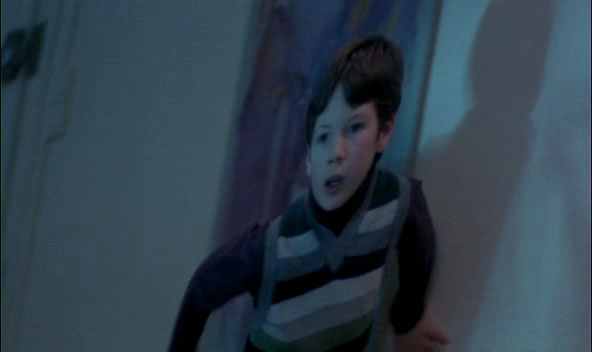
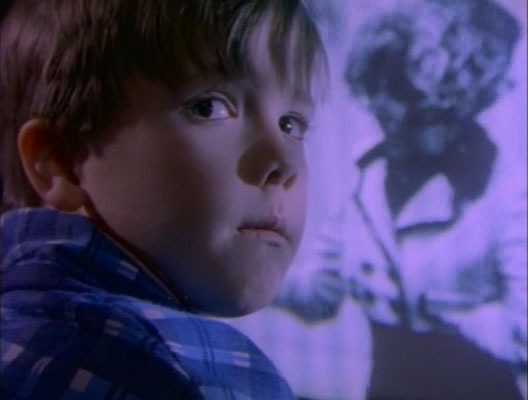
In fact, he begins to emerge as the only good guy, as he gets deeper into the conspiracy (the disappeared cop was killed by his partner Chi Wai (Ka Tung Lam of Election 1 & 2), who is going on crime sprees with his murdered partner’s gun) and Ho reveals himself to be a useless coward. Bun claims to see people’s inner personalities (including “Fatso” and a strong violent dude, both Breaking News vets, and “the calculating woman” who makes all of Chi Wai’s decisions) – in the shot below, Chi Wai’s many personalities ride in the back seat while Ho appears as a scared little boy.

image

So in the end it’s less Training Day meets Silence of the Lambs than MPD Psycho meets Herman’s Head. May (Kelly Lin of Boarding Gate) exists as two characters – she’s Bun’s tough ex-wife, an inspector on the force who warns Ho about his erratic behavior, and in Bun’s mind she’s still his loving wife, always by his side at home and at dinner parties with Ho and his worried girlfriend Gigi.

Inspector May:
image

During the shootout finale in a hall of mirrors (of course there are mirrors), Ho becomes the new Chi Wai, displacing guns and covering up who shot whom to keep himself out of trouble, controlled by his brand-new commanding woman inner-personality, a terribly good, scary ending.

image

Looked to me like To and his cinematographer were using whichever camera Mann shot Miami Vice with, but IMDB says it’s 35mm so I’m way off.

image

AUGUST 2021: Watched again in HD, still great. Guess that English-language remake isn’t gonna happen.

APRIL 2024: And again with Maria, who said at least the first ten minutes was good before it went straight into the deep end.

Wallace & Gromit’s Cracking Contraptions (2002)
Ten W&G shorts. I think these were made to promote the full-length film… of course I had the chance to watch them back then and somehow put it off for seven years. Anyway these are cute – faves were The Snoozatron (a machine that dresses G. up as a sheep and flips him on a trampoline so W. can “count” him and fall asleep) and The Turbo Diner (a table-setting device exactly a la Charley Bowers in He Done His Best).


All This And Rabbit Stew (1941, Tex Avery)
Tex’s final Bugs short before moving to MGM. Hooray, now that I’ve watched those John Ford movies I can recognize that the offensive black stereotype hunter is based on Stepin Fetchit. I tried telling myself that if he didn’t look African the character would basically be Elmer Fudd – but then Bugs gets out of being held at gunpoint by shaking some dice and that idea goes out the window. Ouch.
image


Vivian (Bruce Conner, 1964)
If you liked a girl in the 1960’s, you made an avant-garde film of her. Harvard Film Archive: “An ecstatic portrait of actress Vivian Kurtz that features footage of a 1964 Conner exhibition and couches a humorous critique of the art market.” Set to a pop song called Mona Lisa, loads of fun and only three minutes long. This would go on my “best of a-g” gift reel if it wasn’t such a problem to make such a thing.
image


Journey on the Plain (1995, Bela Tarr)
Poems about friendship loss, life and death, each with a long tracking shot (imagine that), written by famed Hungarian poet Sándor Petöfi and performed by one of my favorite film music composers, Mihály Vig (Irimiás from Sátántangó, in color!). Suddenly in one scene 20 minutes in, he’s on a truck loudly playing a doomed keyboard. An odd movie, peaceful and beautiful. I would gladly watch again, paying more attention to the words of the poems.

image

image


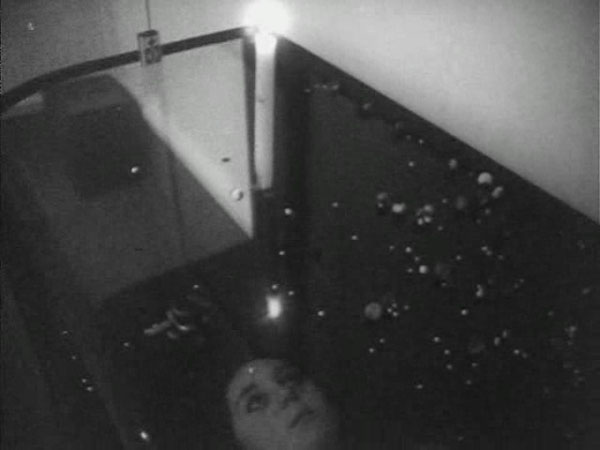
Thriller (1979, Sally Potter)

A narrator goes over the story and characters of an opera, then analyzes it while staring into a mirror, memory and identity swirling about. Very art-film, told in black-and-white stills and scenes, narrator all heavily french-accented. Kind of entrancing, really, with repeated poses and images and phrases, never quite turning into something I can make sense of (though I hear it’s some kind of marxist-feminist critique of Freud and contemplation of human existence, thanks to a useful, knowledgeable and well-considered review on the IMDB – a rare thing indeed).

Sony Pictures: “a critical re-working of Puccini’s opera La Boheme, was a cult hit on the international festival circuit.” Sudden bursts of the shower theme from Psycho. “Yes, it was murder. We never got to know each other. Perhaps we could have loved each other.” I need to see it again, obviously, but I’m not dying to do so anytime soon.

from K. McKim’s great Senses of Cinema article

Potter’s 16 mm black and white cult hit Thriller (1979) overtly equates revision with survival; the film invokes formal conventions to interrogate the narrative necessity of Mimi’s death. Inscribing this inquiry within allusion to female murder victims (Thriller cites Bernard Hermann’s screeching Psycho score), Mimi questions the conventions that locate meaning in the death of a young beautiful woman. Scripted, edited, produced and directed by Potter, Thriller transforms the opera into, as the title suggests, a thriller that uncovers operatic form’s generic and gendered hypocrisy.

image

image


Dottie Gets Spanked (1993, Todd Haynes)
Wow, this was great. Boy with a mommy complex idolizes an I Love Lucy-esque TV show, wins a contest and gets to visit the set. Movie swirls with repression and fantasy and budding sexuality.

The distributor: “anticipates … Far from Heaven with its excavation of placid mid-century surfaces and deeply-buried emotions.” R. Lineberger: “This short film was commissioned by the Independent Television Service as part of a search for short films about American television. The pairing is perfect. Haynes is subversive, but approachable. His film deals with ominous and disturbing themes, but he never comes out and says anything objectionable. For example, Steven’s father is suggested to be violent, or at least sharply critical, but we never actually see any aggressiveness from him. The whispered consequences and punishments exist in glances, or in Steven’s thoughts.”

image

image


13 Screen Tests (1964-66, Andy Warhol)

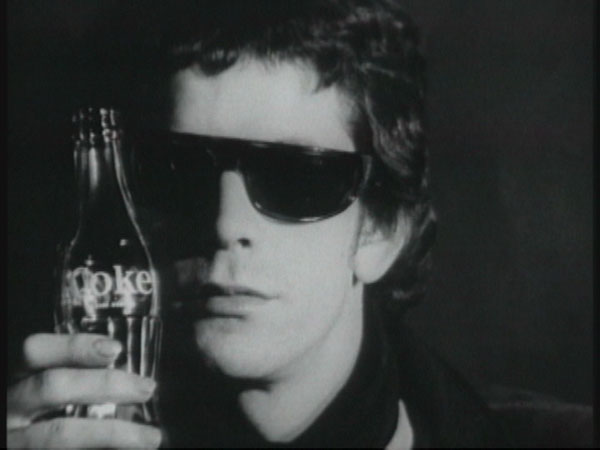
Rented Warhol’s screen tests sorta against my will (I just wanted to hear the new Dean & Britta songs) then proceeded to half-watch ’em while listening to the music. The films were better than I thought (that Edie Sedgwick has got something, and Lou Reed and Dennis Hopper are funny) and the music was worse (standard instrumentals, a few new songs and some covers). I did try watching a screen test straight through, the way I’m supposed to, to see if I experienced a sudden tingly appreciation for the Cult of Andy, but it didn’t work; maybe I picked the wrong one.

G. Comenas:

Factory visitors who had potential “star” quality would be seated in front of a tripod mounted camera, asked to be as still as possible, and told not to blink while the camera was running. … Some of the earliest Screen Tests were those included in Warhol’s film The Thirteen Most Beautiful Boys. … More than 500 Screen Tests were made. In addition to The 13 Most Beautiful Boys, some of the footage was incorporated into other compilation reels such as The 13 Most Beautiful Women (1964) and 50 Fantastics and 50 Personalities (1964).

LA Times:

Each test lasted as long as a single 100-foot roll of film. Each was shot at 24 frames per second and projected at two-thirds of that speed, a trick Warhol often used. Each took a little less than three minutes to film, and takes a little more than four to watch. The slow-motion effect adds a discernible flicker, heightens every movement and contributes to the dreamy, ghostly quality.

image

Interesting, very good movie but I didn’t love it as much as everyone else seems to. Swept the Cesar awards in non-acting categories (a war film called Le Crabe-Tambour picked up the rest). I’ll bet Dennis Potter enjoyed it, too.

Come to think of it, looking over my screenshots a few weeks after writing the above paragraph, this was a damned complicated movie, and showed more imagination than Je t’aime, je t’aime. Definitely have to see again (and maybe again).

image

A writer (John Gielgud who, at 73, still had 60-some movies left in him over the next two decades) lives alone (with servants) in his big old house (“Providence”), spends the first two thirds of the movie dreaming up sordid lives for his family members, including his late wife (Elaine Stritch, lately in Romance & Cigarettes), his astro-scientist son (David Warner of Time Bandits), his lawyer son (Dirk Bogarde of The Servant and a bunch of Visconti films) and the lawyer’s wife (Ellen Burstyn of The Exorcist). He re-casts them, giving the lawyer and wife a bitter, joyless marriage, having them hold affairs with the other two. Stritch becomes an older woman with a terminal illness and Warner becomes a free man unsuccessfully prosecuted for murder. Scenes are re-written halfway through – Gielgud’s voice will narrate the action, then rethink things and suddenly characters will leave the scene or change their mind or the whole thing will start over with a different ending. So very Resnais-like, eh? Meanwhile, the writer himself is stumbling around the house at night, drinking, shitting, falling down, breaking things and griping about his ill health.

In the morning, he’s outside, it’s his 78th birthday, and his two sons and the lawyer’s lovely wife have a happy family visit, with dinner and gifts and happy memories. There’s a little bitterness, mentioning the writer’s wife who killed herself after diagnosed with a fatal disease, but overall it’s happy and serene, leaving us to wonder how much of the family problems and awful behavior from the first half of the movie were completely invented by the writer, and how much is actually there under the surface.

image

I’d thought I would enjoy six-time oscar-nominee Ellen Burstyn’s performance more, but maybe it suffered a bit from having just watched Rivette’s ladies in Love on the Ground – she seemed like the weakest link here, speaking as if she’d just received a script. Watching with headphones, the sound mix wasn’t so good either, but then neither was the quality of my downloaded movie very good, so this wasn’t optimal viewing experience. Liked the movie, fun to watch a bitter old man provide amused commentary on his own nightmares and imaginations, just didn’t blow me away.

Denis Lawson, who played the imaginary footballer (David Warner’s brother), appeared later the same year as Wedge Antilles in Star Wars, the film that helped decimate the world market for fancypants French films such as this one. In 1977 subtitles hadn’t been invented yet, so those watching in France heard the dubbed-in voices of actors Claude Dauphin (Le Plaisir), Francois Perier (Stavisky), Nelly Borgeaud (Mon oncle d’Amérique) and Gerard Depardieu.

image

Gielgud speaks the director’s thoughts: “It’s been said about my work that the search for style has often resulted in a want of feeling. However I’d put it another way, I’d say that style is feeling, in its most elegant and economic expression.”

Some woman wrote an article arguing that the ending is a dream also, but I’d have to pay $12 to read the full thing online.

There are weird flashes to military police and concentration camps, maybe explained by this American Cinematheque quote: “A fascinating visual tour de force exploring the creative process, offset by references to the nightmarish political crackdown in Chile in the late 1970’s.”

Ellen Burstyn:
image

V. Canby for NY Times did not like it: “The old man, it’s soon obvious, has imposed on these perfectly decent folk all of his own fears and guilts about a lifetime spent in philandering, selfishness, disinterest in his family, while he enjoyed a reputation as a writer he never really deserved. The structure is complicated but sadly un-complex.”

J. Travers on the ending: “Yet there is something about this Resnais-esque view of Paradise that is even more unsettling than the Hell we have just experienced. Which of these two interpretations paints the more accurate picture of the world in which we live? Can we take seriously the saccharine-doused scene of marital fidelity, brotherly friendship and sweet father-son love? Isn’t it more believable that the two sons would be rivals, that the elder son would have a mistress and would bitterly resent his father’s slow and demeaning death? Surely the world shown to us in the first part of the film, the world apparently belonging in the mind of a solitary writer, is the world that is nearer to our own, a far more accurate portrayal of human nature? The second world, of calm, family harmony and stability, is surely an illusion, a distorted memory of a past that never was, could never have been. Which reality do we believe?”

image

I’d heard this was a sequel to Suicide Circle, so I assumed it was a horror movie. A natural assumption, since Suicide Circle is very much a horror movie. But by no means is this a horror movie, nor is it any good at all, and it is almost three hours long, which means I could have watched two short, good horror movies instead of this one. Tragedy!

Lots of steadicam, with the low-budget video look of MPD Psycho. First hour is a bunch of teen girl crap, with Noriko getting tired of her family and wishing she was as accepted in real life as she is online, where her screen name is Mitsuko. The online community is related to the Suicide Circle cult (it’s the website with the colored dots), but besides a couple flashbacks to the intro train scene of that movie, some “Desert” posters on a wall and some dodgy explanations at the end by a group member, there’s no real mention of the events of the other movie. Instead, we are presented with a wholly different view on Sion Sono’s ideas of group and individual identity, life and death, and the social problems of modern Japan. Maybe it’s deep if you think about it long enough, but it doesn’t make for a very interesting movie, with its amateurish cinematography, excessive length and dull repetitive voiceovers about the boring family problems of teen girls.

Happier times. But WERE they really happy? Are the kids smiling? ARE THEY?
image

So, right, Noriko/Mitsuko runs away and meets her online buddy Ueno Station 54 (named after a locker full of junk she found). That’s #54, as in the 54 kids who jumped from the train station… you can look for explanations all day long, but it’s not gonna solve anything. Noriko’s sister Yuka runs away a few months later, changes her name to Yoko, and the sisters meet up in the city. With US54 they work for a family-rental business pretending to be family members of lonely people for an hourly fee. Meanwhile, their real parents are crazy with grief over their disappeared daughters, and after a year the mother kills herself so the father (Ken Mitsuishi of The Pillow Book, Chaos, Eureka, Audition, Invisible Waves) starts combing their rooms for clues and finally comes to the city to find them.

Death is no big thing in Japan
image

All is well in the family rental business. Sometimes a client kills a “family member”, as above, but there’s Kumiko/US54 on the left taking his money as if nothing special has happened. The dad gets a friend to help, moves all his stuff from the old house and sets up a new place just like it, then gets the three girls to come over, climactically bursts out of a closet and… stands there like a damned fool. Um, some cult dudes show up and pummel the friend, but dad kills ’em all with a knife. Finally the girls somewhat snap out of it, and go oh yeah it’s our dad. I think Noriko runs away again at the end. I’m probably forgetting something, but whatever.

Separated by sun
image

Hints:
– the suicides kept going after the last movie ended… they did not stop with Dessert’s final performance.
– “What about the suicide club – it’s the result of Kumiko’s grudge, right?”
– “The world is the suicide club, with far more suicides than our circle.”
– “Being close to death gives living value”
– Dad is told by a club dude at a diner: “Feel the desert. Survive the desert. That’s your role.” Get it – Desert? Dessert? Get it?? Phthhhht!

What, no floss?
image

If this was better lit you’d see “Kiyoshi Kurosawa wuz here” on the windowframe
image

Ronny Yu’s entry is my first dip into Fear Itself, aka Masters of Horror season 3. As before, I’m counting them as movies even though they’re obviously not. Don’t know if I’ll be watching more of these until either the promised uncut DVDs come out, or it becomes apparent that they never will. Yu, who brought the Freddy, Jason AND Chucky series to new heights (but whose Jet Li retirement film was so bad, Jet Li had to cancel his retirement) brings no style at all to this slightly gruesome but otherwise standard twilight-zoney story.

A guy from Tigerland and the new Star Trek is a bad criminal who murders families, and a guy from some show called Eureka is the perfect church-going dad, then as they both lay dying in a hospital, they switch bodies and our good dad is in prison being tried for the death penalty while the bad guy is trying to deal with work and family.

image

Written by a guy who did some Carnivàle episodes. Not really a horror story, just an identity-swap thing with a twist ending: dad escapes from prison, there’s a fight, they switch back into their real bodies, but the criminal has murdered dad’s family as dad, so now dad will go back to prison, haha. John Landis’s season-two Family beats this by a mile. This ep was an okay time-waster, not worth watching again on the DVDs… can’t imagine what would’ve been cut out.

“Send this by pneumatic tube, quickly!”

This is now the earliest feature film I’ve ever seen (and the next two runners-up are also by Feuillade). Really this is five movies, each a multi-part serial, so maybe it’s the five earliest feature films I’ve seen…


PART ONE: IN THE SHADOW OF THE GUILLOTINE

The criminal master of disguise Fantomas is introduced robbing a rich woman of her jewels in a clumsy-ass fashion… he gets caught in her house then just walks up, looks at her threateningly, and walks away with them. They couldn’t think of a better scenario for the opening of their movie? I guess it shows that he’s an imposing character, and his appearing-ink business cards are cool (see bottom of page). Then it’s on to introduce Inspector Juve with his funny mustache and his reporter buddy Fandor. A man has been found murdered, so Juve questions his widow (Lady Beltham), who it turns out is having an affair with Fantomas. When inspector and reporter discover this, they easily capture the criminal, who is imprisoned to await the guillotine. But through a convoluted scheme, the widow springs Fantomas – she flatters an actor celebrated for portraying Fantomas on the stage to agree to meet her, and pays off the incredibly dense prison guards to spring Fantomas to come meet her at the same place (with the understanding that he’d be returned to prison within an hour) and they do the ol’ switcheroo – but Juve notices before the actor can be mistakenly executed (in the novel he was too late).

The regular Feuillade style is apparent here – people with comical mustaches who look conspiratorially into the camera, lots of crime, outdoor scenes with actors in cool black capes, convoluted scenarios and a plot that seems to be making itself up as it goes, helping the cliffhanger feeling.

Some nice outdoor shots in this movie. Feuillade is fond of long walls. I like them too.
image

The actor has all these admiring women, yet he sneaks off eagerly when he gets the letter from Lady Beltham? I guess her letter made her seem more “loose” than the ladies in his dressing room.
image

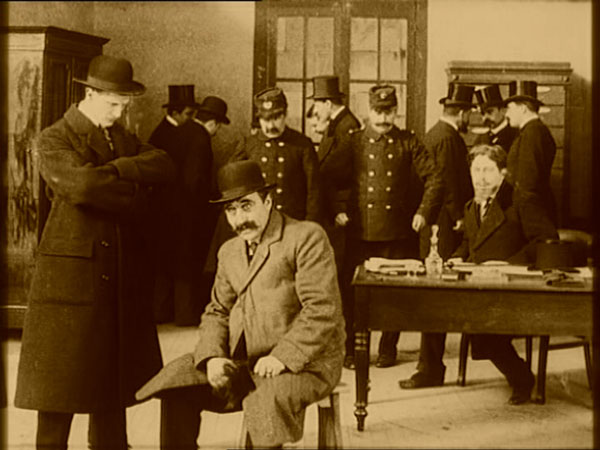
Juve, triumphantly stymied. Fandor (on left) looks on.
image


PART TWO: JUVE VERSUS FANTÔMAS

Opening credits are cool, showing the main actors crossfade into their characters-in-costume (in Juve’s case it’s changing into a hat, a fake mustache and a less-nice suit). At the start, Lady Beltham is presumed dead – but actually she’s organizing a gang of bandits who rob passengers on a train car then cause a train accident to cover up their crimes. Or was that another woman? Either way, our reporter is on the train and escapes with another passenger. He and Juve are lured into a gun trap, but they escape and tail the woman, getting her to lead them to Fantomas, who escapes by putting on his suit with false arms then simply running away, leaving Juve and Fandor each holding an arm. Brilliant! Okay, then Fantomas has a list of people he’s having mysteriously squeezed to death, so Juve wears spiked bands over his body when he goes to sleep and has Fandor hide in the room – wakes up being choked by a boa constrictor, ouch. Later, they’ve figured out where Fantomas hides out, so they storm the house and kill the boa (for real, on camera, uncool) but the criminal mastermind was hiding in a tank of water in the basement, escapes, and blows up the house!! Will the cops survive?? Great episode, action-packed.

great train robbery:
image

wrestling a boa – notice the spiked suit:
image

awwwwwesome closing shot – note sprocket holes:
image


PART THREE: THE MURDEROUS CORPSE

Oh man, this is not gonna be a strong plot summary. I was tired, and I thought it’d be 50 minutes but it was 90. Wasn’t doing anything else while watching but somehow I still got confused. So Juve is missing presumed dead from the house explosion and Fandor is investigating stuff on his own. Fantomas I think is dressed as an old woman who trades stolen goods, or maybe that was an actual old woman, and Juve is made up as a retarded homeless guy who helps her out. A dude is framed for a murder, then killed in prison, then abducted from the prison… WHY this happens I never figure out, but Fantomas makes gloves out of the man’s hands (seriously) and commits a bunch more murders leaving the dead dude’s fingerprints behind. The cops are, of course, mystified, but Fandor comes across a list of the murder victims in the order they’re killed. He finally hooks up with Juve again, Lady Beltham reappears for a minute, probably some other stuff happens but our heroes end up tracking Fantomas to a house and cornering him in the one place where there was a secret trap door. Whoosh, through the trap door and our heroes are empty-handed (actually they got the skin-gloves). NOT as radical an ending as the previous part, and maybe a bit long and convoluted.

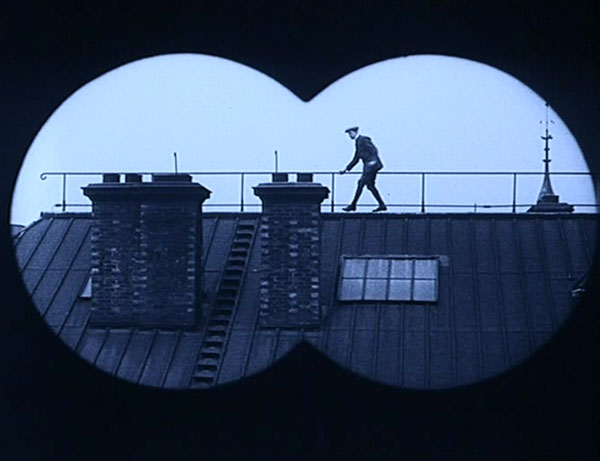
Fandor on the rooftops of paris:
image

Juve (in disguise) approaches Fandor (studying list of victims):
image

They’ve got him cornered! Note trap door and icky gloves:
image


PART FOUR: FANTÔMAS VERSUS FANTÔMAS

Juve is arrested straight away on suspicion of being Fantomas (what, because he couldn’t catch the guy?). The movie is telling us that the written situations are more important than the characters, since our hero Juve sits out most of the movie, making Fandor the hero by default. Fantomas reappears as Tom Bob (seriously, that’s his name!), American Detective. Lady Beltham has remarried and become the Grand Duchess Alexandra. She organizes a costume ball to collect reward money for the capture of Fantomas, and Fandor, not thinking things through, goes to the ball dressed as Fantomas. So do a police captain and Fantomas himself. A Fantomas-fight ensues, the master criminal escapes and the captain is killed.

After Juve is finally released, he’s captured about ten seconds later by Fantomas’s men, who believe that Juve is really Fantomas and want their share of the loot that they’ve helped steal (Fantomas ripping off his own men is a running theme). Fandor is on top of the plot and helps bag the men, capture the loot, rescue Juve and even capture Fantomas, but F. slips the men by walking them into two holes in the ground, the silliest escape in the whole series. I’m starting to doubt that this is a planned five-part series which is building up to something… think it’s just a regular movie franchise that makes it up as it goes along (nope, turns out they are closely based on a series of novels).

Left: “Tom Bob” Right-center: blood leaking from hole in the wall, 70+ years before Evil Dead 2

image

Fantomas vs. Fantomas at the costume ball:
image

Juve, kidnapped, hears Fandor hiding in the barrel. People are always hiding in barrels and baskets in these movies.
image

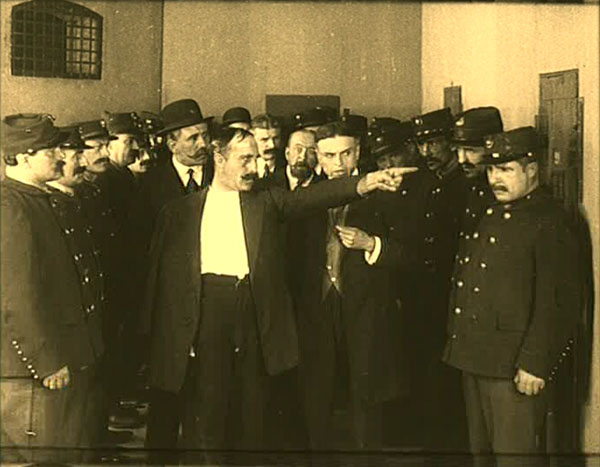
Juve fingers the crooked guard, an inside man who works for Fantomas:
image


PART FIVE: THE FALSE MAGISTRATE

I was hoping for an awesome ending but it seems the series peaked with part two. The plot gets more ludicrous, with Juve voluntarily taking Fantomas’s place in a Belgian prison under the logic that F. was gonna break out anyway, and Juve’s men can just catch him at the border to France. Of course Juve’s men suck at catching Fantomas, so F. runs around impersonating a judge while Juve rots in jail for the first hour of the movie. Fandor buzzes around of course, but doesn’t do all that much… this one is mostly about the criminal, with his disguises and lucky breaks, ripping off the wealthy and his own gang members.

These gang members scammed a rich guy and his jeweler, no big deal. F. takes it a step further, killing the thief with the jewels in a horrible way (he is rung to death inside a giant bell), killing the rich woman’s husband then blackmailing her for more money. Fandor finally figures out what’s up, Juve is released and they corner Fantomas… but a few hours earlier, as the judge, he’d told the warden to release the master criminal Fantomas secretly at midnight because it would actually be Juve in disguise. Juve, unwittingly this time, helps Fantomas escape again!

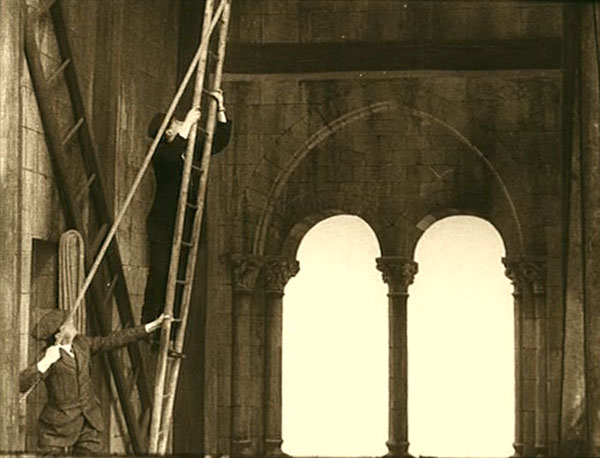
Fantomas helps dude up into the bell where jewels are hidden. Dude throws empty jewel case down and Fantomas takes away the ladder. The next day at a funeral when the bell is rung, blood and jewels rain down on the crowd. Wiiicked.
image

Note how the Belgian prison looks awfully like the French prison (above):
image

Fantomas, as the judge, feeling the pressure:
image

So is this one of the first great features of cinema? Does it meet expectation? Is it still a good movie today almost a century later? Is it as cool as that classic poster which now graces the DVD box cover? Well, no to that last one, but yes to the others. I still enjoy Judex better, but Feuillade’s crime serials are amazing fun, winking at the audience (sometimes literally) at times, getting cruel and serious at others, but always a good time to watch. And you can probably find someone who claims that they changed cinema forever… let’s see… yep, J. Travers says it introduces “not just the idea of a film series, but also [establishes] the crime thriller. The essential ingredients of film noir and the suspense thriller can be seen in this film which, remarkably, (when you consider when the film was made) still appears surprisingly modern.”

He qualifies the five movies: 1. most dreamlike and innovative, 2. best action, 3. most sophisticated, 4. most convoluted, 5. the weakest, comparatively mundane Each movie was divided into chapters with title cards – I didn’t realize each of these was a different serial episode! That means to see the complete Fantomas at the time of release, you would’ve had to go to the theater twenty-one times!

People are always mentioning how much the Surrealists loved these movies… I just read a whole website about it. Watched the bonus feature, wherein K. Newman immediately pronounces it “Phantom-ass.” Now I have to rethink the whole series, imagining Juve, wide-eyed, telling cops “this is the work of phantom-ass!” No wonder they eventually locked him up. Newman says the authors originally wanted to call it “Phant-o-moose” and now I think he’s just messing with us, under the “nobody watches DVD extras so we can say whatever we want” theory. Ahh, he says Diabolik was Fantomas-influenced – I can see that.

Edmund Breon (Juve) was in Les Vampires, took the 1920’s off, then appeared in fifty-some mostly British movies for the next two decades, waiting to die until after he’s been in Howard Hawks’ The Thing From Another World, a good move. René Navarre (Fantomas) was in movies through the 40’s, including a sound version of Judex. Georges Melchior (Fandor) barely made it into sound films. Renée Carl (Lady Beltham was in 180+ silent films – her only sound role was in Pépé le Moko (but last-billed).


“Did you folks in the audience just SEE that?”
image


This just in: a great article by David Bordwell on the series.

The premiere title of my personally-curated Obscure Movie Sundays monthly film screening programme was well-attended (five persons), the viewers anxious to view what my own invitation tantalizingly called “a 1977 surreal sci-fi comedy from Czechoslovakia. Set in the futuristic 1990’s, the plot involves identical twins and nazis with time machines. An obscure cult classic!” The movie lives up to the letter of that description, but wasn’t as wacky-enjoyable as it would sound. Still an affable, somewhat cheap-looking light comedy with a really good ending.

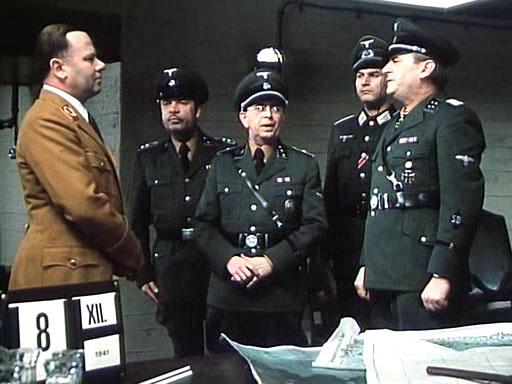
Rocket scientist Jan has an evil rocket scientist twin brother, who chokes to death on a roll at the start of the film. Jan is hot for his brother’s fiancee (an attractive girl from a family of circus performers), so Jan pretends to be his brother (barely mourned at all, so you’d think he’s a pretty crappy brother even though the two lived together) and goes to work – not knowing that this was the day the deceased brother was to participate in an evil plot to travel back in time to 1944, the turning point of WWII, and deliver a briefcase-sized atomic bomb to Adolf Hitler so the nazis would win the war. Things get fouled up royally, both in the 1990’s “present” and in 1941 (where they accidentally end up, right after Pearl Harbor, instead of ’44 like they’d planned) but finally Jan straightens everything out (easy to do when you’ve got a time machine at your disposal) and has the baddies imprisoned before they can meddle in the past. How to solve the problem of his dead brother? Jan travels back to moments after the brother’s choking accident, incinerates the body and inserts himself in its place. Result: two happy Jans are living together, one of them engaged to the evil twin’s attractive fiancee.

The bunch of baddies (right) in ’41:
image

I thought it was a funny movie, but I was the only one laughing – the others found it a little tedious. Too bad. Delightful inventions of the “future”: time travel exists but is only used for tourism, dishwashing detergent dissolves the dishes instead of bothering to clean them, and a stun-ray gun turns people to green statues (they’ll recover just fine in a few minutes, unless someone tries to move them and accidentally breaks off a limb or two). Also, the A-bomb has been miniaturized to fit in a light briefcase and the military has stopped using such weaponry, so it can only be found in museums. That’s a pretty short time window (from 1977 to 1990) from weapon advancement and miniaturization to obsolescence and declassification. Or you’d think they’d disarm the bomb they put in the museum.

My Two Jans:
image

The movie’s writer (I Killed Einstein, Gentlemen and What Would You Say To Some Spinach?), the composer (Three Nuts For Cinderella) and the director (no other movies with funny titles) all died in the last decade. Three of this film’s lead actors also appeared in What Would You Say To Some Spinach?, which came out two weeks before I was born – will have to seek that one out. The actor who played Hitler died in ’84.
image

“Cinema is the ultimate pervert art. It doesn’t give you what you desire; it tells you what to desire.”

With his focus on the “traumatic dimension of the voice… which distorts reality”, I must believe that narrator Slavoj Zizek, with his heavily accented voice, is watching and interpreting slightly different versions of these movies than the ones I have seen. After all, I watch films and he watches “fillums”.

image

A few bits: the three levels of Norman Bates’s house representing the id / ego / superego… the power of the voice represented by Dr. Mabuse… “Music is potentially always a threat”… a look at the intersecting fantasies in Blue Velvet, and the related horror themes of Blue Velvet and Mulholland Drive.

Calls a scene in The Piano Teacher “the most depressive sexual act in the entire history of cinema.” To think I once showed that movie to my girlfriend’s parents!

Wish Katy had finished watching this with me, could’ve helped defend my position on David Lynch movies. And for stupid cinephiles like myself, who love Lynch movies (and The Piano Teacher, and Eyes Wide Shut, and Blue) but get lost in their images and atmosphere without thinking too hard about their psychological implications, he handily explains the stories and characters from a psych point-of-view.

“I think that flowers should be forbidden to children.”

The movie might teach the rewards of closely analyzing a few great movies instead of trying to watch every potentially great movie. This is a lesson I will not be following. Maybe one day…

I feel so vindicated that he picks Alien Resurrection as a film worth discussing. When oh when will that gem get its due? Only the second of the series (after the Ridley Scott original) to count as a horror film, plus it’s good sci-fi and an innovative sequel/reboot that hasn’t been matched since (well, maybe those Chucky movies).

“All modern films are ultimately films about the possibility or impossibility to make a film.”

He compares Cecil B. DeMille to the Wizard of Oz to the mystery man in Lost Highway.

“In order to understand today’s world, we need cinema, literally. It’s only in cinema that we get that crucial dimension which we are not ready to confront in our reality. If you are looking for what is in reality more real than reality itself, look into the cinematic fiction.”

Writer/director Altman, “third woman” Janice Rule, her cheating husband Robert Fortier and the actors who played Pinky’s parents (Ruth Nelson of Humoresque and blacklisted 30’s and 40’s director John Cromwell)? All dead now.

More similar in tone and style to 1972’s Images than to anything else I’ve seen by Mr. Altman. Unlike Images it’s not shot subjectively, showing the hallucinatory visions of a lead character; everything on screen is assumed to be happening. But there’s the tight psychological focus on just two characters and the slow (and sometimes overlapping) motion shots of the mystical ancient-looking paintings set to creepy flute music.

Woman 1:
image

Story goes that three sad women with names similar to “Millie” meet in a small California town (desperate, pathetic but high-spirited single Shelley Duvall, childish Sissy Spacek, and Janice Rule, a painter pregnant by her cheating husband). After each of two harsh breaks in their routine (Spacek’s attempted suicide and ensuing coma, then Rule’s stillborn birth attended by the other two), the women assume different identities. First Spacek becomes an unleashed and attractive version of Duvall’s character and Duvall becomes withdrawn and passive, then in the finale, the three move in together (the husband having met a mysterious shooting death) assuming the roles of daughter, mother and grandmother and speaking in spookily robotic tones. D. Sterritt says the ending “presents a parody of American family life as desolate as it is surreal.”

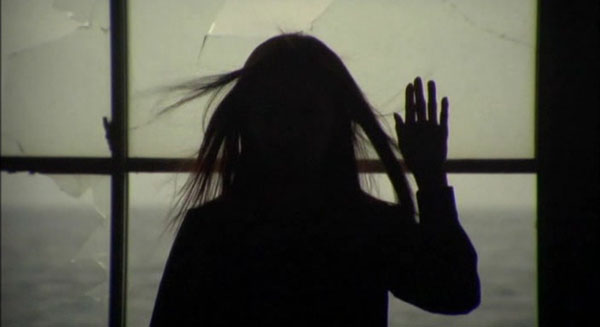
Woman 2:
image

Good movie, but I found it a little slow and wondered at the symbolism. Lots of humor, absolutely perfect performances by a post-Carrie Spacek and pre-Shining Duvall, and an extreme yellow-and-purple color palette.

Spacek uses Duvall’s social security number in her job application, an early sign of the current identity-theft crisis!

Woman 3:
image

Altman: “I’m trying to reach toward a picture that’s totally emotional, not narrative or intellectual, where an audience walks out and they can’t say anything about it except what they feel.”

image