“Cinema is the ultimate pervert art. It doesn’t give you what you desire; it tells you what to desire.”

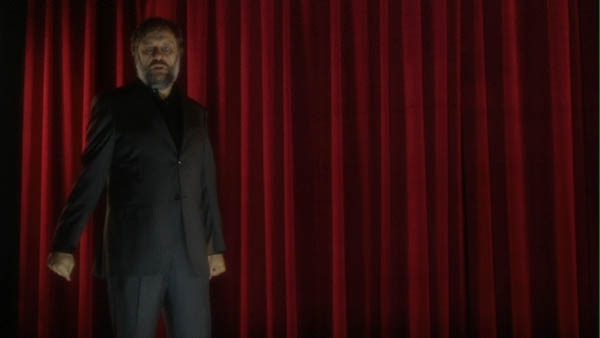
With his focus on the “traumatic dimension of the voice… which distorts reality”, I must believe that narrator Slavoj Zizek, with his heavily accented voice, is watching and interpreting slightly different versions of these movies than the ones I have seen. After all, I watch films and he watches “fillums”.
image

A few bits: the three levels of Norman Bates’s house representing the id / ego / superego… the power of the voice represented by Dr. Mabuse… “Music is potentially always a threat”… a look at the intersecting fantasies in Blue Velvet, and the related horror themes of Blue Velvet and Mulholland Drive.

Calls a scene in The Piano Teacher “the most depressive sexual act in the entire history of cinema.” To think I once showed that movie to my girlfriend’s parents!

Wish Katy had finished watching this with me, could’ve helped defend my position on David Lynch movies. And for stupid cinephiles like myself, who love Lynch movies (and The Piano Teacher, and Eyes Wide Shut, and Blue) but get lost in their images and atmosphere without thinking too hard about their psychological implications, he handily explains the stories and characters from a psych point-of-view.

“I think that flowers should be forbidden to children.”

The movie might teach the rewards of closely analyzing a few great movies instead of trying to watch every potentially great movie. This is a lesson I will not be following. Maybe one day…

I feel so vindicated that he picks Alien Resurrection as a film worth discussing. When oh when will that gem get its due? Only the second of the series (after the Ridley Scott original) to count as a horror film, plus it’s good sci-fi and an innovative sequel/reboot that hasn’t been matched since (well, maybe those Chucky movies).

“All modern films are ultimately films about the possibility or impossibility to make a film.”

He compares Cecil B. DeMille to the Wizard of Oz to the mystery man in Lost Highway.

“In order to understand today’s world, we need cinema, literally. It’s only in cinema that we get that crucial dimension which we are not ready to confront in our reality. If you are looking for what is in reality more real than reality itself, look into the cinematic fiction.”

Writer/director Altman, “third woman” Janice Rule, her cheating husband Robert Fortier and the actors who played Pinky’s parents (Ruth Nelson of Humoresque and blacklisted 30’s and 40’s director John Cromwell)? All dead now.

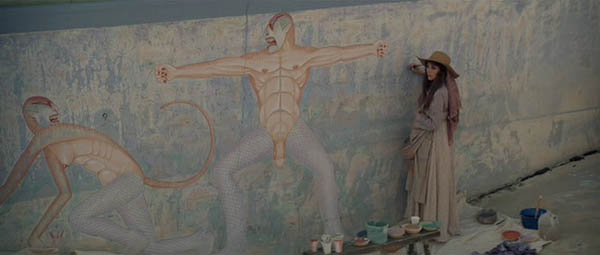
More similar in tone and style to 1972’s Images than to anything else I’ve seen by Mr. Altman. Unlike Images it’s not shot subjectively, showing the hallucinatory visions of a lead character; everything on screen is assumed to be happening. But there’s the tight psychological focus on just two characters and the slow (and sometimes overlapping) motion shots of the mystical ancient-looking paintings set to creepy flute music.

Woman 1:
image

Story goes that three sad women with names similar to “Millie” meet in a small California town (desperate, pathetic but high-spirited single Shelley Duvall, childish Sissy Spacek, and Janice Rule, a painter pregnant by her cheating husband). After each of two harsh breaks in their routine (Spacek’s attempted suicide and ensuing coma, then Rule’s stillborn birth attended by the other two), the women assume different identities. First Spacek becomes an unleashed and attractive version of Duvall’s character and Duvall becomes withdrawn and passive, then in the finale, the three move in together (the husband having met a mysterious shooting death) assuming the roles of daughter, mother and grandmother and speaking in spookily robotic tones. D. Sterritt says the ending “presents a parody of American family life as desolate as it is surreal.”

Woman 2:
image

Good movie, but I found it a little slow and wondered at the symbolism. Lots of humor, absolutely perfect performances by a post-Carrie Spacek and pre-Shining Duvall, and an extreme yellow-and-purple color palette.

Spacek uses Duvall’s social security number in her job application, an early sign of the current identity-theft crisis!

Woman 3:
image

Altman: “I’m trying to reach toward a picture that’s totally emotional, not narrative or intellectual, where an audience walks out and they can’t say anything about it except what they feel.”

image

Happy 10th anniversary to the funniest comedy of the 90’s!

In honor of this anniversary, I intended to post pictures of Jeff Bridges’ smiling eyes, but the DVD crashes my VLC player on both computers, so I will abandon this post before I am tempted to start quoting lines.

Some shots from the ending:

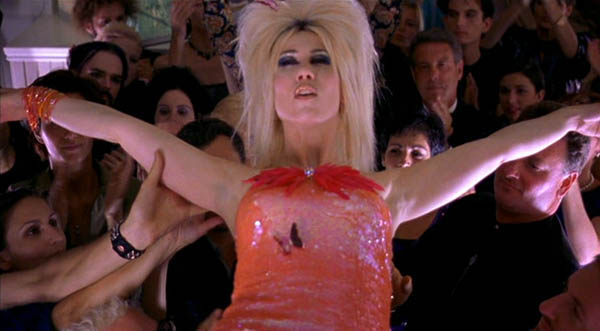
Hedwig-Hansel as Gnosis-Corgan. It’s complicated.
image

That’s songwriter Stephen Trask on the left.
image

Yitzhak unleashed! I will look out for her next time I watch Shortbus.
image

An Emily Hubley moment:
image

edit August 2011:
I finally got Katy to watch this, after five years of trying.
I don’t think she hated it, either.

edit March 2017:
Well, she didn’t like it enough to watch again with Maria.

Another quizzical music biography by Mr. Haynes. Someone said that any of his music movies (“Karen Carpenter Story”, Bowie doc “Velvet Goldmine”) could be titled “I’m Not There”. Dylan is actually there, playing harmonica in close-up at the very very end.

Dylans:

Rimbaud / in interview room giving evasive answers / guy from “Perfume”

Woody / train-hopping authentic-sounding blues kid actually a runaway / Marcus Carl Franklin from “Be Kind Rewind”

Billy / quiet recluse living in a western town of his own imagination / Richard Gere

Robbie / guy playing Dylan in typical hollywood bio-pic / Heath Ledger

Jack / fame-shunning Christian folk singer / Christian (heh) Bale

Jude (also heh) / the well-known “don’t look back” 60’s dylan who cavorts with the Beatles and flippantly defies fan and media expectations / Cate Blanchett in one of my favorite performances of the year

Aaand Charlotte Gainsbourg is Robbie’s estranged wife, who is the heart of the movie, the only character with actual human emotion and understandable actions. She barely belongs except to keep the thing reigned in a little.

Fascinating movie, amazing music (Dylan of course) and b/w/color cinematography (Ed Lachman – The Limey, Far From Heaven, A Prairie Home Companion). Must see again and again.

Katy might have misinterpreted my comment that I hate the characters and don’t like the story but thought the movie was pretty good. Well, I’m not here to expain, only to repeat.

Big wide colorful movie with long motion camera shots, some catchy musical numbers, definitely preferable to the non-musical version of the Pygmalion story.

Audrey Hepburn is the best part as Eliza Doolittle, cute and expressive. She nails the early scenes where she’s gotta howl hideously. Got no problem with actors Rex Harrison (lead actor in Unfaithfully Yours) as the thoroughly unlikeable Henry Higgins or Wilfrid Hyde-White (of The Browning Version, The Third Man, Let’s Make Love) as Henry’s more pleasant colleague, though their non-singing scenes were a little wearisome since I don’t like either one of ’em and I know how it’s all going to end up. More enjoyable (but with less screen time) were Stanley Holloway (of Brief Encounter) as Eliza’s singing, drunken father and Gladys Cooper (of The Pirate and Rebecca) as Henry’s posh mother.

I guess George Bernard Shaw is mostly known for this story, though I wouldn’t know why. Alan Jay Lerner, who made the musical version, also did Camelot, Gigi, Brigadoon, Paint Your Wagon and An American In Paris. Director Cukor did a lotta things, incl. musicals A Star Is Born, Let’s Make Love and Les Girls, and almost directed Gone With The Wind. He won his only Oscar for this movie. Pretty much everyone involved in this was at least nominated, except for Audrey (Julie Andrews, who played Eliza on Broadway but wasn’t offered the movie part, won for Mary Poppins).

Good songs: “why can’t the english learn to speak english”… “i could have danced all night”… “with a little bit of luck”… some lesser ones: “you did it” and “get me to the church on time”.

Funny, at the end Eliza has been “bettered”, become classier, can’t go back to the street where she lived, the flower shops, and (until the final scene) she is miserable for it. And her formerly poor, happy-go-lucky drunken father has come into money unexpectedly and is miserable for it. Second musical I’ve seen in a row (after Hallelujah I’m a Bum) where people get rich and wish they hadn’t.

I get Henry’s character and his lame “i’ve grown accustomed to her face” late realization song, but I don’t get what Eliza’s still doing with him at the end of the film. Not a very romantic romance movie. When it comes to movies about obsessively re-shaping young women, I prefer Vertigo.

Co-directed with Gunther von Fritsch, but I’ve never heard of that guy.

Watched the first Cat People again, and I still like it. Cool movie. Male lead Kent Smith (later of The Fountainhead and Party Girl) is like a ten-year-old in love, simple and naive, which only makes Simone Simon (who has the most excellent mouth of any actress) more interesting and mysterious. Smith’s character name is Oliver Reed. Oliver Reed the actor was only five when this came out.

Curse, the sequel, has Kent and his friend (now wife) Alice returning from the first movie, now with their young daughter Amy, who is seeing the ghost (?) of Simone Simon in the back yard. Not super interesting movie, and even if it was, I wasn’t paying much attention, but it did have a rollicking Christmas carol singalong. Has a nice spooky part at the end, when the reclusive Old Lady Farren (who the young girl befriends) dies on the stairwell and the woman’s grown daughter threatens to kill Amy since Farren preferred Amy to her own daughter (whom she accused of being an impostor, “my daughter is dead!”). So two “ghosts” in one movie, although clearly daughter Farren is not really dead, and the returned Simone Simon might be in the little girl’s imagination. So, it’s like Cat People, another spook movie that might not contain any actual spooks.

Man has accident. Needs new face.

image

Fortunately he’s friends with a brilliant tissue-replacement surgeon who wants to test his theories that facially-scarred people can reintegrate into society if their faces could appear normal again.

image

They find someone with a good face to copy (note: it’s the miner from Pitfall)

image

The doctor works hard in his all-glass laboratory.

image

The procedure is a success!

image

But the doctor’s psychological theories were wrong – the burnt man uses his new face to create a sociopath alternate personality, kind of like Hollow Man but not at all like Darkman.

image

Meanwhile, a young woman with a similarly deformed face has an unhealthy relationship with her brother.

image

Completely beautiful movie, obviously.

image

If Pitfall was a weird movie, this one just dives off a steep cliff of weirdness.

image

And it doesn’t end well. For anyone.

image

A surprisingly great movie. I mean, it’s Cronenberg so I oughtta like it, but at the same time it’s a late 90’s virtual reality thriller… not the kind of thing you can easily recommend to people, after the blitz that was Dark City, The Cell, The 13th Floor, The Matrix, and to a lesser extent, 1995’s Strange Days / Virtuosity / Johnny Mnemonic. But Cronie has been comfy working with virtually unreal worlds for decades, after Naked Lunch and Videodrome, and his movie easily stands above those others (not to knock Dark City).

image

It’s not the story, which is fine, or the is-it-real-or-not bits, which are well played and not overdone or inexplicable, it’s the look of the thing, the sleek style and great lighting… the compositions, which are uniformly attractive without calling attention to themselves or drowning the film in stylistic tricks. It’s genre sci-fi filmmaking that is so good it looks effortless. It won a silver bear in Berlin for outstanding artistic achievement, but was understandably ignored everywhere else.

image

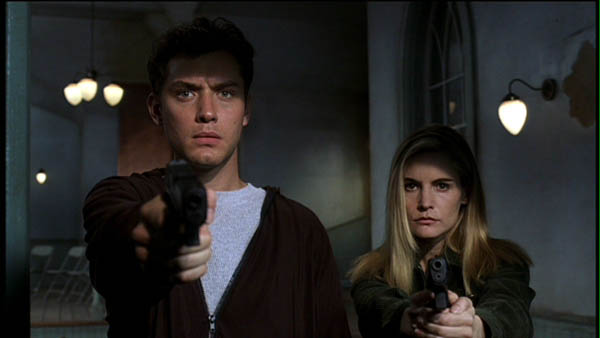
Jude Law and Jennifer Jason Leigh (spoiler alert: last 90 seconds) are underground realists out to destroy the creators of virtual-reality video games. They play the premiere of a new game with its creator (Don McKellar)’s participation, along with gamers Ian Holm, Willem Dafoe and others.

Next level: JJL is premiering her new game to a crowd of excited gamers, but when an underground realist tries to assassinate her, security guard JL comes somewhat to the rescue and they go on the run together. Along the way they meet Willem Dafoe, Ian Holm and Don McKellar, but it’s never clear who’s on their side.

Various sub-levels back and forth. The “game pods” are organic, and plug into bio-ports in your spine, but on some levels it’s a mini gamepod that merges with your spine directly. There’s spy business at a chinese restaurant, acknowledged fake accents, CGI insects, a few killings and close calls, and the deadly spoooores.

image

Has the game-life analogies you’d expect from the genre and the body-horror, sexuality and organic technology mix you’d expect from Cronenberg. Seeing the movie for a second (third?) time, it’s nice to see that the movie really doesn’t trick you, that the ending makes sense. Whether the ending is the really real “real world” or if we’re still within a simulation doesn’t matter, since of course the movie itself is a simulated reality.

image

–
OCT 2019: Watched with Dana, who said “ewwww” a hundred times, so I think it was a hit.