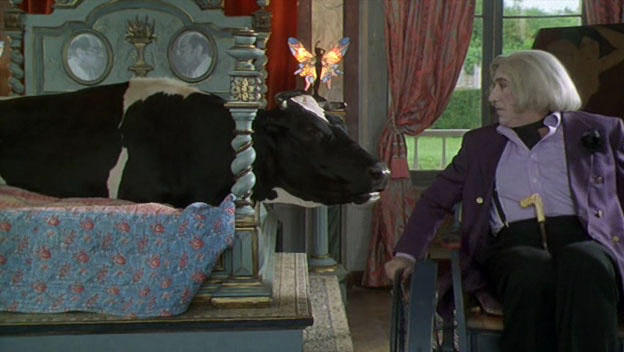
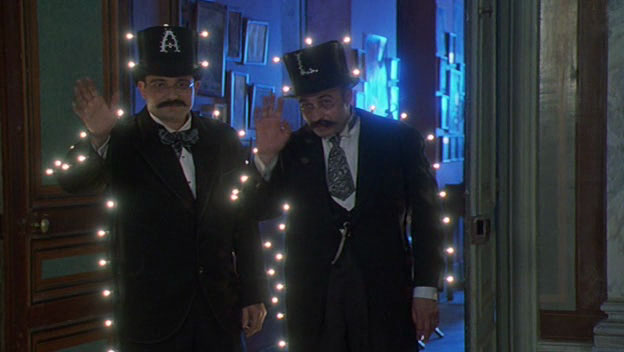
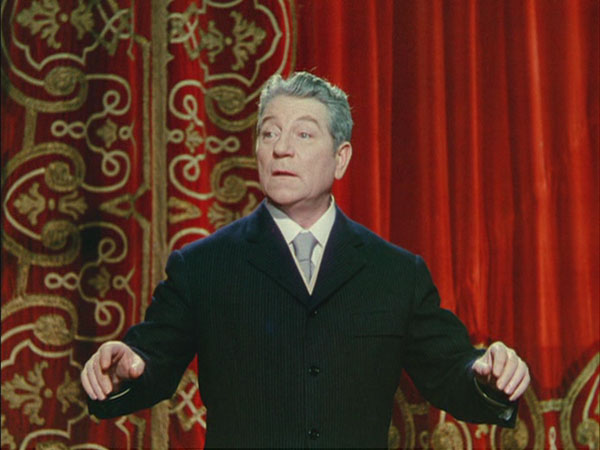
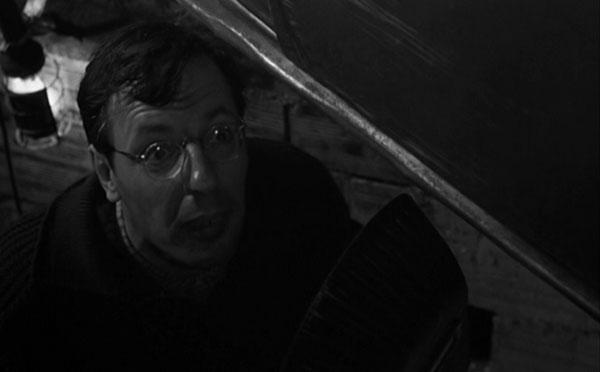
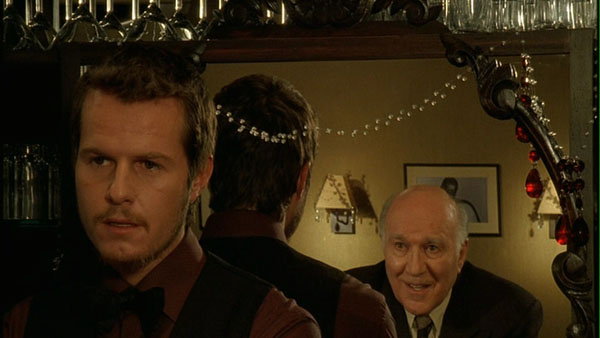
A slow-unfolding (but always formally exciting) Resnais movie gathering most of his favorite actors in a room for a contrived reason (a just-deceased writer/director wants his favorite actors to evaluate film of a modern performance of his Orpheus/Eurydice play). As the film goes on, the actors in the audience interact with it, reciting lines to the screen and to each other, standing up to perform entire scenes. The movie has a crisp, digital look and Resnais makes walls fall away smoothly, transporting the actors seamlessly into scenes from the play, using split-screens to show simultaneous performances of the same scene. It often seems like the ultimate movie of theater and performance, the work he’s been leading towards at least since the early 80’s (if not earlier, the location-jumping and memory-morphing hearkening back to his famed earliest features). Fortunately, it seems he’s still going strong and will have another movie out next year.

In the crowd: the Smoking/No Smoking team of Sabine Azeme and Pierre Artiti, Mathieu Amalric and Anne Consigny from Wild Grass, Michel Piccoli and Gerard Lartigau from way back in The War Is Over, Lambert Wilson (Not on the Lips), Anny Duperey (Stavisky), and more (can’t expect to know ’em all on a first viewing).

Actor Denis Podalyes plays the director, who addresses the group by video at the beginning and appears in person at the end, and his brother Bruno Podalyes actually directed the video within the movie.

Slant:

The reference point in the Resnais canon is 1986’s Mélo, which similarly foregrounded and made a virtue of its theatrical source while doubling and tripling the layers of irony, though nowhere near the extreme degree that the director pursues in his latest. .. Resnais suggests that the proper relation between the cinema and the theater is to throw it all together, take the best of both worlds and present it as pure showmanship.

Mubi:

A collective hallucination of people who think they’re talking to each other but are only talking to a screen: it’s the duly-noted theme of Vous n’avez encore rien vu, as the backgrounds dissolve from the screening room into a train station, café, and hotel, while the characters remain seated in place, stuck in some cinematheque of their imagination, foreshortened by Ruizian compositions a plane apart from their own space.

I actually kept up with all the plot confusion, so better write this down while I still remember it. Thief Maurice (Serge Reggiani, would-be star of Clouzot’s Inferno) kills and robs his fence/friend Gilbert (Rene Lefevre, Monsieur Lange in The Crime of Monsieur Lange), goes home to girlfriend Therese, hangs out with friends Silien and Jean, then gets caught robbing a house the next night, kills a cop who knew Silien and Gilbert, and gets arrested for both killings, neither of which can be proven.

From another POV (with a few holes), as soon as Maurice leaves Therese’s house robbery, buddy Silien (Jean-Paul Belmondo, one of three Melville movies he did between Breathless and Pierrot Le Fou) runs in, ties up Therese (smacking her around first) and asks her where the robbery is taking place. Cops cars arrive just as Maurice’s partner has started drilling the safe – the partner and the cop are killed, and Maurice faints with a bullet wound, picked up by persons unknown in a car. Belmondo visits the police station, a known informer, and offers to call around the bars looking for Maurice – they catch him in one, and he’s arrested. Meanwhile, Therese turns up dead in her car at the bottom of a ravine. Looks like Belmondo has locked up Maurice for offing his cop friend, and killed his girlfriend too. On top of that, Belmondo finds the buried jewels, cash and gun from the Gilbert killing (Maurice had left Therese a map, in case anything happened to him). In jail, Maurice (who’s as much the star of the movie as the over-the-title-credited Belmondo) hires a dude to kill Belmondo once they get out.

But Belmondo turns out to be a true friend who’s extremely good at covering for Maurice’s crimes. Belmondo killed the girl for ratting, saved Maurice at the scene of the heist, met up with his own ex-girl (Fabienne Dali of Kill Baby, Kill) and used the jewels to frame Michel Piccoli for the murder(s). So all is well… or it would be, but Maurice remembers that he’s got a hit man after his friend, so he races to Belmondo’s house and everybody gets killed.

So much twisty plot going on, I barely noticed anything else. Seemed like one of Melville’s more busy, exciting films.

I think these might be time-lapse shots of the tide going out, but the picture quality is too poor to be sure. This is gonna be a rough one…

image

Opens with a closeup of Catherine Deneuve smiling, a good sign, but soon she and husband Michel Piccoli are in a car crash. Afterwards, she can’t speak anymore and he has a harry potter scar on his forehead. Some eerie, powerful string music and many close-ups of crabs later, we’re at a seaside town where the couple have come to recuperate. Apparently they don’t talk with the locals much because there’s plenty of gossip going around.

Sheet salesmen:
image

Doesn’t take long for things to get weird. Small hands drop buttons into pockets. Piccoli (whose character name is also Piccoli) gets scammed by traveling sheet salesmen. Fishermen provide La Pointe-courte flashbacks for the viewer. Piccoli beats a chef with a dead cat. But it’s not a comedy! Something dark and eerie is definitely going on.

Piccoli talks with a horse. The horse talks back.
image

Piccoli is a writer working on a story, and when we see him writing the dialogue being spoken by a woman across town, I’m never sure afterwards what is really happening and what’s part of his meta-movie.

horse: “What is your story about?”
MP: “It’s about a man who knows how to control people by remote control. … but it wouldn’t last very long, a minute at most. This guy would be a bad person, with an evil mind. He wouldn’t be human or animal anymore.”

image

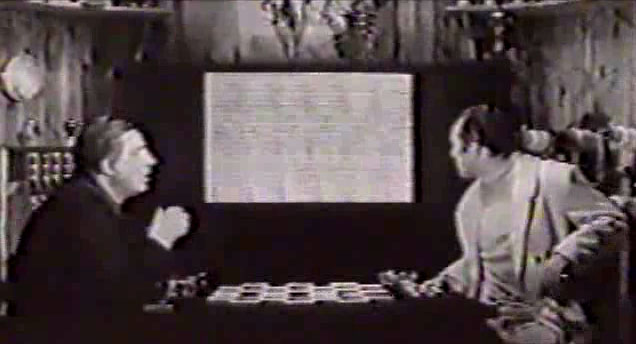
Soon Michel meets a bad man with an evil mind, Mr. Ducasse, who lives in a tower. He’s hired kids to drop magic discs into townspeople’s pockets which enable their wills to be controlled by his super computer. Ducasse calls the townfolk his “creatures”, gets Piccoli to play a game of Battle Chess with him over the fate of the town and of MP’s wife. MP is losing, but decides he doesn’t have to take Ducasse’s crazy misanthropic shit anymore, destroys the computer and tosses Ducasse from the tower. I’ll let NY Times give away the ending below.

image

Other notes I took while watching:

Catherine writes him messages, which I can’t read from the poor picture quality, and even if I could read them, they’d be in French. I have nice DVDs of Varda and Demy movies here, but I choose to watch a junk bootleg instead. Odd priorities.

The dead cat came with a piece of iron that makes the lights go out and causes people to act strange.

He just told a rabbit that his wife is pregnant.

Thief Max burns money, puts on diving suit, gets shot by partner.

image

You can’t tell much about the camerawork from my lo-res letterboxed videotape, but it’s one of the first films shot by William Lubtchansky (a decade before he began his 30+ year relationship with Jacques Rivette) along with two others. Interesting that all of her films until 1977 had multiple credited cinematographers.

Village Voice calls it “really botched” in their roundup for this year’s retrospective… “If it’s about anything, it’s about the creative process in action and stars that fine actor Michel Piccoli as a novelist who bases the characters in his story on friends and acquaintances.”

Ebert: “a complex and nearly hypnotic study of the way fact is made into fiction. It seems to operate on many levels, but in fact it operates on only one, illustrating how fantasy, reality and style are simultaneously kept suspended in the mind of a creative writer.”

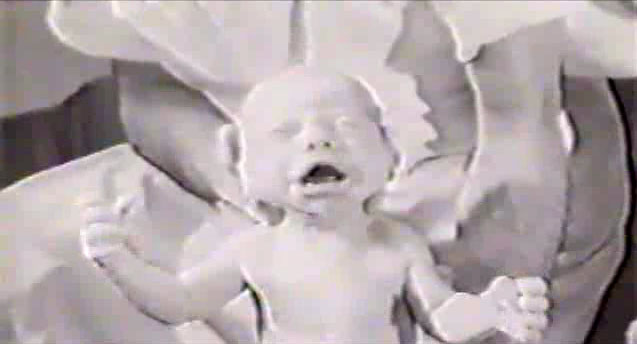
NY Times: “Then love conquers all. The survivors of the seven subplots make happy arrangements — for example, the statuesque hotel keeper (Eva Dahlbeck) gives up mistressing for the town doctor and begins with an underage busboy. The writer almost completes his novel. The wife gets her voice back, pronounces her husband’s name (“Edgar”), and has her baby — a bawling creature who at the end fills up the screen precisely to balance (and somewhat to resemble) a crab creature that fills it at the beginning.”

image

image

The movie’s studied anthropology and attack on human behavior reminds me of Resnais’ Mon oncle d’Amerique. And also of Bjork’s “Human Behavior.” There’s definitely, definitely… definitely no logic.

Camille: “Can I come during the day, from 5 to 7?”
Marcello: “The magic hour for lovers.”

image

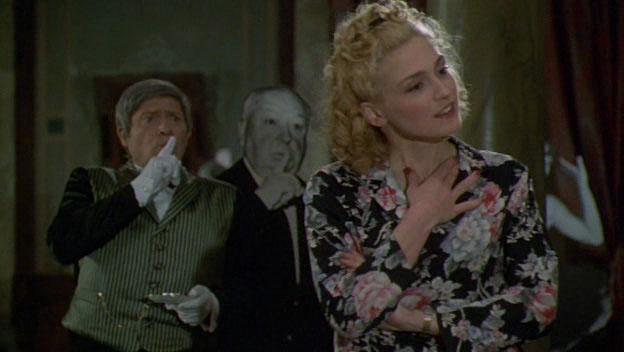
Simon Cinema (Michel Piccoli) isn’t doing too well, confined to his mansion-museum with his butler (Truffaut/Duras vet Henri Garcin) and best friend Marcello Mastroianni (as himself, sort of). Film student Camille (Julie Gayet, the girl with the giant gag vase in My Best Friend) is hired to talk with Simon about movies for 101 nights, and her boyfriend (Mathieu Demy) takes advantage of her position to cast the legendary Mr. Cinema in his student film.

Michel and Marcello:
image

Garcin and Gayet:
image

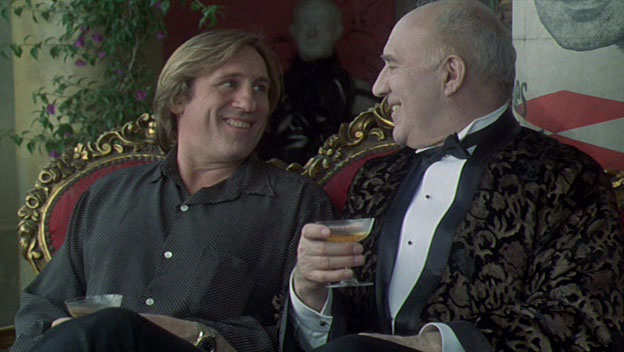
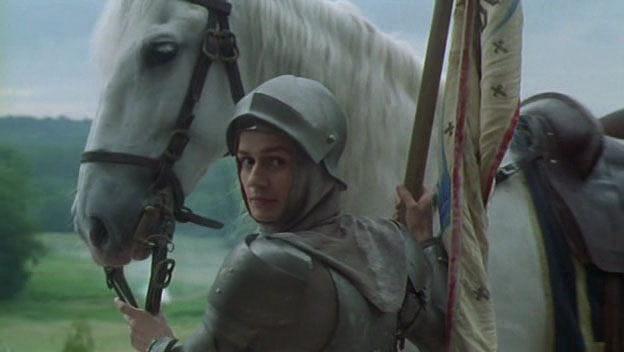
But the plot is just an excuse for some fun. Every star of French cinema shows up, major films are mentioned (nothing is discussed in any depth – no time). Anouk “Lola” Aimée, Catherine Deneuve and Robert De Niro take a boat ride. Sandrine Bonnaire appears as both her Vagabond self and Joan of Arc. Piccoli drops the Simon shtick and the white wig for a minute and compares cinematic death scenes with Gérard Depardieu (“that old devil Demy!”) before a poster of their co-starring Seven Deaths film…

Gerard and Michel:
image

Sandrine d’Arc:
image

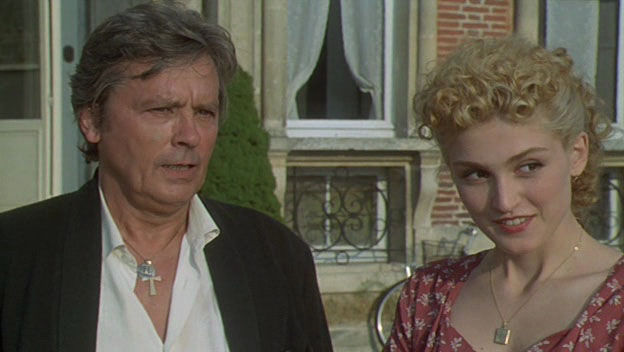
Hanna Schygulla (Fassbinder films, Passion) and Jeanne Moreau (Jules and Jim, The Lovers) play Simon’s ex-wives. There are seven dwarfs. There’s a conspiciously Bonheur-looking sunflower shot. Alain Delon arrives by helicopter (reminiscent, though it maybe shouldn’t be, of the out-of-place helicopter in Donkey Skin).

Gayet with Alain Delon:
image

Jeanne and Hanna:
image

It’s all very light and playful. I’m sure I missed a thousand references, but it keeps many of them obvious enough to remain accessible (if you didn’t catch the meaning when a bicycle is stolen outside the mansion, someone cries “italian neorealism strikes again!”).

Mathieu Demy meets Fanny Ardant:
image

The credits list how many seconds and frames were used from each featured film – impressive – and also all the stolen music cues.

image

tour bus guy: “Glad to see you on form.”
Simon: “Form of what?”
“Why, you seem content.”
“Form and content, a debate even older than I am.”

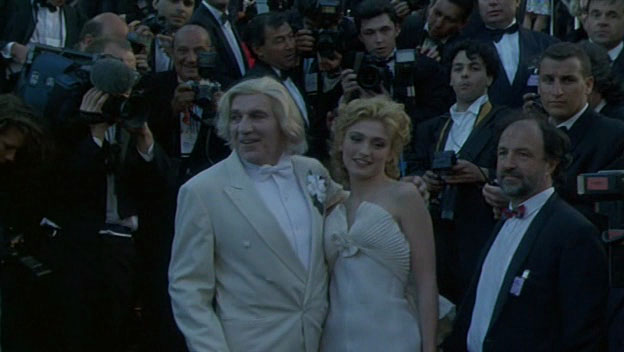
At Cannes:
image

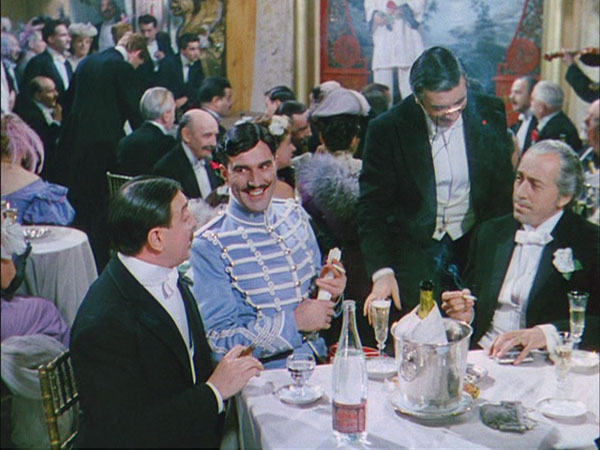
NY Times: “While covering so many bases, Ms. Varda never makes more than a glancing allusion to anything, and at times the film is such an overloaded grab bag that it grows exasperating. Or even baffling; for unknown reasons, Stephen Dorff turns up in a pantheon of great Hollywood stars.”
image

LA Times: “Michel Piccoli plays Monsieur Cinema, who embodies the history and spirit of film, and in particular, that Fabulous Invalid, the French motion picture industry itself. (Since Varda is such a playful director, Piccoli is sometimes simply himself.) Monsieur Cinema may have been inspired by the director of the landmark Napoleon, the late Abel Gance, whom Piccoli resembles when he puts on a long silver-white wig.”

Lumiere brothers:
image

Doctor Belmondo and Jack Nance:
image

image

image

It took me two or three years to finally watch The Golden Coach and then I loved it to pieces, so anticipation was unreasonably high for this one. At first it’s just another Renoir movie, light and magnificent even when being grim and serious, but as the plot threads started to mirror those of The Golden Coach (woman deciding between three lovers) it built to a similarly wonderful ending. So no, not up to Golden Coach standards, but close!

Jean Gabin:
image

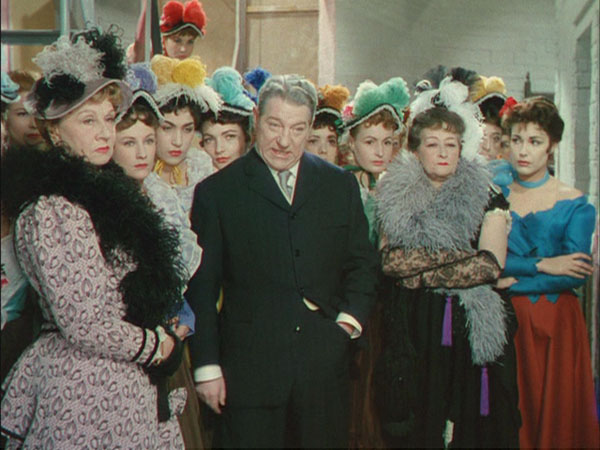
This was Renoir’s big return to France, his first French movie since the distrastrously received Rules of the Game, so he made a nationalistic crowd-pleaser with lots of dancing girls, just to be safe. In the late 1800’s, Jean Gabin (fresh off Touchez pas au grisbi) is having financial trouble with his high-class variety theater, decides to buy a new place and revive the low-class can-can dance as a popular middle-class spectacle. Calls it the Moulin Rouge, ho ho. Recruits and trains non-dancers including washwoman Nini and gathers old favorite companions including hot-tempered star dancer (and part-time girlfriend) Lola, famous whistler Roberto, and singing assistant Casimir, and gains financial assistance from a visiting prince.

Trouble: Nini is fooling around with Gabin, also has longtime boyfriend Paolo, and is also being courted by the prince. Paolo tells her it’s over if she dances the cancan in public, and she breaks up with the prince (leading to his suicide attempt), so she tries to stick with Gabin, under the condition that he see no other girl but her. His reaction:
image

So now, boyfriendless, she throws herself joyously into the dance, choosing art over a steady love life, the same ending as The Golden Coach but in exhuberant dance instead of a solemn speech. Wonderful! Can’t believe Katy didn’t want to watch this back when I kept suggesting it in the apartment. Anyway, I’ll gladly watch again when she changes her mind.

Color and sound and costumes are all brilliant. Acting is usually great, and when it’s not, Renoir keeps things moving fast enough that you can’t tell. I was surprised when Gabin wakes up in bed with Lola – I’d forgotten that you could do that in 1950’s Europe. His scene at the end is great, sitting backstage tapping his foot, imagining the action on stage, knowing all the steps and smiling without having to see. The Criterion essay (or did I read it somewhere else?) points out that this scene lets us know that he choreographed the dance and practiced it with the girls over and over without showing us the actual practices… very effective.

Françoise Arnoul (Nini) had previously appeared in Antonioni’s “I Vinti”, is still acting today
image

María Félix (jealous Lola) was a huge star in Mexico. Giani Esposito (the prince) starred six years later in Rivette’s Paris nous appartient.
image

Franco Pastorino (Paolo) died a few years later, only appearing in one more film.
image

This is the earliest Michel Piccoli appearance I’m likely to see (his earlier films are quite obscure). That’s him in the blue.
image

Cameo by Edith Piaf:
image

This is one of Buñuel’s anarchic sketch films (see also: Simon of the Desert, Phantom of Liberty) which he made in between his relatively more normal, subversive upper-class films (in this case between Belle de Jour and Tristana). I still think I appreciate his films more than I enjoy them, but the more of them I watch, the more I feel that his career is unassailable, that his last twenty years of filmmaking produced one long masterpiece. It turns out I had seen this before, though I barely remembered it. Must’ve rented the tape from Videodrome. Don’t think I finished it last time, because it got foggier around the halfway point.

image

Such a smart and well-researched movie, I don’t feel qualified to discuss it. I can discuss the cinematic aspects though. Good photography with no surprises, unusually long shots but not noticeably/showoffy long. Buñuel’s movies always feel the tiniest bit too slow for me, too perfectly calm and collected, the acting and sets and camerawork too high-quality for their content, which I suppose is the point.

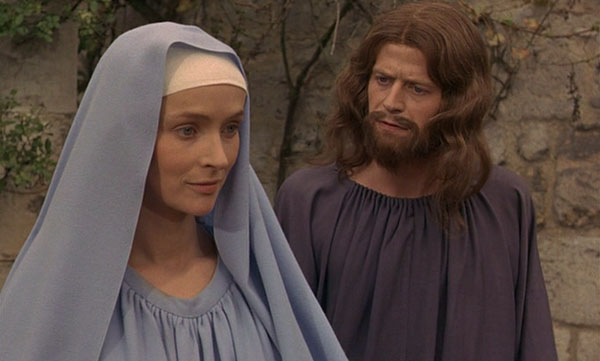
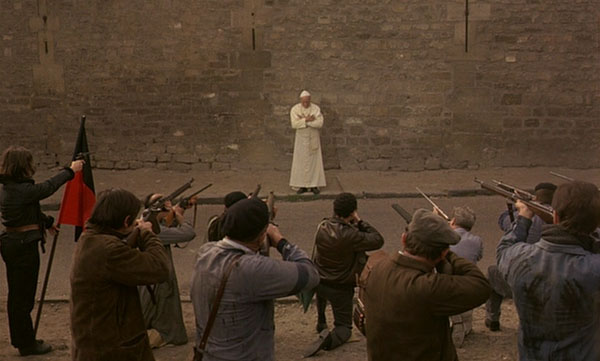
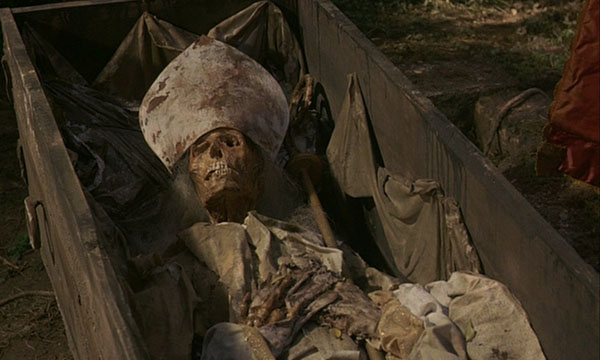
The plot is a “picaresque”, two beggars wander into various scenarios during their long walk from Paris France to a holy pilgrimage spot in Santiago Spain – although it turns out they’re not on a pilgrimage themselves, they just heard there’s a huge crowd in Santiago where they can get rich on spare change. Different historical periods and bible stories blend into their present-day 1960’s voyage without anyone batting an eye. They meet Satan(?), the Whore of Babylon, and lots of people discussing the six central mysteries of Catholicism and their associated heresies. They do not meet Jesus, the Virgin Mary, the Marquis de Sade or the Pope, but they’re all in the movie via sidetracks from the main action (though one could argue that it’s all sidetracks). Plenty of surreal moments keep the movie lively even when the dialogue is all obscure religious debate.

image

French cinematographer Christian Matras was about Buñuel’s age, had also shot most of Max Ophüls’ best films, also The Eagle Has Two Heads with Cocteau and Grand Illusion with Renoir. Co-writer Jean-Claude Carrière (also an occasional actor) worked on most of Bunuel’s 60’s-70’s stuff and over a hundred other movies, including recent ones like Chinese Box, Birth and Goya’s Ghosts. The guy who played Jesus starred in Rohmer’s sixth moral tale a couple years later. Virgin Mary Edith Scob was in Franju’s Judex in the 60’s, and lately in some Raoul Ruiz films and the newest by Olivier Assayas. Of the two tramps, the older would be in the next two of Buñuel’s French films, and the younger would star in Clouzot’s La Prisonnière and Godard’s Détective.

image

In the DVD interviews, Ian Christie tries to make us feel better for not knowing the historical references – he says nobody knew them. He got a press kit. The film was influenced by The Saragossa Manuscript, which sounds cool. “What heresy means for him is a kind of metaphor, I think, for human beings’ fascination with arguing about the immaterial, the invisible, trying to bolt it down and make it literal.” Screening when it did, it was alternately seen as cleverly reflecting or having nothing to do with the political and social upheaval in late 60’s France. Interview with the writer and documentary on the DVD are both pretty alright, nothing that needs repeating here.

Our two bums with the whore of babylon:
image

Michel Piccoli as the Marquis de Sade:
image

Alain Cuny as the mysterious walkin’ guy:
image

L’Age d’or reference:
image

Resnais’s fourth feature, coming out the same year as Rivette’s The Nun. Watched this once before and have practically no memory of it, so this time I read the screenplay then watched again. By doing so, and by watching it alongside the other Resnais films I’ve seen this year, I’m sure I’ll remember and appreciate it more than I did before, but it also makes me wonder about the nature of Resnais’s art, because he has filmed Spanish writer Jorge Semprún’s screenplay word for word and shot for shot. Semprún describes flashback cuts and actors’ facial expressions, and there it is on the screen. The film isn’t as poetic and dreamy as Resnais’ other films of this period, but it definitely fits in with them, has a similar feel, plays like the work of the same artist. The book felt more tense, and the movie felt more melancholy, like a somewhat lighter Army of Shadows.

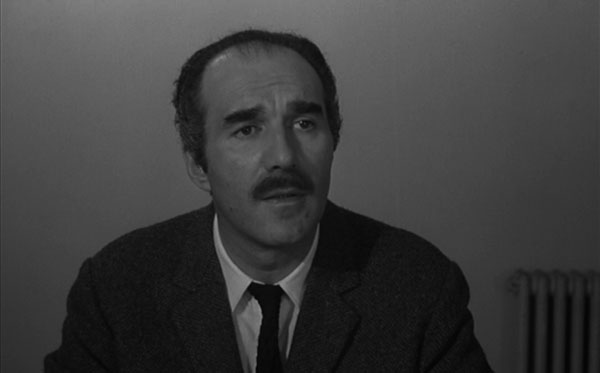
Story takes place across just a couple of days (not counting flashes-backs-and-forward) in Paris suburbs, two weeks before a planned protest and strike in Spain. Diego aka Carlos aka Domingo aka The Passenger (Yves Montand, halfway between his starring roles in Let’s Make Love and Tout va bien) returns from Spain to warn his underground anti-Franco activist organization (led by chief Jean Dasté) about the recent police crackdown in Madrid which led to the arrest of some operatives including one good friend. Diego wants to warn his other friend Juan away from returning to Spain, but Juan is already on his way to Barcelona. Diego was himself detained at the border, his false passport inspected by Customs official Michel Piccoli, which leads to complications later. Diego lives (on the rare occasions when he is back in France) with lover Ingrid Thulin (a Bergman regular who is wonderful in this movie) but he also half-heartedly messes around with a young Geneviève Bujold, daughter of the man whose passport he borrowed and herself a revolutionary, but with a younger group that practices impatient and violent means of returning Spain to her mythical (never existent) past Marxist glory. Diego and his group (incl. pro smuggler Jean Bouise, who later played Warok in Out 1) resent that Spain has become a symbol of the radical left but without any definite progress, that they’ve lost more and more comrades promoting these strikes and protests which are never as widespread or effective as intended. They continue their struggle, workmanlike but without much hope… a tone more fitting (in France) for the mid 70’s than the mid 60’s. Interesting that this came out right when Resnais’s contemporaries were about to turn to politics, then he followed it up with the much less political Je t’aime, je t’aime.

Writer Semprún later adapted screenplays for Costa-Gavras and wrote Stavisky for Resnais. He must be the only non-English speaker to receive TWO oscar nominations for writing. Shot by his regular guy Sacha Vierny with music by Giovanni Fusco, an Antonioni regular who died of a heart attack in May ’68.

The movie is called “stylistically orthodox” and “one of his most accessible films.” It’s not reportage-style realism, just straight drama, which never feels heightened by technique even though there are some signature smooth tracking shots and the love scene with Bujold is downright expressionist. I found the look and the camerawork to be more Muriel than Je t’aime, but of course the editing is completely unlike either of those.

Time Out: “Perhaps it is the film’s directness and obviously dated aspects (middle-age male angst faced with effervescent feminine adoration having become such a staple ‘art movie’ subject) that have made it seem a minor item in an often challenging director’s career.”

Harvard: “A series of premonitions told in flash-forward near the film’s conclusion make powerful statements about memory and aspiration, commitment and faith.”

A. Agarwal: “The film ends in inevitability. Thulin, the mistress whose devotion sometimes makes Montand uncomfortable yet at peace with himself, learns Montand is going to be sucked into a trap, and she starts out to let him know and save him from crossing into Spain. The film ends here, yet there’s a shadow of death over it. Either Thulin will not be able to save Montand, or she will be able to save him and Montand will quit this life and spend the remaining part of it trying to make peace with himself and his country.”

Michel Piccoli
image

Jean Daste
image

Warok
image

Genevieve Bujold
image

Thulin & Montand
image

image

“It’s in my style as homage to Bunuel’s style which is very different.”

Very spare, a couple talky dialogue scenes but mostly quiet, with pillow shots of Paris at night between scenes. Opening titles at the symphony, Husson spies Severine, out to the street, to a bar. Her hotel, a near miss. Back to the bar, Husson confesses what’s on his mind to the bartender – this scene must contain over half the dialogue of the film. Another chance meeting on the street, an invitation to dinner. At dinner Severine wants to know one thing, but Husson plays around, doesn’t tell her. She storms out. A chicken! He pays the servers from her forgotten purse, they clean up after he has left.

Piccoli (right) with the director’s grandson Ricardo Trêpa
image

Bulle Ogier also acted in Bunuel’s Discreet Charm
image

Piccoli, reprising his Belle De Jour role, was in a pile of other Bunuel films
image

N.D. Carlson of Cineaste has a compelling explanation for every part of the film: why it works and what it means… a wonderful analysis.

Sam, as usual, sees something I don’t see, even when I’m seeing what he saw, since it was his favorite narrative film of the year.

M. Dargis calls it “an act of critical violence.”

J. Rosenbaum calls it a “sequel-or tribute, or speculative footnote … more about class and less about sexual desire”

M. Piccoli: “Very often, cinema is indecent. What characterizes Manoel de Oliveira and Bunuel is their reserve. But don’t get me wrong: this reserve allows them to explore the most secret gardens of our existence. They are very modest but very immodest when it comes to shaking the imagination of the audience.”

image

I was looking forward to this, due to my recent Rivette obsession, but didn’t expect to love it, since it’s a period piece about upper-class people unable to declare their love for each other because of societal restrictions, and I tend to hate that kind of story. It’s nice to watch fave Rivettian actors Bulle Ogier and Michel Piccoli and Barbet Schroeder (all sharing a scene) but they’re hardly in the movie and they play gentle, wise elder friends and relatives, with a bit of dialogue but no passionate acting showcases. I got my Rivette themes and trademarks served up: conspiracies, secret rooms, performance (explicitly at the convent, but throughout as the two toy with each other), real locations with creaking wood floors, oceanside drama, but all enslaved to this book-to-film adaptation of Balzac – something that I thought Rivette just said he’d never do in the DVD interview on Belle Noiseuse, that he dances around Balzac in his film writing (that one and Out 1) because a direct adaptation would be impossible. In the story, Montriveau is one of the notorious 13, but the name of the group is never stated here. Anyway, we also get very good performances from the leads – Guillaume Depardieu, lookalike son of Gerard who once played his dad in flashback in Les Misérables, with his false leg used to great effect here on the wooden floors… and Jeanne Balibar, who I don’t remember from Code 46 or Clean, and haven’t seen yet starring in Va savoir.

Not much outward passion to the movie, emotions seem detached (I know, that was the point, sorta) but it has a quietly affecting ending aboard Montriveau’s ship after he breaks into the convent and finds the Duchess dead. The plot being easy to follow, I started paying attention to nerdy cinema stuff like the quality of light (all supposedly from sunlight and candles) and the sound (music used very sparingly, as usual). Sound was rough because of the loud hissing and gurgling noises coming from the ceiling at the Landmark, and picture was even rougher since the film was projected out-of-focus (except for the left third of the screen, which looked lovely). So it was easier to measure the quality of light than, say, the details of costumes and decor. I’m not much for decor anyhow.

Definitely closer to Hurlevent (Wuthering Heights) than to anything else I’ve seen Rivette do. At least I learned how Duchess of Langeais is pronounced (vaguely: “lawn-jay”). This Balzac story was previously filmed a few times, from a 1910 lost silent to a 1995 TV version adapted by the co-writer of Goya’s Ghosts.

————
Excellent analyses found on other sites:

E. Howard:

Games are the film’s central conceit, in fact, whether they be word games, mind games, literary games, games played between appearance and feeling. The game being played at the narrative level takes place between a General and a Duchess … But this is only one game that Rivette is toying with, and he plays an entirely different one with the audience, a game of subtle winks and sly nods that continually disrupts the placid surface of the narrative … This narrative disruption is mirrored in the way the General’s story to the Duchess, about his time lost in the desert after escaping from the enemy’s imprisonment, is continually interrupted, usually by the listener’s short attention span and her tendency to divert the flow of the conversation just as the story is reaching a critical juncture. This results in the General’s story being doled out across three successive evenings that they spend together early in their relationship. On the third night, as they settle in to continue the story, Rivette frames the Duchess in a tight closeup as she asks her would-be lover to finish the tale. At this moment, she turns a sly sidelong glance directly into the camera, maintaining eye contact with the audience, as though to include them in the game.

This game of narrative interruptus is also carried through in the way Rivette uses the text of the film’s original source, a novella by Honoré de Balzac. This is a rigidly faithful adaptation… with texts from the novel periodically included as intertitles to highlight certain moments or get at the characters’ internal states. The titles are also used to convey the passage of time, which is parceled out in scrupulously precise measures: “one hour later,” “twenty-two minutes passed,” “she waited twenty-four hours.” These titles often seem to abruptly cut off the action, sometimes flashing up on screen when, after a long scene of near-stasis, a character is right in the middle of completing the scene’s first real movement or action (most often: leaving the room). The passage of time, like everything else in the film, is subject to Rivette’s subtle humor. After the Duchess kicks her friend out of her house, a title informs us that it one hour passes (a very common interlude), and surprisingly in the very next scene there’s the General again, still standing in her parlor, walking around it aimlessly, looking like only five minutes has passed since she ordered him to leave. Rivette’s use of these titles is obviously very sardonic and mannered, as when he uses a long series of images of the Duchess at a party as though it constituted a clause in between two dashes in a sentence: “the Duchess searched for him —” followed by the visuals and then, when the dangling phrase had almost been forgotten, “— in vain.”

J. Romney:

Characterised as a sort of Napoleonic wild beast ill at ease in the tameness of Restoration Paris, Armand – a general newly returned from Africa who initially fascinates married duchess Antoinette with stories of his exploits – is associated from the start with the great outdoors, prowling Mallorca’s windlashed ramparts, while Antoinette is first seen doubly imprisoned, in nun’s cowl and behind a grille.

The film is largely set in a series of enclosed salon and boudoir interiors, an overtly theatrical domain in which Antoinette is a surpassing mistress of mise en scène. Preparing for Armand’s first visit, she arranges herself for maximum effect on a canapé, in discreet déshabille, ordering her servant to lower the lighting (the thematics of light and heat later extended in the fireplace that Armand pokes with barely contained sexual frustration, and in the brand with which he threatens Antoinette).

As actress, Antoinette is skilled at the well-timed entrance and exit, whereas Armand habitually arrives too early, or storms inopportunely into the star’s dressing room. It is part of Armand’s revenge that he at last masters both mise en scène and performance, in a startlingly excessive scene that replaces Antoinette’s poised comedy of manners with a lurid melodrama: in it, he plays a menacing Byronic ravisher, supported by masked men hovering around a brazier. This sudden eruption of violence in the middle of an analytical drama may seem wildly incongruous, yet the tonal discontinuity comes directly from Balzac’s story, and Rivette achieves the seemingly impossible in making such a disjunction work convincingly on screen. The violence at the heart of the story, together with its cautionary-tale aspect, is foregrounded by Rivette’s reversion to Balzac’s original title for his novel. The reference is to a veiled warning that Armand gives Antoinette, the axe being the English one that beheaded Charles I – the implication is that the reckless cause their own downfall. In reality, however, Armand himself figuratively wields the axe that will destroy his own chance of happiness.

D. Kasman:

How strange that a filmmaker who through the years has so loved process, often in terms of acting and theatre, of seeing the expression of things worked out awkwardly before us, and conspiracy, in terms of the hints that everything out there, out of sight and out of the film frame, may be connected, has decided to adapt a reserved, 19th century historical chamber romance. Oh, but with such a surprise we then get to engage in the pleasures of the hunt! For then we find things like this: how is the navigation of social rules and norms—a very real thing with a very allusive existence—like the theatre and how is it like a conspiracy? Well, it is not without reason that Rivette opens the film at the melodramatic peak of the couple’s aching separation—the Duchess a nun on a remote Spanish isle and separated from the General by the convent’s metal bars—and then transitions and flashes back five years to the couple’s meeting and affair through two sweeps of a theatre curtain. The stage then is not the actual island (filmed on location), but is the interiors of the Restoration period, in all their glory, wood boards creaking like an empty stage. …

It is like a game played again and again with different moves but the same results, the repeating drama inside the haunted house of Celine and Julie transposed to thinking, feeling participants. The drama exists in a hanging kind of closed-off world, all frustrated performances that are almost content, as the playfulness and acting gets close to true expression, true connection. But something holds everyone back, holds the drama back, holds the love back, and gradually both General and Duchess become obsessed with this vague, menacing limitation, a mysterious stopgap to happiness that can neither be seen nor surmounted.

Whew, I love all these themes that get read into Rivette’s work. I always wonder whether he’s aware of them and consciously shaping his films in this way, or if the themes are unintended and they are more or less created by the critics, or if they’ve just become a part of his creative process, so much that he doesn’t think about them as consciously as he used to, and they become more subtle and have to be drawn out by a viewer well familiar with his previous films.

D. Ehrenstein:

The film is “dryly funny. Especially so when “the 13” make their appearance in the last act, looking more like a left bank version of the Keystone Kops than a fearsome secret society.