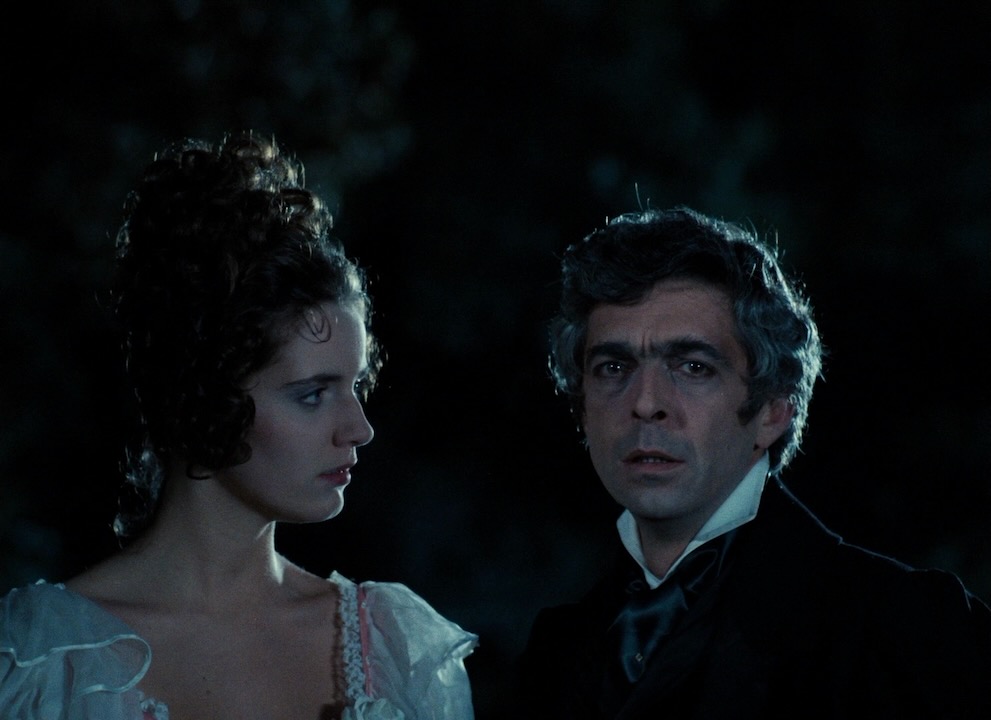
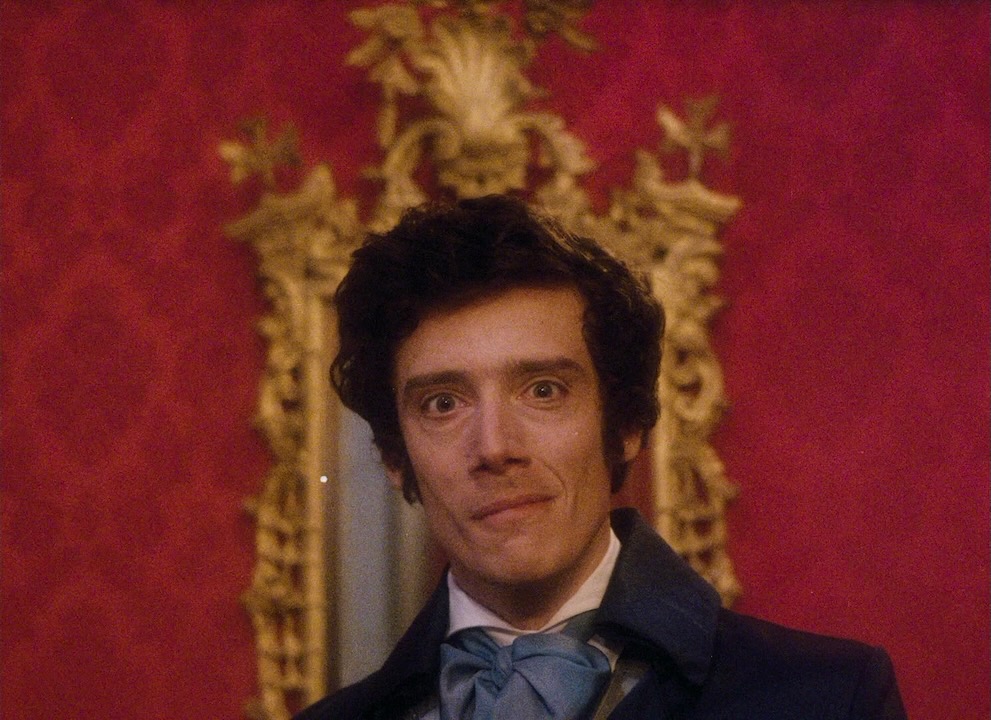
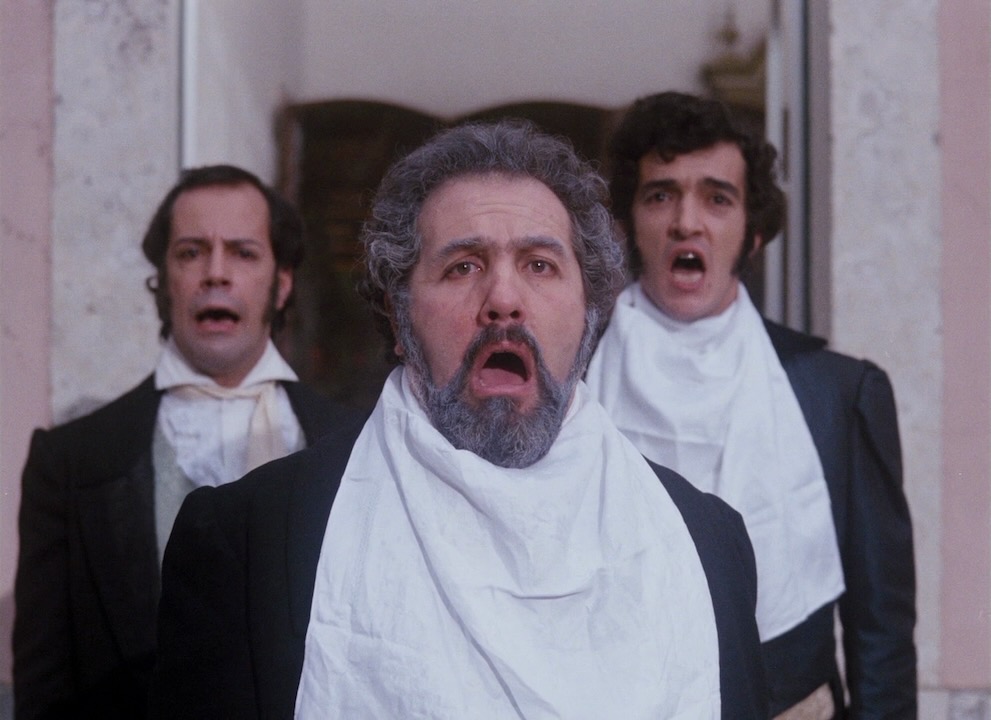
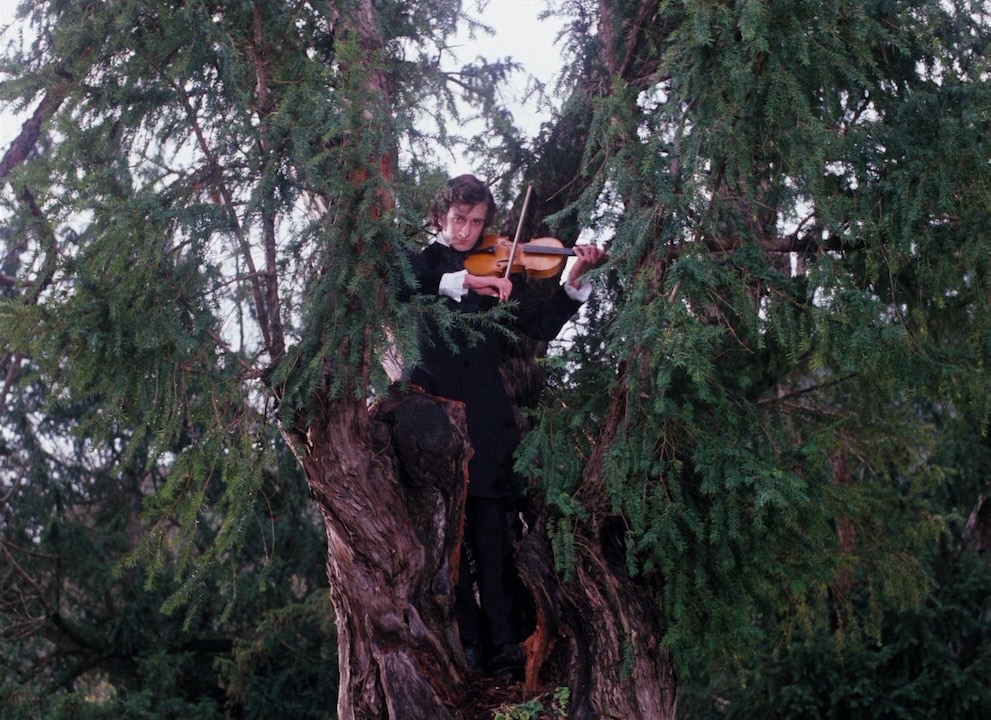
Leonor falls in love with goth Luis Miguel, then is surprised when he acts all goth on their wedding night. The mismatched couple acts all doomed and stoic, allowing her stalker Diogo Doria and the narrator Oliveira Lopes to be pop-eyed loons in the opera’s background.

I had decided that the title must be a metaphor, but for what? Then at the end of the second act, all the lead characters kill themselves, and a new group of men is introduced, who eat Luis Miguel, thinking him part of the bridal party feast after he’d hurled his own limbless torso into the fireplace.

Watching Oliveira films mainly makes one wish to watch more Oliveira films. Looks like good options at the moment are: the earliest stuff through 1964, the latest stuff post-Belle Toujours, and Party – everything else apparently has new restorations that aren’t out on video yet.

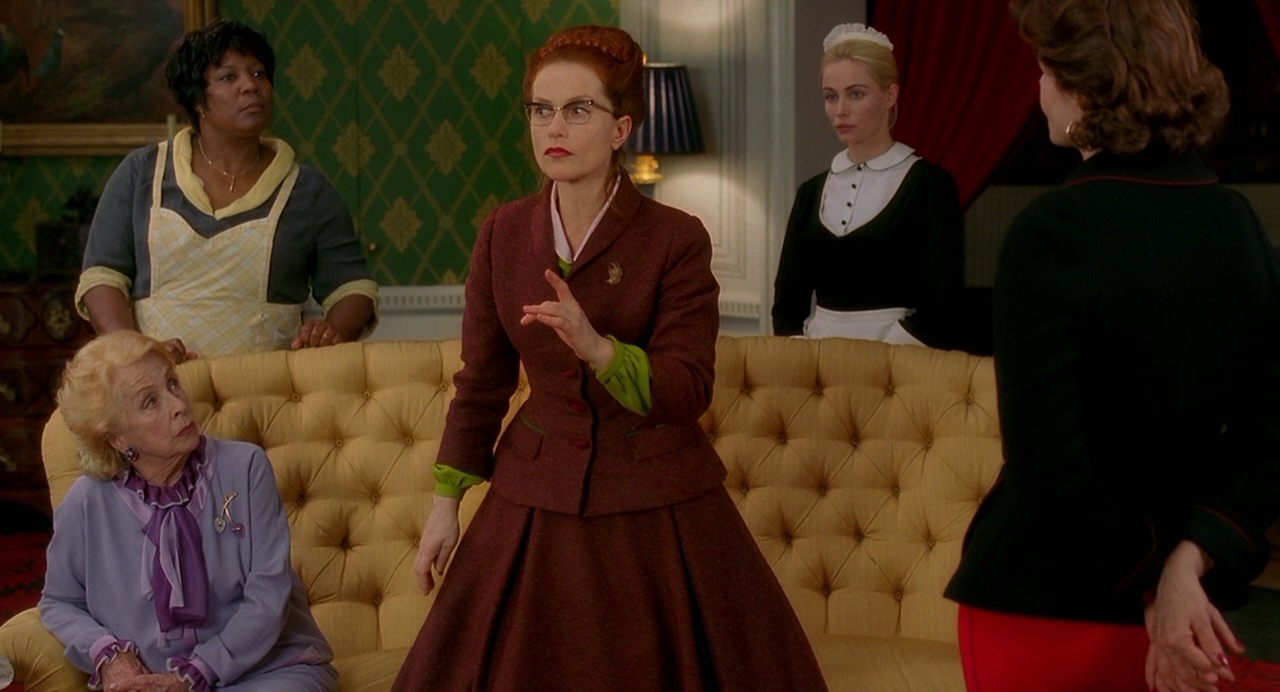
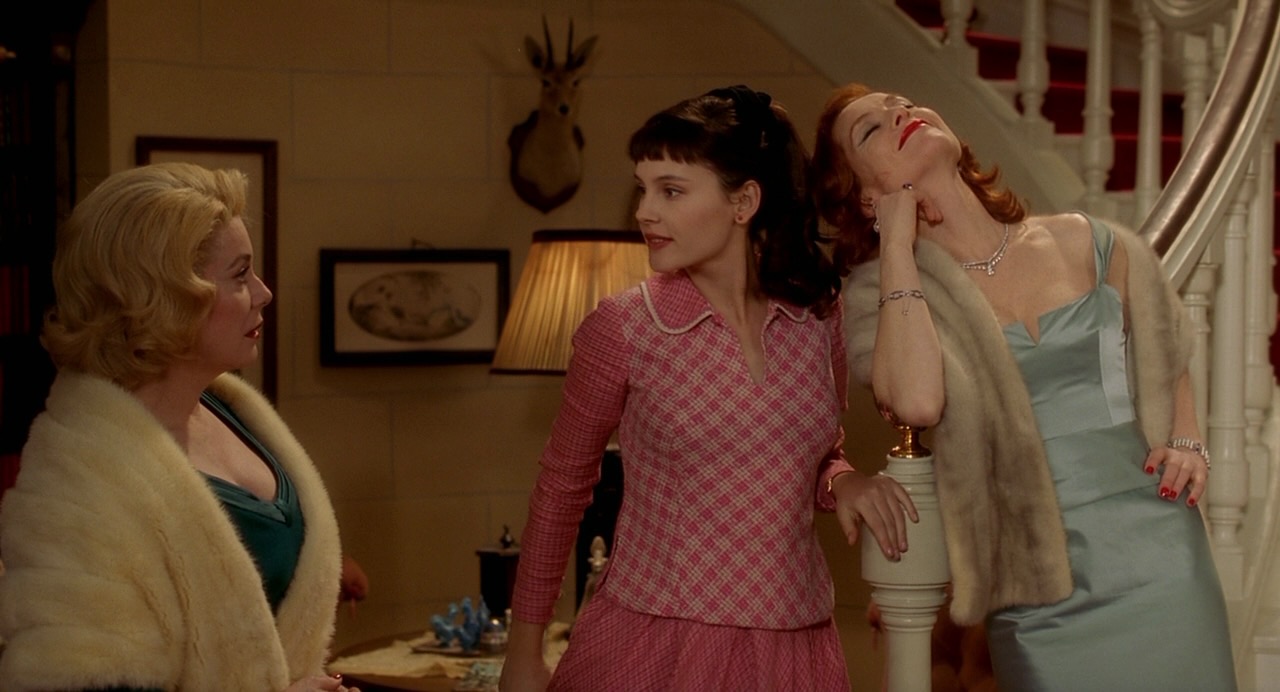
Lovely and delightful, a bunch of the greatest actresses in a color-coordinated single-location murder-mystery musical. I take it Ozon isn’t always good, but I’m thankful to discover that he was ever this good. The ending is a bit cruel (you shouldn’t shoot yourself in front of your kids).

Won a cast award at Berlin (you bet it did). Victim’s wife Deneuve appears here after a couple Ruiz films and in between a couple Oliveiras. Her weirdo sister Isabelle Huppert was also following a great Ruiz, in between a couple Hanekes. Their mom Danielle Darrieux had been playing Catherine’s mom since The Young Girls of Rochefort. Chef Firmine Richard was in an early film from the director of Indigenes which nobody appears to have seen. Suspicious new maid (they’re all suspicious, but come on) Emmanuelle Béart was a decade past La Belle Noiseuse and about to star in Story of Marie and Julien. Victim’s flighty sister Fanny Ardant looks the same as she did in the 1980s Resnais films, played Maria Callas this same year. Older daughter Virginie Ledoyen had already been murdered by Huppert in The Ceremony and more recently played the hotgirl in The Beach. That leaves young Ludivine Sagnier, who would return in Ozon’s Swimming Pool, and get to sing again in Love Songs.

Huppert’s transformation:

Trancefilm, eases you into slow rhythms so you get alternately fascinated and bored. On one hand it’s a musical and I love it, on the other it’s about paramilitary violence and I was sick of that subject before pressing play. I had a few small beers, spaced out a little, and how’d we start hanging out with this drunk poet? Watched this movie featuring a Janus-headed military leader in anticipation of seeing Lav’s Magellan in theaters (a Janus Films release).

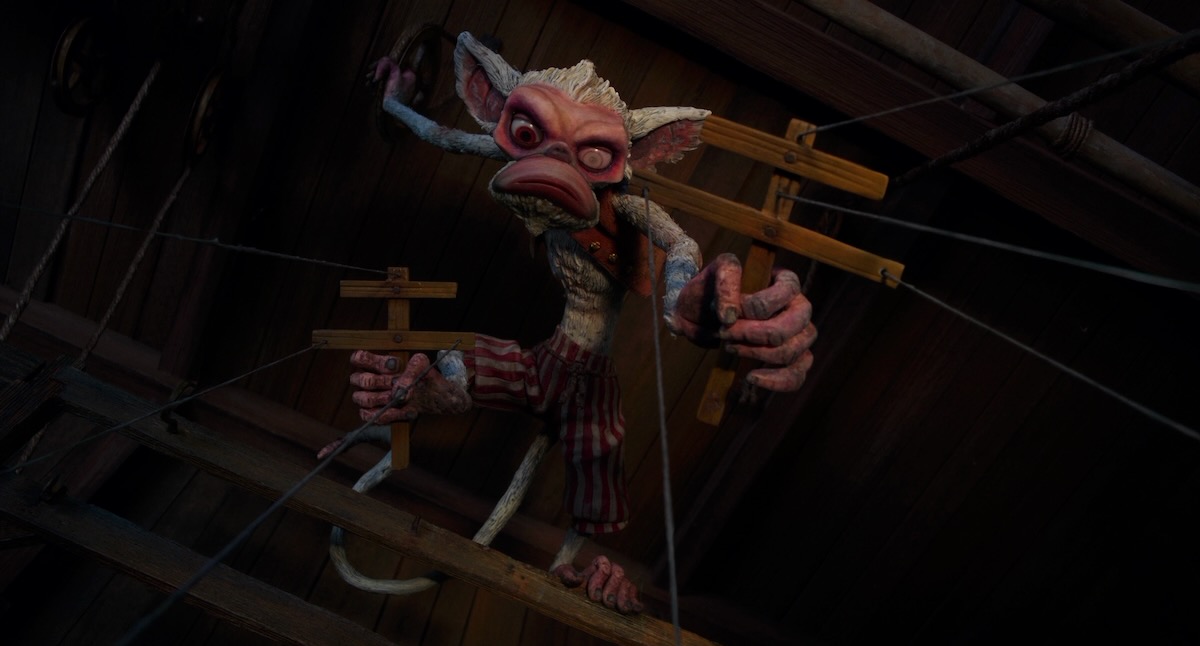
After Don’t Look Now and The Church, I’m on edge when there’s an artist on scaffolding in a movie. Pinocchio (the puppet) is a real horror, created in a drunken rage. Fascists insist that P go to school, but carnie Christoph Waltz wants to kidnap him into the circus instead.

When you are being puppeted by a monkey:

The technical “perfection” doesn’t work in the movie’s favor – it doesn’t look handmade, but composited. Feels like the voices are on one plane, visuals on another, and they are not in unison. At least Waltz (who cannot pronounce Italian names) is having a flamboyantly good time. And have I mentioned it’s a musical for children?

Have I mentioned Pinocchio is Jesus Christ:

When you meet Dragon Cate Blanchett in the afterlife:


Rudolph the Red-Nosed Reindeer (1964, Larry Roemer)

I had never seen this before, at least not in living memory. Mildly distressing to discover it has better songs, better voice acting, and better stop-motion than the Guillermo. Nobody ever talks about the team’s follow-up, a James Cagney Smokey the Bear movie.

Billy Woods released the best album of the year, and on the eve of his followup Mercy he surprise-releases a remix album and accompanying video. I had a very good time watching it.

In a blog first, K took a gowillog pilgrimage to Mork’s and brought back this photo:

A mall-set musical. Nobody respects horny young Robert, not his girl Lili at the salon across the aisle, not even his parents who run the clothing store where he works. Lili waits until Robert is about to marry her coworker Mado before running off with him. Meanwhile his mom has her own drama, bumping into long-lost American lover Eli, who wants her back, while she focuses on running her shop and barely gives him the time of day.

Reluctant salon owner Lili played the lead in a Vicente Aranda movie.

Jean (Jean-François Balmer of Cosmos) owns Lili’s hair place but she doesn’t love him, so he finally wrecks the place in a rage and sells his lease to the neighbors.

Robert’s mom Delphine, post-makeover, with Eli: American director John Berry, who made He Ran All The Way with fellow blacklistee John Garfield

Pascale Salkin (left, the girl who isn’t Maria de Medeiros in I’m Hungry, I’m Cold) bounces between plots, and is the only person in Golden Eighties to also star in The Eighties, which is somehow not out on video. Would-be fiancee Mado later appeared in Carnages. Nathalie “Conann” Richard played a nameless hairdresser coworker of theirs, and neighbor Sylvie who runs the snack shop was in films by Demy, Varda, Sautet, Ozon, Lelouch, etc.

Robert’s dad has the best voice of the men here (Charles Denner aka The Man Who Loved Women). Delphine Seyrig would only star in one more feature – Joan of Arc of Mongolia – before dying of cancer at 58.

Terrible host segments as usual, misguided efforts at diversity, then it settles down into a clip show of dance scenes from classic movies and all is well. Happy to see Bojangles Robinson, whose statue I drive past on the way to the movie theater.

Rewatched for the first time since theaters.

I’ve been reading the Adam Nayman book on the Coens:

Nothing in the film is “original” except for the reconfiguration of elements, which is why the opening citation is more honest than it seems and, in its way, a signifier not of smarminess but of humility. The nod to The Odyssey admits that any artist in the Western tradition owes some currency of debt to Homer, and that to mount any story about homecoming is to reconnect with the roots of storytelling itself – to return to the primal scene.

Nayman:

“If it’s not new and it never grows old, it’s a folk song,” quips the hero of Inside Llewyn Davis, which is O Brother, Where Art Thou?‘s spiritual sequel. Taken together, the two films clarify the Coens’ relationship to a musical genre founded on familiarity. For filmmakers perpetually interested in circles and circularity, the cyclical proliferation and popularity of folk and bluegrass standards – songs largely without cited authors, passed down and performed by different singers through the generations – serves as a potent analogue to their thematic preoccupations.