“If you strangle me, don’t stop midway. It’s too painful afterward.”

image

Kichi runs an inn, makes explicit advances on one of his workers. They begin passionate secret, explicit, OH-so-explicit sexual affair. Eventually he leaves his wife, the girl (Sada) and he move in together having continual sex, the sex gets more dangerous and starts involving knives and choking, and finally he lets her strangle him to death.

I liked Empire of Passion so I thought I’d like Oshima’s celebrated, scandalous arthouse porno even more, but was surprised not to. It’s got less cinematic flair than Passion, and less of a story too. I hate to say it, but all that sex gets boring after a while. Okay I take it back – there’s interesting stuff in here… some cool high shots (see below), a wildly fucked dream sequence where the woman grabs a naked six-year-old’s penis and won’t let go, a geisha gang rape, and some political business (nationalism on the streets, an army march – this is the year before the bombing of Shanghai) completely ignored by our sheltered protagonists, making me think this is a predecessor to Bertolucci’s The Dreamers.
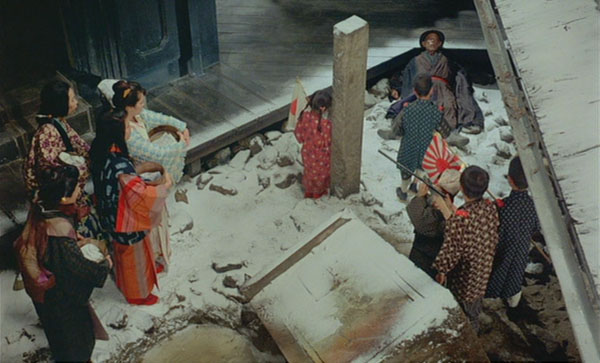
image

Finally, a ridiculous closing voiceover tells us this happened in 1936 and she was arrested a few days later. I thought this was wedged in by the producers, but in his excellent commentary, Tony Rayns tells us that’s Oshima’s own voice.

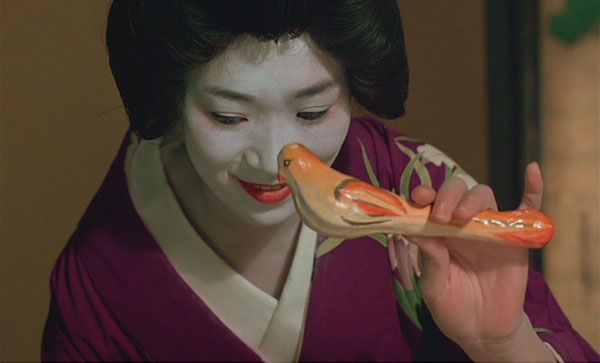
There’s more weirdness involving an egg, pubic hair consumption, fantasies of Sada killing Kichi’s wife, and a quirky dancing man. The girl has a scorpion tattoo on her ear – Tony didn’t tell us the relevance of that, so perhaps it has no relevance, because Tony knows all. The two have a fake marriage ceremony at an inn (not his inn, this is after they’ve run away) which leads to the geisha gang-rape and the quirky dancing man (below). I am already out of things to say… it’s a pretty simple movie for something so controversial.

image

Produced by Wakamatsu Koji (United Red Army), produced and suggested by Anatole Dauman (Hiroshima mon amour, Masculin Féminin, some Walerian Borowczyk features, Fruits of Passion, La Belle captive, Wings of Desire and Marker’s Level Five – wow).

Original title was Empire of the Senses. I assume the Mekons song Empire of the Senseless, with its lyrics about censorship, is referencing that. Oshima’s chosen Japanese title Ai no corrida (translated: Love’s Bullfight) looks to me like Spanish for Hey! No Running.
image

Tony Rayns:
“Oshima sees himself as standing apart from the consensus. For him, anybody who breaks the bounds of convention, anyone who dares to think for him or herself is in some sense an admirable figure,… hence an overall focus, I think, on the figure of the outlaw in many of his films.”

Most of the people in the film are women, including all the voyeurs (and there are many voyeurs). At the very beginning, a woman tries to initiate some lesbian sex with our hero and is rejected outright. Tony tells us these things explicitly delineate Senses from standard porn films.

image

More Tony:
“No two Oshima films look alike – there is no thing as the Oshima style.”

The geishas all falling upon each other as Sada has painful menstrual sex is “not a realistic detail.”
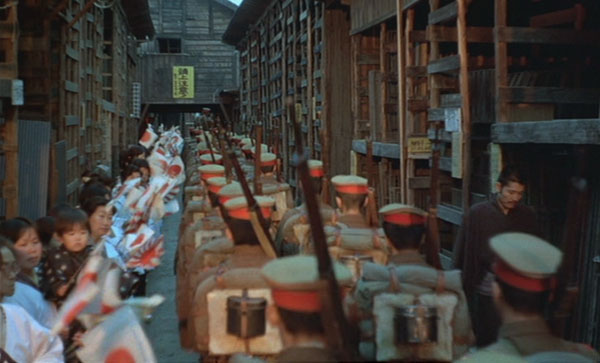
image

Girl who played Sada appeared the next year in a Kinji Fukasaku film with Sonny Chiba, otherwise not too many acting roles, while Kichi became a fairly successful actor. Typical. Although he was also a known actor before this, while she was just starting out in movies (previously in Terayama Shuji’s theater group). The actor playing an old tramp (glimped in the top screenshot) played the father in Kaneto Shindô’s Naked Island. Oshima didn’t finish his l’amour fou trilogy, and only made three more features and a couple documentaries over the next twenty years.
Seki (Kazuko Yoshiyuko of Lady Snowblood 2, Kikujiro) is married to a decent guy, the town’s rickshaw driver Gisaburo (Takahiro Tamura of 24 Eyes, Seisaku’s Wife), but young Toyoji (Tatsuya Fuji, the killer’s father in Bright Future) falls in love with her and ruins all that. One night, in an unexpectedly frank bit of sexuality (later note: not frank at ALL after watching In the Realm of the Senses), he’s going down on her and orders her to shave. A couple hours later he matter-of-factly tells her that since she’s shaved, her husband will suspect them, so they’d better kill him. So they do, strangling the guy and dropping him down a well. Three years later the townspeople haven’t seen their taxi driver around but his ghost has been spotted, Toyoji seems to spend an awful lot of time at Seki’s house and is seen lingering at the well, Seki’s daughter is asking questions and nobody doubts what’s going on… only a matter of time before the cops (led by Takuzo Kawatani of The Burmese Harp and Battles Without Honor & Humanity) catch up and hang ’em. But things get worse before that – Toyoji kills the young master of the property where he works and Seki goes blind.

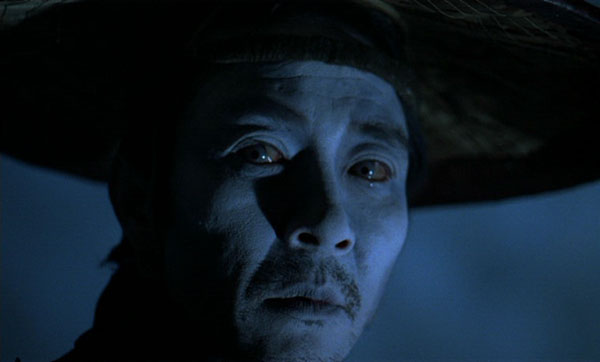
As with Senses, this is based on a true murder from 1896. This one has more town life in it, more theatrically heightened colors, maybe more traditionally studio-looking shots. A very Japanese (pre-Ring) ghost, Gisaburo dressed as he was when he died with an all-white face, wordless. Some wonderful shots from inside the well, as seen on the box art. I failed to get screen shots, so I’ve stolen a couple from DVD Beaver. I liked the movie a whole lot… not a groundbreaking story, but well told with a nice visual style.

image

If I may quote heavily from Tony Rayns’ great essay:

What intrigued Oshima so much in the story of Gisaburo and Seki? First and foremost, the fact that it bore witness to an eruption of amour fou in a social setting where such passions were previously unrecorded. Western literature from the Middle Ages to the nineteenth century—from Geoffrey Chaucer to Émile Zola—had acknowledged and explored the sex lives of the rural peasant class, but there was no real Japanese equivalent; the bawdy fiction of the Edo period had dealt exclusively with the love lives of the samurai and merchant classes. Oshima responded to the factual account of a torrid affair between a married mother of two and a recently discharged soldier twenty-six years her junior. … He recognized the story as an interesting counterpoint to the one he had told in In the Realm of the Senses. Sada and Kichi had retreated from the increasingly militarized Japan of 1936 into a private world powered by their own sexual fantasies; Seki and her lover, Toyoji, lived out their adulterous passion in a world circumscribed by the laws of nature and the rural traditions of village life. For Oshima, the key element in the story was their defiance: the realization that their affair and their murder of Seki’s husband would be exposed rekindled their passion and made them recklessly indifferent to their punishment.

Oshima has said that he reads the tradition of vengeful spooks as a phenomenon related to the militarist code of Bushido—which he has always vehemently rejected. He sees Gisaburo’s ghost as coming from somewhere very different; he once told me, “The ghost in Empire of Passion is a farmer’s idea of a ghost, not a samurai’s.” Gisaburo, in fact, accepts his sad fate as passively as Kichi succumbed to Sada’s murderous fantasies in In the Realm of the Senses. He doesn’t return to the village as a ghost because he wants revenge but because he’s an unquiet spirit; he appears beside his old rickshaw because he wants to go on serving his wife and the villagers, and beside the hearth in his old home because he still wants the comforts of a pot of warmed shochu liquor. He represents, of course, the guilty conscience of his murderers, not assuaged by emptying dead leaves into the well where his body was dumped, and the collective disquiet of the community that a crime has gone unpunished.

Where is Oshima himself in all of this? … The figure he is closest to is the village’s young master, who also represents the author in Nagatsuka’s novel; he’s the most educated person in the community, the most clear-sighted, and the most ineffectual. First seen at his wedding ceremony, he’s played by Kawarazaki Kenzo, the same actor who stood in for Oshima in the tortured family saga The Ceremony. The young master stands for modernization and “progressive” ideas, but he’s fated to be silenced by an ex-soldier who can think no further than self-preservation. The character’s death suggests that the pessimism that led Oshima to abandon filmmaking in the early 1970s was undimmed.

image

Oshima:

The space in Senses was delineated by the different rooms of love. It was artificially created, completely designed for voluptuousness. On the other hand, in Passion it is all about nature. Seki has a house where she lives with her husband, and Toyoji a small hovel that he shares with his young brother. Neither of these places is artificial. The two lovers live in fear because they constantly feel threatened by nature. I am trying to depict the human condition in its primal stage. In that sense, my new film goes back to the roots of all life, much more deeply than Senses ever did. The lovers seem cast into hell because of their sexual urges, but in my opinion, the rumbling of the earth, the murmur of the wind, the rustling of the trees, the songs of the birds and insects, in short, all of nature, is guiding the couple into hell. And the ghost itself is part of nature. Neither sex nor love has any meaning. Life itself has no meaning. And if it doesn’t have meaning, isn’t it hell? All I can do is express and project before you this human life devoid of any meaning, this hell that for me is always beautiful.

I found, several years after directing my first films, that I was very attracted to these two topics, sex and crime. Subsequently, my films have addressed them in a very analytic way. Today, I’m at a stage where I simply like to project the naked reality of sex and crime before the spectator’s eyes.