Clint was just innocently farming when some assholes come along, steal his wife, murder his kid and burn down his house. Cue a training montage! The assholes are a murderous rogue group in the union army, so Clint joins the confederates. Cue a war montage! The last of the confederates surrender when the war is over, and while pledging their loyalty to the revived union they’re all gunned down. Clint sees this, chain-guns 100 unioners, and goes on the run.

“After I get to likin’ someone they ain’t around long.” A dumb blunt movie, Clint now wandering the earth, gathering traveling companions (wide-eyed Sandra Locke, doomed kid, The Chief), tending to arrive at some conflict or another just in time to dispense cold justice. Clint’s fifth movie as director, and the earliest I’ve seen by a decade. Confed troop leader Fletcher (Killer Klowns From Outer Space) is allowed to live, Evil Unioner Terrill (Deliverance rapist typecast as a violent hillbilly) killed on his own sword.

Viggo Mortensen is searching for his missing daughter again, this time as a killer in a b/w Western. Presumably this is a prank on those of us who wanted another Jauja, because after a half hour Viggo’s movie is shrunk down to an SD TV movie and ignored like Danny Glover in Bamako, and instead we follow a Native American cop on her rounds, and then… I think her niece gets transported by a CG stork into a dream-recounting ceremony where a young man stabs somebody then tries to escape.

Shot:

Reverse shot:

“Each story explores questions of indigeneity and its reaction or resistance to the imposition of Western law and order” – Jeff Reichert works through the cinema/myth/dream journey on Reverse Shot, and Alonso has no fucks to give in his Cinema Scope interview.

From Bamako to Dead Man:

Prieto: “I used a LUT that emulated the beginning of color and still photography.” You do the best you can in the times you live in, and in Flower Moon and Hugo, Scorsese is idolizing early photography while living in a fallen digital world. I sat too close to the screen at Movieland, imagining I was watching a Scorsese Film and not an Apple Studios DCP, but ended up noticing the pixel borders, “watching television in public.” The sound was excellent, which is something to remember when I eventually rewatch at a proper distance from a nice TV to see the picture properly while getting the arbitrary surround-squished-into-stereo-speakers audio mix. You’re not Chris Nolan with your IMAX fetish, and Apple gave you a hundred million to make your dream project, so you do your best. But Kings of the Road on blu-ray looks better, so something has gone wrong.

I watched two movies this week where someone survives their spouse’s attempted murder by slow poisoning. Adam Nayman: “Scorsese opts for an agonizing realism that does not preclude two terrible possibilities. One, that Ernest truly loves his wife, though not enough to stop hurting her; and two, that Mollie understands what’s happening to her and is too heartbroken to fight back. ”

Tried to watch a movie at the airport soon after a major thunderstorm caused cascading delays, and I fortunately/accidentally chose one that is broken into numbered chapters, so I could watch a segment every time I found a seat after changing gates and terminals and flights. It’s either a very silly movie that takes itself quite seriously, or a major work of art that doesn’t take itself seriously at all – given my jumbled first viewing, it’s hard to tell.

0. Josh Hartnett (!) drives a long way through the desert, watches someone pour sand into an ATM, reaches his mountain destination, unloads a writing desk from his SUV and starts writing.

I: Tauros – Vagabond John Malkovich is hit by a car while fleeing, post-apple-theft, then enters a secret brick portal to ride a crystal elevator to a cloud-height mansion over the city, met by butler Keir Dullea… so Malkovich is clearly Batman, and Dullea is an aged-up 2001 astronaut.

II: Leetso – Corporate toady on TV debating a local chief who aims to protect people from land poisoning… Angry Guy (Power Ranger Steven Skyler) watching this at the bar has a public tantrum then goes home to abuse his wife, returns to briefly confront Hartnett.

III: Flight – Josh in the chase car as his wife (Katy-show regular Jaime Ray Newman) rides a glider, then domestic scene where she leaves him over his writing quirks and childlessness. They are very rich even though he’s an ad agency copywriter. The work psychiatrist says he should shake up his routine, so he tries mountain climbing with pots and pans tied to his legs, then he walks backwards through the city until tripping over Hobo Malkovich.

IV: Loverock – Angry Guy climbs a sweet mountain and makes love to it.

V: Blueblood – Josh activates the Wyze doorbell retina scanner at the cloud mansion’s golden door and it shows him a montage of his life.

VI: Stonechild – Angry Guy wants his son back from Elder Whitehair Guy (Joseph Runningfox of Ravenous), but the son now weighs a ton.

VII: Museum of Poverty – Skyfall‘s Bérénice Marlohe wants her son(?) back, was hired to pretend to be Malk’s dead wife. Back in the desert, Josh receives divorce papers on his car fax machine so sets the car on fire. Angry Guy punches him for starting fires on protected land, the most honestly grounded thing that happens in the movie.

VIII: Sand Painting – Josh meets the fake wife at the mansion party, where Malk catapults a fancy car off a cliff, and meets his own wife in the desert.

IX: Masters of Fiction – Malk speaks with Josh about his super-rich sadnesses while the Fake Wife attempts escape but gets caged in the basement with the other party guests. BTW, Josh was writing ad copy for Malk’s uranium-based power company that is exploiting Angry Guy’s Navajo lands, so all these things are somewhat related. Or maybe Josh has heatstroke and is supposed to be writing all this stuff at his desert desk.

X: When Mountains Walk – Keir’s giant 2001 space baby rampages through a major city while Malk play-acts death with an ornate mummy routine. Real good songs in this movie – a country tune at the bar, something Nick Cave-ish whenever Josh drives around. Some alarming images. Peter Sobczynski: “The film may be nuts but it certainly isn’t boring.”

A very historical-fiction adventure, not my favorite sort of thing, and I’m pretty sure I prefer Late Mann, beginning around Ali. The last of his theatrical features I hadn’t seen, though half of those are due a rewatch. That leaves The Jericho Mile… the proto-Heat L.A. Takedown… some early doc shorts that are probably unavailable… and I’ll probably never get to the TV series (Miami Vice, Crime Story, Vega$). This was about the twentieth filmed version of the novel, but the credits specify that it’s a remake of the 1930’s Randolph Scott film.

The Mohawk are joining the Brits fighting against the French, but the French have got Magua (Wes Studi) who has a huge vendetta against a Brit major whose daughter Madeleine Stowe (12 Monkeys) falls for Mohican DDL. They’re all trapped in a fort under siege, led by a tyrant major, who has a falling out with the other major (I noted that both majors are terrible).

I only knew two things about this from the advertising: that DDL is the last of the Mohicans (it’s actually his friend), and that the movie’s about him looking for a woman after telling her to stay alive, and that whatever may occur, he will find her (he finds her two scenes later, on the same day).

Victor’s dad (Gary Farmer!) leaves, never comes back, dies a decade later. So sullen teenage Victor takes an interstate trip to see where he died, collect his ashes, meet dad’s girlfriend (Irene Bedard), that sort of thing. He is joined by an overenthusiastic nerdy neighbor Thomas, and they mostly ride by bus on the way down, and drive dad’s truck back.

References: Gary Farmer asks Victor who’s his favorite Indian, Victor repeatedly yells “Nobody“… and Thomas is said to be obsessed with Dances With Wolves, which featured Victor’s mom Tantoo Cardinal. A journey/road trip/family secrets drama that sometimes feels standard-issue, but has some standout technical moments (moving from the lead actors to their flashback-younger-selves without cutting, indicating that the past is always present) and an unusually strong ending, with Gary unforgiven and Victor dealing with a mess of emotions.

Kind of a dark movie, as Depp moves west towards nothing good, becoming a killer of white men before/after being killed by one. But it’s also possibly Jarmusch’s funniest and most beautiful movie, with great music.

Nobody: Gary Farmer (how did I miss him in Adaptation?)

Thel: Mili Avital, whose film career didn’t take off after Stargate

This was possibly Robert Mitchum’s final film:

Two Marshalls named Lee and Marvin:

The Kid: Eugene Byrd, a regular on Bones
Conway: Michael Wincott of Alien Resurrection and Basquiat

Benmont Tench (at right): Andy Warhol in I Shot Andy Warhol

Crispin Glover played Andy Warhol in The Doors. This movie has two Andy Warhols!

Whahappan:

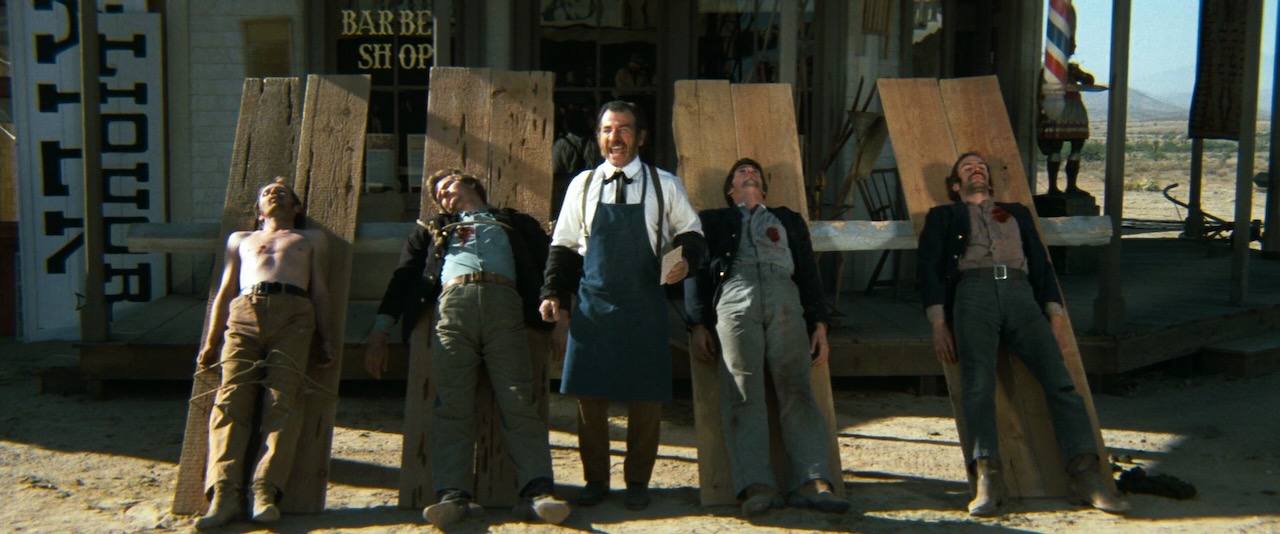
One of Fuller’s final-shot ruminations – that the moment a war ends, killing turns from a heroic act into a criminal one. Feeling oppressed by the North and betrayed by his own losing side, an Irish-Confederate soldier (Rod Steiger, warmonger general of Mars Attacks!) joins a Sioux tribe against all whites. He gets guidance from doomed scout Walking Coyote (Jay Flippen, father-figure crook in The Killing), falls for a girl called Yellow Mocassin (Spanish superstar Sara Montiel, overdubbed by Angie Dickinson), and tricks suspicious Sioux warrior Crazy Wolf. A bunch of whites-vs-natives twists and betrayals later, Steiger and Moccasin leave the tribe, deciding to try their hand with the new USA instead.

Kiss Me Deadly star Ralph Meeker plays the Union officer shot twice by the same bullet (long story), and “newcomer Charles Bronson” plays a Sioux chief. There were actual Sioux players in the film, but relegated to smaller roles.

Sam:

The boys at RKO loved my yarn and gave me a green light to produce the picture the way I wanted. Indians would be depicted as a community of people with their own rules and rituals, not – as in most studio movies – like a pack of marauding killers. .. I think [Rod Steiger] earned more on that picture than I did. After all, I was only the writer, director and coproducer.

Like Reichart’s last two movies, this is a bare sketch of a story. The cinematography is better, the film stock is less grainy, and there are more name actors joining Michelle Williams and Will Patton (both returning from Wendy and Lucy), including Paul “There Will Be Blood” Dano and the great Shirley Henderson from Yes.

Eventually the viewer picks up that a small wagon train (three families) is being led by a paid guide named Meek (Bruce Greenwood, guy who hires Kirk in the Star Trek remake), who seems to be lost. Action is shown somewhat from the women’s point of view, so when the men converse, making big decisions that affect our trip, they don’t get to participate much, until the semi-liberated Williams starts butting in. The group’s fresh water supply is running out when they capture an Indian who’s been following them, and the men appoint him their guide instead of Meek. One family’s wagon is destroyed when traversing a hill, and the others pitch in to help, but nobody is ever shot, or even gets sick – unusual for a Western. The Indian leads them to a large tree, someone points out that water must be nearby, he wanders off unchallenged, end of movie.

It’s a weird choice, that ending, so to understand the screenwriting I turned to T. Stempel’s column “Understanding Screenwriting.”

I heard a sound from the audience I can’t recall ever having heard before. They laughed, and they seemed to be laughing at themselves for having been taken in for 100 minutes by a movie that is not even going to bother finish telling the story it started out to tell.

So he doesn’t know either, but it seems to me like a self-consciously indie thing to do, a Cache move, as if the director thinks her film will be less artistic if she gives us too much information. Anyway, Stempel also says “the picture is slow, which makes sense because journeying by covered wagon was slow,” but it’s not as slow as Old Joy. I don’t suppose I’ve fallen in love with any of her three films so far, but I always enjoy the experience enough to turn up for the next one. EDIT: upon reflection, years later, I think about them lots, about their look and their moods, and so I suppose I do love them after all.