Precautions Against Fanatics (1969, Werner Herzog)
“Have you ever seen a dishonest man with a chest like this?”
Said to Werner’s cameraman by a one-armed man in a suit: “What are you doing here? Go away!” It’s not clear who is supposed to be here where they’re filming, in the training area of a horse racetrack. Some guy is repeating himself and karate-chopping flat stones. This cannot actually be happening! It is all pretty wonderful, a parody of a behind-the-scenes documentary. Made in between Signs of Life and Even Dwarfs Started Small, both of which I need to catch some day.
image

Organism (1975, Hilary Harris)
Time-lapse footage and readings from biological textbooks portray a large city (New York, of course) as a living organism. The dated 70’s sound design is unfortunate but otherwise it’s completely wonderful. Makes me wish I had a classroom of kids to show it to. He worked on this for years, inventing a time-lapse camera in the 60’s for the purpose. Bits from Scott MacDonald “As late as 1975, Harris apparently felt that time-lapsing imagery was unusual and high-tech enough to justify his frequent use of science-fictionish electronic sounds as an accompaniment. … Hilary Harris shot some of the New York City traffic shots used in Koyaanisqatsi, though apparently Reggio didn’t see Organism until after his film was well under way.”
image

L’Opéra-mouffe (1958, Agnes Varda)
Somehow I missed this during Varda Month – one of her earliest shorts hidden amongst the copious features on a Criterion DVD. Varda films either herself or another pregnant nude women, then goes on a rampage through the marketplace, mostly capturing the faces of people shopping there, with interludes featuring actors (incl. Varda regular Dorothée Blank, as nude here as she is in Cleo) clowning around. Sections highlight public drunkenness, anxiety and affection. I want to say this is my favorite of her shorts so far, but then I remember they’re all so good. Delightfully scored by a not-yet-famous Georges Delerue.
image

“I was pregnant. I felt the contradiction of expecting a child, being full of hope, and circulating in this world of poor, drunken people without hope, who seemed so unhappy. I felt tenderness toward them, especially the elderly. I imagined them as babies, when their mothers kissed their tummies.”
image

Silent Snow, Secret Snow (1966, Gene Kearney)
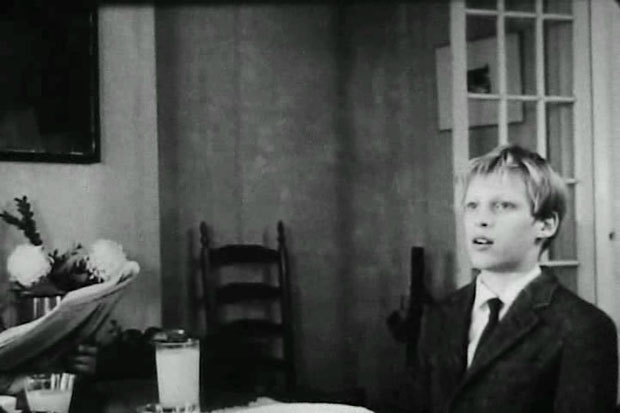
A boy named Paul starts to obsess over snow, allowing the snow in his mind to filter him from reality. Creepy and well shot. Later remade as a Night Gallery episode with Orson Welles narrating. Makes me think of the Handsome Family song “Don’t Be Scared,” with its line “when Paul thinks of snow, soft winds blow ’round his head,” except it’s one of their very few comforting, happy songs and the movie is anything but.
image

Une histoire d’eau (1961, Truffaut & Godard)
A girl wakes up and the whole town is flooded from melting snow. She meets a guy (a young Jean-Claude Brialy) who offers to drive her to Paris before nightfall. Music is weird – gentle flute or horns punctuated with bursts of percussion. Ooh, a Duchess of Langeais reference… in fact there are a ton of references in her quick monologue narration, which ends with spoken credits.
image

The Forgotten Faces (1960, Peter Watkins)
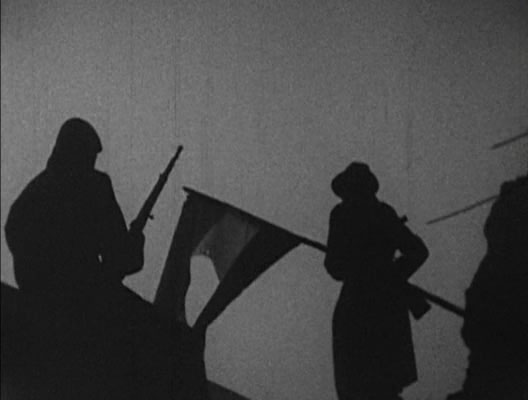
Revolution in Budapest. Nice reconstruction, convincingly documentary-like – where’d Watkins get all those guns? No sync sound, a TV-sounding narrator. One part, the reading of a communist speech turns briefly into a dramatic propaganda montage – don’t see that happen much in Watkins’ films.
image

image

The Perfect Human (1967, Jorgen Leth)
“Today I experienced something I hope to understand in a few days.”
image

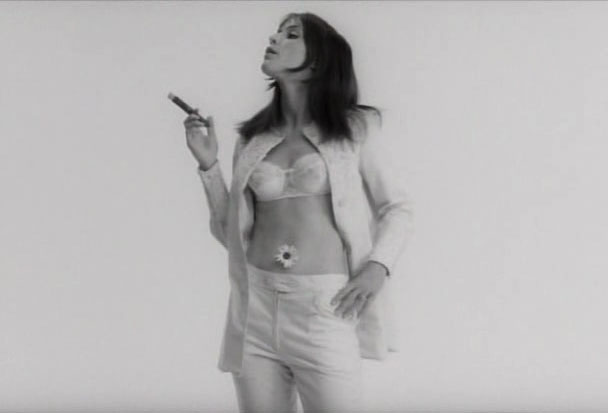
I like the British narrator. “What does he want? Why does he move like that? How does he move like that? Look at him. Look at him now. And now. Look at him all the time.” There’s no diegetic sound, but if this was dubbed in a studio, why does there have to be so much tape hiss? A fake documentary and a stark white delight, with slow zooms in and out, gentle string music, and a general sense of serious absurdity. Only saw, what, a third of this in The Five Obstructions.
image

Les Maître fous (1955, Jean Rouch)
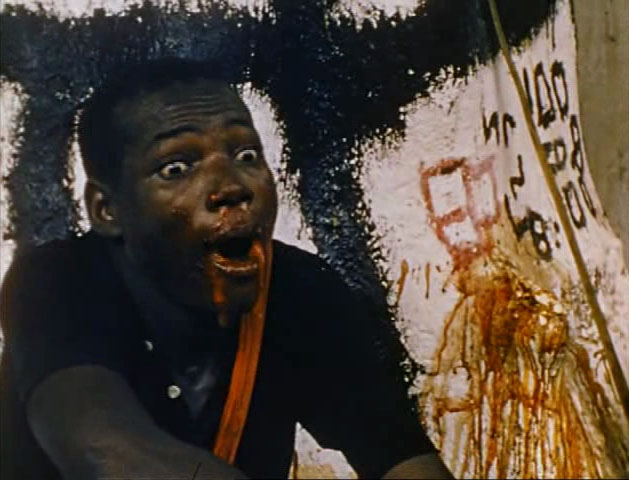
Document of a group in Ghana called the Hauka doing something involving wooden toy guns, red ribbons, chicken sacrifice, dog-blood-drinkin’ and having lurchy foaming-at-the-mouth fits. I’m not ever quite sure, because the French narration has been auto-subtitled by google – whatever they’re doing, the subs call it “having.” After they’ve had, the film crew catches up with them at their day jobs, not freaked-out cultists anymore, just working hard, smiling at the camera. This is one African film that Katy didn’t want to watch, because Rouch is an exoticizing anthropologist. So what’s going on that this film makes the best-ever lists? A Rouch tribute page says he popularized direct cinema/cinema verite, that he was known for rethinking ethnography, and a documentary surrealism (sounds like Jean Painleve). Ian Mundell says the film “drew plaudits from the Nouvelle Vague, in particular from Jean-Luc Godard. They liked the fact that Rouch’s fiction emerged from an encounter between the actor (professional or non-professional) and the camera, and his willingness to break the rules of cinema.” Paul Stoller says Rouch crisscrossed “the boundaries between documentary and fiction, observer and participant,” but I take it that’s more about his later films, which I’m thinking I would like better. So it’s seeming like this film gets awarded because it’s one of the most-seen of his films and because of its influence, not because it’s Rouch’s best work.
image

Nicky’s Film (1971, Abel Ferrara)
A mysteriously silent possibly gangster-related 6-minute film. I can’t imagine even a Ferrara scholar gets much out of this.

The Hold Up (1972, Abel Ferrara)
Super-8 production made when Abel was 21, seven years before Driller Killer. A few minutes in, I realized it’d be much better with the director commentary turned on. “And away we go. Wait, it’s the other way. Which way is she looking?” Um, some guys get fired from factory jobs, hold up a gas station, get caught. The song “Working on a Building” is heard.
image

Opening titles: we hear a nice Tom Waits song (the soundtrack is great overall) and see “JVC PRESENTS.” Didn’t JVC used to make blank tapes? The kind that weren’t even as good as Maxell?

Five segments in five cities. Has cute parts, and I guess it’s part of the greater Jarmusch body of work or whatever, but also kinda feels like something that could’ve safely stayed in 1991 (or maybe ’93; it was ahead of its time). What’s funny is that it doesn’t seem like the kind of movie that should get easily dated (except through the usual – fashions, cars, mobile phones – only period pieces are immune to those) but it has this early 90’s aura about it, like Smoke or a Hal Hartley movie, which I don’t see in Dead Man or Down By Law or Mystery Train. Maybe it’s just Winona Ryder. Anyway this remains my least favorite Jarmusch picture, though I did enjoy it overall. If you could break it up Coffee & Cigarettes-style, it’d be nice to lead from New York straight into Helsinki, and maybe add Rome every third or fourth viewing.

LA: Winona Ryder is a midget phonebook-sitting wannabe-mechanic driving fancypants cellphone-calling casting agent Gena Rowlands home from the airport. Gena’s client is looking for a tough young girl, an unknown, so predictably she propositions Winona, who turns Gena down. Jim says it’s the first movie Gena agreed to do after John Cassavetes died. I never made it past this segment when I first tried to watch Night On Earth a decade ago… pixie Winona is too hard to take as a street tough.

NY: East German Armin Mueller-Stahl (same year he did Soderbergh’s Kafka) is new to New York and cab driving, so passenger Giancarlo Esposito takes over, picking up sister-in-law Rosie Perez for a miniature Do The Right Thing reunion, wide-eyed Armin taking it all in.

Paris: Isaach De Bankolé (stolen from Claire Denis) kicks out some diplomats, picks up a blind girl (Beatrice Dalle, star of Time of the Wolf, also a Claire Denis regular) and asks her a bunch of dunderheaded questions.

Rome: Roberto Benigni picks up a priest, drives like a madman (but there’s no traffic so it’s cool) visits a couple transvestites, and tells horribly perverted stories until the priest dies after dropping his meds on the floor and Roberto quietly unloads him on a park bench.

Helsinki: Cabbie picks up three guys from a hard night on the town. Of course all four of them have been in Kaurismaki films (one of the passengers played Polonius in Hamlet Goes Business. They tell their drunk friend’s hard luck story and the cabbie replies with his own hard luck story. Way to end your movie on a dead baby tale there, Jim.

Nice color cinematography by Frederick Elmes (a Lynch regular who later shot Broken Flowers) – not seen here cuz it was a rental and I forgot to get screen shots.

I’ve become obsessed with this since watching it again at the Fox. Found a book about the making-of, which I’ve just begun to read. The post-film Q&A with Spike and Joie and fellow Atlanta college grad Radio Raheem was nothing earth-shattering, but it’s an honor to be in the same room as Spike Lee. Learned about the cast: Ruby Dee is still alive and working, Richard Edson (Turturro’s friendly brother Vito) was Sonic Youth’s original drummer, one of the shit-talking guys on the corner is Commissioner Burrell on The Wire, and Martin Lawrence’s comic-relief role cracks people up more than it probably should. Looked beautiful on the big screen. Must watch again soon and show to Katy.

Poyraz (2006, Belma Bas)
Rural people sure live quaint and handsomely photographed lives!
Nuri Bilge Ceylan was thanked in the credits

Why Play Leapfrog (1949, John Sutherland/MGM)
Let’s hear it for capitalism! Clever cartoon describes why inflation is okay and raw material costs don’t mean much. A boring explanation of why America is so darned great that ends by telling factory workers to be more efficient and come up with smart cost-saving ideas which will lead to greater pay increases.

Balance (1989, Christoph & Wolfgang Lauenstein)
Ominous stop-motion – five mute guys with numbers on their shirts and telescoping fishing poles in their shirts are on a balanced platform suspended in space. One catches a sort of music box and the others get greedy, leading to a fight which ends with one guy on the far end of the platform from the box.

Broken Down Film (1985, Osamu Tezuka)
It’s a popeye-like cowboy cartoon except that the film’s projection problems (hair in the gate, scratches, countdown leader, etc) are part of the story. Cute.

and a few from the Unseen Cinema box set…

Paris Exposition Films (1900, James White)
Some one-minute films at the Eiffel Tower a decade after its construction. Best part is this guy on the left side of the screenshot. People were walking up to the camera and this guy saw his chance for stardom, so he prepares himself for some manuever (maybe a backflip) but blows it, stopping instead to shake hands with an acquaintance offscreen as the film runs out.
image

Captain Nissen Going Through Whirlpool Rapids, Niagara Falls (1901, Edison Co.)
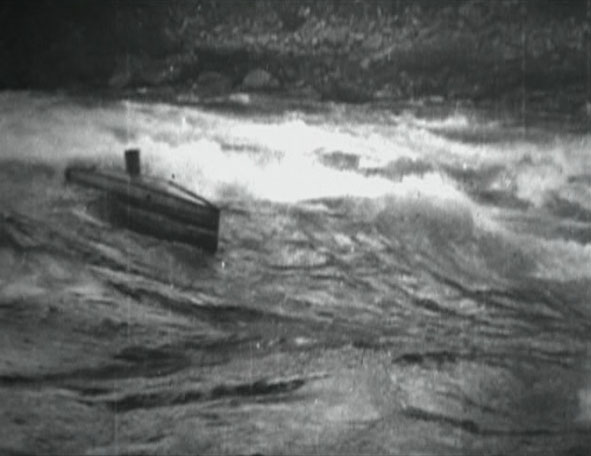
It takes longer to type the title than to watch the film, which is of some submarine-looking craft bobbing in a river. Found a wonderful tale online of Nissen’s stupid death four years later, but unsure if it’s true.
image

Down The Hudson (1903, Frederick Armitage & AE Weed)
Much more interesting than the submarine thing – New York riverfront over a hundred years ago. I assume lots more of this stuff will be on disc five.
image

The Ghost Train (1903)
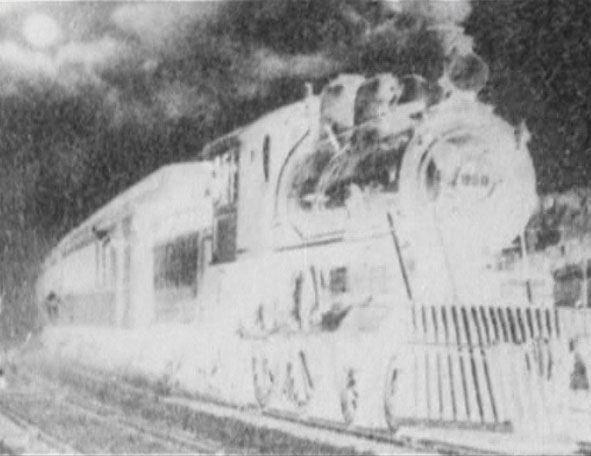
Oooh, someone learned to invert the black/white image AND to matte a moon into the upper corner. This is one of my favorites because it is neat-looking and twenty seconds long. If only you could say the same for Transformers 2.
image

Westinghouse Works, Panorama View, Street Car Motor Room (1904, Billy Bitzer)
Long factory tracking shot reminds me of the beginning of Manufactured Landscapes. Unlike in ML, all the workers stop and look at the camera.
image

In Youth, Beside the Lonely Sea (1925-ish)
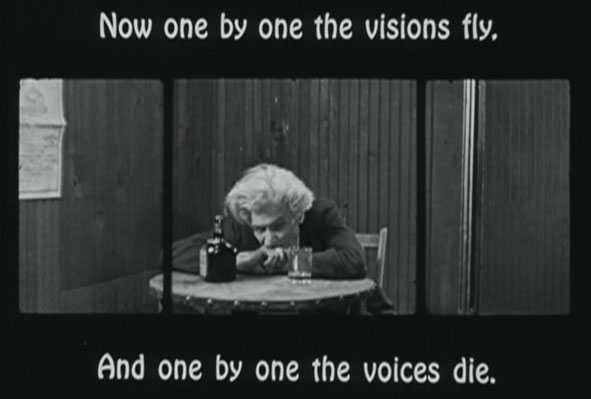
Crazy three-panel layout illustrating the poem told with text above and below the picture. Lots of ghostly superimpositions. This was so damn cool I had to lay down for a while.
image

image

AV Club: “The script comes from Eric Roth, who would probably by accused of borrowing too liberally from Forrest Gump if he hadn’t written that too.” Wow, dude also wrote that Eric Bana gambler love story I was just mocking yesterday, and my favorite film to hate, The Postman. No wonder writing seemed to be the weakness in this would-be-spectacular movie. Huge issues (hello, racism) were ignored, episodes (hello, Tilda Swinton) weren’t well integrated with the rest of the film, and Button ended up seeming like an unambitious blank who doesn’t do much with his so-called remarkable life.

Katy suggested the unambitious-blank part and some Forrest Gump comparisons, but I wonder if that wasn’t the point, to show a regular guy with parental issues who meets a girl, goes to war, has a kid, rambles around and never quite finds his place in the world, the whole aging-backwards thing being the only remarkable thing about him. That and the movie’s obsession with mortality make it a meaningful story about life and how to live it. Maybe we unrealistically expected Button to be some kinda sci-fi superhero, while the movie was trying to speak to us about life and death, love and loss, or maybe on Christmas day we weren’t in the mood for an extended monologue about mortality, but this came out feeling like a pretty alright movie, a tearjerker to be sure but maybe not the acclaimed masterpiece to which we’d been looking forward.

Pretty nice music by Alexandre Desplat was loud and fuckin’ clear, since 45 minutes before the end of the film our dialogue track almost entirely cut out leaving us with whispered words under a huge score… thanks heaps, Regal. At least we could still hear when we tried hard, since most of the audience was either heavily concentrating or fast asleep by then. Shot NOT by Fincher’s Zodiac guy, and boy am I relieved, cuz in the parking lot I was bemoaning the lack of surprise or interest in the camera setups (figuring the CG effects left no room for surprise), comparing it negatively to the immaculately-shot Milk, which we’d snuck into before our feature started… forgetting that the Zodiac guy actually shot Milk, and some nobody (the D.P. of the last M. McConaughey romance flick) shot The Ben Buttons, thus preserving my aesthetic intuitions.

So right, Ben kills his mom being born in New Orleans on the day WWI ends, is abandoned Penguin-style by his dad, discovered and raised by Queenie and (boyfriend?) Tizzy in an old folks’ home, where unsurprisingly, people die from time to time. Ben meets a girl who is not yet Cate Blanchett but one day will be. Ben, BTW, is incredibly old, confined to a wheelchair, then learns to walk with canes as he grows ever younger. He gets a job on a tugboat, has regular sex with married Tilda Swinton in a hotel, and helps in the WWII effort while Cate becomes a dancer with hip bohemian friends & spontaneous lovers. The time is not right for those two to get together, but one day after Cate’s career-destroying car accident the time is right and they do and are very happy and have a kid. Ben finds out that his real dad is Mr. Buttons, who dies and leaves Ben the button factory he ran. Also dying: war friends, Tizzy then Queenie. Ben is afraid when he grows too young he’ll be a burden (he is) so he leaves Cate and bums around the world instead. Interesting how as his brain becomes less developed and he gets smaller, it’s effectively alzheimer’s disease – he forgets more and reverts to childish behavior living in his childhood home. Cate’s daughter grows up, her “dad” dies, and while caring for her dying mom (still played by Cate, unrecognizably) the day before Hurricane Katrina hits, she learns the whole story in a huge framing device.

Brad Pitt, after a brief spell of manic energy in Burn After Reading, is back to his brooding-as-acting style, which should work just fine in next year’s Terence Malick picture with appropriate wistful voiceover. Cate is wonderful as fucking always – the acting highlight of the movie, she can do no wrong. Brad’s Coen-costar Tilda Swinton is fine with the tiny role she gets.

People I Thought I Should Have Recognized But Actually Shouldn’t Have include TV’s M. Etc. Ali as Tizzy, an otherwise uncredited actor as the African fella who takes young Ben to a brothel, Cap’n Mike: Jared Harris (Lady in the Water), and adoptive mom Taraji Henson (Talk To Me). People I Recognized But Didn’t Know From Where include Guy Ritchie action star Jason Flemyng as Mr. Button. People I Did Not Recognize At All include framing-story secret Button daughter Julia Ormond (Inland Empire), and People I Should Have Recognized But Somehow Missed include Elias Koteas as the blind clockmaker who kicks off the story.

OMG I totally forgot I watched this until Katy mentioned it today at dinner. Had Shocktober on the mind, I guess. So yeah, there were two new movies playing that I badly wanted to see, couldn’t decide between them, so Katy decided we’d see this instead. A harmless flick about being super-fuckin-cool kids in New York City. See, they don’t seem cool – the Michael-Cera-talkin’ nervous kid (aptly played by Michael Cera) and the shy girl who everyone uses because of her famous dad – but they are cool because they’ve got their own scene and they totally dig each other and they like the same music.

Music: the movie’s got music on the brain. Nick’s in a band and makes killer mix CDs, Norah (Kat Dennings, principal’s daughter in Charlie Bartlett) likes his band, and her dad owns Electric Lady Studios… but we see about a minute of live rock ‘n’ roll, and all the other music we hear is way in the background. Juno showcased music much better than this movie did. So we turn instead to plot, and it’s alright, a long night in the city during which N&N get together, part, then get together again. And there’s a drunk friend, two gay dudes with a van, an awful ex-girlfriend (Lolita from Broken Flowers!), an ex-boyfriend, a very drunk friend who gets lost (she was in Game 6 – anyone remember Game 6?) and a cameo by John Cho (and I didn’t recognize Devendra Banhart). Katy liked it despite the vomiting and the long-lasting chewing-gum running joke.

I was hoping for another inventive cult-classic a la Brain Damage or writer Larry Cohen’s The Stuff, but I got your standard, straightforward, low-budget horror-thriller with no invention or visual flair whatsoever.

There’s even nothing special about the performances, which is a real crime considering it stars Bruce Campbell (between Evil Deads 2 and 3), Tom Atkins (the cop in Night of the Creeps!), Richard Roundtree (Shaft!) and, um, Laurene Landon (It’s Alive III: Island of the Alive). Robert (“oh, z’no!”) Z’Dar is the titular cop and Sheree North (starred in Frank Tashlin’s The Lieutenant Wore Skirts 30 years earlier) is his crazy caretaker.

A maniac cop is terrorizing the city! Cop Bruce Campbell is cheating on his wife with a fellow cop, but surprisingly this is okay with the movie and Bruce’s wife is killed instead, the killer (actually his smarter mother-figure who works at police headquarters and tells him what to do) attempting to pin the murders on Bruce. There’s a making-of-the-monster backstory, lots more people are killed, then Bruce busts out of jail and chases the maniac cop, who accidentally kills himself… but is he really dead??? Spoiler alert: no.

Bruce Campbell didn’t do it, nobody saw him do it, you can’t prove anything
image

Tom Atkins’ gun is a tiny film projector
image

Sam Raimi, reporter
image

The only novelty death: man’s face shoved in wet concrete
image

This was huge-faced Z’Dar’s big break, landing him the highly desirable role of Joe Estevez’s sidekick in Soultaker two years later
image

Bahrani has Iranian heritage but was born in North Carolina, and this movie was clearly made in the USA so it sadly doesn’t count as part of Iranian Month.

I liked it a lot. It’s got the realist approach, child protagonist and hopeful ending of Where Is The Friend’s Home, but set in the auto junkyards in the shadow of Shea Stadium in Queens. Ale(jandro) and older sister Isamar live and work in an auto garage. He hustles cars into the shop and helps the mechanics by day, and sells bootleg DVDs by night; she works a food stand by day and dabbles in prostitution by night. Together they hope to afford a $4500 food-service truck of their own, but after they buy it the dream comes crashing down. The vehicle can be fixed and painted but the kitchen is unusable so they scrap their just-bought truck for $1000 in parts. Meanwhile, Ale finds out his sister is sucking dicks in the parking lot and wonders what to do/think about that.

Whole movie I’m thinking “indie dramas about poor people in poor neighborhoods always ends in tragedy”, but this one didn’t. The truck is a setback, and nobody wants their sister to be a prostitute, but at the end the kids are still together, making money, with friends and a place to live. They’re making plenty, really… doesn’t seem like it took that long to afford the truck. Nobody is physically hurt or killed, Ale’s secret cash stash is never found/stolen, they’re not kicked out of the garage and back on the street, drugs are never mentioned. Not that big a deal, but jeez do movies love to pile on the tragedy when it comes to poor people, so it was refreshing.

Camerawork is nice, all handheld, nothing that stands out except the awesome final shot (Isamar scares pigeons, camera follows pigeons quickly up, lingers on white frame of the sky, then cut to black). I don’t know if everyone read this in the same place or if they’re all just having the same idea, but every time I hear about this movie it’s compared to Italian Neorealism (fair enough) and they say if it wasn’t for the stadium it would be easy to believe it was set in some foreign country. I don’t know what country they’re talking about, and it seems neither do they. Felt pretty American to me. The kids are very good. My favorite part of the movie was Isamar’s voice, actually. Predictably this kid-salesman movie won the “someone to watch” independent spirit award over Munyurangabo (kid movie) and Frownland (salesman movie).

As Katy said, it’s like a whole new season packed into 2.5 hours. I liked the mexican vacation / food poisoning episode, and the Christmas one where Carrie watches Meet Me In St. Louis, but the others were ehhh. Not any better or worse than sitting down with the series for that long. Of course this means that the S&TC Movie is less damaging to the S&TC legacy than the new Indiana Jones movie is to its own series legacy. Jennifer Hudson was shoehorned into the plot, so now I’ve seen half of her movies.