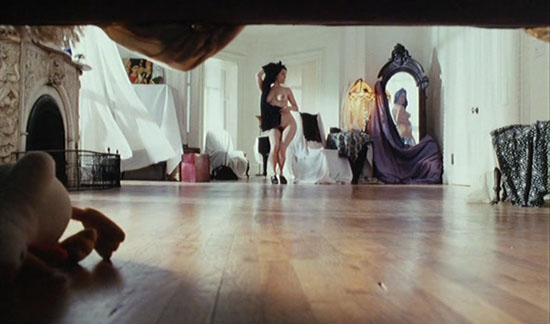
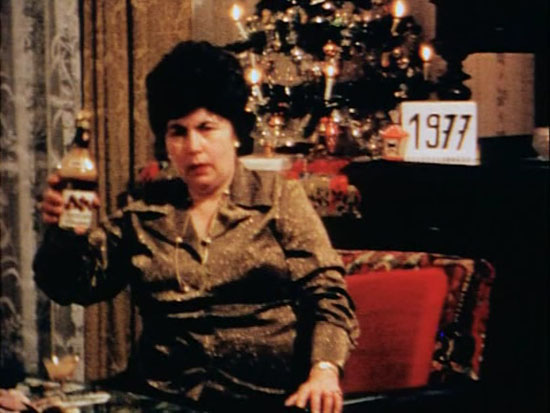
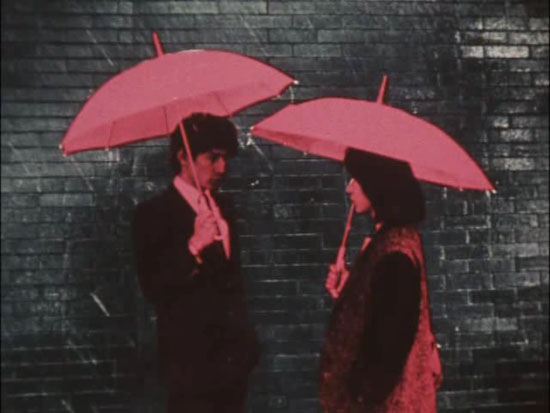
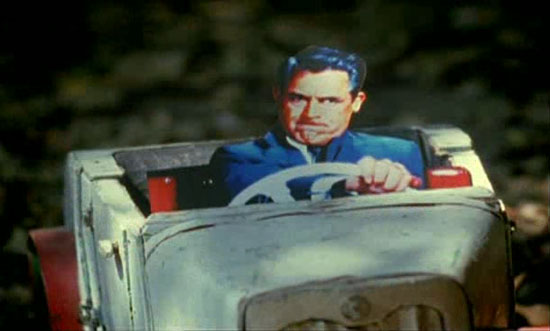
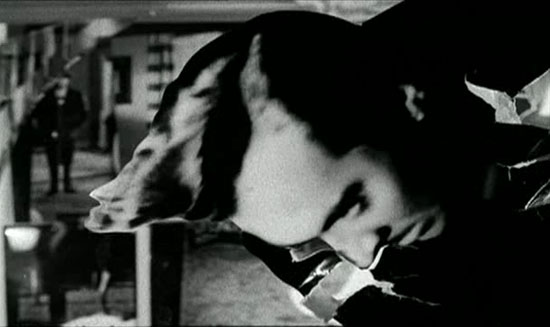
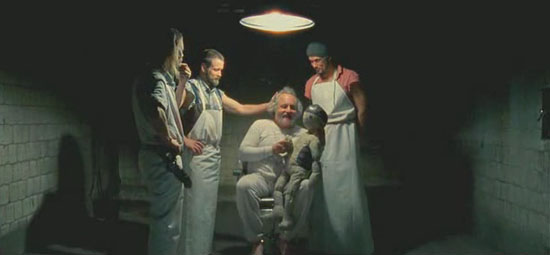
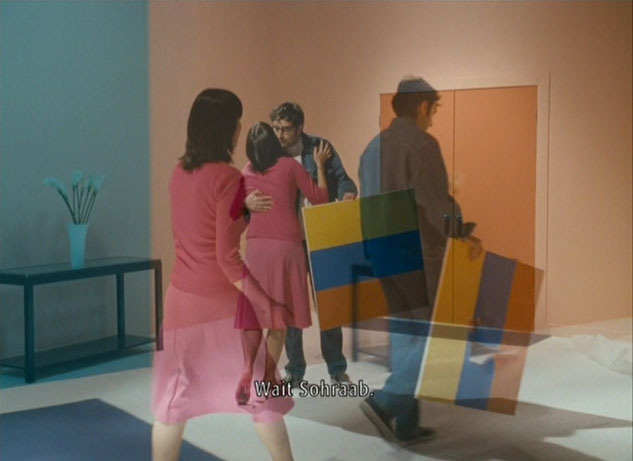
Jimmy came over for an unexpected evening of avant-garde shorts which I kicked off by fast-forwarding through Michael Snow’s Presents to show off its wackyness. Then we skimmed the Index DVD catalogue and I watched some others after he’d left.


Structuralist Films By Kurt Kren
I kinda know what structuralism is, though I’d have trouble defining it… so I defer to P. Adams Sitney, who says a “tight nexus of content, a shape designed to explore the facets of the material,” and the films render content “minimal and subsidiary to the outline.” Sounds a lot like Presents.
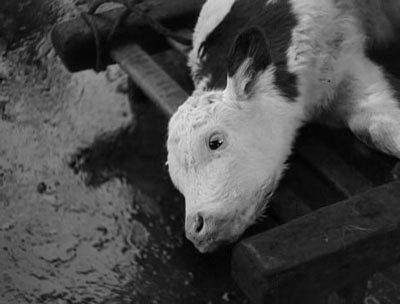
37/78 Tree Again – stop-motion of a tree, sometimes with cows, sometimes without.
2/60 48 Heads From The Szondi-Test – I liked this one best – heads cut out of newspapers or magazines rapidly edited into a time-montage.
17/68 Green-Red – a meditation on green and red bottles. Not too exciting… hardly up to the meditation standards of Lemon, for instance. Not just green/red, I saw some yellow in there.

Christoph Huber, when asked “What is the greatest movie ever made?”:

“Why, Kurt Kren’s 37/78 Tree Again, of course.” – which usually just raises eyebrows. So then, it’s my pleasure to expand on how a film they’ve never heard of, by a filmmaker they’ve never heard of, embodies the beauty and contradictions of cinema in its essence – and does so in less than four minutes. Kren’s film has an additional advantage, not always the case in that grey zone we shall term for purposes of straightforwardness “avant garde:” It can be described quite vividly in words, and its genesis makes for a good story. For about two months Kren returned daily to the same spot in Vermont to shoot single frames of a tree (using a roll of infrared film well past its expiration date). The succession of frames was not chronological, but Kren rewound the film according to a prearranged plan. The result is intoxicating, miraculously and mysteriously capturing time out of joint. In split seconds, seasons change and leaves are flashing in different colours, animals and clouds rush by, light and weather mutate constantly. In capturing decay and renewal of (and around) this tree Kren communicates the perpetual flux of the entire world, and a central paradox of cinema.


Actionist Films By Kurt Kren
A contemporary of Peter Kubelka, who made the irritating short Pause, Kren is also known for his “actionist” films. Actionism was an Austrian movement of artists who rejected “object-based or otherwise commodifiable art practices. The practice of staging precisely scored actions in controlled environments or before audiences.” (wikipedia). A precursor to performance-art, this mostly meant that people like Gunther Brus and Arnulf Rainer stripped naked and threw paint on each other, and people like Kren and Kubelka filmed it. Not as exciting as the structuralist works.
7/64 Leda and the Swan – Leda is covered in goo and acts as the main course in a feast, but the actionists stopped short of actually eating her. Eli Roth might’ve seen this before filming Thanksgiving.
10b/65 Silver Action Brus – Brus is in a tent, painting the walls, I dunno, looked like something high school kids would do as an art piece (because of the cheapness and easy shock-value) then edited to bits by Kren.

Leda and the Swan:
image


Peter Tscherkassky
One of my new favorite people! His “Cinemascope Trilogy” (first three titles below) is mindblowingly awesome. I hope to watch it over and over again… it joins the ranks of Heart of the World and Life Wastes Andy Hardy and Dog’s Dialogue in my short-film hall of fame.
L’Arrivée
2 minutes, train arrives and happy woman disembarks, film itself “arrives” on the screen too after fluttering about for the first half.
Outer Space
10 minutes of terror, as a girl in a haunted house movie gets brutally attacked by film editing and multiple exposures.
Dream Work
11 more minutes of sheer awesomeness taken from the same film as Outer Space, but not as terrifying.
Manufraktur
Super-multi-exposure remix of some TV ads.
Motion Picture
All light/dark white/black flicker with no distinguishable image, short
Get Ready
A trailer for the 1999 Vienna film festival using PT’s exposure techniques

L’Arrivee:
image

Outer Space:
image

Dream Work:
image


Today (1997, Eija-Liisa Ahtila)
“Today my dad’s crying. Last night a car drove over his dad who died instantly.” First part, Tanaan, a pretty girl tells us about her sad dad. Second part, Vera, an older woman, says some stuff but it doesn’t last long and before I’ve gotten my bearings we’re on to Third part, Faija (dad). First we see grandad lay down in the shadows of a dark road, then the pretty girl’s dad talks about being a dad. Movie wasn’t what I was expecting after sitting through all that Kurt Kren, but it’s actually pretty good, really nicely shot, some kinda associative pondering of three generations (going from the girl to her dad to vera/grandad, back to the dad and girl) maybe? Music by 22-Pistepirkko! Ahtila is Finnish. I found art gallery websites spouting off about her methods, but it’s all fancy-talk for “she tells stories about people.”
image


Alone. Life Wastes Andy Hardy (1998, Martin Arnold)
Mickey Rooney, Judy Garland and Fay Holden are trapped in the moment, rewound, slowed down and turned into robots, their every subliminally sexual movement revealed. I can not watch this enough times… so happy to have it on DVD now.
image


Le Film a Venir (1997, Raoul Ruiz)
Yay, more wacky short fun from my man Ruiz. Black and white and mysterious, once more about hidden meaning and light sources and repetitions, abruptly shifting mood and plot, either surrealistic or beyond my comprehension. I’ve watched it twice and I’m pleased to say that I can’t manage a plot description. More play with narrator voices and narrative shortcuts, like in Hypothesis and Dog’s Dialogue. And Ruiz has a hundred movies – a hundred movies! – to explore. I could not be more excited.
image


Letter to America (1999, Kira Muratova)
Disappointingly not half as wacky as the Ruiz. A dude is being filmed by his friend, sending a video message to new york, but the dude has nothing to say. So dude goes to the place he rents and tries to get some rent money out of the woman staying there. She’s being a jerk about it, but gives him a little money. He wanders back to his video friend and recites a triumphant poem before the camera. Apparently had some Crime & Punishment references I didn’t catch. J. Taubman: “Muratova’s film is itself a letter to America. One of its not so hidden messages is an ironic self-commentary on Muratova’s own situation, an example of what talent can do even in poverty.” She won a $50,000 award in Berlin, which helped fund her next feature. I liked it alright, but rather than seeming like a new cinematic voice, it kinda seemed like an american indie short that speaks Russian.
image

Thought I’d watch some shorts tonight, starting with the Guy Maddin shorts listed in the previous post. Unintentional theme: none of them had any spoken dialogue!

Film (Emend) by Deco Dawson
Crazily-edited scratched, grainy black-and-white silent footage of hands? If I hadn’t already known that Dawson was involved with Guy Maddin (as editor and camera op on Dracula and Heart of the World), I easily would’ve been able to tell.

Film (Luster) by Deco Dawson
image
Same thing, except now it’s a boy shining shoes instead of a woman sewing. Some peephole photography and scary closeups of the bootblack-mascaraed boy. As far as falsely-aged avant-garde films go, this is thankfully closer to Maddin than Merhige, although it’s less captivating than it means to be. Good music.

Din of Celestial Birds by E. Elias Merhige
image
Some Begotten image manipulation meets the time tunnel from 2001: A Space Odyssey accompanied by minimalist music and too much MPEG artifacting. Merhige fans may ask “HOW does he do it?” but I’d like to know “WHY does he do it?” Did jobs dry up after Suspect Zero? Some cool time-lapse of plant life for a second there. Made in collaboration with Haskell Wexler’s grandson. There was a “visual philosopher” involved, ha! The actor who played “son of earth” in Begotten (the dude who gets dragged around by druids through the second half) played “son of light” in this (seen above).

Begone Dull Care by Norman McLaren
image
Handpainted film cut to jazz music, excellent in every way. I could watch this all day. First half is full explosive color, multiple layers, second half starts out all slow white scratch lines and finally gets crazy after a couple minutes.

Bread and Alley by Abbas Kiarostami (his first short)
image
Opens with a prolonged shot of a boy kicking a can down an alley to the Beatles “ob-la-di, ob-la-da”. Boy can’t figure out how to get down the alley without being chased by a dog. Puzzles it out for a long while, follows an old man but he only goes halfway. Finally braves it by himself and accidentally makes friends with the dog by feeding it. No dialogue. A very happy little movie.

The Running Jumping & Standing Still Film by Richard Lester & Peter Sellers
image
A jolly bit of madness out in a field. Not the funniest ten minutes of cinema I’ve ever seen, but worth watching. Some of these guys had a radio program called The Goon Show, which I’ve heard somehow led to this film which somehow led to Petulia and Strangelove and Steve Martin’s Pink Panther remake.

EDIT 2021: Watched The Running Jumping Etc. again in slightly improved picture quality, which didn’t elevate the comedy any – nothing new to report.

Congoma-player Marigo hasn’t paid the rent in a few months, so his landlady (the griot from Touki Bouki) has confiscated his instrument until he pays up.
image

With no way to earn a living, Marigo buys a lotto ticket from an optimistic dwarf acquaintance.
image

Marigo has got the winning number… but he pasted the ticket to his front door behind a poster of Yadikoon (“an African robin hood”), so he has to take the whole door to the lottery office.
image

…along the way, dreaming of the rich life…
image

…only to be told that the ticket needs to be detached from the door to be authorized.
image

So Marigo makes a run for the beach and uses the pounding surf to remove the ticket, dancing and dreaming on the rocks, losing his poster but getting the ticket off successfully, screaming ecstatic laughter.
image

I pretty much loved it.

Culturebase.net:
“We have sold our souls cheaply!“, Mambety concludes, though he never described himself as a political director. Yet his films always refer to the economic reality of his country, which is entirely dependent on the World Bank, monetary funds and French economic policy. This is true for his last two films. They were part of a trilogy on “The story of small people.” “Le Franc” and “La petite vendeuse de soleil” are from parables on the lives of people who must ask themselves the same question every morning, namely how to gather the most fundamentally necessary means to survive. The small people in this trilogy are the counterparts to the greed of the hyenas in his longer feature films.”

Filmref.com:
“Mambéty introduces the trenchant idea that the power of the imagination to raise post-colonial African consciousness does not exist in fanciful, but ultimately empty, idle dreams or wistfully dwelling over a lost – and stolen – noble past (a theme that is also articulated in Jean-Marie Téno’s films, as well as Ousmane Sembene’s Borom Sarret), but in a certain wide-eyed innocence and naïve determination that recovery and advancement are still possible with dedicated effort.”

California Newsreel:
“In both films there are conspicuous references to Yadikoon, a semi-legendary figure who in popular memory became a kind of Senegalese Robin Hood, robbing from the rich to give to the poor. In Le Franc, the main character, Marigo has a poster of Yadikoon in his room. Mambety himself named a foundation he established for Dakar’s street children after Yadikoon.”

The only hits I get from “Yadikoon” on google are from articles on these films, so either he’s a Mambety-created character or we are all spelling his name wrong.

Also watched “Echek” again, fun little flick by Adan Jodorowsky:
image

The Landmark theater of course played these Academy-ratio films in widescreen, ho-hum.

WHITE MANE, b/w, boy who lives on the marshes in southern France with his father and little brother (played by director’s son / star of Red Balloon) loves a wild horse, wants to capture it. Nearby ranchers also want to capture it. After a chase, boy rides the horse into the river and floats away, swept out to sea.

RED BALLOON, bright color, boy finds balloon which magically follows him around the city. Adults conspire to keep him away from his balloon, and other kids want to steal and destroy it. When the kids are successful, balloons from all over the city fly over and lift the kid up over Paris.

Jimmy says both movies are about the perils of acquisition. Both have somewhat the same ending… the kid getting (more or less) what he’d desired, a sense of freedom and imminent danger.

The two won a bunch of awards at Cannes, and Red Balloon got an original screenplay Oscar beating out The Ladykillers and La Strada. Remarkable for a movie with almost no dialogue. The two share excellent camerawork and primitive post-synched sound. I haven’t heard of anything else by photographer Edmond Séchan. Lamorisse made some other lesser-known children’s movies, including the earlier “Bim” and a widescreen Red Balloon sequel “Stowaway in the Sky”. The documentary he was filming over Iran when he died in an accident got an Oscar nomination after its completion. Best of all, he invented the board game RISK in ’57.

More shorts from “The Movies Begin” disc 1.

President McKinley at Home (1897): the first president on film plays with his hat and looks uncomfortable.
image

Pack Train at Chilkoot Pass (1898), reportedly recreated at the start of chaplin’s gold rush but I couldn’t say for sure.
image

Sky Scrapers of New York City from North River (1903)
image

Georgetown Loop, Colorado (1903) – those are passengers waving their hankies out the window to be on camera.
image

San Francisco: Aftermath of Earthquake (1906) – awesome film, I had no idea.
image

The Dog and His Various Merits (1908)
image

Moscow Clad In Snow (1908) – just what it says
image

Aeroplane Flight and Wreck (1910)
image

“Innocence will overcome destruction.”

More poetry (written and filmed) on death and war. Narration is about the town of Guernica destroyed by German (film says Nazi?) bombings in ’37 during the Spanish Civil War, while the visuals are of Picasso paintings, then a sculpture at the end. Mournful in tone, dark, with crossfades between paintings and segments, a few lighting and editing tricks to tell the story. Most of the screen time is not the Guernica painting – that’s just one of the ones they use. The writing by Paul Éluard is good but didn’t strike me as great as the Night and Fog narration. I enjoyed the score by Guy Bernard (Statues Also Die). The visuals are more of a Picasso showcase than a filmmaker showoff, though it’s all cut together very effectively.

image

image

Co-directed by Robert Hessens, Resnais’s Oscar-winning accomplice on the Van Gogh short.

Paul Éluard was a poet who associated with Dali, appeared in L’Age d’or, was quoted in Alphaville, and died shortly after this film was released. Same photographer as on Gauguin and Van Gogh. Resnais credited as editing himself. Narration by the princess from Cocteau’s Orpheus.

image

image

The Kiss – The raciest, most controversial film of its time.
image

Serpentine Dances
image

Sandow
image

Comic Boxing
image

Cock Fight – some early animal cruelty from our man Edison, who would later outdo himself with the classic “Electrocuting an Elephant”.
image

The Barber Shop – Can’t imagine the appeal here, watching someone get a shave. One of the earliest films ever made and the “latest wonder” is a cheap/quick shave, not the motion picture itself?
image

Feeding the Doves
image

Seminary Girls
image

Swimming in the Sea
image

Children Digging For Clams – the best short for watching children dressed in silly period garb
image

Loading a Boiler, or, “the one where nothing happens”.
image

Dragoons Crossing the Sâone – dragoon: noun, cavalryman, a member of a European military unit formerly composed of heavily armed mounted troops.
image

Promenade of Ostriches – actually only one ostrich, also a camel and some elephants
image

Childish Quarrel
image

Lion, London Zoological Garden – more animals getting taunted for the camera
image

Photograph
image

Transformation by Hats
image

Carmaux: Drawing Out The Coke – coke: noun, the residue of coal left after destructive distillation and used as fuel.
image

Poultry-Yard – an inferior remake of Edison’s “Feeding the Doves”
image

Arab Cortege, Geneva – first appearance of a black person in the cinema?
image

New York: Brooklyn Bridge
image

New York: Broadway and Union Square
image

Policeman’s Parade, Chicago
image