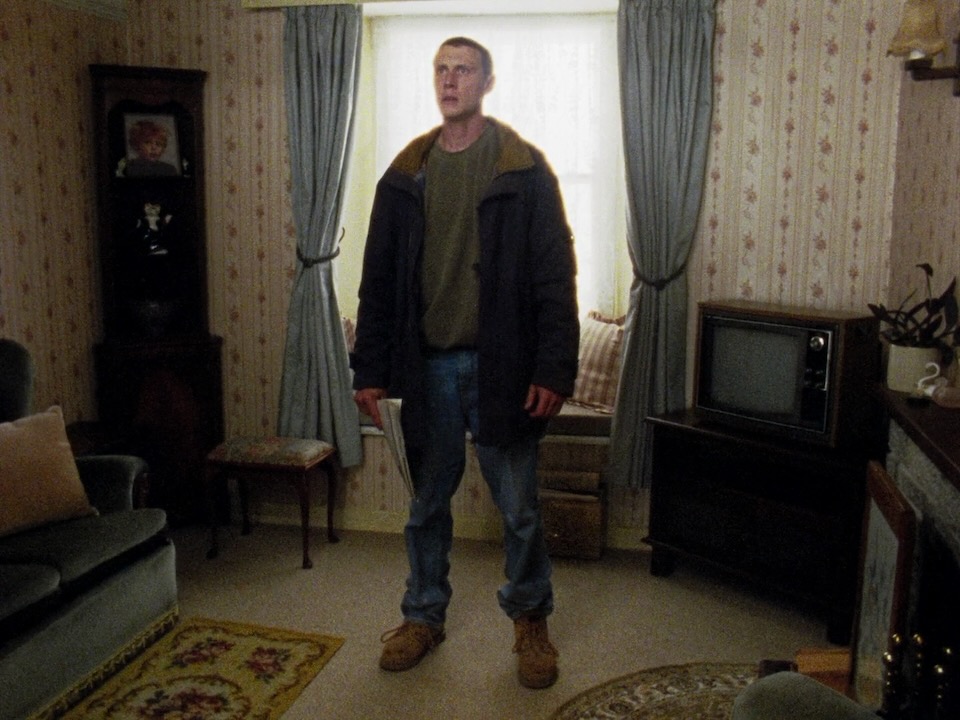
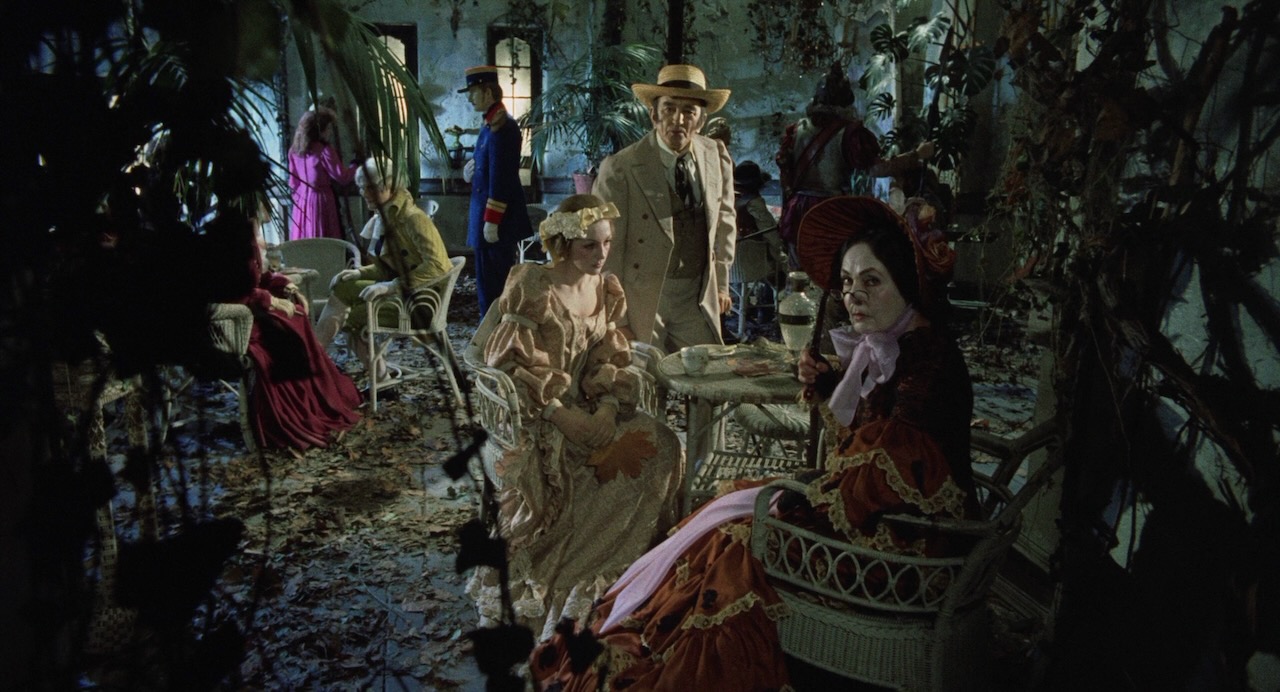
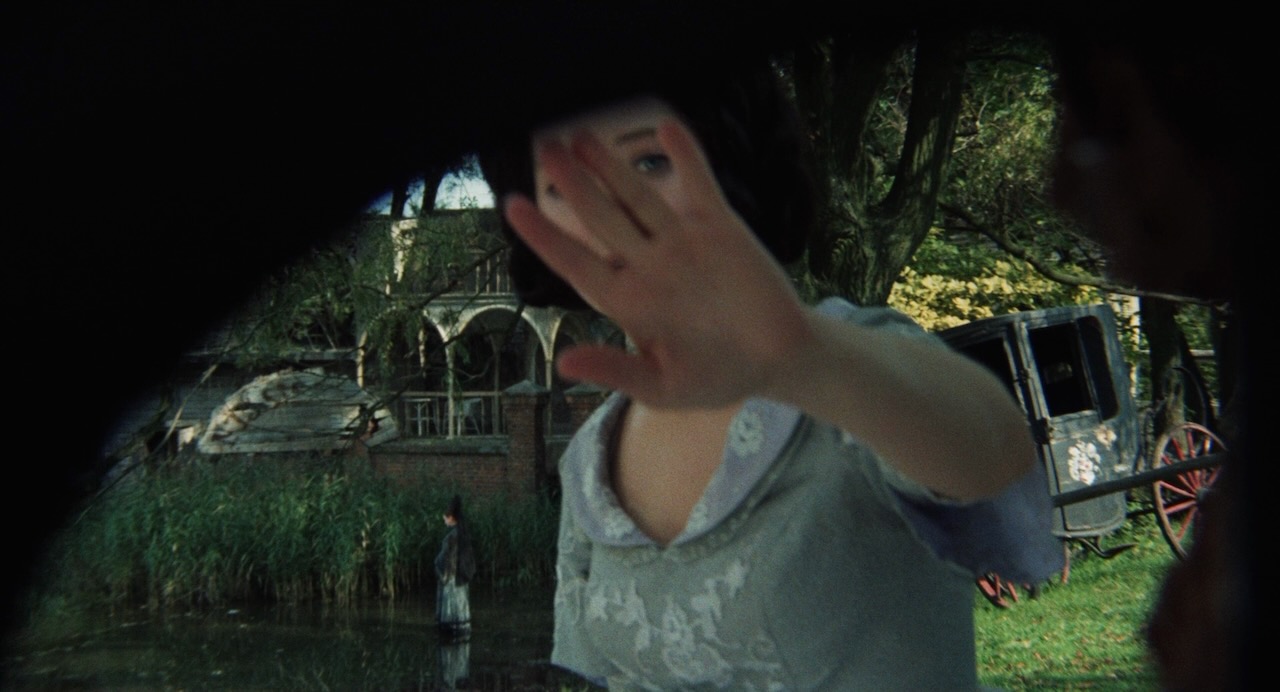
After Saragossa Manuscript, another Wojciech Has movie full of madness, beautifully filmed, and based on an eccentric novel, which didn’t really work for me. Jan Nowicki (Barrier) goes to a time-warping hospital to find his not-dead-yet dad, then wanders through fantastical episodes, full of delirious clutter (and copious cobwebs) in the tradition of Szulkin and Hard to be a God.

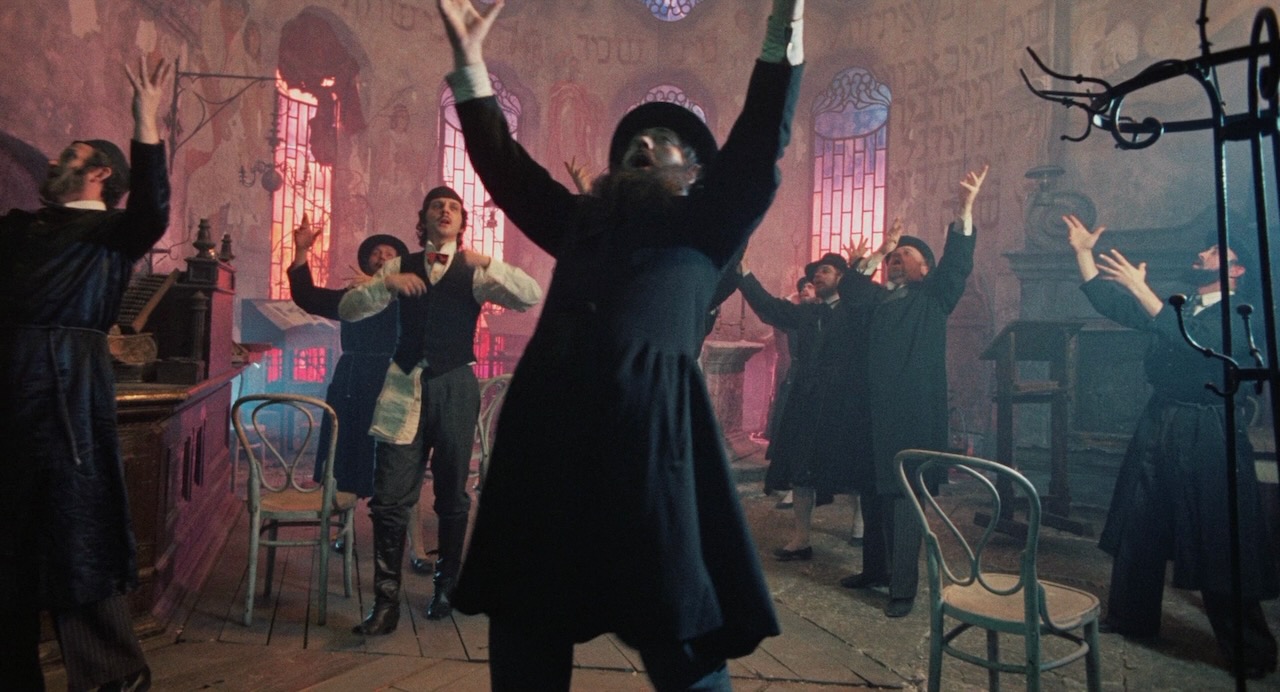
Opens with our guy getting directions from a blind train conductor, ends with him having become the conductor – I guess it all makes sense if you’d read the Bruno Schulz novel, or else making sense isn’t the point. I wasn’t expecting a musical number, but he visits the Jewish neighborhood and they can’t help themselves.

Smart guys like Jake and Yui and PD got it, I’m more on Paul‘s side.

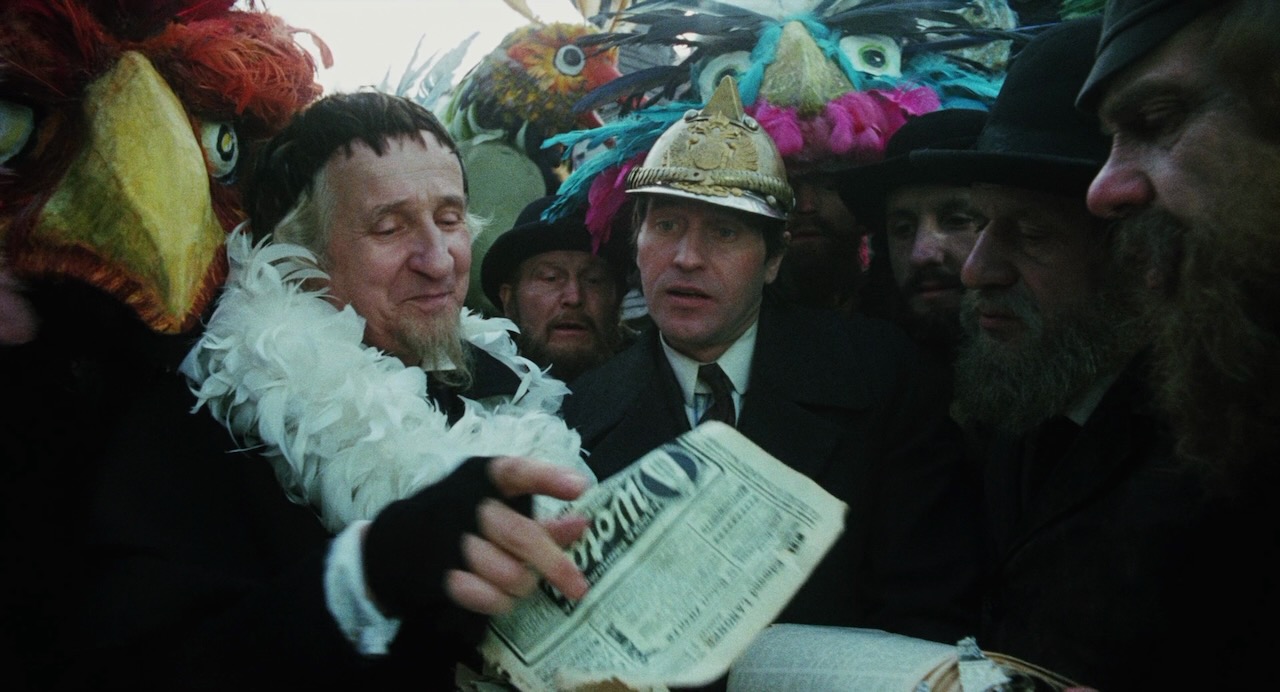
Helmeted protag with his dead father and carnival birdheads:

Remake of Edge of Tomorrow. The lines and colors are all neat, and especially Rita’s hair – her overall character design is better than Tom Cruise’s. It’s anime, which means angsty teens are saving the world while wearing battle armor, but first Rita has to figure out why she’s caught in a time loop, getting killed by Jim Woodring creatures every day. Halfway through she meets fellow looper Kenji (was Russian Doll based on this?), who will eventually absorb the enemy alien and sacrifice himself. Everything magically works out in the end, because this was a kids movie and I had no business watching it.

Something is up with mirrors, and mom realizes the woman in the yard is her own confused, chicken-murdering self, or rather her suicidal ideation incarnate, and that she’s trapped in the mirror world, like if Us was 100x less interesting and featured Nosferatuan shadow-snatching. Yard Woman never seems to do anything, but all the pets are dead and everyone’s hurt and she’s spreading family discord, letting the days go by. Her first words are “how did I get here?” Mom saves the day by time-tunnelling into the gun locker(?). Cameo appearances: before dad’s fatal car crash they park outside a movie theater showing The Mirror Has Two Faces… and was that a Uneeda Biscuit canister in their shed?

Hunter Schafer (Kinds of Kindness) just lost her mom and is reluctantly stuck with her dad’s family for the season, working for suspicious Dan Stevens at a secluded German hotel where people are always barfing in the gift shop. Sometimes there’s an attack or a freakout and the whole movie gets stuck in a fluttery time loop. She’s joined by Lando (Jan Bluthardt from Singer’s also-cool Luz) who wants to eliminate the alien creatures Dan is fostering, which include Hunter’s half-sister, so she’s now trying to save her family from both these men and the evil mom-aliens with her one good arm, a knife, and a half-working walkman as protection from alien time-screams. Gets a little bit too explainy – I’m looking for my bizarre rural euro-sci-fi to be narratively calibrated somewhere between this and Earwig.

With this and Longlegs, murderous moms are in vogue:

Hunter’s music sounds cool, too:

A new Bonello is one of the few things to get me into theaters this year (thank u Movieland for carding me twice before I was allowed to watch this). No real crowd for a French film on a nice weekend, but it’s still nice when the movies are big and loud. I guess we’ll never get to see Coma, huh?

Lea Seydoux meets George MacKay (star of 1917, I don’t remember him from Marrowbone) across three time periods, which are only slightly cross-cut, and only mildly bleed into each other due to a mind-erasing procedure in a robot Under the Skin room in the future-set sequence. In order to get decent jobs, people need to have their personalities (and latent memories of past lives) psychically purged – she aborts the procedure, then is horrified to learn that he went through with it. Previously she was a greenscreen actress (the movie opens with this scene, out of order, so it can be bookended with her Laura Palmer The Return screams) who gets stalked and killed by incel George. Before that they were seeing each other in secret before drowning together when her husband’s doll factory caught fire. So it’s got some of my least-favorite storylines (murderous rightwing youtuber, emotionless dystopian AI future), put together in a compellingly strange way, and with delicious details (present-day Lea maliciously smashing a ming vase and blaming the earthquake, plagued by World of Tomorrow-caliber Trash Humpers popup ads on her laptop).

Based on a Henry James story, and weirdly not the only 2023 French adaptation of this story to have scenes set in a nightclub. There’s also a Delphine Seyrig version directed by a guy that I just learned this morning is a sex creep, and a semi-adaptation by Truffaut as The Green Room.

Brendan Boyle found different Twin Peaks connections:

In the film’s best moments, particularly the one that closes the 2014 section and pays off the use of Louis as threat, her ability to play fear and desire together thoroughly redeem any of Bonello’s shortcomings — shortcomings that vanish when real suspense takes over. The bravura direction that climaxes Gabrielle’s house-sitting stay in Los Angeles brings her together with Louis once more in a sequence that unites the awful violence of Nocturama’s conclusion with the most elliptical aspects of Lynch’s filmmaking and the repressed, heart-stopping romanticism of Wharton and James. Here, MacKay plays the hateful, homicidal Louis as suddenly unsure of himself, as if recalling his own past and future identities — a chivalric archetype tragically twisted by his own shortsightedness into an instrument of calamity, like the doppelgängers of Kyle MacLachlan’s Agent Cooper in Twin Peaks: The Return.

And Michael Sicinski helpfully reminds me that despite the rave reviews I’m reading now, in the moment I was antsy and annoyed over the second half of the movie (2014/2044).

The first half of Bonello’s film was electrifying because it postulated something I’d never considered possible: What if Leos Carax’s Holy Motors, instead of being a mind-bending one-off, was actually the beginning of a whole new way of conceiving narrative cinema?

Considering where this film begins, [the 2014 section] feels like a copout: a recognizably Lynchian thriller … It’s still strange, sure, but it is recognizably a movie, which is disappointing in this context. Maybe this was Bonello’s intention, to display our shared present as the shallowest, least compelling timeline.

Live and/or animated actors and props over distressed rotoed backgrounds, all talking philosophy and quantum physics, like Waking Life: The Western. The infinite universes concept ties into the animation/visual style changing from scene to scene, shot to shot – it doesn’t always work but it’s a big swing. Funny unintentionally as often as on purpose, which was often enough to keep me watching. Announces itself as Part One of The Arizona Antilogy (def: “a contradiction in terms or ideas”).

Our guys are Frank and Bruno, and I can’t prove that writers Marslett and Howe Gelb meant this as a Franklin Bruno reference but I’m gonna assume so. Frank is caught in a time-loop, robbing a store which leads to the death of singer Blackie (Gelb), and his buddy (doing a silly accent) is trying to save him from fate at the hands of killers-from-the-future (who go around the Old West claiming to have written Led Zeppelin songs), then Lily Gladstone helps them sort it all out. There’s an interdimensional camera crew which includes Gary Farmer, plus scenes with Neko Case (the reason I’m watching) and veterans of other surreal westerns. There’s a Timecrimes-ish bit, an it-was-all-a-dream bit, ends on a Schrödinger’s cat joke.

A Nightmare on Elm Street 3: Dream Warriors (1987, Chuck Russell)

Kicking off the second Elm Street double-feature, and Videodrome was right, this is the great sequel, a big blockbustery movie, more inventive than it is jokey. Classy intro music until Kristen (Patricia Arquette’s debut) plays a cock-rock song on her boombox. Freddy slashes her wrists to send her to the psych ward where Nancy now works helping people with dream issues. We meet a new group of weirdos and misfits, who will be killed off one by one, their personality quirks weaponized against them.

Kristen’s thing is that she can pull others into her dreams (good sfx on this), which is how Freddy plans to get new victims, something like that. Is there any reason Nancy’s house should be so important in the hauntings, besides visual reference for the viewer? We get some new backstory, as we must, meeting Freddy’s nun mom’s ghost (Nan Martin: a nun named nan) who reports FK was “the bastard son of a hundred maniacs.” They need to find FK’s bones and bury them in hallowed ground, but the kids don’t know where that is – maybe Heather’s drunk, washed-up dad John Saxon can help, before getting killed by a cool skeleton.

Arquette’s fellow survivors will be mute Joey (Rodney Eastman of I Spit On Your Grave Remake) and combative Kincaid (Atlanta’s own Ken Sagoes of the What’s Happening reboot). Memorable deaths include sleepwalker Bradley Gregg (of some major 80’s movies and also Class of 1999) featuring good stop-motion puppetry, and TV-loving Penelope Sudrow (the Jon Cryer ep of Amazing Stories). We also got punker Jennifer Rubin (Screamers) and wheelchair nerd Ira Heiden (Elvira: Mistress of the Dark) and a slumming Laurence Fishburne as a doctor.

I was getting Hellraiser II vibes from some of this – Arquette can’t help looking like Imogen Boorman, but the mute kid screaming and shattering mirrors, and Freddy pretending to be Nancy’s dad then stabbing the shit out of her all added to the feeling. Nancy gets another doctor (Body Double star Craig Wasson) to believe her crackpot stories about dream murders, the kids imagine themselves as the titular warriors, the bones are buried, and Chuck would go on to direct the pretty good Blob remake.


A Nightmare on Elm Street 4: The Dream Master (1988, Renny Harlin)

They were “the last” of the Elm Street kids in part 3, so what’s left for this movie, which opens with a shitty pop song, and stars nobody? Part three felt like a real movie, now suddenly all the dialogue feels made-for-cable. Wikipedia says the writer’s strike was to blame for this. Parts 2 and 3 were like alternative sequels, different ways to follow up the original, but this one just feels like a part four, so I’m holding off on the next Nightmare movies before they get too depressing.

Should’ve watched Hairspray instead:

It’s a little funny that the dog who digs up Freddy’s bones (which reanimate using Frank’s Hellraiser re-fleshing effect) is named Jason. Different Actress Kristen is now Tuesday Knight, singer of the opening theme and star of Sex Demon Metropolis: Vampire Madonna and AI-generated werewolf film The Amityville Moon, but we’ve still got the real Kincaid and Joey, for a few minutes at least, before they succumb to junkyard and waterbed.

New Kristen is out of the psych ward and in regular school, starts losing classmates left and right. First goes asthma nerd Sheila, then Kung Fu Rick (of the same year’s Sorority Babes in the Slimeball Bowl-O-Rama – it’s a shame John Saxon didn’t live to meet Rick) and Weightlifter Debbie, who gets Gregor Samsa’d. At some point Kristen herself gets burned alive, and the various powers of all these kids are absorbed by classmate Alice (Lisa Wilcox of Watchers 4) who chases after Freddy with her useless boyfriend Dan. Calling back to the childlike magic of the original movie’s ending, Alice shows FK his own reflection, and his imprisoned souls tear him apart. The movie’s one cool addition is sticking the kids in a time loop, a very dreamlike scenario. Harlin had a big moment in the 90’s, but I haven’t heard of any of the ten films he’s directed since he botched that Exorcist prequel.
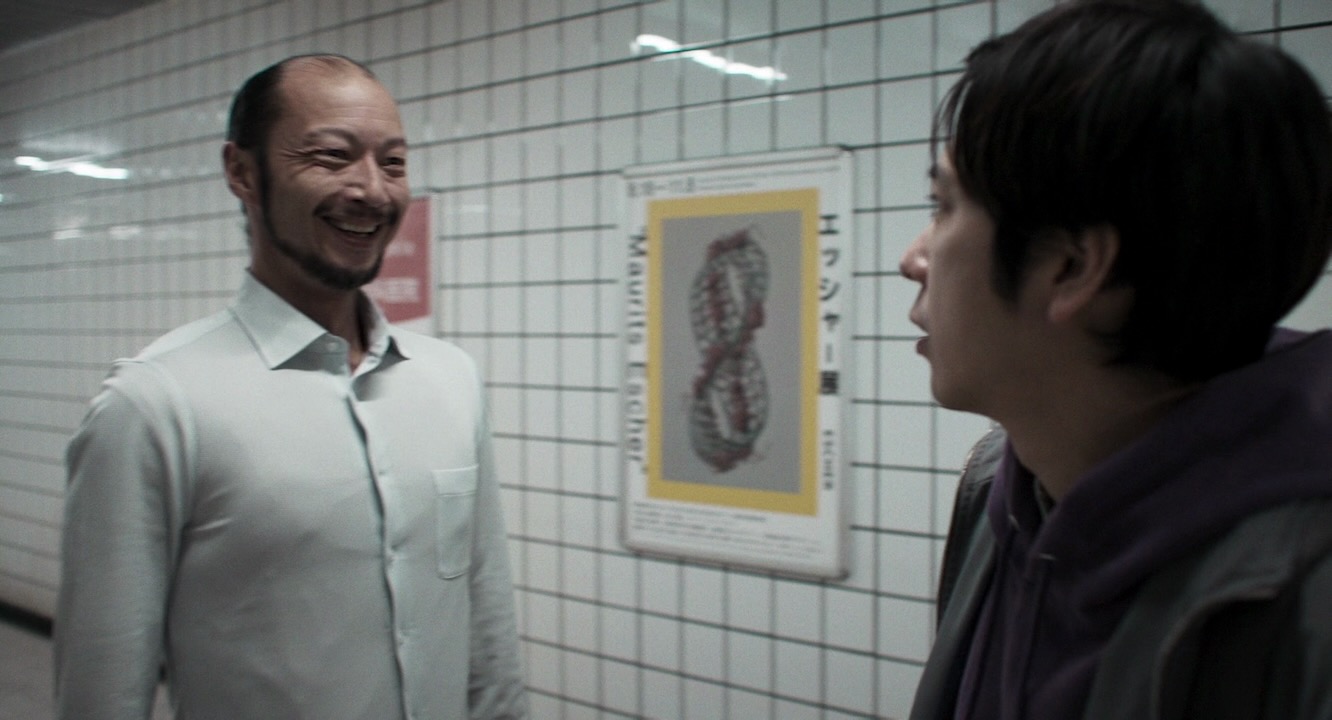
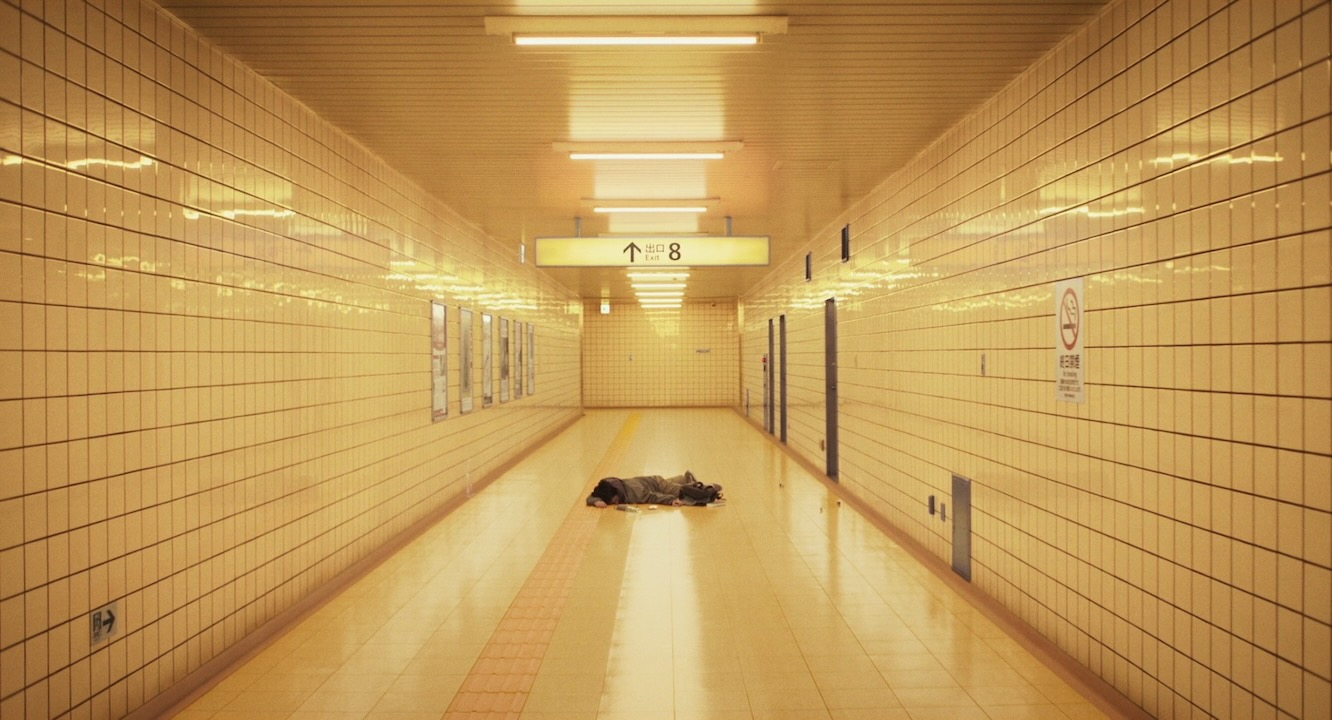
I watched The Lost George Romero Movie just because it’s hot from being freshly rediscovered. Should’ve watched Two Evil Eyes instead, but I hit my Argento quota yesterday. This is a basic Twilight Zone scenario, but unconvincing and overlong, the time-loop plot being the one cool thing about it. If you set an industrial film in a heavy-metaphor theme park, you’re gonna get Carnival of Souls vibes.

Lincoln Maazel explains that he is an actor (it’s true, he’s in Martin), then healthy Link interviews a beaten-up, agonized Link wearing the same suit. We follow healthy Link through various scenarios outside until he eventually becomes his miserable beat-down version. How did this happen? The movie wants us to think it’s elder abuse, but it seems everyone is just selfish dicks and society favors the rich. Anyway, the only Romero movie where the grim reaper rides a merry-go-round.

A swordsman attacks a doll hanging from a string… the motion freezes, stutters and repeats, and the music begins doing the same. A hand-less balding man seated at a table surrounded by inky blackness – his pitcher falls to the floor in a time-locked Brain Candy loop, then appears in a Muybridge time-lapse still, with dark, severe string music. I think we’re inside one of the houses from The Endless.

Librarian and his eagle:

There’s a silly bathtime romp, a scene shot in reverse, a busy library in which all the all the old men are wearing the same old-man mask, the masks and their clockwork motion giving the thing a sense of animation. Naked woman in a wasteland gets trapped in a box. After these unrelated(?) vignettes (DVD description says they’re “all connected by a central staircase”), the last 15 minutes bring something new – all angles and bright lights, TV-static-beings tearing through the screen, revealing perhaps l’titular ange.

Light:

Rotterdam says it “lies on the edge between optical and plastic art, in a gap of constant reinvention.” Bokanowski had another hourlong light-vs-darkness film a few years ago which almost nobody has seen, though those few said it’s great, and he’s been producing shorts regularly since the 70’s.

Bathed Man:

More Light: