Camille: “Can I come during the day, from 5 to 7?”
Marcello: “The magic hour for lovers.”

image

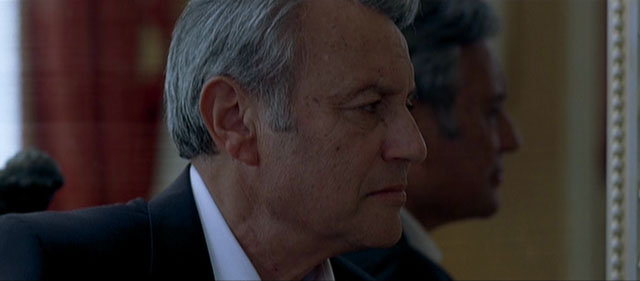
Simon Cinema (Michel Piccoli) isn’t doing too well, confined to his mansion-museum with his butler (Truffaut/Duras vet Henri Garcin) and best friend Marcello Mastroianni (as himself, sort of). Film student Camille (Julie Gayet, the girl with the giant gag vase in My Best Friend) is hired to talk with Simon about movies for 101 nights, and her boyfriend (Mathieu Demy) takes advantage of her position to cast the legendary Mr. Cinema in his student film.

Michel and Marcello:
image

Garcin and Gayet:
image

But the plot is just an excuse for some fun. Every star of French cinema shows up, major films are mentioned (nothing is discussed in any depth – no time). Anouk “Lola” Aimée, Catherine Deneuve and Robert De Niro take a boat ride. Sandrine Bonnaire appears as both her Vagabond self and Joan of Arc. Piccoli drops the Simon shtick and the white wig for a minute and compares cinematic death scenes with Gérard Depardieu (“that old devil Demy!”) before a poster of their co-starring Seven Deaths film…

Gerard and Michel:
image

Sandrine d’Arc:
image

Hanna Schygulla (Fassbinder films, Passion) and Jeanne Moreau (Jules and Jim, The Lovers) play Simon’s ex-wives. There are seven dwarfs. There’s a conspiciously Bonheur-looking sunflower shot. Alain Delon arrives by helicopter (reminiscent, though it maybe shouldn’t be, of the out-of-place helicopter in Donkey Skin).

Gayet with Alain Delon:
image

Jeanne and Hanna:
image

It’s all very light and playful. I’m sure I missed a thousand references, but it keeps many of them obvious enough to remain accessible (if you didn’t catch the meaning when a bicycle is stolen outside the mansion, someone cries “italian neorealism strikes again!”).

Mathieu Demy meets Fanny Ardant:
image

The credits list how many seconds and frames were used from each featured film – impressive – and also all the stolen music cues.

image

tour bus guy: “Glad to see you on form.”
Simon: “Form of what?”
“Why, you seem content.”
“Form and content, a debate even older than I am.”

At Cannes:
image

NY Times: “While covering so many bases, Ms. Varda never makes more than a glancing allusion to anything, and at times the film is such an overloaded grab bag that it grows exasperating. Or even baffling; for unknown reasons, Stephen Dorff turns up in a pantheon of great Hollywood stars.”

image

LA Times: “Michel Piccoli plays Monsieur Cinema, who embodies the history and spirit of film, and in particular, that Fabulous Invalid, the French motion picture industry itself. (Since Varda is such a playful director, Piccoli is sometimes simply himself.) Monsieur Cinema may have been inspired by the director of the landmark Napoleon, the late Abel Gance, whom Piccoli resembles when he puts on a long silver-white wig.”

Lumiere brothers:
image

Doctor Belmondo and Jack Nance:
image

image

image

“The parent system’s no good. Pa grumbles while Ma’s sweet and silent…”

image

Fair haired girl, Pauline, 17, she sings – her ex-neighbor Suzanne, 22, doesn’t. In the early 60’s, strong-willed P is having trouble with her parents, so she visits S, who is having trouble with her boyfriend Jerome, married to another woman. S also has two kids and is unintentionally pregnant. There’s illegal abortion drama, Jerome kills himself, and a title card says “ten years later”…

image

For those who didn’t get Le Bonheur and thought it was asserting male dominance and endorsing cheating on your wife, here’s Varda’s explicitly feminist movie – exploring the joys and pitfalls and terrible music of 1970’s feminism. Unfortunately, explicit feminism (or explicit anything) doesn’t work as well for me as Varda’s more ambiguous movies have… movie is kinda obvious and messagey at times, but she still takes a multifaceted story approach to her message.

image

Anyway, ten years after the suicide, the women meet at a women’s rights demonstration. P is calling herself Apple now, sings a cheesy “my body is mine” song, playing the worst kind of acoustic guitar and tambourine folk. Actually I kinda liked the piano song she sings on an Amsterdam canal boat with her fellow abortion patients later on. S runs a women’s clinic, while P tours her music and theater group, and the two keep in touch sporadically over the years through the mail. Suzanne eventually marries pediatrician Pierre and Pauline goes to Iran with her man Darius (an economist?), and now the two have to cope with being wives and mothers while trying to keep their values uncorrupted. P finds it’s tough to be feminist in Iran so she ditches her guy and returns home. Ends with a lingering shot on Suzanne’s grown daughter, looking troubled at the thought of taking over the plot.

image

P. Kael said “Varda brings a Disney touch to women’s liberation.” Otherwise there isn’t crap about it on the internet, besides saying it’s from France, Belgium and Venezuela, which doesn’t even seem to be true.

an Apple performance:
image

Every movie released in 1977 looks dirty and cheap. Did the entire international film world’s budget go into the first Star Wars? Dialogue is in French, but credits and voiceovers are in English, hmmm. Maybe all this is because of my shady videotape copy.

image

Pauline (Valérie Mairesse) was in Tarkovsky’s Sacrifice and Lucas Belvaux’s Trilogy and Suzanne (Thérèse Liotard, above) was in a Bertrand Tavernier sci-fi flick with Harvey Keitel and Harry Dean Stanton – must see that. The composer shows up as an actor, with four-year-old Mathieu Demy in tow. Assistant camera (in the Iranian scenes?) is appropriately by Nurit Aviv, France’s first licensed female cinematographer.

Who the hell would’ve thought the cowriter of Austin Powers 2 & 3 and Undercover Brother would turn in a sweet, funny comedy? Not I.

Tina Fey (whom I only recognize with her glasses on) is a Whole Foods exec working for mystic Steve Martin, who gets to cut loose for a change. Upright Citizens Brigade’s Amy Poehler has a whole personality, isn’t nearly as one-note stupid as she looked in the trailer, which is what kept me from watching this for a year. Thanks, trailer.

Today’s Hottest Comics (Fred Armisen, Jon Glaser, John Hodgman) get cameos.

Katy and I liked it.

Wonderful program by Beebe, a Florida film prof when he’s not touring art spaces with eight projectors. He’s a low-key charismatic speaker who held the audience easily while introducing films, telling stories or fixing equipment breakdowns. It probably helps that most of us were Film Love regulars who weren’t exactly expecting to see Transformers 2… I wonder how the screening went in Macon the night before.

Last Light of a Dying Star (2008)
This is the big one. Opens with two 16mm loops of blippy light tears, then more 16mm and a Super-8 of science videos (comets, solar system, eclipses) and a german or russian show about the sun getting drunk and trying to stay up all night, and videos of an astounding sequence of thousands of still images featuring the sun or moon aligned and sequenced to show a sunset/moonrise. Also a short stop-motion 16mm loop of a star, sliding and breaking. The frames are positioned around the wall, some overlapping, as Roger “conducts”, starting and stopping and moving frames so it’s more a performance than any kind of traditional film.

Money Changes Everything (2009)
3x16mm, the left and right being documentary shots of Las Vegas while the middle is similar but has a ghostly frame inside a frame, and the audio track sounds like a radio show explaining research which shows Vegas to have the highest suicide rate in the nation.

TB TX Dance (2006)
TB is Toni Basil (singer of the hit song Mickey) and TX is Texas (the state). After their respective introductions, they dance. Made with a laser printer on clear film leader (including the soundtrack), and projected side-by-side with its inverse image, this was an impressive, creative and goofy way to start the show. I won’t say the name of the litigious filmmaker from whom some of the images were borrowed.
image

The Strip Mall Trilogy (2001)
Strip-mall images are reclaimed, decontextualized and rapidly edited. If I was a serious film scholar I would’ve cornered Beebe and bugged him about Hollis Frampton and Zaireeka, but it doesn’t matter if this was Zorns Lemma-influenced or not – it is awesome.
image

Composition in Red & Yellow (2002)
An ironic hymn to the ever-present McDonald’s.
image

Famous Irish Americans (2003)
Educational! Made during a Minneapolis winter when he was afraid to go outside, heh. Tried to show this to Katy but when she learned it wasn’t about Minnesota, she declined.
image

There was another one shot in Paris – spoken intro along the lines of “Now you’ll see I don’t just hate America – I hate France, too.” Also, a reluctant dude from the audience sang along with a karaoke music video of “Touch Me I’m Sick” consisting of clips from a venereal disease educational film. Director was selling (cheap!) DVDs of his work, hence the screenshots.

“I have enough joy for both of you. Happiness works by addition.”

image

Francois is so happy, because he has a wife (Therese) who cares only for him and their two lovely kids. He has a rewarding job as a carpenter, and a good relationship with his brother. One day he meets lovely postal worker Emilie and starts an affair with her, and now he’s even happier. Francois has so much joy that he can’t contain it all, so he tells his wife how happy he is to have two lovely women in his life, and an hour later she goes off and drowns herself. A few months pass before Emilie moves smoothly into the role of wife/mother, and Francois’ happiness continues as before.

Explaining the situation to the wife:
image

The movie, with its bright colors, prominent music, and unsettling focus and editing tricks, is amazing – probably my favorite Varda movie so far. I’d heard it was a deeply ironic, very unhappy movie but I don’t think that’s true, despite the death (not explicitly a suicide). Varda’s got happiness (in feeling and appearance) on her mind, but isn’t cutting it down or saying it doesn’t exist.

Fade to red:
image

Varda: “I imagined a summer peach with its perfect colors, and inside there is a worm. And impressionist paintings, which emanate such melancholy though they depict scenes of everyday happiness. I listened to Mozart, I thought of death’s preponderance. I wrote the film fast, and shot it fast, like the vivid brightness of our short-lived summers. At the time, it provoked much commentary. I said: ‘In a world full of prefabricated images of happiness, it’s interesting to take apart the cliches.'”

Agnes says at the time she hadn’t seen another film called Happiness and she liked the word. I guess Marker didn’t get the Medvedkin reissued until a few years later.

image

Lead actor Jean-Claude Drouot would go on to appear in Chabrol’s La Rupture and Klein’s Mr. Freedom, and his wife would continue not to be an actress, never appearing in another film. Marie-France Boyer (Emilie) had a couple starring roles after this, but fades away after 1970.

A few film references: they go to see a Louis Malle comedy (not giving the title or director, so it took some sleuthing), and watch a scene from Renoir’s Picnic on the Grass (an appropriate title, and another impressionism reference) on television. Then there’s the poster below, advertising Wilder’s Irma la Douche, John Wayne in McLintock, and is that Wyler’s 12-year-old Detective Story?
image

Movie got a silver consolation prize in Berlin after being beaten to the gold by Alphaville.

The New York Times didn’t get it (and called it Varda’s second feature – I guess if La Pointe Courte didn’t play NYC it doesn’t exist).

image

I want to quote the entire Amy Taubin essay because it’s great, but I’ll restrict myself to this bit about the final shot: “When we return in the last scene to this same patch of countryside, it is already late autumn. All that’s left of the sunflowers is their dry stalks. Just as François has replaced one wife with another, Varda replaces the late woodwind quintet with an even later and darker Mozart chamber work—a transcription for strings of the melodic themes of the original piece. The dirgelike sound suggests that as the family, holding hands, walks away from the camera, into the shadowy recesses of the forest, it is already entombed.”

image

The DVD extras are all by Varda herself – only other director I can think of who does that is Peter Jackson. Includes an interview between the two lead actresses and Varda’s daughter, which looks like it was edited by a crazy person. Short interviews with the people of Fontenay about their ideas of happiness. Writers’ quotes on happiness (“He who speaks of happiness always has sad eyes” – Aragon), interviews with two people with the last name Bonheur, a doc of lead actor Jean-Claude Drouot visiting the town of Fontenay and talking with locals about their memories of the film shoot, a 1964 documentary of Agnes on the film shoot (below, with husband Demy)
image

And four intellectuals discuss the film and its ideas of happiness, from which the following:

Michele Manceaux:
“If [the death] was an accident, it was psychosomatic. I think we can say it’s suicide. But it’s hard to fathom how something as serious as suicide could be treated in a story which is like a fairy tale.”

Frederic Bonnaud:
“Max Ophuls made a wonderful film called Pleasure, not Happiness. And the last line is ‘Happiness is not gay.’ That’s it, someone says, ‘But sir, happiness is not gay.’ And I think Agnes’ film is pretty much an analysis of that line.”

Nice to have a laptop full of movies on the plane. I’d loaded up on drowsy motion-sickness pills so instead of falling asleep in the middle of a feature (as I did with The Grand Duke’s Finances) I took a bunch of shorts. The first four are from the 2004 compilation Visions of Europe.

image

Europe Does Not Exist (Christoffer Boe)
A large businessman (actor from The Celebration) tries to pronounce the word “europe” with the help of a hot woman, I’m not sure why. Boe made the art-drama Reconstruction the year before this.
image

It’ll Be Fine (Laila Pakalnina)
Each scene a person or a few stand faces the camera for a not-fixed period of time, then finally nod and walk off. Some vaguely unsettling music and sci-fi soud fx. Europe! Director is an award-winning Latvian.
image

Die alten bösen Lieder (Fatih Akin)
Idel Üner sings about about the death of old evil songs in an empty theater while a guy who may be FM Einheit drills something and hammers a giant spring. B/W music video with a color scene. Interesting, but over my head if it had a point.
image

Cold Wa(te)r (Teresa Villaverde)
Illegal immigrants, I’m guessing – being rounded up on the shore (alive and dead) and processed by the authorities. Wordless, quiet, slow-motion. Not crazy about this one. Villaverde is Portuguese, has a film called Os Mutantes.
image

Love Exists (1960, Maurice Pialat)
“Deep in my memory, a train passes by just like in the movies. Memories and films are filled up with objects we dread.” You have to read the subtitles loosely – translation seems off. Present-tense empty landscapes accompany wistful music and a wistful narrator speaking of childhood memories from these places. I think it’s really easy to use cinema to express nostalgia. I won’t hold it against Pialat – still looking forward to checking his À nos amours and Naked Childhood. Gives way to distopian dread over the suburbs: “Again and again advertising prevails over reality.”
image

image

Charlotte et son Jules (1960, Jean-Luc Godard)
Translated as “Charlotte and her lover” for some reason. Girl (Anne Collette, returning from Charlotte et Véronique but not Charlotte and her steak) walks into Jean-Paul Belmondo’s apartment to jaunty music and he never stops talking for 12 minutes, essentially “I know why you left me, I knew you’d come back, I know why you’re back, I don’t need you, I do need you,” and when she finally gets a chance to speak it’s “I came back to pick up my toothbrush.” Godardian hilarity! Gérard Blain (of Truffaut’s Les Mistons) waits for her in the car. These last two movies were on that DVD “Their First Films,” alongside Resnais’s Le Chant du styrene and Rivette & Chabrol’s Le Coup du Berger
image

image

I. The Battles begins with Jeanne having had her angel visitations already, trying to convince local government to take her to the king, and halfway through the film gets to the battles she led against the English. II. The Prisons is half battles (which is good; we didn’t get enough battles in part 1) and half British prisons (with hardly any of the trial/execution scenes that Dreyer would focus on). All set 1429-1431, except for an odd intro in 1455, with Jeanne’s aged mother, a nun, telling of her daughter’s unjust execution.

image

It’s a Rivette film, all right. Long shots with medium natural lighting, deliberate camera movement, same typeface as always on the titles, brief blackouts between scenes, same list of collatorators in the credits. Quite a follow-up to La Belle noiseuse… I’ll bet nobody saw this coming. It works very well to Rivette’s strengths, though, and stays focused on Jeanne and her quest without gimmicks and without getting caught up in the scale of the story and the hundreds of side characters.

image

Sandrine Bonnaire, a decade after Vagabond and a year before The Ceremony. I didn’t recognize anyone else besides a cameo by Edith Scob. IMDB says Jean de Metz, the guy who leads her to the king’s court, was in Hurlevent, King Charles (André Marcon) is appearing in Rivette’s new film, and Quentin from Out 1 played Pierre Baillot (who was that?).

with Edith Scob:
image

Joan is charismatic and persuasive, but acts realistic. Her supernatural visions aren’t shown – we know Rivette isn’t above showing supernatural visions, but here he has Jeanne speak of them regularly without portraying them as a reality to the audience.

Unfortunately, this four-hour film has another two hours which I can’t see at the moment. Looks like Artificial Eye has released it on DVD. You know, my birthday is coming up…

image

J. Rosenbaum:

…this is a materialist version of a story that offers no miracles, though it does offer a pertinent attentiveness to gender issues (such as the nervousness and sexual braggadocio of the soldiers who sleep beside Joan) and a Joan who’s girlish as well as devout, capable of giggling as well as experiencing pain; when she wins over the dauphin the scene is pointedly kept offscreen, and when she’s interrogated by priests about her faith she could almost be a graduate student defending a dissertation.

with the king/dauphin:
image

C. Fujiwara:

As Rivette and Bonnaire present her, Joan suggests a novice movie director protected by a seasoned crew that humors her as much as obeys her. (Army life in this film is more sitting around than fighting; in this respect it’s like a film shoot.) She doesn’t do miracles; she just uses common sense and takes the initiative.

Grand duke Ramon of some little island (Abacco), not a thrifty fellow, is introduced throwing money into the water for diving natives, while his white-bearded treasurer Paqueno is taking a meeting about the island’s huge debts and given three days to repay them. I thought the rest of the movie would be between the duke and his finance guy, but white-beard disappears after he screws up in chapter four, replaced by a more charismatic character.

Meanwhile, a businessman named Bekker wants to buy part of the island to mine sulfur, which would clear the government debts but would turn this tropical paradise into a stinky sulfur pit, so the duke declines, leading Bekker to instead contact the local easily-located anti-government conspirators.

Bekker and the money man:
image

The Duke’s proposed way out of this mess is the love letter he’s received from Russian Crown Princess Olga, who wants to marry our duke despite her family’s objections. She finally heads to Abacco, “pursued by a descendant of Ivan the Terrible,” and bumps into…

image

Professor Philipp Collin, “a gentleman of changing names and professions,” our movie’s new hero! A master of disguise and trickery who has just broken into a blackmailer’s house and retrieved the purloined royal love letter (long story), he puts ugly old-woman makeup on the princess and pretends she’s his wife.

Lady and the duke:
image

The princess manages to marry our duke, Collin makes a fortune in bond trading through his inside-info on the royal goings-on, and Bekker and the conspirators are easily defeated after they try to hang the duke.

image

Amusing comedy, packed with plot left-turns, broken into chapters so it plays like a serial. A few exciting motion shots (camera scrambling onto land from a boat). Movie is much better than its title.

A Nazi collaborator made a sound remake ten years later, after Murnau’s death

image

Grand Duke Harry Liedtke, who’d appeared in early Lubitsch films, was killed at home by Russian soldiers in ’45. Professor Alfred Abel, star of Metropolis and Phantom, was also in a Sirk film and tried his own hand as director. Princess Mady Christians came to the U.S. in the 30’s, played in the remake of Seventh Heaven and portrayed an old Joan Fontaine in Letter From an Unknown Woman.

image

Walter Rilla (which one was he again?) fled the nazis in the 30’s, returned later and played in the 1960’s Dr. Mabuse pictures. Max Schreck, after Nosferatu and The Street, plays one of the conspirators (which one?)

My favorite intertitle:
image

image

Superficially, this is closest to The Adventures of Robinson Crusoe than any other Bunuel movie. Voila: it is set on an island, features a fight for survival, and is in English. But psychologically, it’s most similar to early Mexican film Gran Casino because of… oh ha, I’m just kidding – I have no idea. In fact, it seems not even vaguely like anything else I’ve seen of Bunuel’s, not even Robinson Crusoe. It’s an American South civil rights drama set in isolation, so you’ve got lynch mob threats but no mob. Very good movie, excellent writing, I just can’t reconcile the Bunuel connection (not that it’s bugging me).

image

Traver, a black musician, flees to a small island, falsely accused of raping a white woman, and runs into Miller, the suspicious racist white dude who runs the place. Miller, meanwhile, is plotting to marry his young ward Evalyn, who’s really too young so he’ll be in trouble if people find this out. The irony that he’s helping capture Traver for sexual crimes (and the suspicion that Traver is actually innocent) isn’t lost on him, so despite his threatening poses, he eventually helps Traver escape after the arrival of a priest and a super-racist friend threatens to call attention (and that mob) towards the island.

Miller, introduced sneering with a dead rabbit in the foreground:
image

Has two of the same writers as Robinson Crusoe (aha!) and thrilling cinematography by Gabriel Figueroa of Simon of the Desert, Los Olvidados, Nazarin and Under The Volcano. Filmed in Mexico, and looks awfully dubbed at times. In the original short story, Traver gets killed at the end.

image

Senses of Cinema:

…though slow-paced and rather stilted, is nevertheless interesting in the way it frames racism and sexism as parallel discourses. … The Young One, unlike Robinson Crusoe, didn’t do well at the box office. Buñuel commented in My Last Sigh: “one of the problems [with it] was its anti-Manichean stance, which was an anomaly at the time, although today it’s all the rage.” Nevertheless his tone suggests that he is quite proud of these American productions, as if to say he could have been a Hollywood filmmaker like other European exiles, had chance not sent him to Latin America.

image

Slant:

Framed by a monophonic rendition of “Sinner Man” by Leon Bibb, the film has the scorching emotional urgency of a black spiritual. … In the constant frustration of Traver’s escape and Miller’s inability to play nice with him, Buñuel evokes the face of humanity repeatedly peeking out from and retreating into the steely shell of a racist comfort zone. To this already unnerving gumbo of feelings and ideas, the director adds a white supremacist hellbent on lynching Traver and a priest whose compassion has limits: he makes a case for Traver’s innocence but has Evalyn turn a mattress over so he won’t have to sleep on the same side Traver did the night before.

image

Main white dude Zachary Scott, facially Gary Sinise-like, had starred in Mildred Pierce and Renoir’s The Southerner in 1945. His final film appearance would be two years after this in Tashlin’s It’$ Only Money (I didn’t see that coming). Bernie Hamilton went on to play cops and convicts, a chauffeur, a “negro,” then in the 70’s had parts in Hammer, Bucktown and Scream Blacula Scream. I’m guessing this would be his career high point, then. The girl appeared two years later in another island drama, then IMDB loses track of her. Crahan Denton played the super racist guy, turned up appropriately enough in To Kill a Mockingbird two years later. And the priest, Mexican Claudio Brook, would star in Simon of the Desert, later in horrors Alucarda, Mansion of Madness and Cronos.