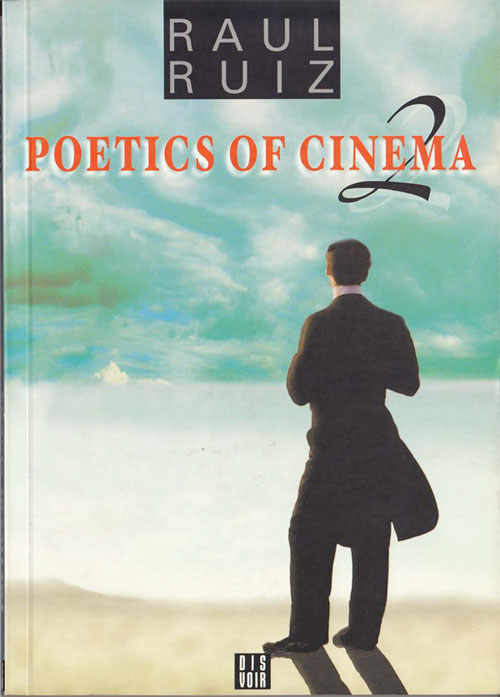
I don’t get 99% of his references, and I lose about 90% of his trains of thought, but I like these books anyway. Some good bits:
My goal is to show that certain germinal images or instant fictions are the best starting point for a film that wishes to have a poetic pretext.
On many occasions I have been asked whether: “All types of cinema must necessarily be poetic. Might a simply narrative cinema not be possible in our times? A type of cinema for which things are simply interesting as peripeteias?”
Yes and no.
I have already said this before: cinema is condemned to be poetic. It cannot but be poetic. One cannot ignore this aspect of its nature. For poetry will always be there, within out reach. If so, then why not use it?
Although it is true… that in most films poetry is incidental, more often than not it’s there partly due to the fact that it has been ignored; nor is poetry really found in so-called beautiful things: rivers, landscapes, mountains and sunsets. Rather, we find it in the haphazard intersecting of sequences, in the instances of narrative incoherence and in crossing sight lines.
Yet, it is there. It is.
From this point of view, poetry is endemic in cinema.
Describing the roles of different people on a movie set, “A lighting technician is above all a maker of shadows. Though nobody seems to notice.” He then suggests that movie studios could hire a philosopher “to destroy all that seems evident.”
Cinema ought to continually play with the harmony and lack of harmony that exists between narrative evidence and visual doubt (that which I have just seen- have I indeed seen it?)
Film is “a language, but composed solely of verbs.”
I don’t know what “this idea” refers to, and I read it twice.
In our field, in the practice of cinema, this idea… suggests the possibility of linking ideas, sequences and situations, which, though placed in different parts of the film, and despite what the distances between them may be (or rather, and I would be willing to say, the greater the distance the better), connect with each other, one reinvigorating the other. Not only because they participate in the same intensity, but also because they have the same ‘sequence of durations’. Five or six shots remind us of another five or six shots from another film and they feed each other by means of an effect that I call ‘mirrors of duration’. It’s not that these shots last the same amount of time. Rather, here we have two intensities, which I am tempted to call states of fascination, producing the effect of emotional detachment.
After beginning to describe the plot of an imaginary film:
Up till this point we’ve had a film about justice, about the act of judgment. A film about. And I seem to recall having mentioned that I find it hard to tolerate and, above all, to make films about … (We should remember that the first question that the average American viewer will pose when confronted by a film that perplexes him is: “What is this film about?”).
He swears the following is “not lacking in all good sense or reason as it might seem initially”:
A few days ago, together with some friends, we played with the following idea-situation: if we accept that what Hitler really wanted was to take possession of Vienna, then it would have been enough for him to stroll through the city’s streets, walk every now and then into one of the cafes, observe the people, breathe in the contradictory odours that escaped from the city’s chimneys. However, it seems that it was indispensable for him to be accompanied by an army and that he be worshipped by the dumbstruck masses. When we enter a film, we would like somehow to appropriate it ourselves, we wish to invade it, we would like for it to adhere to our expectations.
Oooh, a promised third volume:
In the third volume of the Poetics of Cinema, I will be much more explicit, more generous, regarding analyses of specific cases and in proposing exercises.
Ruiz notices his own book’s roundabout nature:
I would like to write: “Yet we shall develop this theme later”. But the translators, who at this very moment are rewriting my words into inadequate and foreign tongues, have already made me realise that each time I have said “but this theme will concern us later”, I have, in fact, forgotten it forever.
WTF:
How does one represent all men, Jedermann, as king of the world? As a lonely man? As the dictator who strolling through the palace of ten thousand mirrors confuses himself with his 200 doubles? Or as one who, smiling under the rain, is condemned to smile even in his coffin, for they are always filming him? The image-man, let’s say Tony Blair (NB A. Blair, the Prime Minister of Great Britain as the first edition of this book was in print, deceased two years later).
On metaphors:
Often, and at times immodestly, I have made use of metaphors in order to approach intuitively certain ideas; many of which could best be described as images and half-glimpsed visions. I hope that among them it is the angelic smile rather than the sardonic irony or the biting impetuousness that has the upper hand. ‘Metaphor’ is a word that has a bad reputation among theorists. To use it implies that one does not have clear ideas, and in that case, the best thing to do is to remain silent. That may be so and I regret it. Yet, in the present state of the arts: does anyone have clear ideas?