Great films and presentation, a great time. I’ll let the pamphlet say the rest:
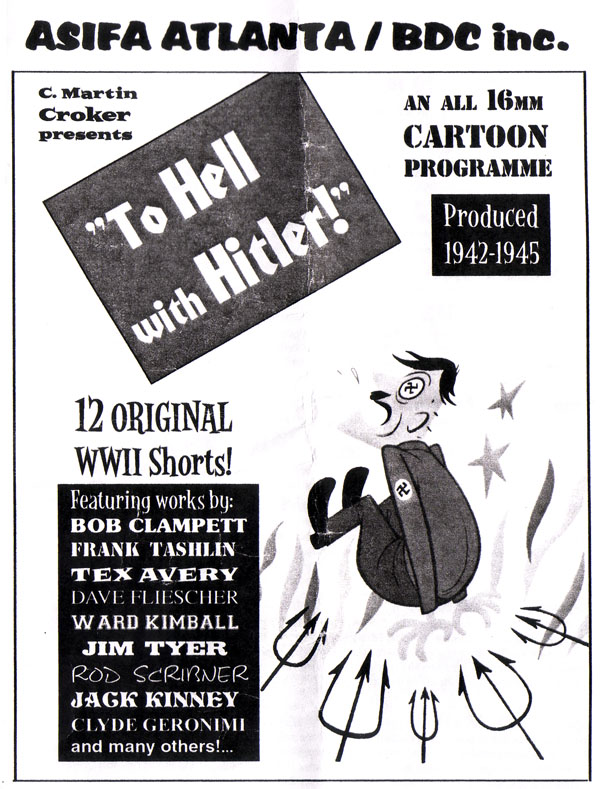


Great films and presentation, a great time. I’ll let the pamphlet say the rest:
I didn’t like it much. The handheld aspect makes it seem like it should be “reality,” but a little while in, I gave a big Juno-shrug and decided that it’s not more “real” than Land of the Dead was, just more annoyingly shot. That’s when you gotta sit back, admit that you’re watching a trashy movie, and enjoy it for what it is.
Rather than waste any more time on this one, here’s a confused and hastily-written email I sent to PG:
—————–
I re-read the article (was actually in Film Comment) and they call the movie brilliant without saying why. Film people think that the confused subtext about media people excuses everything else. Gives them license to say it’s a “brilliant vision, an important work, a masterpiece, though obviously flawed”. It’s real cool to champion a genre movie, makes you sound like you know what’s what, as opposed to those high-minded losers who sit around talking about jean renoir and citizen kane. And it’s especially cool to praise Romero since he has the reputation of being an important and gifted filmmaker in a typically ignored genre and has the good fortune of having been Belatedly Discovered in the academic community (sometime between “bruiser” and “Land of the dead”). Therefore, in the eyes-wide-shut way of seeing things, any new film he releases can automatically be called a masterpiece without any need for justification.
Usual thoughts that arise in this situation (“Maybe eyes wide shut IS a masterpiece and I just don’t understand it yet? Time will tell!”) don’t seem to apply here, as DiaryOTD will only get less relevant over time, and unlike EWS it does not have hidden layers of obscure meaning, it splays itself right out on the dissection table for the viewer to feast on its brains. I’ve heard two things from Romero interviews… 1) He is a big fan of SHAUN of the dead and 2) He is pondering an immediate sequel to Diary, possibly re-using the girl-narrator character-actor. It’s easy to find comedy elements in previous DEAD movies, but nothing as outright nutty as that mute amish farmer segment. You can groan in pain at that segment but I found it pretty funny and exciting, and I read the Professor as a comic caricature (which ruins the whole “this is a documentary of something which is really happening” feel), and see a different kind of movie here. ARE romero’s thoughts on the media confused, or is the movie-in-the-movie confused because it is looking through the eyes of two people… the obsessive and immature male media/filmmaker and his girlfriend who never agreed with his way of doing things, and so is editing against his intentions.
Anyway, reason I brought up Romero’s sequel comment and the comedy aspect is because I am going to go ahead and say that Diary is Part One of a new Dead series. They’re not numbered so I can say whatever I want. LAND is part 4 of the original, and the final part to date. If there’s a Diary Part 2 it’ll only confirm this.
Unrelated: Professor reminds me of Mark Borchardt’s actor friend… you know the one… Thee ACTOR. And that guy was a “real” person. But of course, he was on camera, and always knew when he was on camera… so the Professor can actually be seen as realistic, a cross between that playing-it-for-the-cameras american-movie fellow and the Bob Odenkirk blustery prof caricature.
Whatever I was gonna write when I started this email is now forgotten, as was the point I was gonna make on “diary” since I went off on tangents and there’s rock music in my head and I crave pizza.
Another Clive Barker story that was either badly adapted or bad to begin with. And another story about writers’ creations coming to life. This is all writers think about.
At first it seemed like it was headed exactly in the direction of “dreams in the witch-house” but it took a far more boring turn. The episode seems like the creation of a repressed network-TV writer… it exists just so dude can yell “shit” and “fuck” and we can show a naked girl on TV.
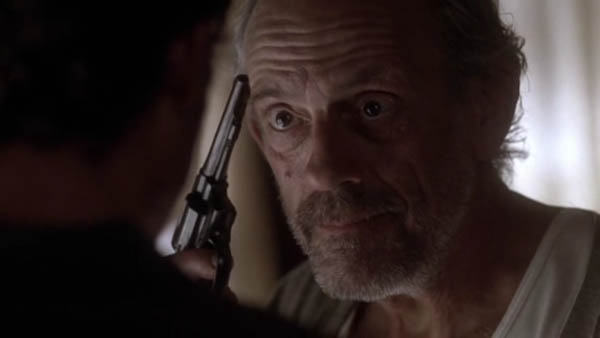
Star actor Christopher Lloyd has little to do. Barker vet actor Tony Todd (candyman!) plays the beast. Whole thing is just terrible. Oh, our main guy turns into book pages and blows away at the end… he was a fictional creation, just part of the story all along!!!
Season 2 overall kinda sucked. Maybe my expectations were just high because s1 was half good, but it seemed like this one’s hit-to-miss was much lower.
I am not making this screen shot up:

A supervisor for a call center (bizarrely located in the USA) finds that his ears have turned against him, greatly amplifying certain sounds, making him annoyed and finally insane:

I could talk for a while about the last four episodes in a row I’ve seen from MoH, how two featured parents who tragically lost a kid, one had a kid who kills his father, and another had a father who tries to kill his kid. Or I could go on about Brad Anderson, who is exhibiting auteurist tendencies with this and Session 9 and The Machinist having people with body issues who hear voices. Or I could ask how our guy trashes his house with a baseball bat without awakening his wife upstairs. But I’m busy, so I’ll just say that the music over the closing credits was “Don’t Have To Be So Sad” by Yo La Tengo.

Holy awesome, an incredible movie. The actors are OUT there, Rock Hudson all repressed, Dorothy Malone all seething sexuality, Robert Stack extreme in everything he does, and poor Lauren Bacall ping-ponging all over the place. The sweeping style announces itself right at the start with the best windstorm since David Copperfield, a speeding car and gunshots (movie starts at the end, just like all movies do today). Tons of over-the-top comic moments that had our appreciative audience chuckling (or howling, as in the ending when Malone suggestively strokes a phallic oil-well model while thinking about Rock).
Apparently based on the death of RJ Reynolds’ son. Robert Stack, fresh off Sam Fuller’s House of Bamboo (and doesn’t this movie display some Fuller-esque drama) plays the son and ROCK is his hard-working best-bud wingman. Rock (in the middle of a streak of Sirk films) is tied to Stack’s family but would like to get out and do something for himself. Dorothy (Artists and Models, Colorado Territory) is Stack’s spoiled, slutty sister who has always been in love with Rock. And Lauren (The Big Sleep, etc) is a hot thing first noticed by Rock but violently wooed away and married by Stack. The less-than-proud father of the big oil family is Robert Keith (Lt. Brannigan in Guys and Dolls).
When Lauren can’t conceive, Stack’s penis is blamed and in shame he turns to wild drinking and loutish behavior. Rock’s and Dorothy’s pent-up love issues can’t be contained and the thing explodes into a violent, windy passion when Stack beats his wife causing her to lose their baby (which he believes is Rock’s), and Dorothy accidentally shoots her brother in a fight. Closing court scene gives a somewhat believable happy ending (Dorothy has a chance to lock up Rock, but she proves herself an alright gal by setting him free).
Movie is gorgeous and wonderful. Sirk called it “a film about failure”. Laura Mulvey says the film “responds to these failures and frustrations by crowding the screen with answering images from the overtly Freudian to flamboyantly cinematic lighting, color and decor.” At oscar time, Dorothy Malone won best supporting actress, Robert Stack was beaten by Anthony Quinn, and Rock was nominated for Giant instead.
Mulvey again, on the greatest part of the movie:
In one of the film’s key moments, she performs a wild solo dance of rebellion in her bedroom. As her loud, jazzy music fills the house, her father slowly climbs the sweeping staircase, only to collapse and fall to his death. With Sirk’s instinct for melodrama (in the literal sense of music plus drama), the intercutting between the spaces occupied by father and daughter quickens to create an innovative, cinematic rhythm for a montage sequence that was rare in studio-system Hollywood.
Feb 2017: Watched it again with Katy, who was impressed and disturbed by all the psychology on display and isn’t sure what to think about this Sirk fella anymore.
“Human beings will always betray you. You can only trust the numbers.”
Well-chosen images (sometimes picked for more comic effect than illustration) keep the thing entertaining while it lectures us. Good use of stock footage and music (incl. Yo La Tengo’s “return to hot chicken” and “nowhere near”).

PART 1
Post-Depression-and-WWII expansion of American gov’t in order to “control the economy and protect society from the dangerous self-interest at the heart of capitalism.”
Friedrich Von Hayek predicts tyranical outcome from gov’t planning and control of society, says everyone pursuing their own individual self-interest should lead to social order.
Intro of game theory and cold war strategy.
John Nash enhances Hayek’s theory, shows that “rational pursuit of self-interest” leads to a happy equilibrium, but after Nash was locked away to treat his schizophrenia, his coworkers tried to adapt his theories. Nash one of the few theorists and politicians who comes off looking kinda good at the end, saying that he was wrong and that his theories were mis-used.
RD Laing investigates schizophrenia, discovers a treatment (getting affected people the hell away from their horrible families) and a related scary fact, that sane people can be sent to an asylum and believed to be mad. Develops system to quantify personality disorders and remove subjectivity from diagnosis.
James Buchanan argues that politicians’ working for what they call “the public interest” is deceptive, greatly influences Margaret Thatcher. Sets up number-based productivity targets for health-care employees to “free” them based on Nash’s simplified vision of purely selfish individuals.
PART 2
John Major sets out to harness the individualism of public servants through liberating paradigm of the free market via performance targets.
Greenspan and Clinton’s economic advisor tell Clinton that his programs won’t work, needs to move to market-driven society and government.
“Freedom was redefined to mean nothing more than the ability of individuals to get whatever they wanted.”
When he talks about misinterpretations leading to this market-driven society, John Carpenter’s sinister “Halloween” theme kicks in… nice.
An anthropologist actually named Napoleon did a bizarre observational experiment which “proved” that game theory can be applied to the genetic level, that humans, like other animals, are self-interested machines.
“With the rise of this machine model of human beings a new idea of how to change society began to emerge, not through politics any longer but by adjusting how well the individual machines function” and into “a new form of order and control” in the form of imagined new mental disorders and treatments such as prozac. And the drugs turned them into simpler beings, closer to the machine model.
Meanwhile, performance targets weren’t working, corporate crime was huge, and class division was greatly increasing.
PART 3
Overview of how these simplified machine models of human behavior and other stupid theories led to increasingly bad policy decisions in England and the US, into an intro to Isaiah Berlin. I thought I kept notes during this one, even remember spelling out “Isaiah Berlin” but I can’t find them. So here’s wikipedia:
“Berlin is best known for his essay Two Concepts of Liberty, delivered in 1958 … at Oxford. He defined negative liberty as the absence of constraints on, or interference with, agents’ possible action. Greater “negative freedom” meant fewer restrictions on possible action. Berlin associated positive liberty with the idea of self-mastery, or the capacity to determine oneself, to be in control of one’s destiny. While Berlin granted that both concepts of liberty represent valid human ideals, as a matter of history the positive concept of liberty has proven particularly susceptible to political abuse.”
Tony Blair tried at least, sending Berlin a letter asking for advice, but Berlin was on his death bed and never responded. Bunch of sadness ensues, and the movie’s ray of hope for humanity’s future only appears in the final sentences. I will have to watch this part again.
Overall a helluva terrific movie. I want to see it again and I want everyone everywhere to see it also. Katy even almost watched it with me.
Addendum JAN 2011:
Watched again with Katy and I was thrilled that she loved it also. We talked about how damned clever, well-researched and respectful of its audience it seems to be, and how all other documentaries seem lessened in its wake.
I guess I don’t know what makes a Howard Hawks movie a Howard Hawks movie. No anti-auteurism implied, but I have an awfully hard time detecting the directorial stamp in pre-1960’s studio films like those by Hawks and Lang. This is an awesome movie, one of the best comedies ever made, but at first glance the camera work and editing don’t seem to be helping. We put Rosalind and Cary in frame and they recite the screenplay as fast as they can manage and voila, instant classic. It can’t be that simple though, and every Hawks movie seems to be superb so there’s something Hawksian here, even if it’s only in his ability to attract the best scripts and collaborators. Let’s go to the experts. Actually let’s just go to Senses of Cinema:
“Hawks was able to impress upon these genre films his own personal worldview. It is essentially comic, rather than tragic, existential rather than religious, and irreverent rather than earnestly sentimental.”
“Nicknames point to the primacy of the group over the individual; the value of male bonding through rivalry or through rite of passage; the elevation of male communities validated by codes of ethics and professionalism; the potential for women to gain access to male groups in unconventional ways; and the articulation of mystique-laden alternative forms of social and sexual arrangements outside of Hollywood’s idealisation of the nuclear family. These are the traits of Hawks’ work which are almost universally noted by film critics.”
“Hawks’ own characteristic plain vanilla style (eye-level camera privileging dense formations of actors in the frame)…”
So not a mise-en-scene thing so much as an expression of a certain world-view. I get it.
This was the third or fourth time I’ve watched “His Girl Friday” since 2001, and I watched it not as a work that I know well, but as something new and exciting but vaguely familiar. When something happens I go “oh yeah, that’s what happened” but I have little prior recall of plot, character or dialogue. I am seriously thinking of renaming this site “The Amnesiac Filmgoer”. So rather than recount what happened in the movie and put up screenshots, I’m going to go ahead and forget it again so it’ll be just as new and exciting the next time I watch it.
From writer Mick Garris and director of Snoop Dogg horror Bones, I wasn’t expecting much. It’s actually a kind of alright movie in search of direction from a better script. The young actors are fine, the ringer Michael Ironside (Scanners, Starship Troopers) is suitably awesome (but he’s no George Wendt) and the atmosphere and horror elements are there, but the story is slack and pointless.
Opens with kids playing Violent Video games (v-words) and one of ’em fighting with his dad over the parents’ divorce, then suddenly it’s all Stand By Me as they head for the funeral home to check out a dead body. Long, “suspenseful” (actually kinda boring) scene follows checking out the home and finally (finally!) discovering it has been taken over by Vampire (v-word!) Ironside (which doesn’t make a whole lot of sense since the movie later emphasizes that vampires can only drink blood from the living). Long story short, both kids become vampires, one kills himself and the other heads for New York to join the cast of Blade.

Okay, any show that opens with George Wendt dissolving his father in a bath of acid is gonna be good. Never quite lives up to its promise (or its predecessor, “Deer Woman”), but it gets 80-90% there, and that ain’t bad at all.
His coolest horror role since House:

Young couple moves in next door to utter lunatic Wendt. Besides being a bit socially awkward, he’s also creating himself a lovely family of well-dressed skeletons in an upstairs room and imagining whole conversations (even fights) with them. Young couple is an investigative reporter and an ER doctor whose daughter is part of Wendt’s family. Turns out they have tracked him down in order to torture him to death, a perfectly horrible ending (and I mean that as a compliment). Some of the couple’s own fights, which we assume are about deciding to have a new baby, are actually about deciding to go through with the murder plot, a detail which makes the somewhat-slack middle of the episode come to life upon reflection. And the more lighthearted & comedic moments come from Wendt’s delusions and the care with which he assembles and dresses his skeleton family, so it’s probably a darker piece than “Deer Woman”.
