Archive for August, 2007

Richard Pryor Live In Concert (1979, Jeff Margolis)

A pretty good Richard Pryor stand-up act. This got a theatrical run in early ‘79, and is on Jonathan Rosenbaum’s list of his 1,000 favorite movies. I love a good stand-up act, and I guess if I had a better memory for jokes, I could fold my favorite stand-up acts in with my favorite movies… but I really consider them to be separate beasts. Comedians still get theatrical runs once in a while (Sarah Silverman “Jesus Is Magic”), but I hardly ever think of them as cinematic. Even my favorite Spalding Gray monologue films (”Monster in a Box”, “Gray’s Anatomy”) I have a hard time reconciling with my other favorite films… I prefer to think of them as illustrated audio-books (sorry, Steven Soderbergh and Jonathan Demme).

I know Pryor was a groundbreaking comic, so I cringed when he got into the “black people walk differently than white people” part of his act. Not exactly original anymore, and not nearly on the same level as an average Chappelle Show episode. The more observational stuff, crowd interaction, stories of growing up, mostly great. Still, last week I rented Louis C.K. “Shameless” (directed by Steven J. Santos, an awards-show stage manager) and laughed more. Didn’t even think to add it to my “films” list. I think I only added those Ricky Gervais stand-up specials to the list because they were directed by the guy who did the Alan Partridge series.

Jeff Margolis directed the Academy Awards show for the first half of the 90’s, then moved onto the Miss America Pagent and Country Music Awards. I guess he’s the guy in the control booth who says “camera two on my mark… and… mark.”

I still want to check out the other Pryor concert movies sometime (chronologically, from directors of playboy videos, the hanna-barbera happy hour, and pryor himself) and maybe his TV special and series (from dir. of Mr. Show!).

Tags: ,

Comments

Hallelujah, I’m a Bum! (1933, Lewis Milestone)

Lewis Milestone, having just made “all quiet on the western front” and “the front page”, turns his attention to an anti-capitalist Al Jolson musical. Why not? It’s no more weird than going from “Frankenstein” to “Show Boat”.

IMDB reviewer puts it thusly: “The best way to appreciate this odd film is to put one’s self back in the early 30’s, the Depression era. The drama glamorizes life on the streets and parks, probably to make the ordinary hard-up person feel better about his own financially depressed plight. It also played into the prevailing poverty consciousness of the mass public.”

Written by Ben Hecht, one of the biggest screenwriters of the 20’s through 60’s. Music by Rodgers & Hart (pre-Hammerstein). Most of the musical scenes are pretty unexciting, people having halfheartedly-rhyming conversations, vaguely sung with background music not matching up… but there are a couple good songs including the title number.

image

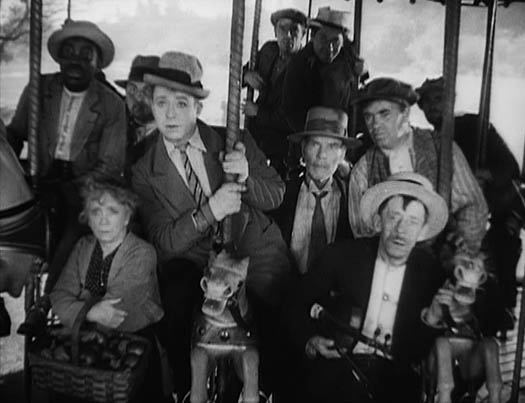
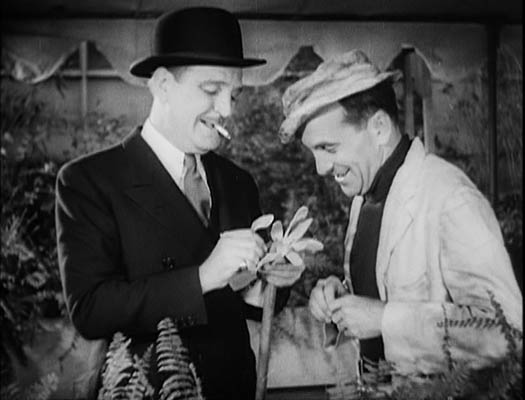
Al Jolson (above, right) is the “mayor of central park”, proud to be a bum. Money is a curse, you see, and the happy denizens of the park (where the weather is always fair) are better off without it. The actual mayor of New York (above, left, oscar-nom Frank Morgan of “wizard of oz” and “shop around the corner”) has love troubles, mistakenly thinking his girlfriend was cheating, he’s lost without her. When she jumps in the river, Jolson saves her. She has a convenient bout of amnesia and they fall for each other. Jolson cleans up, gets a job to support the girl… finally learns who she is, leads the mayor to her like a good friend, goes back to his happy-go-lucky ways.

image

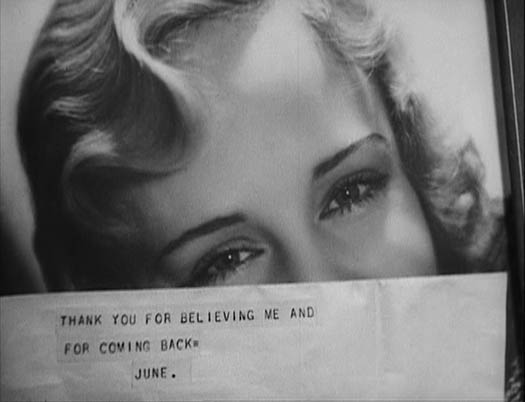
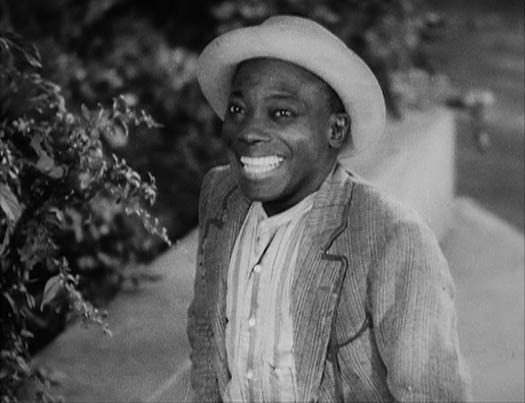
Funny that the mayor leaves June (Madge Evans of “pennies from heaven”) when he suspects she’s with another man, and desperately takes her back when she’s actually, provably with another man. Silent comic Harry Langdon plays Egghead, hardworking socialist trash collector, and Edgar Connor is Acorn, Jolson’s black friend/servant - they’re my two favorite parts of the movie. I must’ve missed the homoerotic tension between Acorn and Jolson that Rosenbaum mentions.

image

Rosenbaum: “Rodgers and Hart scored this one too, and once again it’s closer to operetta than to the usual song-and-dance stuff. It’s hard to know whether the remarkable inventiveness comes from the story (Ben Hecht), screenplay (S.N. Behrman), preproduction director (Harry d’Abbadie d’Arrast) or final director (Milestone). Who thought up the devastating montage parody of Eisenstein timed to the American anthem, or an illustration of economic deflation via throwaway dialogue during a tracking shot across a bank floor, or the notion of a Trotskyite trash collector played by Harry Langdon? And what about the rhyming dialogue, or the homoerotic relationship between a black and a white tramp? We know that a portion of the parable-like plot involving the mayor of New York (Frank Morgan), his amnesiac mistress (Madge Evans), and the mayor of New York’s homeless (Al Jolson) was lifted from Chaplin’s City Lights, but who put it all together with such bittersweet conviction? This was one of Jolson’s rare commercial flops, but it’s so sad and peculiar that one isn’t surprised. Even though it’s a fantasy, the Depression in all its grief comes alive here as in few other pictures.

image

Tags: ,

Comments

Le Joli Mai (1963, Chris Marker)

The long-awaited continuation of my Marker-a-thon!

Dedicated “to the happy many”

“The Lovely Month of May”, in two parts:
Part 1, “prayer from the top of the eiffel tower”
Part 2, “the return of fantomas”

“It happened in may 1962. For some it was the first springtime of peace.”

A series of interviews with Parisians at/about the end of the Algerian War. A little provocative, but more of an inquisitive survey than a personal statement.

Marker as interviewer recommends “Cleo from 5 to 7″ to a guy who sells suits, then tries recommending “Marienbad.” Guy replies “but it’s something you’ve gotta understand.” “Don’t you understand things?” “Sure, but why should I take the trouble? I pay, don’t I? Sitting in a movie to rack my brains?”

Narration: “The mayor of Paris would have a lot to do, but there is no mayor of Paris”

Someone petting the head of a baby owl, narration untranslated.

Sometimes there are whole sections that aren’t subtitled or translated. Sigh…

The interviewees are asked about money, politics, world events, their daily lives. Some prodding to get the more apolitical citizens to talk about politics, or to talk about why they don’t want to. There’s a shift to more specific issues in part two. More about racism and prejudice, poking around about the Algerian War. This is the same year Alain Resnais was making a very different film concerning the Algerian War, “Muriel”.

Not very cinematically interesting, I guess, but today it’s a fascinating look back at a certain time and place (May ‘62, Paris) and a general survey on people’s thoughts, hopes, fears and prejudices. I wonder what Parisians thought when the film came out. Can’t imagine they raved about it. He’s asking questions that lots of people didn’t want to be asked, seems like he’s throwing social problems into the faces of the Parisian viewer. I’ll bet foreigners were more intrigued.

A long interview with an Algerian ends with spoken statistics about that particular May over time-lapse photography of the busy streets. “But for the 5,056 people in the prisons of Paris, each day of May was exactly the same.”

“As long as poverty exists, you are not rich. As long as despair exists, you are not happy. As long as prisons exist, you are not free.”

A surprisingly affecting movie… I liked it more than I thought I would. Movie ran only 1:58, forty-five minutes shorter than the IMDB runtime, so that’s further incentive to see a more complete and better translated version if/when I can find one.

Marker: “What I wanted to come out of the film is a sort of call to make contact with others, and for both the people in the film and the spectators, it’s the possibility of doing something with others that at one extreme creates a society or a civilization… but can simply provide love, friendship, sympathy.”

From Catherine Lupton’s book:
“Immersing himself in groundbreaking new developments in camera and sound equipment that allowed human encounters to be filmed with greater ease and spontaneity, Marker brought the interview centre stage in the filming of Le Joli Mai, a less-than-flattering depiction of French social attitudes at the close of the Algerian War.”

“Marker stated that one of his ground rules was to avoid selecting the participants or manipulating the interviews… in order to confirm a ready-made conclusion… Another was to refuse to regard participants as stock examples of social or character stereotypes. ‘People exist with their complexity, their own consistency, their own personal opacity and one has absolutely no right to reduce them to what you want them to be.’ Le Joli Mai does grant its participants the space to be themselves, and to speak fully on the topics and questions proposed by the interviewer, without reducing their contributions to caricatured soundbites. Even when the film makes pointedly critical montage interventions into a discourse that it evidently regards as misguided or fatuous, it still retains the texture and substance of the interviewee’s speech, so that it is possible for the spectator to measure Marker’s reaction against the statements or attitudes that have prompted it.”

Marker produced this film and “Le Jetee” simultaneously, a film which turned “the documentary adventure of Le Joli Mai inside-out, distilling its subterranean fears and anxieties about the future into an elegaic masterpiece of speculative fiction.” His new filmmaking identity “might be the critical conscience of contemporary France, or the cosmonaut of human memory.” “In his self-curated retrospective at the Cinematheque Francaise in 1998, the earliest of his films that Marker elected to show were La Jetee and Le Joli Mai. He went on record to state that he regards his earlier films as rough and rudimentary drafts and no longer wishes to inflict them on the cinema-going public.”

“The camera operator Pierre L’homme is credited as co-director in recognition of his central role in creating the film’s mobile, responsive visual images.” Pierre later shot “Army of Shadows”, “Mr. Freedom”, a Bresson feature, a Godard short, and “The Mother and the Whore” before working with Marker (and Yves Montaud) again on “The Loneliness of the Long-Distance Singer” in 1974. Narrator Yves was in “Let’s Make Love”, “The War Is Over”, “Tout va bien” and “Le cercle rouge”, and narrator Simone Signoret I know from “Army of Shadows” and “La Ronde”. Composer Michel Legrand did a James Bond movie, “F For Fake”, some Jacques Demy (incl. the musicals!), some Varda and Godard.
Tags: , ,

Comments

Sunday In Peking (1956, Chris Marker)

image

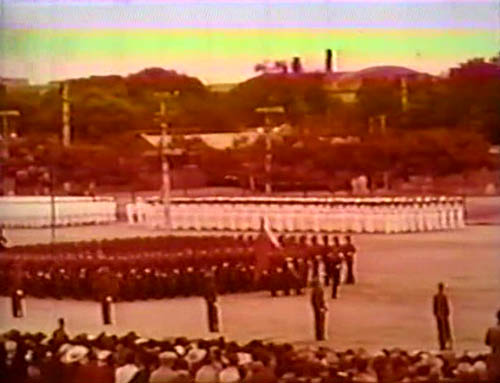
Marker’s third movie, the one he made right before “Letter From Siberia”.

image

Nice to have a fast-paced English voiceover so I can actually tell what is being said, unlike with the washed-out subtitles of “letter from siberia” and “description of a struggle”.

Movie is short, poetic and comical. We reeeally needs a nice dvd set of these travelogues to go with the great current releases of “Sans Soleil.”

image
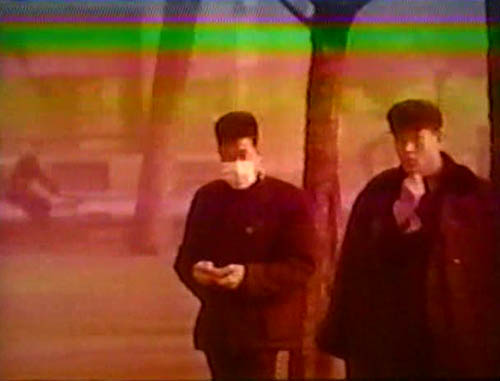
“this isn’t an absent-minded surgeon; it’s a townsman protecting himself against the dust

The narrator remarks that dust, germs and flies are the enemies of the revolution, so there may still be capitalists in China, but there are no more flies. Catherine Lupton: “This remark neatly commends the energy put into overcoming problems, while taking ironic note of the obstacles that may have been overlooked in the rush to cleanliness. This hint of light-hearted subversion wholly escaped the selection committee for the Berlin Film Festival of 1957, who refused to screen Sunday In Peking unless the comment about the vanquished flies and a number of other remarks deemed to be Communist propaganda were removed.”

image
“shops covered with characters as if they were huge boxes of tea”

Nice line: “the harsh price of the picturesque”… and history remembers “legendary wars that still resound through the peking opera house today.” Images and writing about the past and future, history meeting present day, the nature of time.

image
“the chinese people celebrating their bastille day, their day of revolution”

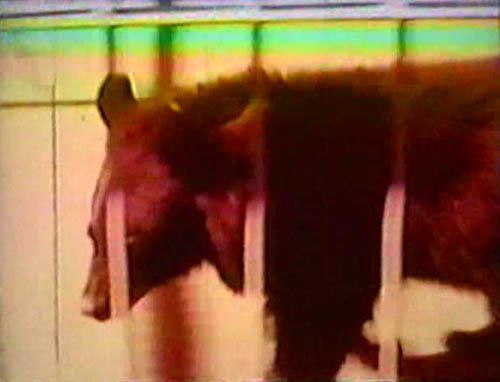
I don’t remember any owls, and cats were (entirely?) restricted to the title cards, but there was a Siberia-reminiscent bear:
image

These movies are all still good, worth watching for enjoyment, not just as academic exercise to probe Chris Marker’s beginnings in film. Wish they’d get a little more attention.

image

Tags: , ,

Comments

Description of a Struggle (1960, Chris Marker)

Catherine Lupton says the film “examines the identity of the state of Israel by reading it as an accumulation of signs, marks of the multiple conflicts that have carved out its twelve years of existence as a nation.”

Signs:
image

Movie is a “Letter From Tel-Aviv” then, exploring Israel, Palestine, Jerusalem, Haifa, with the humorous and intelligent commentary as in Marker’s other early docs. Of course I’ll need to see it again sometime whenever possible, since my copy has nearly unreadable white subtitles and tiny, crappy picture quality. I’m not even sure what language is being spoken by the narrator.

Marker’s owls are present:
image

And cats as well… a man who feeds them calls in hungarian “to all hungarian-speaking cats”
image

Electronic sound effects and filming an oscilloscope predate the technological curiosity in Sans Soleil by more than 20 years.

Cinematography by Ghislain Cloquet, who later shot Mouchette, Balthazar and Jacques Demy films, won an Oscar for a Roman Polanski film, then died during the production of Sans Soleil.

“born in camps, crushed by camps… us, germany, with our crimes,” fragments of a whole unexpected section of accusatory comments against Europe. This could be a more-hopeful sequel to “Night and Fog.”

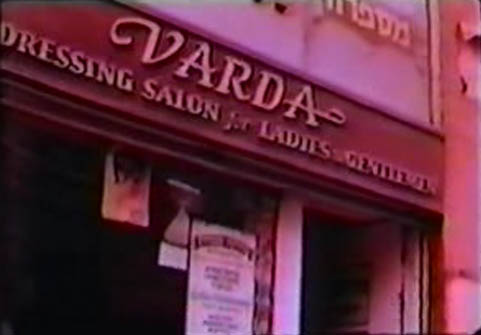
Store signs at the beginning read: samson, delilah, varda and ali baba
image

Definitely some plays on words like in Letter From Siberia but harder to tell what’s being said… some play with editing and sound effects (announcer and crowd cheering while camera follows a kid skating downhill through the streets, as if he is inaugurating a new Olympic sport).
image

A scene of quiet study brings to mind the library short “Toute la mémoire du monde”.

I miss every third or fourth line so not always sure what points he’s trying to make, especially during a section composed of stills and zooms in the orthodox quarter.

We get a favorite theme from “Sans Soleil” discussing pictures/images vs. reality in the photographs taken home by tourists and in the ancient biblical paintings of this land.
The Jewish Saturday has a “mood of general strike”… he calls the kibbutz meeting an “absolute democracy” then describes a communist “Utopia”. His purposely combining terminology of communism and democracy during the kibbutz meeting scene must’ve incensed some people when this came out.
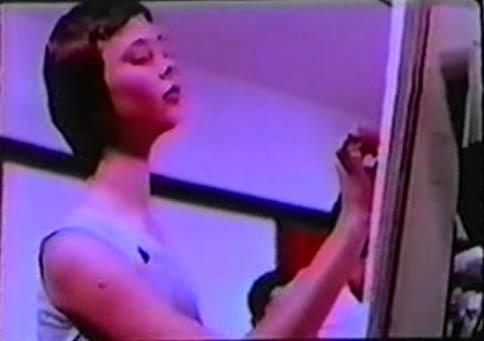
The young artist who Marker chooses to represent the Israeli state in the final scene:
image

Mad:
image

Cat windows:
image

Children:
image

Tags: , ,

Comments

Andy Warhol’s Bad (1977, Jed Johnson)

I can’t account for how this movie could have nearly a 7/10 rating on IMDB, unless the only people bothering to watch and vote are drug-addled youth who think it makes them hip to pretend to like everything with Andy Warhol’s name on it. Movie is John Waters lite with crap dialogue and acting. Story’s not great, filmmaking is worthless, movie only seems to exist for shock value.

Money-grubbing Carroll Baker runs an electrolysis business and a hitman business out of her home. Her “nephew” Perry King moves in to work on a job for a week, while a detective is shaking her down for protection money and her sister-in-law is whining pathetically about her life, her baby and her missing husband. Bunch of contracts come in for the all-female assassins, kill a baby, a dog, a mechanic. Perry has been misbehaving all week, fnally gets his call to kill an autistic kid but refuses to do it, detective kills Carroll, sis-in-law is still sad, the end.

image

Why make this movie? Warholstars.org gives no clues, just talks about how they financed it, problems with casting, and jealousy behind the scenes. Andy apparently never talked to director Jed after this came out.

Heh, one negative review says “still, it makes you appreciate Paul Morrissey”.

Wikipedia just says the baby-throwing scene is “infamous” and that Julie Christie and George Cukor attended the premiere.

I guess the movie could be called “outrageous” if it wasn’t so boring and lifeless… but coming out soon after Rocky Horror, Texas Chainsaw Massacre, Thriller, Shivers, Salo, Taxi Driver, and Morrissey’s monster movies, what’s the point in just aiming for outrageous? This being the same year as Eraserhead, it’s no wonder nobody talks about “Bad” anymore. This was the last movie with Warhol’s name on it (unless Blank Generation counts).

image

This movie is as old as I am. Carroll Baker, one of the only good actors here, played the title role in Baby Doll and a lead role in Giant (both ‘56). Lenny Bruce’s daughter was in this. The awful police detective was in Blazing Saddles and Super Fly and died in ‘96. Girl who played Mary (sis-in-law) has had good roles in lots of things (Forbidden Zone, Crybaby, Tapeheads, Big Top Pee-Wee, Masked and Anonymous, Fat City), lost her legs in 2000 from a blood disease. Director Jed Johnson died in the TWA Flight 800 explosion in ‘96, never directing anything else before or after, and Warhol died in ‘87 after hosting two seasons of “Andy Warhol’s 15 Minutes” on television.

image

Tags: ,

Comments

Some Seventies Shorts

Frank Film
image
Barebones story of Frank Mouris’s life narrated on the soundtrack blended with a free-association list of words. Visual is a fast-motion collage of magazine-clipped images. Neat, must’ve taken forever. Won the Oscar, kickstarting a long life of filmmaking obscurity for Frank, poor guy.

Valse Triste
image
Looks like a montage of found footage from rural America in the 1940’s set to sweeping sad music. Sepia-tinted, only 5 minutes long. Took me a visit to IMDB to realize the montage represents the wet dream of the boy who goes to sleep at the beginning of the film, damn. I get it now. Bruce Conner born in Kansas in 1933, so he WAS that boy!

Adam, 5 to 12
image
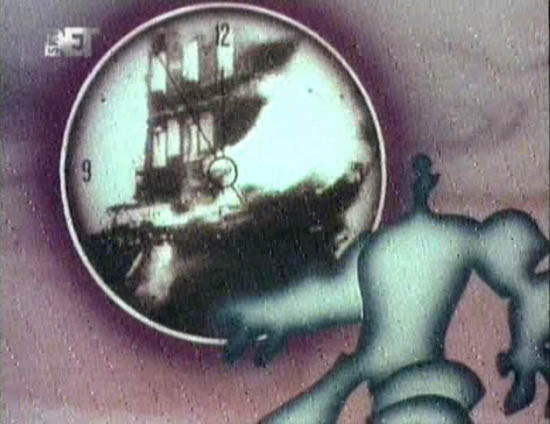
Begin the rhythmic russian vocal music. Trippy animation doesn’t do much, then the clock appears, then a whole pile of grim images of war and death are overlaid on the clock. Adam tries to turn the clock back but it’s frozen at 5 to 12. Finally it moves dramatically to THE END. Director Petar Gligorovski died in 1995.

Reflecting Pool
image
Wow, this is great. Seven minutes of a reflecting pool with some video effects. A man motions to jump in, but is frozen in midair while the pool stays in gentle motion. The man slowly fades out, and most of the rest of the action takes place in the pool’s reflection and through its varying levels of agitation. Probably just a more complicated metaphor for sex than the last film… I don’t pick up on those things easily. Bill Viola is only 56 and still working.

Sweet Light
image
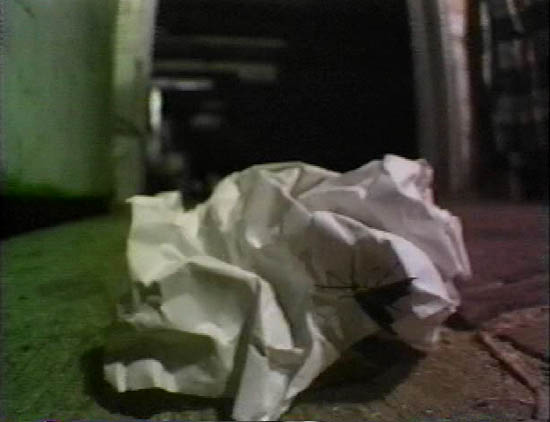
Another by Bill Viola. Close-up: some flies on a windowsill. Camera moves slowly and evenly away and turns toward a man writing at a desk. Camera fast follows a ball of paper he hurls on the floor. Abrupt change to camera spinning around a dinner table candle, then insects leaving vapor trails in the air. There is light involved, and it’s all pretty sweet, so there’s your title.

Pause!
image
A man against a wall making hand gestures, distorting his face and making breathy sounds. Gets violent at times. Probably also a metaphor for sex. My copy was dark and muddy but it’s not like I’ll be scouring rare video stores looking for a better version. Oh, I looked it up and the man is Arnulf Rainer, a surrealist-influenced artist known for “body art and painting under drug influence”. This must be body art. I wouldn’t have named a museum after this guy, but I guess the New York art scene knows better than I do. Directed by Peter Kubelka.

Powers of Ten
image
By famous designers/architects/filmmakers Charles and Ray Eames. “A film dealing with the relative size of things in the universe and the effect of adding another zero”, made for IBM. A man is laying in a park in Chicago. We zoom out from him to 100 million light years (10^24 m) then zoom into his hand to 0.000001 angstroms (10^-16 m). Both Eames died on August 21, ten years apart. Music by Elmer Bernstein (also dead) of “far from heaven” and “ghostbusters”.

The Metamorphosis of Mr. Samsa
image
The Kafka story done with cool mushy black and white perspective-shifting animation (paint on glass?). Samsa might be some sort of spider/beetle. Caroline Leaf works with the National Film Board of Canada.

Elimination Dance
image
Co-written and starring Don McKellar (Last Night). Dir. by Bruce McDonald, who made cult films Roadkill and Hard Core Logo. Couples dance all night while an announcer reads off descriptions (”anyone who has lost a urine sample in the mail”) eliminating them one by one, as the cops slowly close in fearing unrest. A comedy, cute. Not from the seventies, I realize (1998).

A Doonesbury Special
image
Kind of limited animation, but that’s not a cool criticism to make of a well-intentioned independent production like this one. Neat movie, could’ve stood to be another half hour longer. A regular day at the commune with a bunch of flashbacks, “feeling the present as it moves by”. A little sad, some disillusionment about the fallen ideals of the late 60’s, probably a nice companion to the comics (which I haven’t read since Hunter died). Both Hubleys have died, Trudeau cowrote the Tanner movies.

La Soufriere
image
“This is the police station. It was totally abandoned. It was a comfort for us not having the law hanging around.” Would’ve probably been one of Werner Herzog’s best-known movies (OR have led to Herzog’s fiery death) if the volcano had exploded as predicted, but since it didn’t, this is an obscurity on a DVD of documentary shorts. “There was something pathetic for us in the shooting of this picture, and therefore it ended a little bit embarrassing. Now it has become a report on an inevitable catastrophe that did not take place.” Herz and crew tromp about an extremely dangerous volcano site in the Caribbean, explore the completely empty towns below, and interview what few stragglers remain. One of the cameramen is from Morristown NJ, also shot “far from heaven”, “a prairie home companion”, “tokyo-ga”, “true stories” and “the limey”.

Most of these movies are as old as I am.

Tags: , , , , , , , ,

Comments

Buster Keaton Shorts (1920-23)

The Boat
image
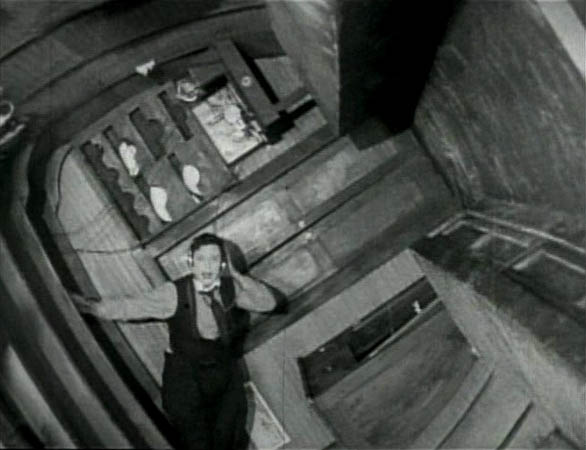
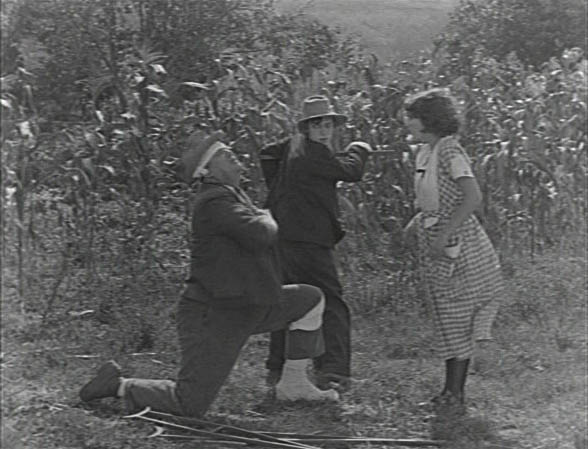
Keaton has built a boat in his garage, and takes his family out for a sail. Destroys the house getting the boat out, destroys the car getting the boat in the water, finally destroys the boat, leaving the four of them floating in a bathtub for a life raft, when his son pulls the drain plug. The boat itself is as complicated as “the electric house”, with collapsing masts (for going under bridges) and makeshift repairs. Nice scene where the whole boat is rotating in a storm (actually rotating, not just a camera trick) while Keaton tries to stay right-side-up. Pretty sure I like this one more than Electric House… in fact, most of these are at least as good as that one. Don’t know why I obsessed on it for so long.

The Love Nest
image
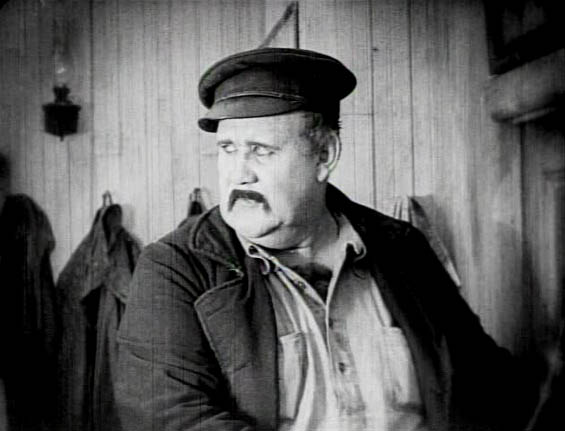
I recognized Big Joe Roberts from “Cops”, the giant clear-eyed fat man. Turns out he plays the antagonist in almost every one of Keaton’s silent shorts. He died of a stroke shortly after “Our Hospitality” in October 1923. Big Joe plays the cruel, murderous captain of a whaling boat Love Nest that picks up Keaton who is stranded at sea. At the end, Keaton can’t launch the lifeboat alone, so he sinks the whole ship to float the small craft. Entire Love Nest sequence turns out to have been a figment of his food-and-water-deprived imagination… thinking himself stranded at sea for weeks, his boat is still tied to the dock.

The Goat
image
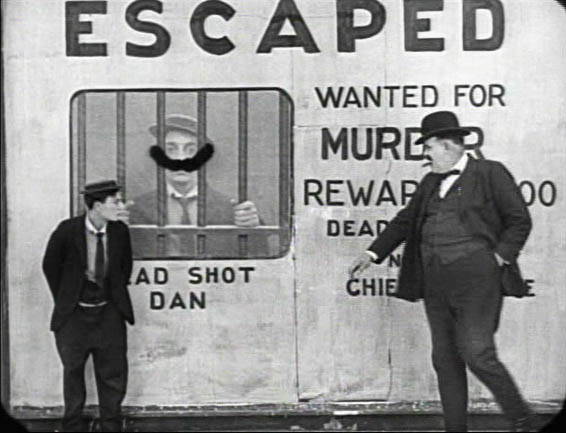
As in “scape”goat, turns out… there’s no goat here. Dead Shot Dan arranges to have the police photographer get a shot of bread-line refugee Keaton through a window, then makes his escape. Keaton sees the poster, thinks it’s for real and that he killed a guy he pushed down in another town, chased around by sheriff Big Joe Roberts, ending up accidentally in Big Joe’s own apartment. The escape from the apartment has one of my favorite series of gags, a chase through the building’s single elevator.

My Wife’s Relations
image
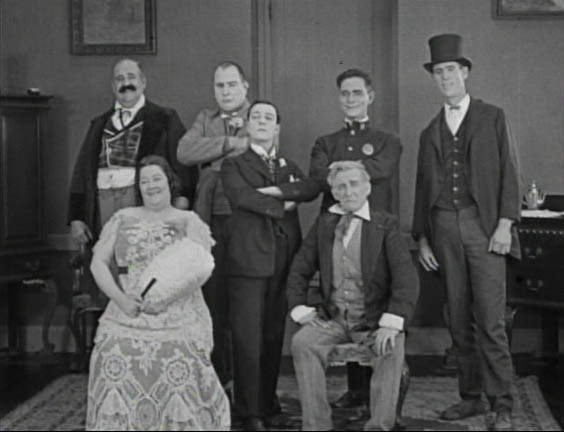
Running from cops, Keaton accidentally (preacher speaks Polish I think) gets married to a woman who’s trying to have him arrested. Comes home to her family of large, rough, intimidating men. Tries to fit in at first, then plots to escape, riding the train to Reno at the end.

The Scarecrow
image
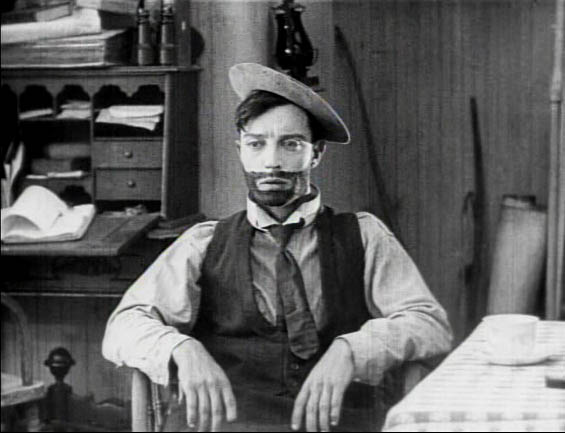
Keaton is friends with Big Joe in this one. They live in a one-room house that inventively conceals a bath, bed, stove and kitchen table with ropes and hinges. Both men are competing for a woman (same girl played the wife in The Boat, her farmer father is played by Joe Keaton), leading to a chase scene where Keaton disguises himself as a scarecrow. Best part is Keaton in a dangerously high chase with a dog that can climb ladders (up and down!) which ends up going through the rigged house.

The Paleface
image
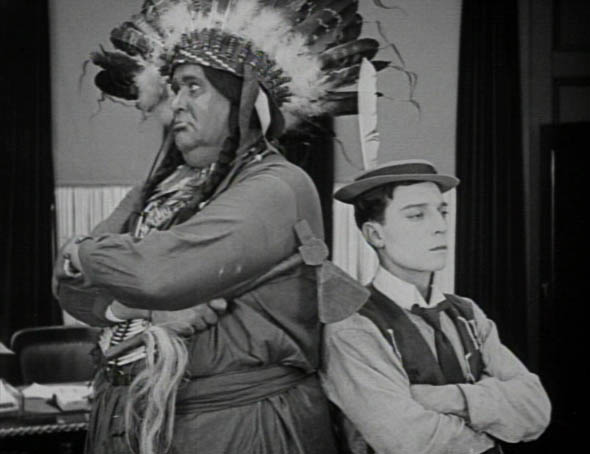
Keaton wanders into an Indian reservation right after they swear to kill white men in response to their land being stolen by oil barons… finds time mid-chase to make an asbestos suit, so after he fails to burn at the stake, he’s made an honorary member of the tribe. Now he and chief Big Joe team up against the scheming white men. Virginia Fox, hot girl from The Goat, Cops and others, plays the chief’s daughter, Keaton’s prize for saving the reservation at the end. She never gets much to do except to look pretty in a few close-ups.

These are all totally worthwhile shorts… think I’d choose Scarecrow and Goat to show off to others, if I ever had people over for a shorts-fest like I keep threatening to do.

Big Joe Roberts:
image

Tags: , ,

Comments

Sherlock Jr. (1924, Buster Keaton)

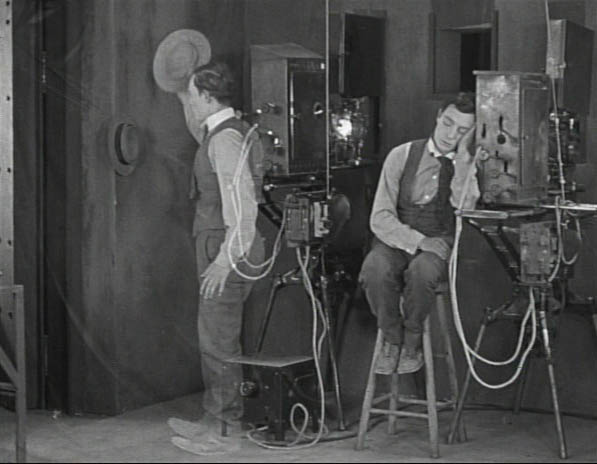
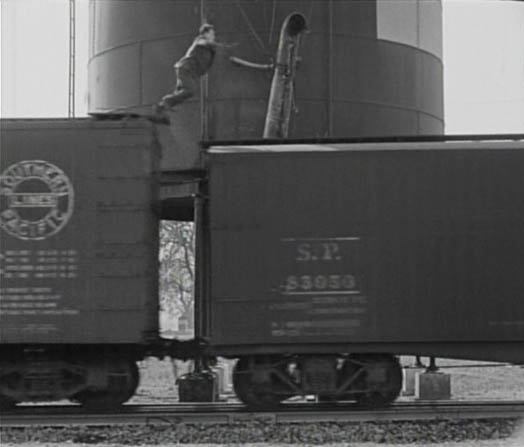
Supposed to be a full feature, but cut down to 45 minutes after initial screenings. Probably they cut most of the plot, since what we’re left with is a slowish intro, an awesome running-on-train-cars gag, then a huge dream sequence where Keaton goes inside a movie screen for the tightest collection of astonishing gags probably ever performed. Jumping right through his assistant, through a window into an old lady costume, riding the handlebars of a motorcycle, and an exploding billiards game.

image

image

The intro to the dream/movie sequence is great, scene-change backdrops changing under Keaton as he tries to adapt. Cute ending too, shy Keaton looking to the movie screen for advice on what to do with his girl. Only possible thing wrong with this movie is the horrid score on the DVD… will have to find something appropriate to play next time I watch it.

image

Tags: ,

Comments

Dog’s Dialogue (1977, Raoul Ruiz)

“Colloque de chiens” is the real title, “Dog Symposium” is the title on the subtitles. The movie is a story told to each other by dogs through a series of stills, La-Jetee-like, with quavery synth music and dry narration. The dogs are shot live-action with natural sound.

Dogs on a vacant lot bark at each other over the credits.

image

“The woman you call mum isn’t your mother” Monique turned pale on hearing those words from a school friend. Madame Duvivier tells little Monique that Marie, the woman who often comes by, is the real mother. Marie tells Monique that she doesn’t know who her father is. Monique flees Bordeaux. “From now on, sex and domination shall rule Monique’s life.” Monique is a nurse, has illicit affairs with her male patients. Christmas eve 1966 she dances with rich, 65-year-old Hubert, intends to seduce him for his money. Monique becomes a “cold and dry voiced whore” with “an urge for revenge”.

Dogs bark in apartment windows and balconies.

image

Monique falls for the TV repairman, Henri, who she remembers from her hometown. She starts a new life, opening the Joli Mont cafe, but “in fact she’s buying her own death”. Henri helps her run it. Alice, a friend from home, comes to visit, blackmails Monique to not tell Henri about her sad past, has an affair and falls in love with Henri. When the three are in the park, Monique kills herself and her 3-year-old son Paul-Henri. Dogs.

image

“Henri’s only option is to marry Alice, his wife’s intimate friend, who dominates him. In a way, Alice was buying her own death.” Alice tells about both women’s pasts on their wedding night. Henri has an urge for revenge. He grabs an empty bottle of wine, which turns into a knife on the images, and kills her. Dogs. Henri cuts up Alice’s body and hides the parts all over town, which switches to live-action for a bit, with no dogs but the sound of children singing.

image

Back to stills. Henri goes to Marseilles and falls into some shady dealings with gangsters, is jailed for 5 years. Nurses a sick cellmate with whom he has an affair. The police draw a map of the body parts they’ve found, which form a circle, the Joli Mont cafe at the center. “The universal geometric laws gave him away”. Live action street shots, adults singing.

image

Stills. Mr. Benami tells Henri about sex-change operations in Casablanca, “the perfect disguise”. “Henri Odile has become a charming young lady.” Christmas eve 1974 she’s invited out by a rich, 65-year old man, intends to seduce him for money. Odile becomes a prostitute. Goes back to Montsouris, sees the Joli Mont is for sale, buys and runs it, adopts young Luigi. One evening, 18-year-old Fernand comes to the bar with a bottle of wine / knife / empty glass, kills Odile. Dogs barking. At school, Luigi is pestered by his friends. “Your mother was killed by her lover.” “That’s not true. The woman you call my mother wasn’t my mother.” Credits.

image

This movie is as old as I am. I watched it three times in one weekend… it is fantastic.

The editor and composer both still work with Ruiz (”That Day”, “Klimt”, etc), the cinematographer is now with Olivier Assayas, and the actress (!) who played Henri is now a press agent. Everyone involved still alive and well, including Ruiz, who has a euro-art-meets-quentin-tarantino cast of actors lined up for his next film.

Tags: ,

Comments

Gang of Four (1988, Jacques Rivette)

Netflix says: “Art and life intertwine when four aspiring actresses study with a renowned film instructor in this acclaimed psychological drama directed by Jacques Rivette. Assigned to analyze the play Double Infidelities, the women - who also happen to be roommates - soon find themselves caught up in a web of suspense and scandal as the script spills over into their offstage lives.”

image

Only my seventh Jacques Rivette film, but here I am watching it going “oh that’s SO Rivette” as if I’m some expert or even someone who knows how to pay attention properly while watching a movie. Half (?) of this one takes place in Bulle Ogier’s theater, where the girls are practicing a play we never see performed, and I’m all “ooh, that’s just like in Out 1 and Paris Nous Appartient” but I’m not really paying attention to the text of the play, so whether the Netflix blurb is accurate I cannot say. Then we’ve got a secret conspiracy, the train rides from Secret Defense (done very differently here, brief and abstract, much better), a direct reference to La Belle Noiseuse, and Bulle Ogier and you’ve got Rivette 101.

The careful compositions and slow unveiling of story and character flow like a Rivette film, but otherwise I can’t say it was similar to his others that I’ve seen… the experience of watching them was very different. I guess it’d be the most like Secret Defense, if I had to compare.

image

Above: JR muse Bulle Ogier as a great actress turned acting instructor.

The titular four are Joyce, Anna, Claude and new roommate Lucia, who is replacing ex-roomie Cécile, who has started acting strange and disappearing a lot, caught up in her boyfriend’s criminal trial. In a mystical storm scene, Lucia finds some keys that Cécile has hidden in the apt., keys which could clear the boyfriend’s name while taking down someone powerful. Thomas is out to stop this at all costs, following each of the girls (mostly non-threateningly) and asking them questions, finally getting sometime-lesbian Claude to fall in love with him, gaining him access to the house so he can search for the keys. Cécile has also come back looking for the keys, and even Constance (Bulle Ogier) gets involved, getting arrested at the end for hiding Cécile’s boy after he escaped prison.

image

Some occasional Celine-and-Julie antics (see mock trial above). What movie has most in common with Out 1 is its split between the easily-summarized plot (above) and the theater scenes which add to the character of the movie but since I didn’t understand those scenes’ connection to the rest of the story, don’t come out much in my discussion.

Irene Jacob of “Red” and “Double Life of Veronique” had a small part, as one of the actors I think.

image

Above: the Four, left to right:
Lucia - Inês de Medeiros - in movies by João César Monteiro and Pedro Costa
Joyce - Bernadette Giraud - later in Secret Defense and Joan of Arc 1
Claude - Laurence Côte - in Up Down Fragile, Thieves and Godard’s Nouvelle Vague
Anna - Fejria Deliba - in an Olivier Assayas movie

And:
Cécile - Nathalie Richard - Up Down Fragile, 2 by Assayas, 2 by Haneke
“Thomas” - Benoît Régent - lead dude in “Blue”, died a month after “Red” opened
Constance - Bulle Ogier - of “Out 1″ and everything else

Tags: , , ,

Comments

The Ten (2007, David Wain)

Not in order: 1. Guy (Adam Brody) gets stuck in ground after bad parachute dive, achieves short-lived fame / 2. Woman on Mexican vacation (Gretchen Mol) has passionate affair with Jesus Christ (Justin Theroux) / 3. Guy (assistant chef in wet hot) skips church to stay home naked, invites over lots of other guys / 4. White mom confesses to black kids that their real dad wasn’t white, hires impersonator (Oliver Platt) / 5. Doctor (Ken Marino) leaves scissors inside patient “as a goof” / 6. Woman (Winona Ryder) leaves new husband for ventriloquist dummy / 7. Animated rhino (Jon Benjamin) lies until no one trusts him, then town is wiped out after not believing his warnings / 8. Prisoner (Marino again) being raped by cellmate wishes to be raped by a new cellmate (Rob Corddry) / 9. Neighbors (Liev Schreiber & Joe Lo Truglio) have rivalry over who owns more cat-scan machines / 10. Couple from framing device (Paul Rudd & Famke Janssen) meet years later and get back together

What humor there is gets stifled by the endless unfunny parts, a pained grin on my face, wanting to enjoy the movie but being horrified instead by its lameness. Parts 3, 4, 6, 8, 9, 10 and the entire overlong Paul Rudd framing device pretty much suck, and that’s most of the movie. The others would be funny web sketches that I’d watch on YouTube (but probably turn ‘em off before they were over) but they’re not movie-worthy… the thing doesn’t feel like a movie, like W.H.A.S. did, just a rough draft of a failed sketch show.

Jessica Alba and Janeane Garofalo and Michael Showalter and Michael Ian Black knew better than to get deeply involved - they all have bit roles. Either replacing Showalter with Marino as co-writer was a bad idea, or the whole thing was doomed from the start. The trailer was funnier. Just glad I saw it for free.

Tags: , ,

Comments

Goya’s Ghosts (2007, Milos Forman)

A pretty well-composed movie, not bad overall. The artistic look, good framing, lavish sets & costumes all put indie-hack fare like “last king of scotland” to shame, so it’s a fine movie to watch, if nothing great is playing. No doubt that this one isn’t “great”… it’s too even, regular, plain… nothing daring, original or transcendent, just a big pretty movie. Director Forman only pops up every 4-7 years to make another biopic (amadeus, larry flynt, andy kaufman). IMDB says he’s working on another one already.

First, to get it out of the way, the bad. It’s one of those movies where you can play “spot the reshoots”, as newly-dubbed lines show up when characters’ backs are turned and they weren’t supposed to be speaking, or during another actor’s reaction shot, then they’ll cut back to the speaker (in long shot, preferably) and his lips don’t match up. It’s not like I’ve read that this was a troubled production that required reshoots… they’re right up there on the screen. That, and our theater smelled like Windex.

Then the good. I told Katy I hadn’t seen Javier Bardem since Before Night Falls (2000) but I forgot his small part in Collateral (and I missed Live Flesh at the Almodovar retrospective). Fun to watch him croak out his lines with that serious look on his face, but even more exciting is Michael Lonsdale (THOMAS from Out 1) as Bardem’s superior. That shouldn’t be so thrilling, since he’s in Munich and Ronin and other stuff, but maybe that should tell me something about “goya’s ghosts”, that the most engrossing moments were when I was imagining scenes from “out 1″ instead.

Funny thing about Randy Quaid (played the king). He’s in nothing but the dumbest movies for twenty-five years, then he gets cast in Brokeback and now suddenly he’s “and featuring academy-award nominee randy quaid” in studio prestige pictures. the Oscar nom was from 1974, not from Brokeback. Heh, from Pioneer Press: “Swedish Stellan Skarsgard plays Spanish painter Goya and where a key theme is that the Spanish people hate their new king because he’s from France. Which is weird, because he’s played by Randy Quaid, whose accent evokes not Baroque Spain or France, but Houston, circa today.”

Yeah, uneven accents and just a not very great movie full of tragedy with sad ending, but there’s even more Natalie Portman torture/imprisonment than in “V For Vendetta”, so if that’s your thing, here’s your movie.

Tags:

Comments

My Best Friend (2006, Patrice Leconte)

One of those breezy, happy, lightweight French movies that attracts elderly people to the Tara. I didn’t think I’d be watching stuff like this, but “The Valet” was good and I needed a comedy, so…

Probably liked it better than The Valet, too. Movie about friendship, or more accurately about people who have no friends and why that is. Climax is a maybe-overlong segment of Who Wants To Be A Millionaire with the French Regis.

Rich guy from Valet plays antiques dealer, and lead Valet’s valet friend plays a talkative trivia-obsessed taxi driver who is friendly with everyone and friends with no one. There’s a significant, expensive vase, a daughter who doesn’t love her dad (awww), some jaded girlfriends and coworkers, a cruel bet, and two concerned parents. PG-13, 90 minutes long, better than it sounds, and already due for an American remake.

Okay, just read a Reverse Shot article calling this movie out for being completely uninventive, almost entirely unfunny, and having not a single realistic character or situation, catering to oldies who can’t handle today’s profane American comedies, giving them this “Gallic piffle” that seems highbrow because of the subtitles. Probably true, but I was in the mood for it at the time.

Tags: ,

Comments

The Gay Divorcee (1934, Mark Sandrich)

A light and funny musical about trying to ruin a woman’s reputation, sort of the opposite of the end scene of Buster Keaton’s “College”.

Supposed to be “the first film that featured Astaire and Rogers in equal billing”. I kinda recognized Rogers from “Monkey Business”, and Astaire from those cartoon caricatures where he has a giant head and big hands. Hmm, now I’ve seen his first (”flying down to rio”) and second movies, and none of the other 40+ he made through the years. Who else?

Alice Bracy as the almost-annoying Aunt Hortense was also in “my man godfrey” and “young mr. lincoln” before dying of cancer in ‘39.
Edward Evertt Horton, Fred’s posh-looking straight-man sidekick (the lawyer who arranges the divorce at a resort), appeared in other Astaire movies incl. “Top Hat” and “Holiday”
Erik Rhodes is Mr. Tonetti, the amorous fake-beau who pretends to cheat while his wife cheats on him for real, was in the Broadway version of this, and later appeared in “Top Hat”.
Eric Blore, the waiter, was also in “Top Hat”, jeez.
Betty Grable, the most famous pin-up girl of WWII and star of “the beautiful blonde from bashful bend”, had a featured dance, but I didn’t recognize her.

Won best song at the Oscars for “The Continental” but lost out best picture to “it happened one night” and best art direction to “the merry widow” (also with edward e. horton). I’m not sure it should have been in strong contention for best art direction in the first place… not exactly a huge production with lights and mirrors, sort of small-scale simple dancing and singing. We liked it.

Tags: ,

Comments

« Previous entries