Archive for October, 2007

The Nightmare Before Christmas (1993, Selick/Burton)

Watched many times before, but never in dolby disney digital 3-D with cool polarized-lens non-headache-inducing glasses! The 3D effect was great, adding layers of depth (not pop-out-of-the-screen gimmicks) to an already gorgeous movie. Of course seeing the movie on a big screen again gives new appreciation to the intricate visual details, but why were some of the camera-panning motion scenes so blurry? Did the 3D effect do that, or have they always been that way?

fun fact: Chris Sarandon, lead actor in master-of-horror Tom Holland’s “Child’s Play” and “Fright Night”, voices the non-singing Jack Skellington.

Katy sorta likes it. Maria did not. Kids today… sigh.

Tags: , ,

Comments

Rabid (1977, David Cronenberg)

Interesting movie, pretty good. Funny how I can rent a movie looking for an entertaining horror one night, and it’s not scary or entertaining so it’s crap. Eight years later I can rent the same movie as an auteurist curiosity and it becomes “interesting movie, pretty good”. Was I right before, or am I right now? Fortunately it’s all opinion and nobody cares, so I can change my mind and justify things all I like.

image

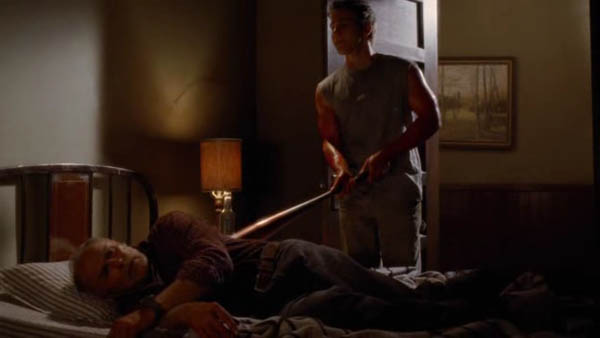
Clearly one of Cronie’s body-horror origin stories. Porn star Marilyn Chambers was cast for financial reasons (not political/commentary as often supposed) because producer Ivan “Ghostbustin’-ass” Reitman thought she’d be a bigger funding draw than the unknown Sissy Spacek. Then as shooting was beginning, Spacek’s other movie came out (see shot above). Oopsie.

Chambers capably plays a car accident victim who has a medical procedure (see two quotes below) that somehow lead her to grow a very sexual-looking little bloodsucking rabies-zombie-virus-transmitting armpit-mounted appendage. It’s nuts, but still not nuttier than the ice cream man movie I just watched.
image

Nice looking movie, grimy and low-budget but well composed. When the characters have believable behavior, it always helps a horror movie… of course it’s one of the rarest things in the genre.

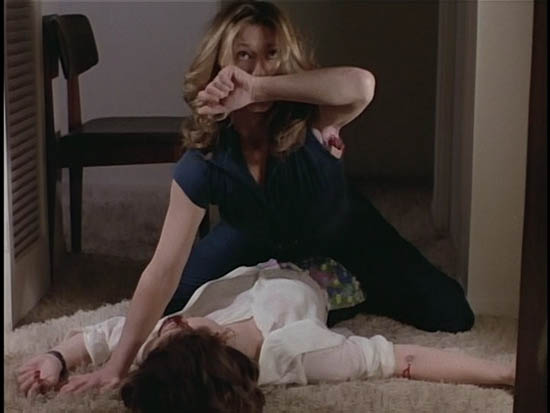
Chambers stays with a friend, goes out at night finding people to kill/infect. Is finally caught killing the friend (above) and gives herself up to one of her zombie victims in remorse, ending with the “night of the living dead” reminiscent close, an army cleanup crew tossing her body into a garbage truck.

image

Senses of Cinema’s Ashley Allinson, in his barely-decipherable Cronenberg piece, says “Coinciding with the AIDS outbreak, Chambers, walking virus, is an apologetic martyr of “very experimental surgery” going wrong”.

image

Film Freak interviews Cronenberg:
FF: “Rabid is home to your first major statement about body-modification–plastic surgery.”
DC: “Yes, and ironically enough what I invented in that movie has recently come to pass in stem cell research. Not that I think of prophecy as my métier, but we invented this neutral tissue that would become whatever tissue it came in contact with and that’s the basis of stem cell research, sort of the universal organic loam–so I have to take a little credit. (laughs) I suppose that there were some intimations even in my earliest work, Stereo and Crimes of the Future, about technology altering the body and there’s some of that in Shivers too. The plague in that film is an artificial one, of course, the result of an experiment gone wrong, and it occurs to me now that it was also meant to replace damaged organs. I hadn’t thought of that in years.”

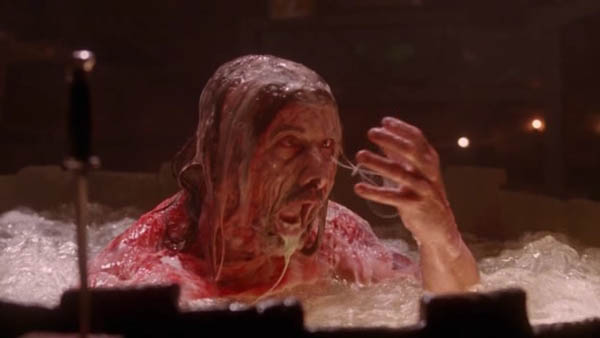
Reminded me of the Dafoe scene in “Existenz”:
image

No interesting cast/crew stories besides Cronie and Ivan Reitman. The murdered friend turned to cartoon voice acting, and one of the cops tracking Marilyn co-starred in “Shivers”.

Watched this the same week we went out to “Nightmare Before Christmas”. Neither movie is kind to Santa.
image

Tags: ,

Comments (2)

We All Scream For Ice Cream (2007, Tom Holland)

From the non-auteur behind the classic horror hits “Fright Night” and “Child’s Play” and the less classic S. King adaptations “Thinner” and “The Langoliers” (also writer of Psycho 2). This is from the writer of “The Fury”, which makes me a little less excited to see that one.

image

Holland must not have been allowed to adapt King’s “It”. Here we’ve got a story about grown men being hunted down by a killer klown, with flashbacks of these guys as young kids doing bad things together. Sounds like “It” to me. But this one adds exciting story elements that “It” never had, such as that the young kids once conspired to kill a retarded ice cream man, and that the ice cream man comes back as an evil klown and if the now-grown-men’s KIDS fall under the klown’s spell and eat a special ice cream bar, the men will turn into ice cream and melt and die.

image

Ridiculous story, reasonably well acted/directed, not a bad thing to half-watch while I’m doing something else, like writing these entries.

Tags: , , , ,

Comments

Pelts (2006, Dario Argento)

“A lot of bad shit’s been happening around here ever since we started working on this coat. It’s like it’s cursed or something.”

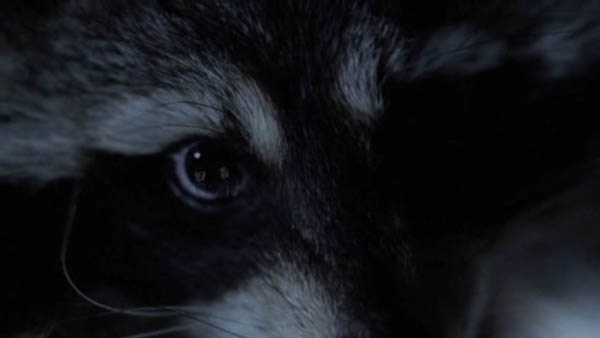
Yes, this movie is about a cursed coat made from the cursed pelts of cursed raccoons, trapped and killed by (an obviously cursed) John Saxon on some cursed land near some cursed ruins behind a cursed old witch’s house.

Terrible music and bad acting in a silly story. What, did “Friday the 13th: The Series” use up all the cool stuff that could possibly be cursed, so now we’re down to raccoon pelts? At least Master Argento didn’t write it - guy who wrote the novel behind Michael Mann’s “The Keep” did.

Meat Loaf makes coats and likes strippers (one in particular). Saxon traps a buncha raccoons and raves over how perfect they are, phones Meat Loaf who picks them up and makes a coat to woo his favorite stripper. Oh, and since the pelts are cursed, everyone who touches them kills themselves and/or someone else in a bloody, horrible way.

Should’ve hired the makeup guy from Hellraiser 2, because in the climactic scene when Meat Loaf walks around skinless, it looks very much like he’s just wearing a gory black shirt.

Contains all three of the big MoH signature elements: naked breasts (boy, a lot of them), recognizable actors doing ridulous stuff (meat loaf, duh) and something nasty happening to an eye (lady in coat factory sews hers shut).

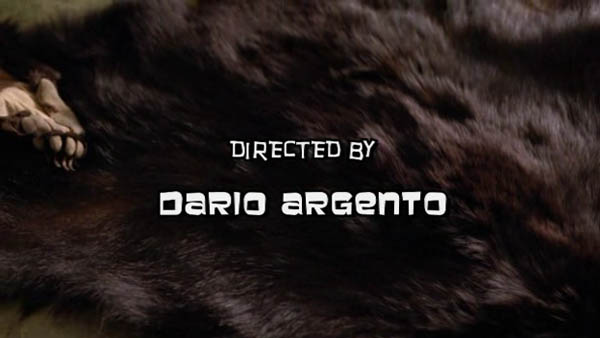
Why do the credits use a goofy comic font?
image

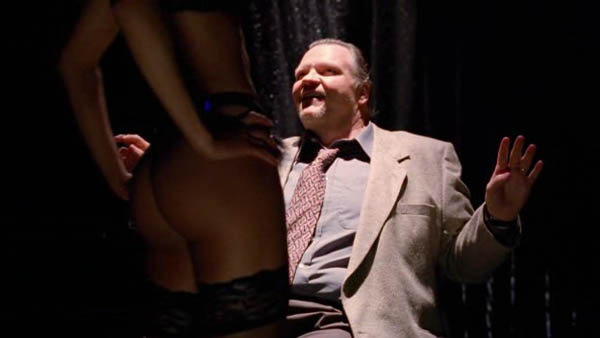
Meat “Loaf” Aday being creepy:
image

Scary raccoon:
image

John Saxon (of Tenebre, A Nightmare on Elm Street, and Mitchell) about to be beaten to death:
image

Of course, writing this led me to look up “Friday the 13th: The Series” on IMDB. Who knew that Atom Egoyan and actor David Morse directed episodes and the writer of “Mystic River” and “The Postman” wrote a couple? For that matter, who know that the writer of “Mystic River” worked on “The Postman”?!

Tags: , , ,

Comments

The Black Cat (2007, Stuart Gordon)

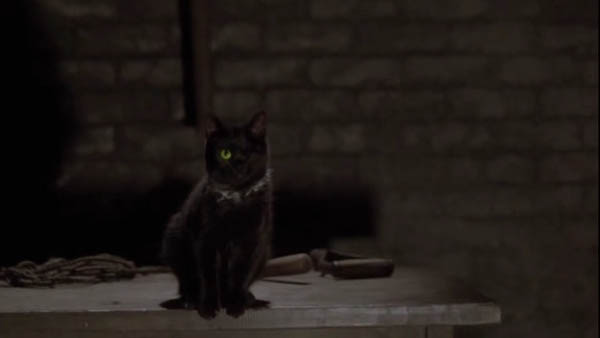
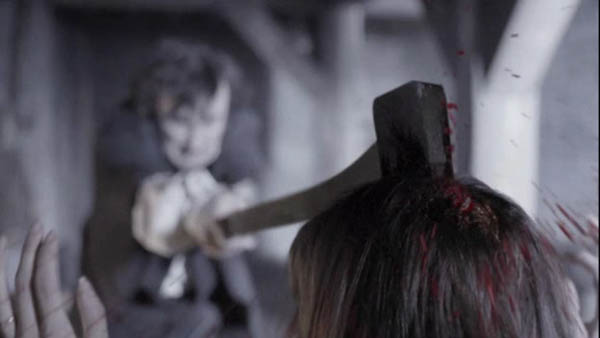
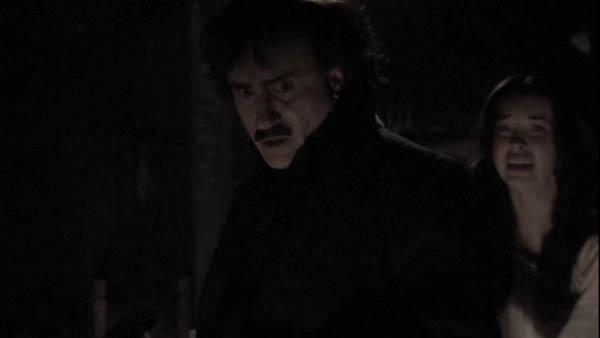
Late into SHOCKtober (Oct. 18th), I have finally unpacked my office enough to uncover the disc holding season two of “Masters of Horror”. Katy’s little brother is joining me for the celebratory kickoff screening, so I choose episode eleven, Stuart Gordon’s entry. It’s been a Gordon-filled month and his stuff is always either effective (”Dagon”) or entertaining (”Dolls”) or more usually both (”From Beyond”). Disappointingly, what we’ve got here is a slow-moving period piece that failed to impress or entertain.

The movie is supposedly based on Poe’s “The Black Cat”, but it’s actually an “Edgar Allen Poe In Love”, where we watch Poe’s visions and dreams that inspire him to write “The Black Cat”. Poe fans on the IMDB comment board enthusiastically rave about all the references to Poe’s life and stories scattered throughout the movie. Sort of a condensed look at Poe, implying that Gordon and usual co-writer Dennis Paoli will not be exploring each Poe work in-depth (this is the second after “Pit and the Pendulum”) as they have been doing for HP Lovecraft (seven films and counting).

Never heard of most of these actors and the only thing that turns up on IMDB is that half of them have been in the “Highlander” series for some reason. MoH trademark eye-gouging is here, but no nudity and I suppose an enthusiastic Jeffrey Combs will have to be our token celebrity casting.

image

image

image

image

Tags: , , , ,

Comments

Lord of War (2005, Andrew Niccol)

“Every faction in Africa calls themselves by these noble names - Liberation this, Patriotic that, Democratic Republic of something-or-other… I guess they can’t own up to what they usually are: a federation of worse oppressors than the last bunch of oppressors. Often, the most barbaric atrocities occur when both combatants proclaim themselves freedom-fighters.”

Funny, a riot of a movie, and the most I’ve enjoyed watching Nic Cage since “The Rock” (though I hear he was awesome in Wicker Man remake).

Nic has no morals and neither does the film. Rather than preaching all Hotel Rwanda and Last King Of Scotland on us, the movie takes Nic’s side, making its violence funny and nihilistic, just an unfortunate side effect of business as usual. The downfall comes as expected… Nic loses his uncle (blown to bits), then his brother (shot down trying to destroy some weapons) and his wife (leaves him, takes the kid) and finally gets arrested for illegal arms dealing. But the movie subverts expectation one last time by having a powerful general (based on Ollie North) set Nic free, because the U.S. armed forces need people like him to do things that they can’t be caught doing themselves.

Funny I was thinking how it’s an all-male movie with a token part for the wife when she comes out with this dialogue: “I feel like all I’ve done my whole life is be pretty. I mean, all I’ve done is be born! I’m a failed actress, a failed artist… I’m not much good as a mother. Come to think of it, I’m not even that pretty anymore.”

Pretty stylin’ movie, nice CG-assisted intro following a bullet from factory to a shocking war-zone head-shot. The movie is amoral to make its point, but it doesn’t expect its viewers to be.

Tags: , ,

Comments

Climates (2006, Nuri Bilge Ceylan)

Katy & I really hit the art-film jackpot with this one, since we saw three professors we know at the screening. That’s not gonna happen at “Resident Evil: Extinction” at the mall on a sunday night.

Gorgeous movie, as advertised. Slow-moving enough that the guy behind us kept yawning/sighing loudly and the guy in front of us apologized to his friends afterwards and said that they can pick the movie next time.

Our professors, all pros at picking out symbolism and meaning, talked about the artistry of the shots and the symbolism behind the seasonal changes and architecture.

Ron Holloway on some random site: “Shot as intersecting episodes against the changing seasons of blistering summer, rainy autumn, and frosty winter, only spring is missing in Climates – although Bahar, the female lead, is the Turkish word for “spring.” A master at probing the loneliness of the soul, Ceylan blends powerful imagery with sparse dialogue in his personal tales of lost chances and fatal decisions.”

And that’s all there is… sparse dialogue, a minimal character study and seasonal symbolism. A beautiful picture, to be sure, but not enough to keep Katy happy or to make my top-ten.

Tags:

Comments

Dolls (1987, Stuart Gordon)

Part three of my Stuart Gordon run during Shocktober 2007. Never thought I’d rent “Dolls”, but here I am. This movie predates Puppet Master by two years, Dollman and Demonic Toys by four and five years. Of course, stuff like “Devil Doll” has been around forever, but I used to see the box art for Dolls and assume it was a Puppet Master ripoff… guess not.

This is a gory horror movie for little kids. I’ll bet it didn’t do very well. A doll-loving little girl with an active imagination has a neglectful father and a wicked stepmother. Their car breaks down outside a huge house in the country owned by an elderly dollmaker couple. Coincidentally, a big doll-loving man-child and two brit-punk hitchhikers he picked up are in the same situation. Who will survive the night? Hint: only those who are pure of heart, treat children with respect, love dolls and don’t attempt to steal from the elderly.

Disturbingly, instead of (or in addition to?) outright killing people, the dolls capture them and turn them into new dolls, with awful little apple mummy heads behind their gentle ceramic faces. There are some doll-sized stabbings and shootings, but sadly no Puppet-Master blowtorches or drill-heads. Story really does play out like a children’s tale, which is just confusing. Kinda cool movie overall, cute and short.

The writer of this thing later co-wrote “Honey I Shrunk The Kids” with Gordon and Yuzna, and is now writing those badly-animated christian movies.

One britpunk girl starred in A-Ha’s “Take On Me” video. The manchild played the Big Bopper in “La Bamba” and costarred in Gordon’s “Pit and the Pendulum”. Gabriel the old man played Toulon in four of the Puppet Master films (heh, typecast as a murderous puppetmaker). The stepmother, awesome at being a completely horrible person, is the electroshock-giving evil doctor in “From Beyond” who gets her brain sucked out her eye socket by Jeffrey Combs. And the bad dad appeared in the Charles Band-written classic “Terrorvision”.

Movie starts the same way as “Dagon”… family vacation threatened by a suspiciously sudden thunderstorm.

Tags: , ,

Comments

Dagon (2001, Stuart Gordon)

Since I enjoyed FROM BEYOND, here’s another Stuart Gordon / Brian Yuzna / HP Lovecraft movie, DAGON (pronounced “DAY-gun”) which was released straight to video in the U.S., for some shameful reason.

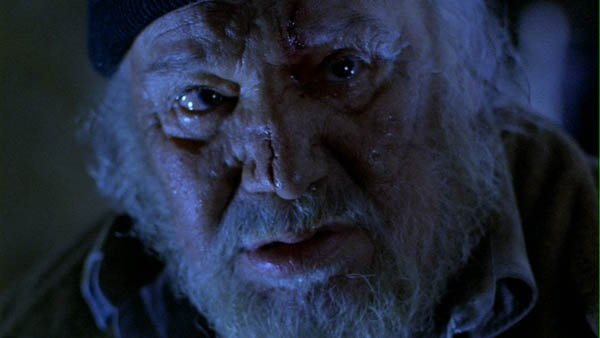
Whole new cast and crew for this one, which was set/filmed in Spain. Sadly no Jeffrey Combs, just a nerdy Ezra Godden (who later starred in Gordon’s first Masters of Horror entry) and a lot of Spanish actors, including Francisco Rabal: the film director in Tie Me Up, Tie Me Down… the voice of Luis Bunuel in 100 Nights of Simon Cinema… a hit-man in Sorcerer… the guy monica vitti dumps at the start of L’Eclisse… the guy Viridiana ends up with… somebody (dom morel) in The Nun… Father Nazarin… and in his final role, a drunken old man, the only human survivor in a small Spanish town overtaken by the cult of DAGON.

More serious and faithfully Lovecraftian than FROM BEYOND. Some unfortunate-looking digital effect shots of the boat, but all the makeup effects and sets are very good. It’s not exactly a tense, rapid-fire battle of wits and strength, but rather semi-competent Ezra (channeling Harold Lloyd) versus an army of slow-moving dull-witted fish creatures.

Oh yeah, so Ezra is sailing off the Spanish coast with his girl and another couple when a storm hits. He and the girl raft to a deserted town for help. Ezra returns to the boat to find his friends gone (he later turns up skinned to death, she turns up minus one leg and raped by fish-creatures), then returns to land to find his girlfriend gone. He hides at the hotel until the cult comes calling, hilariously escapes using his limited physical abilities and a pocketknife, then crashes with Francisco Rabal who fills him in on some back-story about the townsfolk’s demon-worshipping and eventual devolution into fish-beasties.

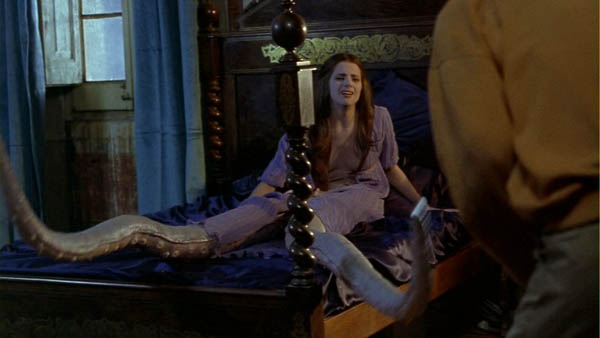
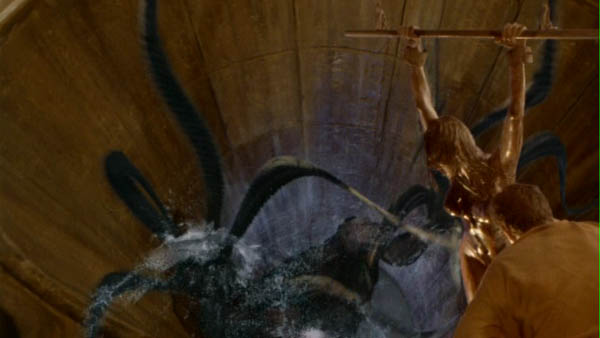
Ezra, of course, turns out to be the son of the high priest in this town, and his half-sister is the gorgeous mermaid he’s been dreaming of, who wants him to stay with her and have dirty incestual hot mermaid sex (which may actually be possible, since her legs are just sorta tentacles, it’s not the full-on fish fin). He fights this idea at first and tries to rescue his girl from being sacrificed. When his girl is raped by and then eaten by Dagon, Ezra is given another chance, but opts to set himself on fire instead. Fortunately (for those of us perverse enough to have hoped for such a thing), he’s extinguished and goes on to live eternally underwater with the half-human half-sister in the kingdom of DAGON.

Ezra (left) with girlfriend and evil priest:
image

High priestess:
image

Francisco Rabal, a fine actor whose final scene in his final film had his face getting graphically ripped off by the evil priest:
image

Mermaid love:
image

Dagon (left):
image

Tags: , ,

Comments

From Beyond (1986, Stuart Gordon)

From Beyond fits in nicely with other 80’s horrors featuring characters who explore the outer limits of bodily experience, like Brain Damage (1988), Hellraiser (1987), Society (1989) and Teen Wolf Too (1987). Maybe it was a topic on everyone’s mind, or maybe they were just getting around to ripping off David Cronenberg. This one has an S&M-tinged sex theme to its body horror (as opposed to the blatantly S&M-drenched sex theme in Hellraiser or the hallucinogenic drug theme to Brain Damage). Movie never takes itself seriously, dialogue and character behavior a bit on the stupid side, still totally worth seeing.

image

Movie stars everyone’s favorite lunatic Jeffrey Combs as a research assistant to weirdo Dr. Pretorius in a big spooky house. They succeed in their attempts to create a crazy machine that magnetically taps into the pineal gland, psychically revealing a new dimension of reality where swimming, bitey eel creatures and larger, darker things lurk. One of these things bite Pretorius’s head off, and Combs is committed to an ethically unsound institution by some questionable cops. He is released into the care of an even more ethically unsound psychiatrist, Dr. Katherine (the hot girl from Re-Animator), and taken along with somewhat-competent cop Ken Foree (from Dawn of the Dead!) back to the old house to reignite the experiments for no clear reason. They just hang out doing experiments until Pretorius reemerges all messed up from the alternate dimension and starts to gain control over everything. Oh, also our heroes’ newly-awakened pineal glands make ‘em want to have kinky lite-S&M sex with each other.

image

The horror and monsters escalate towards the end, there’s a sidetrack visit back to the hospital (where our psychiatrist is just rescued from shock therapy), Ken finally dies (eaten by a million black insects), and Jeffrey and Pretorius destroy each other in the end. Final shot is pretty great, Dr. Katherine going mad, just like Jeffrey apparently did at the end of the opening sequence.

image

Gordon and producer Brian Yuzna have built their careers on filming HP Lovecraft stories… you could certainly find worse things to do with your time. I wouldn’t be surprised to learn that this screenplay isn’t very close to the source material, especially the funny/campy parts.

Wikipedia: “The pineal gland is occasionally associated with the sixth chakra (also called Ajna or the third eye chakra in yoga) or sometimes the Seventh (Crown) chakra. It is believed by some to be a dormant organ that can be awakened to enable telepathic communication.”

image

Tags: , ,

Comments

Storefront Hitchcock (1998, Jonathan Demme)

It’s a Jonathan Demme picture alright, and he’s got the crew to prove it. Demme works here with a camera operator from “Silence of the Lambs”, editor from “Beloved”, cinematographer from “Cousin Bobby” and “Subway Stories”, assistant director from “Married to the Mob” and “Philadelphia”, sound crew from “Heart of Gold” and “Manchurian Candidate”, producer from “Stop Making Sense”, and unfortunately, a studio (Orion Pictures) that didn’t even exist anymore at the time of the film’s release, hence its obscurity.

Robyn plays half of his most recent album “Moss Elixir”, some songs that won’t come out on albums for a few years, a cover song and scattered older tracks (but no “oldies”). Demme keeps the visuals interesting but never distracting, and that’s a hard line to follow. With a solo artist standing still and playing songs on acoustic guitar, it would seem tempting to make the film more “cinematic” by adding and adding and cutting and re-cutting, but the presentation is simple enough to do great service to the music, making you feel more like a concert-goer than a movie-watcher. Unlike in “Stop Making Sense”, with its very few audience shots, this film has no audience shots at all, at least none that we can see on the cropped “modified to fit your screen” image of the DVD, so there’s no “them” in the crowd, only “you”. We get a mirror ball, a colored gel backdrop, a few planted passers-by on the street, a line of text for Robyn’s father at the start of The Yip Song, a few moments of quick editing, and a nice four-camera split for the credits and the final song. Interestingly this movie semi-references “Stop Making Sense”, with Robyn shouting David Byrne’s name in the middle of “Freeze”.

I can’t remember if I’d discovered Robyn’s music before I first saw this movie, but the movie has surely made an impression. I’ve played it more than any other DVD I own, and possibly (if you include the soundtrack) I’ve played it more than I’ve listened to any other Robyn release all the way through. Was just pondering that this weekend when I put this disc on instead of a CD while painting - it’s really one of my all-time favorite films. It’s great in the same way as the Spalding Gray movies and Stop Making Sense… it’s an elegantly simple film of a great performance, a documentary of an event worth documenting. It’s not gonna be studied in film class or given a large chapter in a book on Jonathan Demme, since the performer is the auteur here, but hopefully at least it stays in print for other Robyn fans to enjoy.

Film Tracklist:
Devil’s Radio
1974
Filthy Bird
Let’s Go Thundering
I’m Only You
Glass Hotel
I Something You
The Yip Song
I Am Not Me
You and Oblivion
Airscape
Freeze
Alright, Yeah
No, I Don’t Remember Guildford

The soundtrack albums have a different running order and also include:
Statue With a Walkman *
I’m Only You *
Where Do You Go When You Die? * +
The Wind Cries Mary * +
Eerie Green Storm Lantern *
Beautiful Queen * +
* double LP
+ CD

But neither soundtrack includes “Devil’s Radio” or “I Am Not Me” from the 77-minute film. So it would be something like a 105-minute show if edited all together.

Robyn says: “I’m Only You,” “Freeze” and the “The Yip! Song” are descended from my days with the Egyptians, “Glass Hotel” is much as it was on Eye. “I Something You” appeared on a K-Record 7-inch. I’ve been playing Jimi Hendrix’s “The Wind Cries Mary” for years. “1974,” “I Don’t Remember Guildford,” “Let’s Go Thundering” and “Where Do You Go?” were written with the movie in mind.

Robyn again: “It’s worth pointing out, however, that a concert movie and a soundtrack record are radically different things. A film doesn’t have to bear the repeated scrutiny that the soundtrack does. An album has to survive a degree of repetition. So I’ve reduced the number and volume of introductions to the songs and they have been cued up on the CD as separate tracks, so you can skip them. It’s also worth mentioning that a song like “Airscape” worked better visually than sonically, so it didn’t make the CD. Conversely, “Beautiful Queen,” although a great performance, didn’t make it into the movie.

Edit: can’t believe I didn’t think to put this in the “musicals” category earlier. If this isn’t a musical, what is?

Tags: , ,

Comments

Inferno (1980, Dario Argento)

“Help me. Rats are eating me.”

Rose (not shown here because I didn’t think to get screenshots until after she’d died) lives in a spooky “New York” apartment building above a rare book store run by cat-hater Kazanian. She reads his book about The Three Mothers (which is not such a rare book since he has a few copies in stock). Bumbles around the basement, drops her keys into an underwater room with a portrait of a Mother and some floaty dead bodies, then recovers from that only to be stabbed in the neck.

Kazanian hating on some cats:
image

How to die in this movie, in three steps:
1. a hand injury
2. (optional) animal attack
3. stabbed in the neck

Rose’s mustachioed brother Mark is in Rome studying music with his buddy Sara, when he gets a mysterious letter from Rose referencing the Three Mothers book.

Mustachioed Mark, seen here whispering into a hole:
image

Mark runs off, freaked out by a cat lady who appears in class, so snooping Sara reads the letter.

Cat Lady, seen here in music class:
image

Sara picks up a copy of the not-at-all-rare book in Rome, and stumbles immediately upon another of the three evil buildings that the book mentions. She runs away from an evil alchemist and befriends a man in the elevator who soon gets stabbed in the neck.

Sara’s elevator buddy, seen here under a heavy blue filter:
image

A monster catches Sara and dispatches her with a broken window to the neck. I am not kidding.

Snooping Sara shortly before getting her stupid self stabbed:
image

Mark goes to “New York” to find his sister, meets her hot neighbor Elise. Elise helps get him caught up on the mystery, then she gets tormented by having stagehands throw cats at her from off-camera, and stabbed to death.

Elise on the set of INFERNO:
image

Also in the apartment are an evil nurse who wheels around an evil old man, a nondescript woman (not shown), and a loyal butler.

Mark hassles poor Kazanian, who is later tormented by cats in his bookstore. Kazanian loads the cats into a bag, takes it to the river to drown them, falls down and is nibbled by rats before being stabbed in the neck. His own fault, really.

Back at the mysterious apartment building, the butler is probably evil (aren’t they always?) but I don’t remember for sure… anyway, his eyes are gouged out, breaking the knife-to-the-neck rule set forth by INFERNO in order to keep the “an eye must always be gouged out” general law of Italian horror.

Butler near a birdcage:
image

If the butler isn’t the mastermind behind all this evil, it must be the old man, who lives like Phantom of the Paradise in the cellar with his listening devices and his robot microphone.

Phantom of “New York”:
image

Wrong again! It’s the nurse who wheels him about! I think the movie is saying that she’s one of the Three Mothers and that she is very evil, but I’m not sure how far her evil extends, or if it’s even dangerous to people who don’t live in this apartment or attend music class or hate cats. But oh my god, when Mark goes downstairs to face her, the movie’s theme song plays with lyrics sung in Latin, and that is great.

One Evil Mother:
image

The nondescript woman sets the place accidentally on fire (it’s an “inferno”, if you will), and the Mother is either delighted or horrified by this, hard to tell since at this point she is wearing a rubber skeleton mask, but anyway she throws her hands in the air and Mustache Mark escapes, the end.

My favorite part of the whole affair is the interview on the DVD, where a weary-looking Argento talks about what a difficult and personal film this was, and how he and assistant director Lamberto Bava (dir. DEMONS and DEVIL FISH) and his father Mario Bava (dir. BLACK SUNDAY and DIABOLIK) struggled over this effects shot where a woman dramatically crashes through a mirror and comes out wearing a fakey skeleton costume. Yep, it took the three greatest minds of Italian horror to come up with that one. If only they could’ve got Lucio Fulci (ZOMBI 2, THE BEYOND) and Umberto Lenzi (CANNIBAL FEROX) to make her a better rubber suit.

The underwater bit isn’t bad, which is the same thing I said about ZOMBI 2. Maybe the Italians should make a whole horror movie underwater.

At least I was so busy marvelling at the silliness of the whole thing that I didn’t notice the dubbing.

Implications of this movie:
- women (or maybe actors in general) are just set dressings to be put in pretty poses and then threatened and stabbed.
- there is something evil, and it’s been around forever, and it is easily defeated by unknowing incompetents, though honestly it’s better off being left alone since it’s not much of a threat to anyone.
- alchemists are scary, cats are evil, architecture is evil

I think “Eyes Wide Shut” was based on this movie. The atmosphere and pacing, the camera zooms, the drowsily agitated characters, the fake New York, the singing in Latin… it all adds up.

“Total Film” mag and the They Shoot Pictures List call this one of the best horror movies of the ’80’s, but those people are tripping.

This is a semi-sequel to “Suspiria”, and Dario Argento’s brand new film “Mother of Tears” is a sequel to this one starring his daughter Asia (as a woman in trouble) and Udo Kier. Mustache Mark never amounted to much… Rose appeared in “Puppet Master” and “Watchers II”… Sara was in something with Marcello Mastroianni and Tom Berenger… Elise has been in all the big Italian horrors and will appear in “Mother of Tears”… the nurse was in The Beyond… Sara’s blue-tinted friend dubbed the title character in the Italian release of “V For Vendetta”… the old wheelchair man appeared in “The Seventh Victim” in 1943… and Kazanian was the husband in “Last Year at Marienbad”!

Tags: ,

Comments

Young Girls of Rochefort (1967, Jacques Demy)

Not a total musical like “Umbrellas” was, and no connecting characters between the two, just a brief mention of the town of Cherbourg. This one has the same longing tone as the previous film in parts, but mostly it’s a much sunnier film, a loving, colorful, musical tribute to Hollywood escapist classics.

At this point, Demy was far out of touch tonally with his French New Wave contemporaries. “Umbrellas” characters were at least affected by the ongoing war, but “Rochefort”, coming long after “Muriel” and “Paris Belong To Us”, and after “The War Is Over”, is in its own insular world for the most part. A few years later, after the May ‘68 riots and Godard’s and Marker’s hard turns to the left, after even Demy’s wife Agnes Varda had filmed “Black Panthers” and contributed to the “Far from Vietnam” project, Demy would continue to go his own way, filming a musical fantasy fairy-tale with Deneuve and Jean Marais in 1970. By that point, I gather that he was not well-liked by his New Wave filmmaker/critic contemporaries. I don’t think he is well-liked still… I’ve been reading that his career was pretty uneven, and only a quarter of his films are talked about regularly. I guess Demy’s films have had to be recontextualized to be appreciated, removed from the radical French 60’s and enjoyed as pure cinema.

Danielle Darrieux (star of Madame De… and the cheating wife in La Ronde, later in 8 Women & Demy’s Une chambre en ville) plays Yvonne, mother of Catherine Deneuve, her tragic real-life sister Françoise Dorléac (of The Soft Skin and Roger Vadim’s La Ronde remake) and young Boubou.

Yvonne regrets having left Boubou’s father Simon Dame (Michel Piccoli) ten years ago. Delphine (Deneuve) keeps missing her dream man, an artist/poet doing his military service, Jacques Perrin (of Donkey Skin, Cinema Paradiso, the Kieslowski-penned 2005 Hell). Solange (Dorléac) dreams of meeting famous American composer Andy Miller (Gene Kelly). And they all (more or less) meet up and fall in love at the end of the movie.

Guess I’m not so musical-savvy, don’t know what to say about this one stylistically. I mean, it’s bright and colorful and fun, less sense of loss and longing than “Umbrellas”, but I kind of miss that. Gene Kelly is a cutie, fits in just fine.

Katy asks why the mother has to work all day at her diner to get by, while her daughters live high in their fancy apartment and pretty dresses from teaching song and dance lessons. Are the realism and the fantasy rubbing against each other uncomfortably, or is the mother paying for Boubou’s school and still helping to support the girls until they get married? If the latter, I’d hope they’d take a shift at the diner once in a while.

This and “Umbrellas” had a funny combination of set and location shooting, with Demy doing location shots in the actual towns, but repainting the storefronts to his liking. Nice music, nothing memorable for me, having heard it just once. The girls refer to “Jules and Jim” and composer Michel Legrand. The camera should count as a cast member since it is engaged by the other characters and dances around with them. A self-reflexive movie then, both in its use of the camera and its reference to musical convention. Bright, solid primary colors abound. The DVD looks lovely. I’d definitely like to watch it again soon.

Agnes Varda made a 60-minute film in 1992 called “The Young Girls Turns 25″, which of course would have made for a fantastic DVD extra, but of course is not included on the barebones U.S. release.

Jonathan Rosenbaum: “There are English-dubbed versions of both Umbrellas and Young Girls; I haven’t seen the latter, but the English version of Umbrellas is so unrelievedly awful that I’m happy to have missed the dubbed Young Girls.” Although if the IMDB trivia page is to be believed, “Rochefort” was fully shot in English as well as French, so it might be worth hunting down an English version if it still exists anywhere.

Caroline Layde for Senses of Cinema:
“However undemanding and lollipop Demy’s films may appear, they present some nuance and sophisticated intertext, and they share a certain charm, vivid and unified. His films inhabit worlds in themselves that may peripherally refer to social reality and the real world but remain content as alternate realities of poetry, color, and music.

“Demy’s consistency of vision itself justifies his inclusion among the “auteurs”, defined by André Bazin and François Truffaut and expanded by Andrew Sarris as distinguishing themselves with their salient visual language from mere metteurs-en-scène. Demy certainly created a signature style of poetry and innocence and clung to it. Yet this quality also has a sophisticated aspect, suggesting the dream worlds of the surrealists and of Demy’s inspiration, Jean Cocteau. It is fitting that the American critic Gary Carey has described Demy as “the Joseph Cornell of French cinema”.

Tags: , , , , ,

Comments

Retribution (2006, Kiyoshi Kurosawa)

Don’t know why I’m frustrated by this, but the movie seems VERY Kiyoshi Kurosawa in themes, plot, pacing and look. It’s nice to see auteurist consistency, but Kurosawa’s not injecting his personality subtly into a studio picture, he’s writing all his own films, so maybe he could stick these themes somewhere else than another supernatural detective story. Those complaints aside, going through the screenshots I was struck again by what a nice looking movie it is… probably superior to the rest of the now decaying J-horror genre, which is again why I wish he’d break out of that genre for good instead of coming back to ghost stories after showing his depth with “Bright Future” and “Charisma”. Although, maybe Kurosawa was requested to write this kind of picture by his producers, who have done a whole ton of J-Horror, including the Ring and Grudge series, Reincarnation and Cross Fire… yeah, I’ll go with that.

image

Kurosawa fave Kôji Yakusho plays Noboru, an unremarkable detective with a cute girlfriend he sees off and on. A murder is committed, a woman in a red dress drowned in salt water, and the clues point to Noboru. His partner Miyagi suspects him and he begins to suspect himself, but soon there are two other murders to distract them. A high-school kid and an office worker are also found drowned in salt water, but Noboru, playing on a ghostly intuition, quickly finds the murderers: the boy’s father Dr. Takagi, upset at the boy’s out of control behavior, and the man’s secretary with whom he was cheating on his wife.

image

The two (three?) are unlikely people to be murderers, but they are all apparently driven to kill by the ghost of the red dress lady, who has been haunting our detective. I think she was either a former inmate at a black asylum on the river or a passer-by who got lost there. The ferry used to pass that building a decade ago, and our hero would see her in the window. The killings are her revenge for being ignored and left behind. “I died, so everyone else should die too”. She’s the collective conscience of the ferry riders, or the guilt of a civilization.

image

I’m not sure if our detective killed the woman in red, but he is revealed to have killed his girlfriend. In the end, he alternates between seeing her (ghost) and being able to hold her, and seeing her dead decayed body on the floor, drowned in a pan of salt water. He goes to the black building and confronts the woman in red, who is grateful to be recognized, but carries on her quest to drown everyone in salt water. The final scene is our man wandering the empty city streets, once again (as in “Pulse”) the survivor of a ghostly apocalypse brought on by loneliness and neglect (and revenge [let's not forget the title of the film], another of Kurosawa’s very favorite topics).

image

Kurosawa reveals the ghost in different ways. Sometimes the detective is haunted in his dark apartment (the usual way to be haunted by a ghost), but sometimes he sees her in broad daylight, disturbingly composited into the shot to give her an otherworldly appearance, and sometimes (as in a great long-shot interrogation scene with Dr. Takagi) she’s in the room with a group of people, but only visible to one (and not to the audience).

image

The movie is not too scary as horror (just a few jumpy moments), and it’s only okay as a detective story or a parable about society, but Kurosawa brings his usual mastery to the plotting and camera work, making it the most worthwhile movie I watched this week anyway. It’s not nearly as complicated / incomprehensible as reviews seem to indicate… jeez, are these people playing video games during the movie that they can’t ever follow a story, or am I some sort of narrative expert that I can? The movie portrays Tokyo as a crumbling metropolis besieged by earthquakes, and scenes are set in decayed abandoned buildings and over landfills.

H. Stewart at Film School Rejects writes: “Retribution’s greatest defiance of horror convention is that despite the identical M.O.s of the murders, there is no serial killer afoot, as the police suspect; Kurosawa’s cultural commentary, vaguely similar to that found in Mario Bava’s Bay of Blood, hints that the sorry state of our global society is not the result of one bad individual, one rampaging murderer of the Michael Meyers variety, but as a result of all of our combined actions; nearly everyone in the film is a killer, implying that we are all collectively culpable, not only for the things we do but for the things we don’t do that nevertheless manage to have a pernicious effect on others, even though we might not be conscious of it. … Retribution, coming in the era of the Iraq War, serves to show the devastating result of an unquenchable need for vengeance, and how we’re all responsible.”

Our guy and his partner:
image

Interestingly, the working title for Rob Zombie’s new remake was “Halloween: Retribution”, so I just saw two movies in a row named Retribution.

The cinematographer previously worked on K. Kurosawa’s “Loft” as well as “Fatherfucker” and “Splatter: Naked Blood”. Dr. Takagi starred in “Princess Raccoon” and Kurosawa’s “Bright Future”. The woman in red starred in “Parasite Eve”. Detective Toru Miyaji (above, right) was the horse-riding Baron in “Letters From Iwo Jima” and starred in the first of the 90’s Gamera movies. Harue starred in “Udon”, which I just missed at Emory last week. Kôji Yakusho (our star Noboru) starred in Cure, Charisma, Doppelganger, Seance, Eureka, The Eel, Shall We Dance, Babel, Memoirs of a Geisha, and appears at the end of Pulse.

One article on this film refers to LOFT as a “ghost story/mummy film”. Can’t wait.

Tags: ,

Comments

Blue (1993, Krzysztof Kieslowski)

I meant to go through the commentary and other material this time, but didn’t get to it, so I remain stupid to all the symbolism. Doesn’t change that I love this movie, one of my favorite films of the 90’s.

Plot follows the aftermath of Juliette Binoche’s car accident that kills her husband and kid… her initial reaction (attempted suicide), denial (withdrawing from all human contact) and acceptance (returning to music and her ex-lover). The camera work is sooo beautiful - cinematographer later did “Veronique” and “Gattaca”, but not “White” or “Red”. That along with the sound design (sudden symphonic bursts as the picture fades out and in mid-scene) are what blow me away, but Katy got me paying more attention to character details as well (K. doesn’t buy most of Juliette’s behavior).

Juliette is currently starring in Hou’s “Flight of the Red Balloon”. Her on-again lover Olivier (whose attempts to finish the husband’s millennial composition AND cluing in Juliette to the husband’s affair help return her to civilization) plays the dangerous and mysterious “Thomas” in Rivette’s “Gang of Four”. Lucille, the friendly stripper neighbor who lends Juliette her cat in the apartments, has been in at least two Eric Rohmer films. And Sandrine, the husband’s mistress whom Juliette invites to move in with her at the end, has been in nothing else I recognize.

Kieslowski on the color significance: the principle behind the trilogy is “how the three words liberty [Blue], equality [White] and fraternity [Red] function today – on a very human, intimate and personal plane and not a philosophical let alone a political or social one”.

The movie took a bunch of awards, including the Venice Golden Lion, but lost the French César to Alain Resnais’s “Smoking / No Smoking”. Katy’s not the only one who didn’t love it, though. Vincent Canby’s NYT review calls it dead, absurd, pretentious euro-art.

Derek Jarman’s “Blue” also came out in 1993. I’m sure the two are not very similar.

Tags: , , ,

Comments

« Previous entries