Archive for January, 2008

Pather Panchali (1955, Satyajit Ray)

“Silent World” by Jacques Cousteau and Louis Malle beat it for the golden palm at cannes, but it took the “human document” award. The film print said “grand prix” but it doesn’t even look like that award was handed out in ‘56. The print also calls Ray “Roy”, but those two seem interchangeable by the IMDB. Supposed to be India’s “Rashomon”, the one that brought Indian film to the world’s attention.

Daunting to watch a movie known for 50 years as a masterpiece… well-illustrated when I walked into the room early and saw a bunch of freshman watching the end of “Citizen Kane”.

Oooh, my fourth 50’s film in a week. This came out less than a decade after Bicycle Thief, its inspiration, and the year after Senso, La Strada, Seven Samurai and Saga of Anatahan.

Ray’s first film, with great music by then-unknown Ravi Shankar. Rich drama, very moving and awesomely shot. I kind of expected to be underwhelmed, but I loved it (probably more than the film students around me who sighed a lot and started fidgeting and text-messaging towards the end) and maybe even cried a little. Some of the students did too, so there’s hope for them.

Little Apu is born to overburdened mom, underemployed dad, always-in-trouble sister and elderly aunt. Sis’s friend is getting married. Apu goes to school. Dad gets work with the landlord but isn’t paid for months. Sis steals a necklace. Mom fights with aunt while trying to make sure kids are fed and staying out of trouble. One horribly powerful fight scene when, after the necklace dispute, mom drags sis out of the yard by her hair, collapses against the inside of the door while through the wall we can see Sis crying on the other side.

image

The scene is edited and scored with such force, seems like it couldn’t be the work of a first-time film director working before his country even had a proper film industry. Anyway, Sis gets sick and dies right before father comes home from the big city (he’s barely in the film) bearing money and gifts. Death scene (during a horrid rain storm) is at least double what the hair-pull fight scene was, with the music peaking into the scream that we never hear from the mother. In the finale, the family is moving to a new town to start again, Apu finds the necklace and throws it in a lake.

Movie feels like a masterpiece despite my pedestrian plot description.

When looking for screenshots I found this scene that wasn’t in the print we watched. The parents have a rare conversation about their lives and bring up moving out of town for the first time.
image

Ray: “The cinematic material dictated a style to me, a very slow rhythm determined by nature, the landscape, the country. The script had to retain some of the rambling quality of the novel because that in itself contained a clue to the authenticity: life in a poor Bengali village does ramble.”

Ray in ‘82: “All artists owe a debt to innovators and profit by such innovation. Godard gave me the courage to dispense largely with fades and dissolves, Truffaut to use the freeze.”

Truffaut walking out in ‘56: “I don’t want to see a film about Indian peasants.”

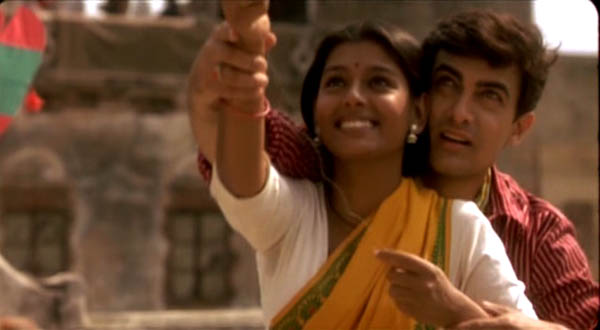
Apu:
image

His sister in the rain, celebrating a short-lived freedom:
image

Outcast auntie:
image

Sad parents:
image

Tags: ,

Comments

Mr. Freedom (1969, William Klein)

“I’m very happy to announce that we’ve destroyed at least half of the country. I hope now they’ll understand that aggression does not pay.”

That sums up the whole movie. It’s so obvious and loud and obnoxious and garish and that’s probably just what it intends to be. But it makes for an unpleasant viewing experience. I can’t imagine this movie screening in theaters without walkouts by exasperated viewers saying “I GET it already” (but probably saying that in french).

All-American titular superhero is introduced blithely massacring a black family in the middle of their dinner. Then Dr. Freedom (Donald Pleasence) calls to tell him that his French equivalent Captain Formidable has been killed and commies are invading France from neutral Switzerland. It’s up to Mr. Freedom to save the ungrateful French, not for any love of the country but to stop the dreaded domino effect and protect the world from communism.

Doesn’t play like a proper movie at all. Sometimes it feels like an advertisement (America’s priorities are more Capitalist than Democratic), and sometimes like a bunch of people goofing around and pretending to make a movie. The dubbing ain’t great, either.

Some funny touches: the american embassy in France is a wal-mart full of dancing girls. And sometimes the cheapness of the project turns into a lo-fi charm. Superfrenchman is played by a balloon with easily confused henchmen, and the also-inflatable Red China Man breathes frozen fog that settles on the ground.

Freedom of course ends up destroying most of France, his french guide Marie-Madeleine turns out to be a commie traitor, Russian Moujik Man is somewhat of an ally but can’t really be trusted. Freedom, not too fazed by the death of all his compatriots and followers, prevails through violence. Sadly it’s not a dated period piece and what Klein’s saying about American foreign policy applies perfectly well today.

Criterion: “Delightfully crass, Mr. Freedom is a trenchant, rib-tickling takedown of gaudy modern Americana.” It’s funny to think how many Criterion completists will soon own this movie.

Movie plays better in stills. When considering the screen shots I took, it seems almost like a good movie, clever and funny and ramshackle without the loud, boisterous, stagey dialogue to distract. In other words, it’s a much better movie when you’re not actually watching it. And since Klein was renowned in the 50’s as a still photographer and appears in Marker’s still-composed La Jetee, I’ve kept more screenshots than the film might deserve.

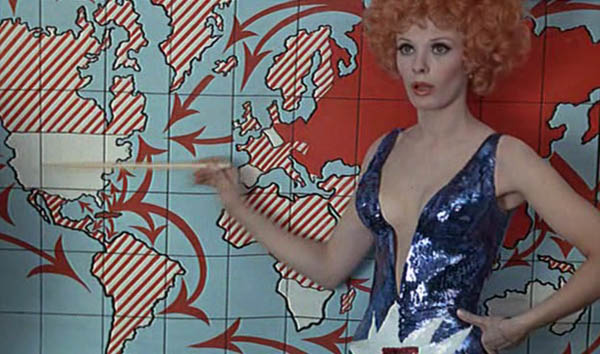
The introduction of Marienbad star Delphine Seyrig as Marie-Madeleine, yowza.
image

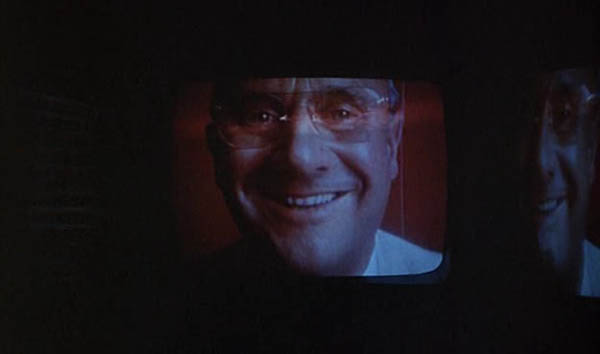
Dr. Freedom:
image

Captain Formidable is played by classy French icon Yves Montand:
image

“Anti-freedomism is at a new high.” Can’t get enough of that dress. Note Marie-Madeleine’s placement in front of the red portion of the map, foreshadowing the revelation that she is a communist spy. Just kidding.
image

Over a temporarily fallen Freedom, L-R: Moujik Man, Red China Man, Jesus & Mary
image

Freedom celebrates the defeat of Superfrenchman… I don’t remember exactly what went on here:
image

Forcing the maid to taste the poisoned food she brought. Nice shot setup:
image

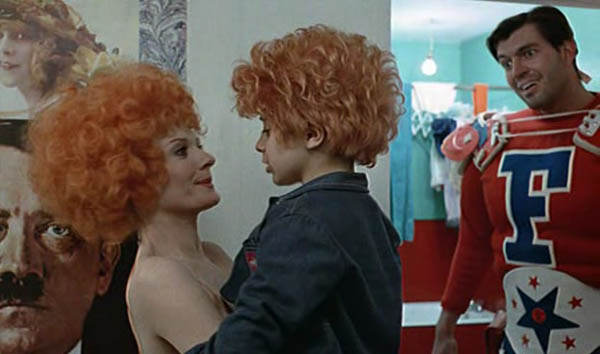
I love this shot so much. The matching hair, the goofy look on Freedom’s face, the unexplained picture of Hitler hanging on Marie-Madeleine’s wall:
image

Serge Gainsbourg very nearly survives to the end:
image

Freedom! Now available in a convenient spray!
image

Tags: , , ,

Comments

How To Cook Your Life (2007, Doris Dörrie)

An extremely lame waste of time. Uninteresting doc about uninteresting man who claims to be a zen chef then undermines both parts of that description. I was willing to bet that the director was one of his middle-aged female students so enamored with his personality that she simply had to make this movie to show the rest of the world how fascinating he is… but she turns out to be a professional filmmaker with more than 25 works to her name, most of them fictional. Oops. As for our chef, I think he wants to look cool on camera, but he overdoes the dorky humble shtick and ends up looking like a mixed-up hippie who has gotten where he is by faking it. Either way, Hal Holbrook and Catherine Keener were much more convincing and entertaining as mixed-up hippies in “Into The Wild”.

Tags: ,

Comments

Earth (1998, Deepa Mehta)

I hate to be so down on the movies Katy picks, but I can’t help myself any more than she can pretend to enjoy watching “ace in the hole” or “pennies from heaven”.

This felt like an obvious and uninteresting adaptation of an alright story about the partitioning of India and creation of Pakistan as symbolized by a conveniently diverse group of friends in Lahore and as seen through the eyes of a young innocent.

The young innocent is rich-girl Lenny-baby (of a neutral parsee family) whose hindu caretaker Ayah (a cover girl from Fire) is one of the friends. Also in there are muslims Hassan The Masseur (guy from Bollywood/Hollywood) and Dil The Ice Candy Man (Lagaan), a sympathetic sikh whose name I can’t find right now, and Lenny’s cousin Adi who has an arranged marriage to a short old man.

I took it as a history/culture lesson, though I had to ask Katy lots of questions because this movie doesn’t spell out as much as Water did for the uninitiated. Had the feeling of a postcard yearning for old peaceful times, so I didn’t see the violent atrocities of the second half coming… turns into a giant bummer.

peaceful days:
image

friendly chat:
image

an ice-candy betrayal, baby:
image

Tags: , ,

Comments

Ace in the Hole (1951, Billy Wilder)

Billy Wilder: “My delight… is ’cause everyone has been looking down on movies as something kind of third-rate until, thank god, the invention of television. Now we have something to look down on.”

Not quite a film noir, I don’t think, but close. Continues the string of 50’s movies I’ve watched lately, but this one’s from back in the year of “Day the Earth Stood Still” / “Thing From Another World” and “Fixed Bayonets” / “The Steel Helmet”.

It’s a damn well-made movie, as the commentary track helpfully illustrates, but Katy didn’t like it because of unlikeable characters (which is why when she asks if she’ll like “there will be blood” I tell her no) and Jimmy fell asleep since we started it at midnight. It’s about a desperate newspaper man whom Sam Fuller would have despised, making the news himself and conspiring to suppress other reporters while building up a sensationalistic story to glorify his own reporting and get himself back on top. At least when it fails, he recognizes what he has done and owns up to his own role in the trapped miner’s death, though by Code rules, the reporter dies too, stabbed by an equally hot-tempered and strong-willed woman.

A deeply-dimpled Kirk Douglas stars (shortly before doing “Big Sky” and “Bad and the Beautiful”) alongside Jan Sterling (who did “High and the Mighty” with John Wayne before retreating to television) as the miner’s wife who wants out but plays her part as a concerned wife out of greed for tourist cash. Professional villain and Preston Sturges actor Porter Hall is Douglas’s very straight-laced, belt-and-suspenders small-town newsman boss. Corrupt sheriff Ray Teal ended up famous for playing sheriffs, and his unhelpful deputy is Gene Evans, the newspaper man in “Park Row”. Porter Hall was dead in two years, and the guy who played the miner’s dad (John Berkes) died one week after the film’s release.

Our heroes:
image

Evans and Berkes:
image

Porter Hall:
image

I’d pay to see some great S&M amusement:
image

Kirk Douglas addresses his “fans” from the mount:
image

A sad father surveys the aftermath:
image

Tags: ,

Comments

Tales of Hoffmann (1951, Pressburger & Powell)

First rented this in December 2005, took over two years to finish it. Only movie to top that is The Decalogue (begun in 2001, still unfinished).

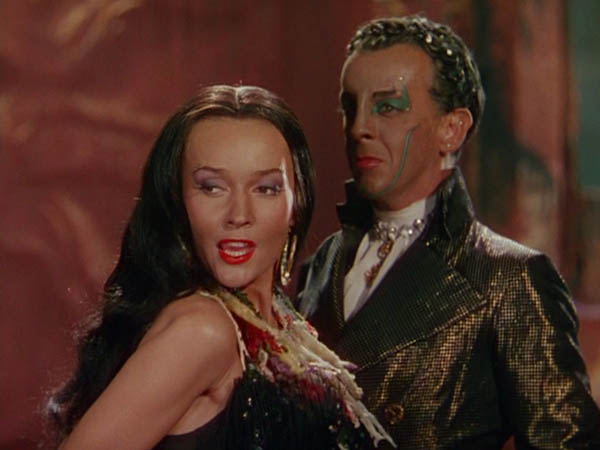
Katy didn’t want to watch it, and I’ve got trouble with it myself, not having any experience with opera. Some of the songs (”all in vain”) are lovely, though. The acting is extremely stagy, with huge facial expressions and body movements. Hoffmann himself moves stiffly through the film, maybe the only non-dancer in the cast but with a great voice (if he’s not dubbed). Sumptuous set design and costumes, one large room at a time with not much that is apparently cinematic about it. Even some of the effects (scattered, living doll parts created by actors wearing mostly black) are stagy. But then it can explode into incredible matte-painting sets with killer editing tricks and one very memorable camera-trick perspective shot involving a staircase shot from overhead. Camera is mostly still during dialogue/singing scenes, with some well-parceled sweeping movements… all fits together amazingly. Some of the richest color I’ve seen on my little television and laptop screens. They make great use of height in the frame, all columns and high-ceiling rooms. Since the dance numbers are mostly one or two people at a time, you never wish for widescreen. Only thing that really needs to be said is that it has more amazing bowl-me-over visual moments than almost anything else I’ve ever seen. Need to watch again as many times as possible.

Hoffmann is at the ballet falling for the dancer, whom his rival is also lusting over. He and his friends abandon the show for a bar where Hoff narrates three stories, starring himself, his rival, and Hoff’s nearly silent male companion (played by a female redhead), about three thwarted romances. At the end, the girls all dance together and collapse back into the original girl. And as Hoff falls exhausted to the bar table at the end of his story, the dancer shows up only to be escorted away by the rival.

image

The main dancer and the doll in the first story were Moira Shearer from The Red Shoes. The second girl with a jewelry obsession was Ludmilla Tcherina. Third girl, sickly with a dead mother, was Anne Ayars. All are stage dancers best known for this and other Powell films.

Hoffmann was a big opera star, also appeared in Carousel. Rival Robert Helpmann (probably the most facially expressive here) has played sinister characters in a few films. The most prolific was Pamela Brown, Hoff’s silent companion, who had fourth-billed roles in Cleopatra, Lust For Life, Olivier’s Richard III and Powell/Pressburger’s “I Know Where I’m Going”, which is the next one I’ve gotta see.

Also watched a 1956 widescreen Powell solo short of The Sorcerer’s Apprentice with some of the same art crew as Hoffmann. It was an early showoff reel for CinemaScope, only now available in a shortened far-from-pristine print. The voiceover stands out awkwardly, but the costumes and dancing are great - the living broom and dancers representing the water that fills the room. Cool little film. IMDB says the apprentice, Bulgarian born, was the second woman to ever be knighted in Norway.

image

Tags: , ,

Comments

There Will Be Blood (2007, PT Anderson)

Wowie-hell, a super awesome movie.

D-D Lewis is Plainview, ruthless oilman and master manipulator who worked hard to get rich and aims to get richer and nobody better get in his way. Paul Sunday Dano (the kid from L.I.E., the vow-of-silence brother in L.M. Sunshine) plans to start a church and get rich off religion and nobody better get in his way. They get plenty in each other’s way but little Sunday is no match for the awesomely awesome awesomeness of fuckin Plainview, the scariest man in the movies. There is, finally, blood, but before it shows up, TWWB has already out-horrored this year’s batch of horrors.

C. Jerry Kutner:
There Will Be Blood is a well-shot, well-acted film with epic ambitions, but where it falls shortest is in its attempt to link Plainview to the greed and folly of the Reagan/Bush years. All the obvious elements are there - oil, blood, unfettered dog-eat-dog capitalism, and its unholy alliance with organized religion - but unlike, say, Chinatown or even Citizen Kane, There Will Be Blood never quite connects the dots. Thus, politically speaking, Anderson’s latest film fails to move beyond the specific to the universal. It remains a story about aberrant individuals, setting us up for some great unexpected insight about community and our present-day world that it never delivers.

Manohla Dargis:
It’s an origin story of sorts. The opening images of desert hills and a droning electronic chord allude to the beginning of “2001: A Space Odyssey,” whose murderous apes are part of a Darwinian continuum with Daniel Plainview.

Glenn Kenny:
The “blowing” of this gusher causes H.W.’s deafness (conveyed in one of the few portions of the movie which adopt the subjective point of view, e.g. the dropping out of the soundtrack as Plainview rescues the boy and carries him to safety), and renders him alien to Plainview. H.W. has been the only person Plainview has ever really confided in. Now he can’t communicate with him. Plainview’s exchange with his right hand man Fletcher Hamilton (Cieran Hinds) is telling in a number of ways. “Is H.W. okay?” Fletcher asks. “No, he’s not okay,” Plainview says. Soon, he looks again at Fletcher. “What are you so miserable about? We’ve got an ocean of oil under our feet…and only I can get at it!” Note the use of the first person singular here. Of course it suggests Plainview’s selfishness, callousness…but it also suggests a sundered partnership. Had H.W. been standing with Plainview and Fletcher, uninjured and whole, Plainview would have been speaking to H.W., and he would have said “we.”

Michael Koresky:
For all its measured pacing, exquisitely framed long takes and parched period beauty, There Will Be Blood finally cannot contain the reservoirs of Day-Lewis’s intense melancholy. Not so much a slow burn as a damning accumulation of moments, unforgiving in their spareness, the film seems structured like a two-and-a-half-hour self-denial capped by a horribly therapeutic self-actualization.

Tags: ,

Comments

The Thing (1982, John Carpenter)

A remake (of the Hawks film which I liked very much) which is about to be remade, ha!

Little did I realize when I watched this right after “Twilight’s Last Gleaming” that it was written by Burt Lancaster’s son. Starred rugged Kurt Russell as an alcoholic helicopter pilot and a buncha people whose names I vaguely know like Wilford Brimley and MST3K fave Richard Dysart.

Ancient alien organisms are dug up by Swedes and escape (within a dog) to American Arctic base. Dog sprouts killer tentacles and wipes out the other dogs, then starts to assimilate the other men… but which men? Turns into a body-snatcher paranoia movie and a “cold” war (ha!) with totally badass makeup effects by Rob Bottin, Stan Winston and a huge team of fangoria-reading dudes. Nice widescreen, with unexceptional music by Ennio Morricone.

I was proud of Carpenter and young Lancaster that the black guy who plays his music too loud was NOT the first one to die, and in fact lived almost to the end. The other suspicious-acting black guy “lives” at the end, along with Kurt, both about to freeze to death having hopefully been successful in eliminating the creature in all of its forms.

Jimmy brought beer. Thanks, Jimmy.

Tags: ,

Comments

Boo (2007, Joe Dante)

“He was dead before he was killed, which medically makes him a zombie.”

image

Fourth-season Halloween episode of “CSI: New York”. Whoa, I’ve never watched this show. Forgot about The Who theme song and star Gary Sinise. Written by staff writers of this show (also of “24″ and “Demolition Man”)

image

Opens with Bruce Dern telling spooky stories and being attacked by a zombie. Lots of sudden zooms into wounds. The CSI team’s job and hi-tech equipment look fun. There’s a zombie walk, or “zombie flash mob”.

image

I am very disappointed that there was no unexplained supernatural activity in this episode. Guy fakes his own death for insurance, only to be whacked by his wife with a cricket bat after crawling out of the coffin. And family murder/suicide turns out to be just murder, ex-resident returned to the house + whacked ‘em all.

image

Tags: ,

Comments

Twilight’s Last Gleaming (1977, Robert Aldrich)

Movie is set on Sunday Nov. 16, 1981.

The President: “Screw church.”

The Vietnam War was a show for the Russians, which we intended to lose, just to prove that we had the will to sacrifice troops for no good reason. General Burt Lancaster knows this and is going to force the President of the United States to publically admit it on the air. This is our premise.

Wait, it gets better. Burt will achieve this goal by taking over a nuclear missile station and threatening to launch nukes at Russia unless the President obeys.

Burt breaks in:
image

What goes wrong: Burt doesn’t count on the very evil military (who stay in power because of their legacy of secrets) being willing to kill his hostage, the President (who hadn’t even known about the vietnam conspiracy).

President Charles Durning (Waring Hudsucker, also in The Sting and Hi Mom):
image

Lancaster’s buds are Burt Young & Paul Winfield. Young gets shot in an almost-successful anti-Burt operation towards the end, and Winfield is mostly on Burt’s side but manages to reason with him a little, convince him of the futility of launching the missiles.

Winfield, of White Dog:
image

I don’t know a whole lot about Aldrich. This seemed a kinda low-budget effort, with a 70’s TV-movie look to it, except in the hugely stylish split-screens which sometimes divided into three or four simultaneous actions or angles.

image

But wait, have I mentioned that Thee Great Richard Widmark plays Burt’s nemesis General MacKenzie?

image

Widmark does go to church, seen below with his wife, one of the only appearances of a woman in the film.

image

This was the final film of Charles McGraw (below), star of “The Narrow Margin”, appeared in “The Birds” and “The Defiant Ones” and “A Boy and His Dog”, and previously appeared with Burt Lancaster over thirty years earlier in “The Killers”.

image

Other things:

Paul Winfield: “Jive-ass honky!”

Widmark’s pager goes off in church, back when that was socially awkward rather than business as usual.

Multiple product-placements for Coke.

Burt: “Gentlemen, we are now a superpower.”

image

image

image

Tags: , , ,

Comments

Charlie Wilson’s War (2007, Mike Nichols)

Starts with the ending, no opening credits.

Written by Aaron Sorkin, dude who made “West Wing” and “A Few Good Men”. Director of “Closer”. Where have Tom Hanks and Julia Roberts been? Only in one movie each for the past three years. Phil S. Hoffman stole the show just like everyone said. I watched all three of his 2007 movies in a two-week period, and would say he was the most likeable in this one. Tom’s assistant Amy Adams was the princess in “Enchanted” and a naked girl he almost has sex with was Emily Blunt from that fashion comedy.

Story of senator Charlie Hanks Wilson who, with the support of FBI nerd Hoffman and crush christian society woman Roberts, gets congress to eventually funnel a half billion dollars into arms and training for afghani forces to fight back soviet forces and thus turn the tide in the cold war towards the defeat of communism. It’s an engrossing and exciting story even though it’s just a buncha guys talking fast at each other and making phone calls, and the movie gets its reason to exist in the last few minutes. Half a billion for arms, then a year later Charlie can’t get one million approved for rebuilding schools in Afghanistan.

“These things happened. They were glorious and they changed the world… And then we fucked up the end game.”

Another movie with a killer ending. There were a bunch of those this year. Throws a ton of information your way but doesn’t quite connect all the dots for you, and avoids mentioning in postscript anything about our current Iraq/Afghan situation. Okay, so you’d have to be some kinda “August Rush” loving moron to not draw those connections immediately by yourself, but still Katy appreciated its restraint. I think Paul is complaining that it didn’t go far enough in criticizing the American war-waging machine, but I think it’s pretty awesome to drop this movie right before the presidential caucuses, in the middle of award season, starring three huge oscar winners, with an extremely relevant message to our wars in the middle east, and besides I’m not sure that Paul even saw it. I guess “Lions For Lambs” tried the exact same thing, but I hear it sucked. And I know the western union quote about message movies, but this week I’m into the idea that a mass-market movie should have something to say besides “look at all the pretty killing”, which is why I’m starting to think I like “Juno” better than “No Country For Old Men”.

This and “Enchanted” were the first movies I saw in ‘08, but I’m behind on my journal entries so stuff like “The Savages” is showing up in January.

Katy liked it too.

BIG UPDATE: I got harshly corrected by the film group on this one, and now have to add that Charlie Wilson’s War (and everyone involved in its making) is fascist. And I’m not so sure that I like Juno anymore either. Bleah.

Tags: ,

Comments

Enchanted (2007, Kevin Lima)

No opening credits, and started at the beginning, which it had to since it’s a tribute to classical disney storytelling.

From the director of 102 Dalmations, heh. Cartoon princess Amy Adams gets kicked out of cartoon fantasy land by evil queen Susan Sarandon and is found by Dr. McThingy and his precious daughter. But princess is chased by Prince Cyclops, who was about to marry her, and queen’s henchman Timothy Spall, who we just saw in Sweeney Todd. Cyclops is a buffoon and the princess finally realizes that, and McThingy comes around to falling for the princess and there’s an obligatory explosive action finale when Susan Sarandon turns into a dragon and chases people around. A tolerable and sometimes funny little kids flick. There are cartoon birds and pretty songs which were triple-oscar-nominated. Katy liked it.

Tags: ,

Comments

Juno (2007, Jason Reitman)

A new movie that did not start at the end, and had opening credits! What’s the world coming to?

This year’s little miss sunshine indie-rock dream-team cast: Ellen Page from Hard Candy, boyfriend Michael Cera from Arrested Dev./Superbad, parents Allison Janney (West Wing?) and JK Simmons (Spiderman’s boss), and adoptive parents Jason Bateman (Arrested Dev.) and Jennifer Garner (Elektra). Ellen gets knocked up and gives the baby for adoption but restless Bateman breaks up his marriage so Garner gets baby by herself and Ellen starts hanging with Cera again, the end.

Waaay overbaked dialogue written by a showoff blogger and a cutey sitcommy setup made it the darling oscar-nom hit of the year. Movie is either a hateful, opportunistic, love-desperate mockery of teen pregnancy, abortion, adoption, marriage and parenthood… or, as Katy says, it’s great for being a funny and clever movie (which it is) which portrays real behavior and choices not commonly seen at the movies.

I’ll decide later.

Tags: ,

Comments

Michael Clayton (2007, Tony Gilroy)

As with “Before The Devil” which I saw the same day, it’s a bit of classical hollywood storytelling without a very innovative story. This one I loved, however, and “Devil” just seemed okay.

Directorial debut by Gilroy, writer of the Bourne trilogy and junk like “Armageddon”. Starts at the end (not quite the end), and don’t know about opening credits beause I was a few minutes late. Opens with the only calm moment in George’s few days (few weeks? I forget), his pulling off the road and wandering into a field to admire some horses. George is middle of the shot with his look of tired awe, on one side of the frame a horse very close, on the other George’s car idling down on the road. Just when I’m thinking “what, are they trying to show George as being caught between nature and technology?” the car fuckin explodes and the movie begins.

George is the company fixer at a law firm run by the awesome Sydney Pollack (Eyes Wide Shut) and is called in to deal with his good friend, the awesome Tom Wilkinson, who has gone nuts in the middle of a multi-year class-action suit defending a horrible company who hurt a buncha people… a company with a legal team run by the awesome Tilda Swinton. So it’s already shaping up to be a pretty awesome movie. Tom gets killed (set up as suicide) and George loses his faith, ends up with Tom’s evidence against the company he was supposed to defend, and presents it personally to Tilda in one of the most gratifying, well-deserved righteous climax scenes I can recall. What’s next is even better, with George just on fire, going downstairs and out to a cab, driving off in one long shot, camera fixed on his face as the closing credits roll and we watch George veeeerrry gradually loosen up, realizing that he’s won.

No tags for this post.

Comments

Before the Devil Knows You’re Dead (2007, Sidney Lumet)

Starts in the middle, no opening credits.

Only awards it’s winning this year are for ensemble acting. Phil Hoffman is the debt-ridden drug-addict stealing from his employer and about to get caught, and Ethan Hawke is his spineless loser brother behind on alimony payments and sleeping with Phil’s wife. Their aged jewelry-store-running parents are Albert Finney (ugh, amazing grace) and Rosemary Harris (spiderman’s mom). Hawke’s ex-wife is Amy Ryan (from Keane) and Hoffman’s cheatin’ wife is Marisa Tomei (In the Bedroom).

So yeah, a real good cast (esp. an awesome Finney). Movie just seemed alright, though. Your standard crime story of desperate men getting a little greedy, going deeper and deeper over their heads, ending up with a lotta death and no money.

Phil coordinates the crime to knock off his parents jewelry store but delegates the actual holdup to Hawke, who hires a guy who shoots (and is shot by) their mom. Mom dies, dad wants revenge, goes to a known diamond fence (cool Leonardo Cimino, who was playing old-man roles twenty years ago), tracks down his own sons. The brothers are blackmailed by the girlfriend of the dude who died, so Hoffman wipes out the girl’s brother and Phil’s own drug dealer, gets himself shot and hospitalized where Finney fuckin’ kills him in the hospital bed. Ethan runs but is too big of a loser to get away.

Movie comes off kind of unengaging, shot not as coolly detached as “Little Children” with its silly narrator, but not exactly sympathetic either. Comes down to a sweet old couple with some extreme fuckup kids who destroy the family. Kind of depressing. Wouldn’t call it a must-see movie.

Tags:

Comments

« Previous entries