Archive for April, 2008

Slapstick of Another Kind (1982, Steven Paul)

1982: the year of Blade Runner, White Dog, Poltergeist, The Thing, Gandhi, Britannia Hospital, Fitzcarraldo, Fanny & Alexander, Tron, the Sting version of Brimstone & Treacle… and this, the legendary Worst Kurt Vonnegut Adaptation Ever. From young hotshot Steven Paul, one of the producers of Doomsday, and I know I just said I wouldn’t waste my time watching anything created by anyone involved with Doomsday, but the Vonnegut connection combined with this movie’s reputation for being one of the worst comedies of the 80’s forced me to watch it out of morbid curiosity.

Laurel and Hardy? The book was dedicated to them.
image

Opens with narration by Orson Welles, surely giving even less effort than he did as the voice of the planet in Transformers: The Movie. You can immediately tell that the movie has no comic sense whatsoever. It looks cheap despite the big-name cast, and every “joke” is dead on delivery. The comedy is mostly people falling down, moving fast, talking funny (slapstick, I guess) and it’s badly staged… for instance, the twins are giant-sized, but only when convenient.

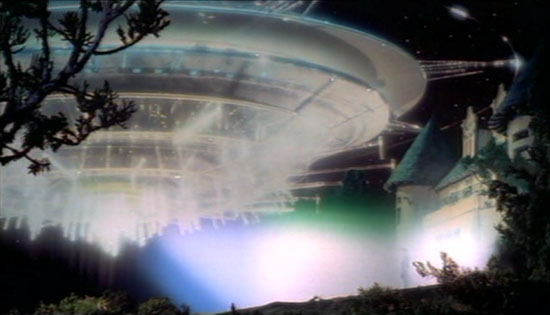
I don’t think Vonnegut was as mean-spirited towards the Chinese. And of course, Noriyuki “Pat” Morita is not of Chinese descent, but better him than Mickey Rooney I suppose. He plays the shrunken thumb-sized ambassador, a reference only understood by readers of the book since it’s unexplained during the movie. Other bits from the book are also rethought and bungled, and the twins are from SPACE now (and return to space in the ridiculous ending). All traces of Vonnegut’s trademark sadness and humanity are lost, unless you consider the sadness of the cast and the releasing studio and the audience. Rogue Cinema points out that the movie’s cast (Khan, Feldman, even Welles) and poster and title (and renaming the doctor “Frankenstein”) aimed to make audiences think that this would be a Mel Brooks Close Encounters parody. That particular advertising lie is probably the most well-thought-out part of the whole film.

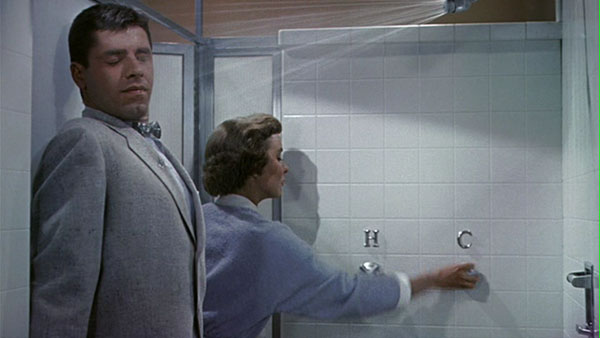
Lewis!
image

Khan!
image

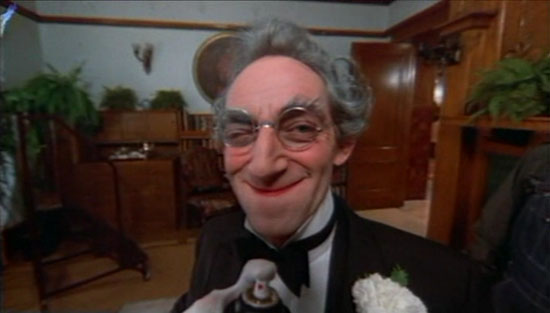
Madeline Khan and Jerry Lewis double-star as both the super-genius twins and their rich, detached parents. Marty Feldman is the butler in the twins’ secluded home. John Abbott plays a guy with a cool beard and Samuel FULLER is the colonel at the Military School For Screwed-Up Boys.

Feldman!
image

Fuller!
image

One of the last films of Jim Backus (Mr. Howell on Gilligan’s Island, voice of Mr. Magoo), John Abbott, Marty Feldman, and even Jerry Lewis (had starring roles in 6-7 more movies, most of them bad) but Jerry recovered in time to make Arizona Dream. Yes, Slapstick was a mega-career-killer, destroying the respectability of everyone involved! It ruined cinematographer Anthony Richmond, who previously shot the beautiful Man Who Fell To Earth and Bad Timing but went on to shoot Dane Cook movies and Dumb & Dumber 2. And - little known fact - it contributed to the death of Orson Welles and was directly responsible for his never completing Big Brass Ring, The Dreamers or Other Side of the Wind. Orson’s female co-narrator’s career was so thoroughly demolished that the internet has no record of who she was. But on the bright side, the movie helped launch the film career of Pat Morita, who would star in The Karate Kid two years later.

Morita! (he’s the one not looking at the camera)
image

Music by Michel Legrand and a song with lyrics by Vonnegut were edited out of the movie after the original release - why?? Assistant-directed by Michel’s son Benjamin Legrand, ending his short career as assistant-director (begun the year before on Rivette’s Merry-Go-Round).

Everybody wants prosthetic foreheads on their real heads? The incest scene doesn’t go very far, because we need a “PG” rating.
image

Released around the same time as Scorsese’s awesome King of Comedy, also with Jerry Lewis, though I think this was shot first and shelved for a while. Gene Siskel calls it “shockingly bad” and Ebert calls it offensive but makes a point of not blaming Vonnegut or Lewis. I heard one detectable Jerry joke: “You know, do as the romans do… when in rome, that is - I had it backwards” (it’s all in the delivery). There’s an occasional passionate line-read by Madeline or Jerry, the occasional animated bit of action, but mostly the movie moves mechanically from one laborious scene to the next, a simple motion illustration of a screenplay written by a guy who knows a guy who talked to a guy who once read the Vonnegut novel (which wasn’t one of KV’s best stories to begin with). I would looove to say that Fuller, Lewis and Feldman were excellent and the movie was slightly worth watching, but they weren’t and it wasn’t. I’m not in any hurry to rewatch Breakfast of Champions to decide whether this one is worse, but I think it probably is.

Close Encounters of the Dumb Kind:
image

Tags: , , , , , , , ,

Comments (1)

A Valparaíso (1962, Joris Ivens)

Directed by Ivens, narration written by Chris Marker, assistant camera by Patricio Guzman. Wow! Not to discount Ivens’s achievement, but this plays just like Marker’s travel documentaries. Definitely belongs with that group in some imaginary DVD box set, hopefully with far improved image quality over the awful version I just watched. I want to say this had better camera work than the Marker docs, but in this state, it is hard to tell.

image

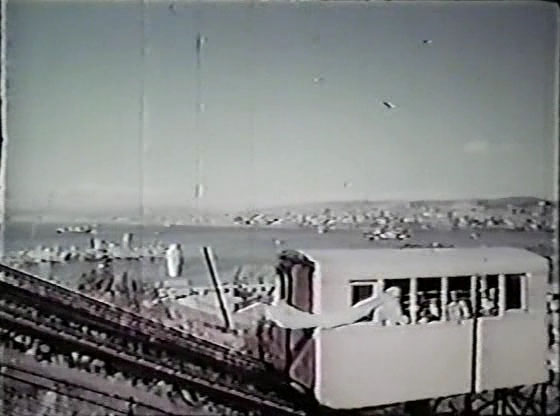
A decade before the Battle of Chile events would begin, Ivens and crew give us an overview of life in this port city built on a series of steep hills. Focus is on things that affect the residents (like the funicular system) and events they participate in (huge annual fireworks show, a kite flying festival), not the popular tourist sites and historic buildings mentioned on wikipedia. Or maybe Ivens just hired a local tour guide and didn’t check wikipedia before going over there. A humorous tone to the commentary (when appropriate), shots of penguins, seals, pelicans and cats (no owls in town), a fire, some jump-cutting in line for the funicular. One very non-Marker-esque bit when a staged (I assume) bar-fight shatters a mirror and leads to a splash of blood, audio dissonance, a kaleidoscopic shot cutting to a burning pirate flag to introduce a history of colonialism in the state… awesome.

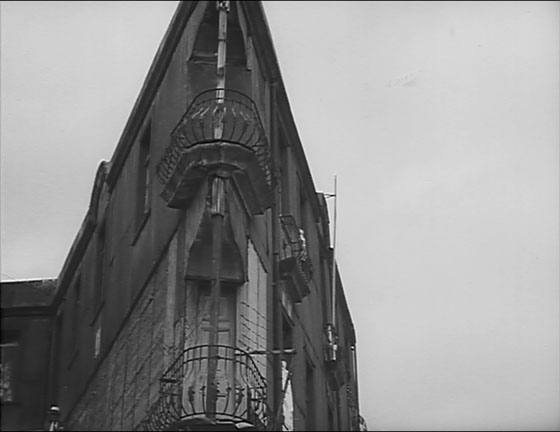
buildings that look like ships:
image

Wikipedia: The opening of the Panama Canal and reduction in ship traffic dealt a staggering blow to Valparaíso, though the city has staged an impressive renaissance in recent years.
image

Tags: , , , ,

Comments (1)

The Battle of Chile (1975-78, Patricio Guzmán)

“Popular unity against the criminal bourgeoisie!”
image

Other street protest chants:
“Bourgeois shit, the street belongs to the left!”
“We need an iron hand!” (?!)

I alternately see this referred to as an epic 1979 movie, a long two-parter with a third-part postscript, or three separate movies. I guess they were presented theatrically in different ways in different countries. The 2/1 split seems right to me, as I’ll explain.

Part one drops me into the middle of an election in March 1973, which I didn’t understand until towards the end of the movie. I wondered why nobody was saying Salvador Allende’s name - turns out it was a senate election, and either the pro-Allende party lost, or they just did not gain enough seats in congress to prevent the opposition from holding a majority. So for the rest of Allende’s short reign as president, the country’s senate is mostly against him, undermining his authority. Movie is on the street, taking opinions from everyone, kind of slow at the start since I don’t know what’s happening, but excitement is in the air, and things straighten out soon enough. Cameraman is terrific, patient but curious, always looking for the best thing to shoot even if it means wandering off the person talking. I can’t believe the sound guy can keep up with him, but he does.

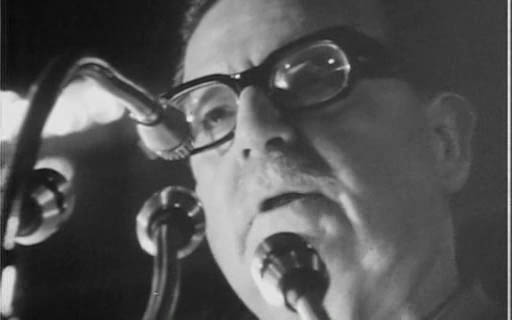
Salvador Allende:
image

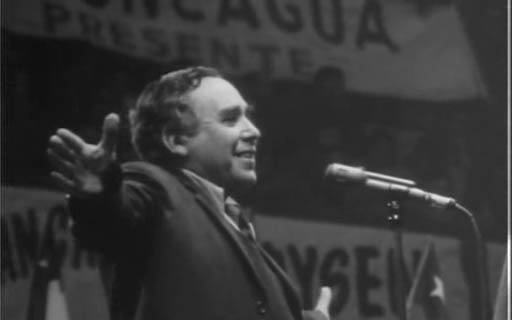
A politician:
image

image

image

Part two picks up right where the first one ends, with an attempted military coup on June 29 1973, and part two ends Sept. 11 1973 with the successful coup that killed Allende and instated General Pinochet as ruler. In between those dates, Guzmán covers everything that happens in the whole country, it seems, with access to the marches, the debates, worker meetings, everything but the secretive military that turns against its country (with help and provocation, it turns out, from the U.S. government). This is by far my favorite of the three parts, and could easily work as a standalone movie… I see the Film Forum in NYC thought so as well. The events themselves, a democratic country swerving communist then falling military-dictatorship, is the best movie material you could hope for and Guzmán and his crew make the best of it, watching from ground zero as history is made, producing one of the best docs I’ve ever seen.

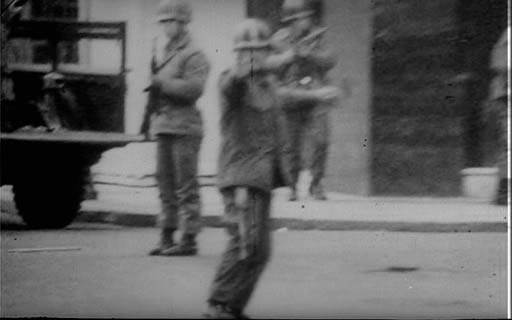
Military man who shot and killed Argentine cameraman Leonard Hendrickson at the end of part one:
image

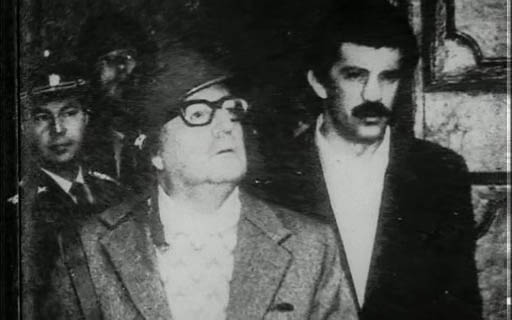
Salvador Allende, file photo:
image

Bombing of the presidential palace:
image

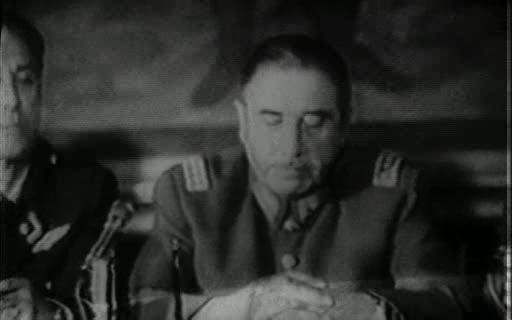
Pinochet addressing the nation on TV:
image

Military rule:
image

Pinochet: “After three years of support for the Marxist cancer we have been given a disaster that is economic, moral and social, that could not continue to be tolerated by the sacred interests of the mother country.” (or something like that - I think it’s all amateur-translated)

Guzmán: “From the 11th of September, all resources of the Chilean army are mobilized to repress the popular movement with the compacency of the North American government. The first armed resistance offered by some industrial cords, agricultural populations and student centers are squashed quickly in unequal fight. Thousands of people are killed and the main sport fields become concentration camps. The longest democracy in the history of Latin America ceases to exist.”

I don’t exactly wish I’d skipped part 3, but it would’ve made a nice recap six months later instead of watching it right after 1 and 2. Filmmaking in Chile wasn’t easy during Pinochet’s rule, since Pinochet was killing and imprisoning everyone who disagreed with him, including the cameraman of Battle of Chile (to whom the completed work was dedicated), so Guzmán backs up and shows further details of the workers’ movements during Allende’s presidency, not again mentioning Pinochet or the violence. The many worker meetings and the creation of multi-factory blocs and the attempted attack on Allende’s credibility by the “Christian Democrats” (his primary opposition) via a U.S.-funded transportation strike had all been covered in the previous films, but now we see them in greater depth… “depth” meaning lots of guys with sideburns talking into microphones at meetings. Since I’m not personally interested in creating a communist worker’s paradise in my own neighborhood, part three wasn’t of much use to me, but I’ll bet it’s exactly what Chris Marker was hoping for when he helped fund Guzmán’s efforts to document what was happening in the country. Marker’s own angry reaction to the coup is documented in his short Embassy, which I’ll have to watch again now that it’s on a new, clean DVD.

The transportation strike:
image

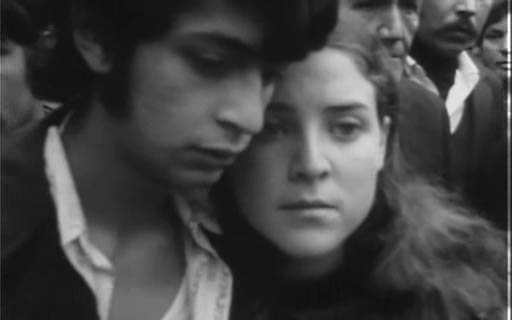
The people:
image

The sideburns:
image

The revolution:
image

Tags: , , , , , , , ,

Comments

25th Hour (2002, Spike Lee)

“This life came so close to never happening.”

A movie about sadness and mourning, loss and bad decisions, real friends and sham friends. Picked this as the first of my Seven Favorite Movies To Show Katy but forgot to mention to her that it’s my favorite heartbreakingly sad movie and that I can start crying at work just by thinking too hard about it. Oops! Still, a little sadness can be good for you and once she stopped crying Katy said it was a good movie.

Came out late 2002 and proceeded to be pretty much ignored. Won two awards for best music score and some film festival in Barcelona gave Edward Norton “best foreign actor”. I guess it was nominated for a golden bear in Berlin, beaten out by Michael Winterbottom.

image

D. Edelstein doesn’t think the 9/11-WTC connections belong in the film: “The story of 25th Hour is fueled by the threat of anal rape: It’s what preoccupies Monty, and it’s the heart of the sexual-panic motif that runs (subtly, mischievously) through the screenplay.”

Where Are They Now: writer David Benioff put an X-Men reference into his “25th Hour” script (which starred two X-Men movie vets) and is now writing the Wolverine movie. Good job. Spike’s doing a TV movie with Amy Ryan and a WWII movie set in Italy, and I still feel bad for never watching When The Levees Broke. The “sheeeeeeeeeit” detective was on The Wire, Rosario Dawson may or may not be in Sin City 2 or 3, Anna Paquin’s starring in a TV show and Ed Norton is HULK.

Tags: , ,

Comments

My Blueberry Nights (2007, Wong Kar-Wai)

Cowritten by Lawrence Block, longtime mystery writer once adapted by Oliver Stone for a film directed by Hal Ashby! This is his first screenwriting credit. Cinematography by Iranian Darius Khondji, who shot a lot of other visually-distinctive stuff like the Caro/Jeunet films, The Beach and Panic Room.

Norah Jones is dumped by her boyfriend, leaves her keys at the cafe for him in the hands of Jude Law. Talks to JL every night over blueberry pie, starts to like him, one night she takes “the long way” across the street to his cafe and goes on a year-long trip across the country, getting waitressing and bartending jobs, saving up for a car and writing poor Jude Law lots of postcards but never giving a return address.

First major stop is in a Memphis bar where cop David Strathairn (Good Luck and Good Night, Mother Night) pines for his separated wife Rachel Weisz (The Fountain) and drinks and drinks. Violence escalates, he dies in a car crash, Rachel is sad and Norah is outta there. Then somewhere in Nevada, a casino where Norah gives all her money to Natalie Portman with NP’s nice car as collateral. NP tries to teach a convoluted lesson about mistrust by faking that she lost all the money, giving up her car and having Norah drive them both to Vegas to see NP’s dying (oops, dead) father, but the lesson doesn’t come off very well.

With both of her extended stays in foreign cities and attempts to make new friends having ended in death and sadness, Norah comes home to NYC, where Jude has decided to let go of his ex-girlfriend Cat Power (on account of her being an unconvincing actress in her only scene) and the two are free to fall in love in their own distinctive way (bonding over security-cam videos, eating too much pie, Norah falling asleep and Jude kissing her without permission). A sweet ending.

So the story is kinda muddled, though the characters are all pretty strong (if a bit unbelievable and cliched) but the movie flows more or less like a WKW film, with slow-motion and emotional edit/flashbacks, a dreamy pop soundtrack (Ry Cooder, Otis Redding, “The Greatest” played three times, and a touch of Yumeji’s theme when Jude first falls for Norah). Strong colors, close-ups without establishing shots, the camera like a hazy memory lingering behind glass and slowly creeping behind obstructions, but focus always sharp. Glad I was warned not to expect too much, but I ended up liking it a whole lot.

Tags: , , , ,

Comments (1)

Dil Chahta Hai (2001, Farhan Akhtar)

Katy showed me this Bollywood movie to wash away the pain of Partner. This one wasn’t hateful, loud, empty, an extended music-video ripoff of an already-bad Hollywood film, but I didn’t love it either. Katy said the camera work was very good and often beautiful, but I found it uninspired, generic. Music was unmemorable but not bad. One nice music segment when a couple is at the movies seeing themselves onscreen reminded me of Pennies From Heaven. Story is alright, a light romance about three buddies and their love lives.

Akash (Aamir Khan - ice candy man in Earth, main dude in Lagaan) has a little beard patch under his lip, kinda arrogant but becomes a Good Guy as movie progresses. Gets sent to Australia and falls for a girl his parents previously tried to set him up with.

Sid (Akshaye Khanna - played Gandhi’s son last year) has an uneven hairline, is an artist and a Good Guy to begin with, falls for an alcoholic older woman with a kid and an ex-husband but she dies in the end.

Sameer (Saif Ali Khan - once played a character named Jimmy, but not THE Jimmy) has no distinguishing features or characteristics except that he falls in love with every girl he sees.

Also some women with names like Preity and Dimple, but don’t confuse me here.

Was nominated for 13 Indian academy awards, but got trampled by Lagaan.

Tags: , ,

Comments

The Major and the Minor (1942, Billy Wilder)

What a wonderful coincidence that I watch You’re Never Too Young, and then find out the next day that the film it remade is on Turner Classic.

Robert Osbourne introduced as a screwball comedy, but the only thing screwball here is the premise. Movie is played as a straight, semi-romantic comedy. Same story as the Lewis flick but minus the jewel thief and with a sex reversal (and predictably there’s no equivalent to the Dean Martin character). So Ginger Rogers is the scalp-massager lured to an apartment under a false premise which gets her to leave town and have to pose as a kid to afford a ticket. She hides out in Ray Milland’s room, same thunderstorm and morning discovery scene, then has to keep up the ruse so Ray won’t get in trouble and kicked out of the military. Again, a happy ending with Ray getting his wish to be sent on active duty (makes more sense in the nationalistic war-ragin’ 40’s than in the 1955 remake) and happening to meet a finally-acting-her-own-age Ginger on the train platform (where she gives him a Katy-disapproved line about how all some girls want is a letter from their husbands-abroad every couple weeks).

Cute movie, with some major Creepiness Issues (Ginger cuddling up to Ray, wanting him while pretending to be a little girl and calling him “uncle”). Not the madcap funhouse of the remake, though… no Dean songs (they’re not missed) or speedboat chases, choral performances or marching band shenanigans. Turning the all-girls school into a military academy surprisingly doesn’t change much. Some scenes are very similar, like the long-distance call at the phone switchboard (though Jerry ups the humor with his nutty dancing and a voice-dubbing stunt). I’m sure there’s some auteurist reason why I should prefer the original to the remake, but sorry, I sorta don’t.

This came out a full decade before Ginger Rogers had a lot more fun playing a little girl in Monkey Business (another movie comparison which does this film no favors), and TWO decades before Ray Milland acquired his X-RAY EYES. Back in the 40’s he was cast not for the x-ray eyes but because he is an effective leading man, and an exact cross between Jimmy Stewart and Cary Grant. Wilder sez: “I wrote the part of the major for Cary Grant. I always wanted him in one of my pictures, but it never worked out.”

15-year-old little Lucy would grow up to play the love interest in the remake. Ray’s meddling fiancee (and Lucy’s big sister) was Rita Johnson (The Big Clock, Here Comes Mr. Jordan). The strict colonel (Lucy’s father) was Edward Fielding, who managed to portray military men, doctors, ministers and shopkeepers in over 70 films in the 1940’s despite a fatal heart attack halfway through the decade. Ginger Rogers’ mom, in her only screen appearance, played Ginger Rogers’ mom. Guy who gets a scalp massage at the beginning was Robert Benchley, the Jaws author’s grandfather. The young high-school age kids were actually 22, 21 and 16 (x2). That’s more accurate casting than the remake managed to get. The one familiar-looking boy had played Rudy in Shop Around The Corner, the kid the shop owner takes out for Christmas dinner in the final scene.

And what do I know about Billy Wilder? Not very much! Just enough to see plot parallels between this and Some Like It Hot. Saw none of the cynicism for which he’s known, but Wilder explains: “I was very careful. I set out to make a commercial picture I wouldn’t be ashamed of, so my first picture as a director wouldn’t be my last.”

Internet says the screenwriter invented the bad pickup line “Why don’t you get out of that wet coat and into a dry martini?”.

Tags: , , , , , , , ,

Comments

You’re Never Too Young (1955, Norman Taurog)

“Dig that crazy homework.”

I appreciate that none of Lewis’s movies have even vaguely believable plots. Plausibility is an unnecessary weight on the shoulders of comedy. This one has Jerry playing an aspiring barber in a fancy hotel who gets caught up in a jewel-heist plot along with haircut customer Dean and Dean’s girl Nancy (both teachers at a girls school in a distant town). Jerry mugs an oversized 11-year-old and steals his sailor outfit in order to get a half-price ticket home, but hiding out from the gun-toting jewel thief he bunks with Nancy. Once discovered, he has to keep pretending to be 11 so Nancy won’t be exposed for having a man in her private room. Of course he falls in love with her (and has to fight off teenage girls at the school), but Nancy still marries Dean, awww.

Besides playing the romantic straight-man, Dean sings five dreamy but unmemorable songs. I always think it must be hard to be the woman in those scenes, having to smile through a whole song without attracting attention away from Dean or looking too vacant.

Remake of Ginger Rogers/Ray Milland-starring Billy Wilder-directed The Major and The Minor, in which it’s the girl pretending to be a kid. Hmmm, it’s on TCM tonight. Bosley Crowther’s original New York Times review calls Lewis “noisy and ungraceful” and says the film is “on a mental level that will not demand an exertion from anyone.” Thankfully, Crowther didn’t live to see Neil Marshall’s Doomsday, but yeah, nobody would call You’re Never Too Young challenging. I just found it a cute comedy with Lewis actually at his most likeable and everyone else (Dean included) pleasant enough to watch without adding anything very distinctive.

Good DVD quality. I put this on while paying bills, expecting it to be the lesser of the Artists & Models double-feature disc, so I didn’t pay strict attention but it gradually roped me in. Perfectly fine cinematography by Daniel Fapp (Lord Love a Duck, Let’s Make Love, West Side Story) and direction by Taurog (everything from Andy Gump for President in 1924 to Dr. Goldfoot and the Bikini Machine in 1965). Written by Sidney Sheldon, screenwriter of Anything Goes and creator of I Dream of Jeannie. IMDB says his family can expect a big royalty check in 2010.

Look at these two. Hard to believe they were involved in a sinister bisexual mafia prostitute murder conspiracy. Oh wait, they weren’t… that was an Atom Egoyan movie.
image

Dean’s girl Nancy was Diana Lynn, the youngest brother’s girlfriend Gwen in Track of the Cat, went straight to television after this and died of a stroke sixteen years later.image

Nancy’s uptight co-teacher (not pictured here, since I haven’t forgiven her for being a nosy, moralistic tattletale) is Nina Foch of a buncha period films like Spartacus, The Ten Commandments and Scaramouche.

Not the first time that American Hans Conried (left) played a Frenchman named Francois - and he was also Dr. T in The 5,000 Fingers.
image

The very sinister Raymond Burr (center), fresh from playing the bad guy in Rear Window, is the jewel thief. Veda Ann Borg (left), vamped as the thief’s wife in this scene. Besides having a very awesome name, she costarred in the 1940 serial The Shadow and appeared in Guys & Dolls and Mildred Pierce.
image

Orpheus! Don’t look back!
image

Appropriate that in the water-skiing stunt-double chase scene, Lewis says “I don’t know how to do this!” against a rear-projection screen. It’s a great comic action scene, but I preferred the music performance that preceded it, with Jerry as conductor of Dean and the women’s choir. Similar to a section near the beginning when Jerry leads the girls at a march, only now instead of aping his spastic movements, they vocalize them.

All the “young high school kids” look to be in their twenties. IMDB says they were indeed. Gags involve a milk-shooting water gun, eating cigars, drinking disgusting liquids, falling into a swan pond, and other slapstick stunts, but it’s not over-the-top physical comedy. Or maybe in this post-Dumb and Dumber America, Jerry Lewis humor seems subtle. One of the gags, when Jerry pretends to be a gangster towards the end to escape the school, is referencing 1940’s William Castle movie series The Whistler. Weird how the happy ending involves the girl being left alone as Martin goes back on active army duty, which he’s been hoping to do all movie long. It’s the anti-Stop-Loss.

image

Tags: , , ,

Comments

Film Without Boundaries 2008

Experimental shorts program at the Nashville Film Festival. Below in italics I’ve quoted their online program notes for each film and added my thoughts in regular text. Unfortunately my memory is very bad and I was neither taking notes nor concentrating on remembering details during the screening, just getting lost in the films, so my thoughts might be wrong or meaningless. I will say it was a cool program, a little saggy in the middle/end but mostly high-quality work, very enjoyable. Most of these were on video, but not the first few I don’t think.

Olivo Barbieri’s Sevilla (06) (Italy 2006,13 min.) is a tale about the perception of Europe in Africa…from the vantage point of an airplane.

Deceptive to call it a “tale” since it’s non-narrative. Also I thought it was from a helicopter - there are helicopter noises on the soundtrack (along with harsh electronic sounds coinciding with some edits, mostly near the beginning and end). I struggled throughout this one to tell if it was out-of-focus, if my eyes had gone funny, or if it’s just supposed to look that way. Didn’t know what city I was ever in, assumed Sevilla, Spain. Whether caused by the focus effect or not, it looked very much like models, a giant, detailed model city, until I’d see traffic moving. Think I liked it, anyway a nice way to start the program. I still remember the percussive music, but I bet I won’t the next time I read this. How to describe music?

Combining live action, stop-frame animation and a kinetic sculpture, Harrachov (Matt Hulse, Joost van Veen, Netherlands 2006, 10 min.) explores the effect of an arcane force that, like a black hole or an immensely powerful electromagnet, exerts a far-reaching and irresistible power upon certain objects and materials, willfully seducing, centralizing and internalizing them.

Junk moves across uninhabited ground towards a sinister shed, pulled by unseen strings, magnets, animated by stop-motion or simply tossed and rolled. Very cool movie, black and white, really brought to life by the great sound effects. We never see the final assembled creation, unless it was obscured in darkness or I blinked and missed it, but it’s shown on the website:
image

In The Drift (Kelly Sears, USA 2008,9 min.), a mysterious disappearance on a space journey gone awry launches the counter-cultural revolution at the end of the 1960s.

Not quite slow-zooms on still 1960’s photos, because slight motion is added to the “photos”. This one had a story and a voiceover, unusual for the program, and the woman next to me whispered “was that experimental?” From the director’s website statement: “The Drift uses frame-by-frame techniques to weave an absurd fable about our country’s unflinching frontierism and the desire to push too far, too fast. Images dug out of thrift store bookshelves and flea market bins are animated to create an alternate take on what really happened behind the face of ground control, the space program, and the American psyche.” A cool little movie about a contagious space-disease, certainly better than The Astronaut’s Wife. The drift theory would probably answer some of Werner Herzog’s questions about the inhabitants of Antarctica.

Sera Sera (John Murphy, USA 2007, 3 min.) sets atomic-bomb-testing footage to a reggae-ized version to hypnotic effect.

Director was in attendance but I had to haul ass to Phantom Love (which it turns out was cancelled, so I could’ve stayed, sorry Mr. Murphy, and sorry also for not being able to remember your film clearly but I do recall that it was short and felt like a good music video and that’s not an insult because I like a good music video). Come to think of it, the music was a trippy “que sera sera” remix. Wait, it’s coming back to me, 60’s footage treated with Tscherkasskian film-off-the-rails effects.

With water imagery as the foundation, Number One (Leighton Pierce, USA 2006,11 min.) engages the experience of elasticity between varying states of mind.

A flowing, sometimes symmetrical composition with a sliver of image in the center, and mirrored or continuous images on the left and right. And sometimes it’s something else entirely. Put me in a happy mood. Can be bought in digital form from the iTunes store.

Dig (Robert Todd, USA 2007, 3 min.) is a constricted frame in agitation, with the sweet music of jackhammers raging throughout - with intermission.

Haha, Mr. Todd, the “sweet music of jackhammers,” I get it. A desperately irritating movie about the annoyance of road construction. Actually, it’s pretty cool visually, rapid-rapid-fire shots of painted road markings spinning and sliding - would watch it again with the sound turned off. This is when people started walking out, about 3-4 per film from now until the end.
image

Kip Masker (Maria Petschnig, Austria 2007, 3 min.) disguises body parts in altered pieces of clothing to create semi-abstract compositions that defamiliarize the human form.

J. Schaffer says: “Soft, strained breathing accompanies the picture, intermixed with the occasional crackling of latex. From the start, I am faced with the task of disentangling the compositions magnified on screen: a hole purposely cut into a white bra with a shoulder muscle swelling over the seams? A white supporter for a packer (a silicone penis), worn the other way around?” And so on. I actually got and appreciated the intention of this film, a rarity for me. People next to me didn’t like it one bit.

The Green Bag/Documentary Happens (Tim Sharp, Austria 2007, 7 min.) is a single take, real-time documentary shot from the terrace of the Circle Hotel restaurant in Gondor, Ethiopia. While it allows a brief look at the density and multiplicity of everyday interactions taking place around the camera, the film also stimulates questions related to defining the essence of what documentary film is as a cultural artifact.

I was mesmerized by a green plastic bag blowing in the wind… dancing with me. Just kidding, I was actually bored to tears by this dull documentary by Wes Bentley, errr Tim Sharp. It stimulated questions like “when will it end?” and “how many more people will walk out?” Movie had a stunt ending: the appearance of a different-colored plastic bag. A different bag! Reminded me very much of Hidden In Plain Sight. Apparently there’s a new trend in filming stuff nobody cares about and calling it an experimental documentary. Paging Andy Warhol…

With super high-speed cinematography, reminiscent of adored science education films from our childhood, gun fetishization is taken to a surrealist extreme in Kogel Vogel (Frederico Campanale, Netherlands 2006, 6 min.).

Gun shoots bullet through glass in super-slo-mo - whoosh! Liked it, but not much there besides art-i-fying those mentioned education films.

In Ariana Gerstein’s 96 (USA 2007, 7 min.), the space between being 90 and 6 is always shifting in this moving picture portrait.

Something about photographs and a little girl? I don’t remember! I think the sensual overload of the next film acted as a memory-blanker.

Daddy I’m Scared (Tijmen Hauer, Netherlands 2006, 4 min.) is an iconoclastic video piece consisting of thirteen different children’s cartoons layered on top of one another, transforming their innocent qualities to an aggressive and mesmerizing inferno of image and sound.

Almost interesting, but the clips don’t seem to be meaningfully combined, just thrown atop each other to form a red-tinted fiery Disney nightmare. I recognized Aladdin by sound and Hunchback by visual. It was short at least.

In Light Is Waiting (Michael Robinson, USA 2007, 11 min.), a very special episode of television’s Full House devours itself from the inside out, excavating a hypnotic nightmare of a culture lost at sea.

The one I’d been looking forward to (and the reason I didn’t wander away unhappily during the green plastic bag doc) didn’t quite live up to expectations. Funnier as described to me than to actually watch. Excerpt of a Full House ep (which Katy remembers) where they drop a TV from a great height turns into SCREAMING BLINKING PAIN turns into a mirrored, folding-in-upon-itself color-tinted noisy nightmare, an extreme slow-mo excerpt from a different episode on some fantasy island (which Katy also remembers). Good move equating Full House with shrieking hell, but not actually much fun to watch. I want some Peter Tscherkassky, please.

Tags: , , , , , , , , ,

Comments

Encounters at the End of the World (2007, Werner Herzog)

Not as audacious as La Soufrière nor as profound as Grizzly Man or moving as Little Dieter Needs To Fly, but has its measured share of audacity, profundity and… moving… ness. Motion? Werner goes to Antarctica to look at things, interview people, and express his contempt for it all. He finds some stuff to love, and there’s some gorgeous, wondrous underwater photography (non-Herzog-directed) by Henry Kaiser - THE Henry Kaiser, guitarist friend of Fred Frith - who also did the music. For above-ground shooting Werner brought along his Rescue Dawn/Little Dieter cinematographer Peter Zeitlinger.

We get the obvious “ice is melting and we are all doomed” bits, and shots of penguins, and interviews with the philosophers and scientists who live (either temporarily or not) in the ugly US base city of McMurdo. Touristy reaction scenes and the training sessions given to visitors before they’re allowed to leave the base. Then there are more typically Herzog moments. He comments on the commercialization of the south pole, the end of human discovery over the planet, signs we leave behind for future generations and visiting aliens. He cuts off some interviews, giving his own postscripts and summaries and arguments in their place (interrupts one woman flatly saying “her story goes on forever”). It’s a cool movie and a nice addition to Herzog’s philosophical travelogue cinema of human behavior on the edge, probably not destined to be a classic Great Film. Was very happy to see it on the big screen, and it was a nice breather among all the avant-garde shorts. Katy was a little disappointed with her first Werner Herzog experience, then I think after I told her she’d already seen a Herzog film and it was Nosferatu: Phantom of the Night, she liked Encounters a little more by comparison.

Tags: , ,

Comments

45 Years of Canyon Cinema

NAFF says: “We celebrate their 45th birthday with this meticulously-chosen collection selected and introduced by Canyon Cinema’s executive director Dominic Angerame.” I don’t know what it means to be meticulously chosen. I mean, I assume Dominic is well familiar with Canyon’s films and he might’ve agonized over the selection, wondering how best to artistically and effectively represent his company’s holdings. Anyway, it was a very good selection, but NAFF could’ve been more meticulous with the presentation, misthreading one film which caused delays during which half the audience left early. But let’s face it, half the audience always leaves early during avant-garde film presentations. On with the descriptions… italic text is quoted from NAFF’s descriptions, regular text is from me.

Alone. Life Wastes Andy Hardy (Martin Arnold, Austria 1998, 15 min.), where Arnold remixes several clips of a Mickey Rooney/Judy Garland Andy Hardy film to form an erotic Oedipal musical.

I talked briefly about this one here and here. Seeing again on a giant screen in a nice theater with a packed audience was rewarding. Lots of laughter when people caught onto the oedipal/sexual jokes. Brilliant movie and concept - still one of my favorites.

Autumn Leaves (Donna Cameron, USA 1994, 6 min.), where the splendor and pleasures of autumn are the focus of this richly textured and brilliantly colored paper emulsion film.

I don’t remember it! I know I liked it - I liked all of these, but I do not remember in what specific ways I liked it. A shame, possibly.

China Girls (Michelle Silva, USA 2006, 3 min.), a short composition of women posing for skin tone and color slates used in film leaders that reveal some skin and the aesthetics of their day through film stocks and fashions.

Didn’t love this one, actually - all slates and countdowns and blips and test patterns. I see that stuff at work all day. I mean, yeah they were vintage test patterns with subliminal shots of women with carefully-maintained hairdos. A minute longer might’ve been too much, but this was harmless, probably of interest to someone else.

Delicacies of Molten Horror Synapse (Stan Brakhage, USA 1991, 10 min.), where four superimposed rolls of hand-painted and bi-packed television negative imagery are edited so as to approximate the hypnagogic process whereby the optic nerves resist grotesque infusions of luminescent light.

I mentioned this one previously here. Silent and gorgeous. Audience didn’t rustle around or yawn loudly or start to leave - they liked it too! Some of the multi-layered visuals are television images, and given the “molten horror” title you’d expect something like Light Is Waiting, but thankfully that’s not what you get.

Eaux D’Artifice (Kenneth Anger, USA 1953, 12 min.). Filmed in the gardens of the Villa D’Este in Tivoli, Italy, and accompanied by the music of Vivaldi, Camilla Salvatore plays hide and seek in a baroque night-time labyrinth of staircases, fountains, gargoyles, and balustrades.

Covered this one here. Light through water!

Ellipses (Frédé Devaux, France 1999, 6 min.), where a ripped strip of film is sewed back together following an aesthetic mode, in a celebratory end-of-century apocalypse of positive, negative, super-8, regular-8, black and white, color, saturated and faded found footage.

Oh god, I don’t remember this one either!

Georgetown Loop (Ken Jacobs, USA 1997, 11 min.), a reworking of 1905 footage of a train trip through the Colorado Rockies, where the original image is mirrored side by side to produce a stunning widescreen kaleidoscope effect.

Opens with the original film (discussed here) on the right half of a wide screen, kind of unnerving, then gloriously mirrors it onto the left. Images don’t overlap over themselves like in Light Is Waiting, but vanish into the center line, expanding and contracting, the train’s always-curving motion making it constantly split and merge. But it’s kind of an easy trick, doesn’t seem worth being called a great film, or even very “experimental.” I’m guessing they wanted to show something by big-name artist Jacobs and this was his shortest film?

In Kaleidoscope and Colour Flight (Len Lye, 1935/1938, 8 min.), Len Lye, pioneer kinetic artist, sculptor and experimental filmmaker, painted colorful designs onto celluloid, matching them to dance music.

Zowie wow, these are electric. They start out all hoppin’ jazz, colors and shapes and stripes and light and love, all in fast motion to the beat, then about three minutes in when you least expect it, they hit you with a cigarette ad. More, please!

Psalm III: Night of the Meek (Philip S. Solomon, USA 2002, 23 min.), a meditation on the twentieth century at closing time. Psalm III is a kindertotenlied in black and silver on a night of gods and monsters…

I guess it’s scenes from other films turned grey and treated with a heavy emboss filter. Often no recognizable details, then they’ll emerge suddenly from the murk. We see some nazi imagery at one point, pretty sure I saw Frankenstein a few times, and little Elsie’s balloon from M caught in the power lines. Longish, but nice, enjoyed it. Can’t remember the audio at all.

Tags: , , , , , , , , , , , , , , , ,

Comments

Don’t Touch The Axe (2007, Jacques Rivette)

What to say? Despite my recent Rivette obsession and how I was looking forward to this, I didn’t love it. But I didn’t expect to love it, since it’s a period piece about upper-class people unable to declare their love for each other because of societal restrictions, and I tend to hate that kind of story. I got to watch fave Rivettian actors Bulle Ogier and Michel Piccoli and Barbet Schroeder (all sharing a scene) but they’re hardly in the movie and they play gentle, wise elder friends and relatives, with a bit of dialogue but no passionate acting showcases. I got my Rivette themes and trademarks served up: conspiracies, secret rooms, performance (explicitly at the convent, but throughout as the two toy with each other), real locations with creaking wood floors, oceanside drama, but all enslaved to this book-to-film adaptation of Balzac - something that I thought Rivette just said he’d never do in the DVD interview on Belle Noiseuse, that he dances around Balzac in his film writing (that one and Out 1) because a direct adaptation would be impossible. In the story, Montriveau is one of the notorious 13, but the name of the group is never stated here. Anyway, we also get very good performances from the leads - Guillaume Depardieu, lookalike son of Gerard who once played his dad in flashback in Les Misérables, with a false leg used to great effect here on the wooden floors… and Jeanne Balibar, who I don’t remember from Code 46 or Clean, and haven’t seen yet starring in Va savoir.

Not much outward passion to the movie, emotions seem detached (I know, that was the point, sorta) but it has a quietly affecting ending aboard Montriveau’s ship after he breaks into the convent and finds the Duchess dead. The plot being easy to follow, I started paying attention to nerdy cinema stuff like the quality of light (all supposedly from sunlight and candles) and the sound (music used very sparingly, as usual). Sound was rough because of the loud hissing and gurgling noises coming from the ceiling at the Landmark, and picture was even rougher since the film was projected out-of-focus (except for the left third of the screen, which looked lovely). So it was easier to measure the quality of light than, say, the details of costumes and decor. I’m not much for decor anyhow.

Definitely closer to Hurlevent (Wuthering Heights) than to anything else I’ve seen Rivette do. At least I learned how Duchess of Langeais is pronounced (vaguely: “lawn-jay”). This Balzac story was previously filmed a few times, from a 1910 lost silent to a 1995 TV version adapted by the co-writer of Goya’s Ghosts.

————
Excellent analyses found on other sites:

E. Howard:

Games are the film’s central conceit, in fact, whether they be word games, mind games, literary games, games played between appearance and feeling. The game being played at the narrative level takes place between a General and a Duchess … But this is only one game that Rivette is toying with, and he plays an entirely different one with the audience, a game of subtle winks and sly nods that continually disrupts the placid surface of the narrative … This narrative disruption is mirrored in the way the General’s story to the Duchess, about his time lost in the desert after escaping from the enemy’s imprisonment, is continually interrupted, usually by the listener’s short attention span and her tendency to divert the flow of the conversation just as the story is reaching a critical juncture. This results in the General’s story being doled out across three successive evenings that they spend together early in their relationship. On the third night, as they settle in to continue the story, Rivette frames the Duchess in a tight closeup as she asks her would-be lover to finish the tale. At this moment, she turns a sly sidelong glance directly into the camera, maintaining eye contact with the audience, as though to include them in the game.

This game of narrative interruptus is also carried through in the way Rivette uses the text of the film’s original source, a novella by Honoré de Balzac. This is a rigidly faithful adaptation… with texts from the novel periodically included as intertitles to highlight certain moments or get at the characters’ internal states. The titles are also used to convey the passage of time, which is parceled out in scrupulously precise measures: “one hour later,” “twenty-two minutes passed,” “she waited twenty-four hours.” These titles often seem to abruptly cut off the action, sometimes flashing up on screen when, after a long scene of near-stasis, a character is right in the middle of completing the scene’s first real movement or action (most often: leaving the room). The passage of time, like everything else in the film, is subject to Rivette’s subtle humor. After the Duchess kicks her friend out of her house, a title informs us that it one hour passes (a very common interlude), and surprisingly in the very next scene there’s the General again, still standing in her parlor, walking around it aimlessly, looking like only five minutes has passed since she ordered him to leave. Rivette’s use of these titles is obviously very sardonic and mannered, as when he uses a long series of images of the Duchess at a party as though it constituted a clause in between two dashes in a sentence: “the Duchess searched for him —” followed by the visuals and then, when the dangling phrase had almost been forgotten, “— in vain.”

J. Romney:

Characterised as a sort of Napoleonic wild beast ill at ease in the tameness of Restoration Paris, Armand - a general newly returned from Africa who initially fascinates married duchess Antoinette with stories of his exploits - is associated from the start with the great outdoors, prowling Mallorca’s windlashed ramparts, while Antoinette is first seen doubly imprisoned, in nun’s cowl and behind a grille.

The film is largely set in a series of enclosed salon and boudoir interiors, an overtly theatrical domain in which Antoinette is a surpassing mistress of mise en scène. Preparing for Armand’s first visit, she arranges herself for maximum effect on a canapé, in discreet déshabille, ordering her servant to lower the lighting (the thematics of light and heat later extended in the fireplace that Armand pokes with barely contained sexual frustration, and in the brand with which he threatens Antoinette).

As actress, Antoinette is skilled at the well-timed entrance and exit, whereas Armand habitually arrives too early, or storms inopportunely into the star’s dressing room. It is part of Armand’s revenge that he at last masters both mise en scène and performance, in a startlingly excessive scene that replaces Antoinette’s poised comedy of manners with a lurid melodrama: in it, he plays a menacing Byronic ravisher, supported by masked men hovering around a brazier. This sudden eruption of violence in the middle of an analytical drama may seem wildly incongruous, yet the tonal discontinuity comes directly from Balzac’s story, and Rivette achieves the seemingly impossible in making such a disjunction work convincingly on screen. The violence at the heart of the story, together with its cautionary-tale aspect, is foregrounded by Rivette’s reversion to Balzac’s original title for his novel. The reference is to a veiled warning that Armand gives Antoinette, the axe being the English one that beheaded Charles I - the implication is that the reckless cause their own downfall. In reality, however, Armand himself figuratively wields the axe that will destroy his own chance of happiness.

D. Kasman:

How strange that a filmmaker who through the years has so loved process, often in terms of acting and theatre, of seeing the expression of things worked out awkwardly before us, and conspiracy, in terms of the hints that everything out there, out of sight and out of the film frame, may be connected, has decided to adapt a reserved, 19th century historical chamber romance. Oh, but with such a surprise we then get to engage in the pleasures of the hunt! For then we find things like this: how is the navigation of social rules and norms—a very real thing with a very allusive existence—like the theatre and how is it like a conspiracy? Well, it is not without reason that Rivette opens the film at the melodramatic peak of the couple’s aching separation—the Duchess a nun on a remote Spanish isle and separated from the General by the convent’s metal bars—and then transitions and flashes back five years to the couple’s meeting and affair through two sweeps of a theatre curtain. The stage then is not the actual island (filmed on location), but is the interiors of the Restoration period, in all their glory, wood boards creaking like an empty stage. …

It is like a game played again and again with different moves but the same results, the repeating drama inside the haunted house of Celine and Julie transposed to thinking, feeling participants. The drama exists in a hanging kind of closed-off world, all frustrated performances that are almost content, as the playfulness and acting gets close to true expression, true connection. But something holds everyone back, holds the drama back, holds the love back, and gradually both General and Duchess become obsessed with this vague, menacing limitation, a mysterious stopgap to happiness that can neither be seen nor surmounted.

Whew, I love all these themes that get read into Rivette’s work. I always wonder whether he’s aware of them and consciously shaping his films in this way, or if the themes are unintended and they are more or less created by the critics, or if they’ve just become a part of his creative process, so much that he doesn’t think about them as consciously as he used to, and they become more subtle and have to be drawn out by a viewer well familiar with his previous films. I sure hope it’s that last one!

D. Ehrenstein: The film is “dryly funny. Especially so when “the 13″ make their appearance in the last act, looking more like a left bank version of the Keystone Kops than a fearsome secret society.”

Tags: , , , , , , , , ,

Comments

La Belle Noiseuse (1991, Jacques Rivette)

Won the grand jury prize at Cannes, but didn’t have quite enough of that barton fink feeling to take the golden palm. Did not take the nation’s award shops by storm - lost the Cesar to some Gérard Depardieu flick, and wasn’t nominated for an Oscar or much else. But it did put Rivette’s name back into public circulation.

Music by Igor Stravinsky, and the name Divertimento was stolen from the short version of one of his works. An in-joke for Stravinsky fans. That fits in with the Balzac references and the fact that the entire project was based on a joke, a flip fake answer Rivette would give when asked about his next project.

A vacationing Marianne and Nicolas visit the estate of long-idle painter Frenhofer and his wife Liz, where an unguarded look by Marianne gets Fren’s artistic urges raging once more. Nicolas tells Fren that Marianne will pose for a painting without asking M.’s permission first, but she comes anyway, with an angrily determined look on her face, to spite Nic. First few scenes when she goes naked in the studio are just astounding. Frenhofer goes about his work, setting up a drawing table, sketching some lines (Rivette, in his usual fashion, shows us the entire artistic process, omitting nothing for the sake of runtime), while M. has this incredible internal struggle visible on her face. It probably helps a lot that the film was shot in order, so the character and the actress become increasingly comfortable with her nudity as the audience does too.

image

Fren’s relationship with his wife Liz proves to be complicated. She was once his model, and the very painting he’s attempting to achieve with Marianne was once begun and abandoned with Liz. In her conversations with Fren and Marianne and Porbus the art dealer (with whom she once had an affair) and in her movements and her uneasy looks we get a wonderfully conflicted character. She’s never showy or artificial - the only one here who fits that description is Marianne’s boyfriend Nicolas, who grows increasingly absent. He comes back towards the end when his sister arrives to artificially force a closure to Nic and Marianne’s long limbo-vacation. Marianne, either dedicated to the painting or still stubbornly trying to prove her mettle, refuses. When she sees herself in the finished painting, sees what she’d been trying to hide while apparently so exposed, Frenhofer watches her expression, and what he sees convinces him to hide the painting forever behind a brick wall and stay up all night creating a substitute, a pleasing but powerless work which pleases Porbus and sickens Nicolas. I wonder if Frenhofer’s falling in love with Liz prevented him from ever finishing the painting a decade earlier, for fear of scaring her, or if his falling in love prevented him from being able to see that part of her which would enable him to finish it. Either way, a very satisfactory ending, the masterwork completed but Frenhofer, a greater man than Nicolas, hides it for the well-being of the two women.

Simply shot, mostly in long takes in authentic locations. I mean, the shots aren’t Tarr-long, or even Rivette-long, just longer than most films - though there are authentically long insert-shots of sketches and drawings created from scratch before our eyes. I watched with headphones and found the sound of Fren’s pen scratching across his notepad to be almost unbearable. Rivette’s usual favorite sound effect of footsteps on a wooden floor can be muted when convenient, as when Liz comes into her husband’s studio and watches unnoticed.

Frenhofer = Michel Piccoli - Simon Cinema himself, of lots of films by Ruiz, Oliveira, Godard, Bunuel, Hitchcock, Varda, Demy, Resnais, Malle, Clouzot, and Mario Bava. I’ve only seen a few of his movies before and never can remember who he is - maybe after four hours of him as Frenhofer it’ll stick this time.
image

I just saw Emmanuelle Béart as Marie, and she’s been in two different movies called L’Enfer.
image

Jane Birkin was in Love on the Ground, Same Old Song, Kung-Fu Master, Keep Up Your Right and Blow-up.
image

Art dealer Porbus (right), Gilles Arbona was in similarly-titled La Belle Captive.
image

Nic’s sister Julienne, Marianne Denicourt (left with David Bursztein as Nic), later starred in Haut bas fragile and played Victor Hugo’s wife (?) in a French TV biopic of Balzac.
image

“And the hand of painter Bernard Dufour.”
image

Towards the end, when Frenhofer is through sketching and has started to paint, we see the first slash of red across a canvas. There’s more red during the next painting session, and when we glimpse the bottom of the “true” completed painting from under a sheet it’s mostly red). The false ringer painting is almost all light blue.

image

J. Heilman:

The film begins unassumingly in a hotel courtyard where we see a young man stealthily sketching some seemingly oblivious English-speaking tourists. As Rivette’s camera continues to pan, however, we find that our casual artist is actually the subject of another’s art. A woman on the hotel’s balcony furtively snaps a photo of him, but is noticed by sketcher, who becomes visibly irate. As soon as he confronts her, though, it becomes immediately apparent to us that most of this incident was a ruse. The two artists are lovers, and their coyness was entirely put on. Spurned by the excitement of their charade, they retire to the bedroom. The stunt even continues a bit farther than planned when one of the tourists watching this amorous French drama unfold says to another in mock culture shock, “Well, what do you expect?” This seemingly frivolous episode resonates throughout the rest of the film, since it manages to say much about the relationship between an artist and subject, the secretive, similar natures of art and love, and the need to sometimes create an environment where ever-fleeting inspiration might strike. It’s these themes that come to the fore during rest of the long journey that La Belle Noiseuse takes.

image

K. Uhlich in Slant, less reverential than most, says it “vacillates between genuine insight and didactic mystique-of-the-artist bullshit.”

Jacques Rivette:
image

Tags: , , , , , ,

Comments

three by Hollis Frampton and Kenneth Anger (1964-70)

Wonderful 16mm screening at Emory, but not well-received by the students and regulars who came to be entertained. Silly students and regulars, it is not a university’s job to entertain you!

Scorpio Rising - 1964, Kenneth Anger
Couldn’t remember if I’d seen this before, but of course I have… opening credits bedazzled onto a motorcycle jacket were immediately familiar. Despite the nazi imagery and comparisons between bikers headed for a gay orgy and Jesus and his disciples, I heard no complaints. I think people enjoyed the juxtapositions (well-prepared presenter Andy warned us about ‘em in advance) and grooved on the hot 60’s rock radio score (kept hearing “oh I love this song” from behind me).

Lemon - 1969, Hollis Frampton
Lovely film, second time I’ve seen it. Should be shown every year. Only comment overheard: “I don’t know about the second movie. Just a lemon.” Mostly people were quiet about this one. I choose to believe that they were awed into silence, contemplating its light play and imagining possible deeper meanings, and not quietly wondering what they needed to pick up at the grocery store. A movie can feel much longer or shorter than it is. Lemon is supposed to be seven or eight minutes long, but I say it feels like four, five tops.

Zorns Lemma - 1970, Hollis Frampton
(no apostrophe, in tribute to James Joyce’s Finnegans Wake)
Okay, this one feels its length… its exact length, measured second by second.
1) Black screen, voice reads us some children’s poetry, each line beginning with a successive letter of the Roman alphabet (so I=J and U=V) to make 24.
2) The meat of the piece, 24 seconds, one letter per section. First section we see each letter once. Then a word beginning with each letter. Then again (different shots, different words). Again. Again, but X has been replaced by a shaking, roaring fire. Again, with the fire. Again. Again. Again, but Z has been replaced by the ocean, flat horizon, a wave rolling out to sea. Again with the fire and the ocean. Again. 24 letters at 24 frames per second (though it’s 25 seconds if you consider that each alphabet section is followed by a second of black, a shout-out to our PAL-locked buds in Europe who see everything on video a little faster than we do). And on until, some 40 minutes later, each letter has been replaced (C was the last to go). No audio except the groaning and laughter of my fellow filmgoers.
3) Sound and Vision together! A visual cooling-down after part two, two people and their dog walk across a snowy field from bottom of the screen to top as six alternating female voices on the soundtrack read us some philosophical writings about light - at precisely one word per second.
4) The audience members (those who hadn’t walked out) were horrified!

D. Sallitt liked it:

The bizarre experience of taking a test during a movie was completely distracting, so that I absorbed the materiality and the narrativity of the alphabet images only indirectly, during brief rest periods. Somehow this strengthened my investment in the images: I don’t think I would have found the “letter H” guy’s walk around the corner very interesting in itself, but that corner took on mythic spatial qualities for me.

Hahaha, I know what he means about the corner. Of the little movies that replace each letter, seen in one-second increments, some stay pretty much the same (the fire, the tide) and some progress as time passes (someone peels and eats a tangerine, this guy walks towards a corner). Everyone breathes a little sigh of relief when, finally after a half hour, the man disappears around the corner in a one-second bit toward the end. Next bit is just the corner. Next one the man comes back around the corner! Must be considered one of the biggest twist endings in non-narrative avant-garde cinema.

excerpts from S. MacDonald:

Even a partial understanding of Frampton’s films requires a rudimentary sense of the history of mathematics, science, and technology and of the literary and fine arts. … Nowhere is Frampton’s assumption that his viewers can be expected to be informed, or to inform themselves, more obvious than in Zorns Lemma, the challenging film that established Frampton as a major contributor to alternative cinema. Zorns Lemma combines several areas of intellectual and esthetic interest Frampton had explored in his early photographic work and in his early films. His fascination with mathematics, and in particular with set theory … is the source of the title Zorns Lemma. Mathematician Max Zorn’s “lemma,” the eleventh axiom of set theory, proposes that, given a set of sets, there is a further set composed of a representative item from each set. Zorns Lemma doesn’t exactly demonstrate Zorn’s lemma, but Frampton’s allusion to the “existential axiom” is appropriate, given his use of a set of sets to structure the film. Frampton’s longtime interest in languages and literature is equally evident in Zorns Lemma. …

The tripartite structure of Zorns Lemma can be understood in various ways, at least two of them roughly suggestive of early film history. The progression from darkness, to individual onesecond units of imagery, to long, continuous shots. … If the second section of Zorns Lemma is Muybridgian - not only in its general use of the serial, but because the one-second bits of the replacement images “analyze” continuous activities or motions in a manner analogous to Muybridge’s motion studies - the final section is Lumieresque.

As set after set of alphabetized words and their environments is experienced, it is difficult not to develop a sense of Frampton’s experience making the film. The film’s collection of hundreds of environmental words suggests that the film was a labor of love, and an index of the filmmaker’s extended travels around lower Manhattan, looking for, finding, and recording the words.

For most viewers the experience of “learning” the correspondences is fatiguing - especially since the process of watching sixty shots a minute for more than forty-seven minutes is grueling by itself - but the laborious process has been willingly (if somewhat grudgingly) accepted. The experience of learning the correspondences is the central analogy of the second section. It replicates the experience of learning that set of terms and rules necessary for the exploration of any intellectual field.

In a philosophic sense, Grosseteste’s treatise [spoken during the third segment] is an attempt to understand the entirety of the perceivable world as an emblem of the spiritual. And, on the literal level, what Grosseteste describes in the eleventh century is demonstrated by the twentieth-century film image: For a filmmaker, after all, light is the “first bodily form,” which, literally, draws out “matter along with itself into a mass as great as the fabric of the world.”

Tags: , , , , , , , , , , , , , , , ,

Comments

Profit Motive and the Whispering Wind (2007, John Gianvito)

Edit, one week later:
I unexpectedly got to see this again, in the theater in Nashville when Phantom Love was postponed. The festival guy described it as an “experimental documentary”, and that got most of the packed theater to walk out right there. A few more left immediately after the subtitled berry-mashing chant that opens the picture, and more shuffled out gradually until around the 1920’s there was only me and the two other people who stayed till the end. Movie makes me extremely happy, glad I saw it again. Was on video, though, so not real different from my home viewing, only larger.

——–
Apr 14:
I was nervous about this one, and wouldn’t have rushed to watch it if not for the Hidden in Plain Sight connection. On one hand, it made top-ten lists last year and was featured on the front cover of Cinema Scope, a magazine that hardly ever steers me wrong. On the other hand, it’s an hour-long narration-less tour of gravesites, which sounds less than exciting.

Cinema Scope was right. A moving, beautiful film which I now want to show to everybody I know. Peaceful and contemplative, with shots of trees and fields to break up the reading of gravestones and historial markers. The graves include people I know of (Frederick Douglass, Malcolm X, Emma Goldman, Paul Robeson), people I SHOULD know but don’t know very well (Mother Jones, Sacco & Vanzetti), people whose social relevance is explained by the text on the markers (the founder of the first all-female labor union) and people and events I was inspired to look up on wikipedia (Philip Berrigan: a pioneering Vietnam War protester, Lucretia Mott: women’s rights advocate in the 1800’s, The Ludlow Massacre, when the Colorado National Guard murdered the children of striking mine workers in 1914).

image

Felt good to watch, moving and energizing, not morbid despite the cemetery locales and mentions of massacres and executions. Shows these past people & events, triumphs and defeats, from today’s perspective, mostly a natural perspective with no living humans in the shot, but sometimes an Exxon will be seen across the street from a cemetery, cars will be whizzing by a historical sign, a marker will be located in the parking lot of a PetCo (!). Closes with some recent protest footage with lively editing. The struggle continues.

CScope: “In addition to forging a radical remapping of the American terrain, Gianvito’s film provides its audience with the rare opportunity to pay our respects by proxy.”

image

JG: After September 11, 2001, “I found myself re-reading stretches of Howard Zinn’s A People’s History of the United States, re-encountering some measure of what is admirable in this country’s past, the words and deeds of so many, known and unknown, who contributed to the historical struggle for a more just and egalitarian society. In time the idea took root to pay homage to this significant history, as well as to this book which continues to mean so much to so many of us, and by so doing, the hope was to draw sustenance from the sacrifices and efforts of those who came before us. Profit Motive and the Whispering Wind was intended to be a small poem to this progessive past.”

Tags: , , , , ,

Comments

« Previous entries