Archive for June, 2008

Tartuffe (1925, FW Murnau)

A relatively minor, quickie film made between The Last Laugh and Faust. The essay in the DVD booklet tries to boost Tartuffe’s reputation simply by putting its name alongside every other great silent film (cinematographer of Metropolis and Dracula! producer of the Nibelungen! writer of Caligari!) kinda like I do, except with an added sense of importance.

image

A. Jacoby:

Molière’s polished cynicism seems a world away from Murnau’s romanticism, and the film is at first sight atypical – a fact which may explain its unjust neglect. In contrast with the evocative use of natural landscape in Nosferatu and City Girl or with the studio-built worlds of Faust and Sunrise, Tartüff is essentially an interior film, betraying its roots in neo-classical theatre with its setting confined to a single chateau. Likewise, the camera style displays a distinct economy compared to the extravagant tracking shots of Murnau’s then recent tour de force, The Last Laugh. Here, the only camera movements are pans: a stylistic decision which again imbues the film with an air of classical austerity.

An undercurrent of homosexual implication is detectable as Tartüff replaces the countess in her husband’s affections. … In a brilliant mirror shot, Tartüff, on the verge of succumbing to temptation, resists when he catches sight of the watching count’s distorted reflection in a polished pot on the table. Though his overt motives are practical, there is a subversive visual hint that he is affected, rather, by the presence of his original object of desire.

The theme is made clearer in the modern framing story which Murnau added to Molière’s text. The main section ends, like Nosferatu and Sunrise, conservatively, with the reunion and celebration of the bourgeois heterosexual couple. The framing story inverts the trajectory: here, a young man uses Molière’s story to free his misguided elderly relative from the malign influence of his female housekeeper, so that the film ends with the celebration of masculine solidarity and homo-social bonds.

image

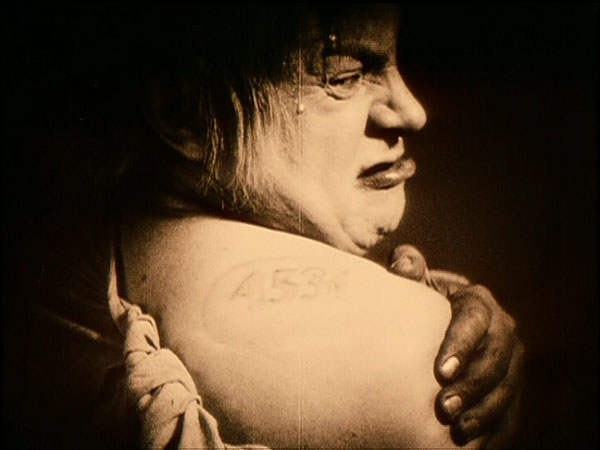
You wouldn’t think that the forbidding Emil Jannings lookalike Rosa Valetti (above) would get many movie roles, but you’d be wrong - she was in a bunch of high-profile films including M and The Blue Angel. Werner Krauss, in the not-too-exciting role of the deceived Mr. Orgon, had early played Dr. Caligari himself, and would later play an evil jew in a nazi propaganda film - ouch. Jannings, who would do his most famous work for Murnau, and Lil Dagover (star of Destiny, The Spiders and Phantom), who were excellent here, both appeared in nazi progaganda films during WWII portraying the brilliance of Otto von Bismarck, leader of the second reich.

M. Bailey: “Murnau was wise enough to realize that silent cinema had no capacity to do justice to the acid wit of Molière’s flawless alexandrines (not a single line from the play remains intact in the film), so he made a special effort to ensure that the satiric humor was translated visually. This is accomplished through sprightly editing, comedic use of extreme close-ups, sight gags, and the arch performance (occasionally tipping over into hamminess) of Emil Jannings.”
image

The Murnau Institute’s documentary included on the disc, with its illustrations and comparisons, is greater than any audio commentary could have been. Reminds me of that condensed, informative documentary on Letter From an Unknown Woman, also a British disc… maybe I should watch more of the doc supplements on my DVDs.
Tags: , , , , ,

Comments

Belle toujours (2006, Manoel de Oliveira)

“It’s in my style as homage to Bunuel’s style which is very different.”

Very spare, a couple talky dialogue scenes but mostly quiet, with pillow shots of Paris at night between scenes. Opening titles at the symphony, Husson spies Severine, out to the street, to a bar. Her hotel, a near miss. Back to the bar, Husson confesses what’s on his mind to the bartender - this scene must contain over half the dialogue of the film. Another chance meeting on the street, an invitation to dinner. At dinner Severine wants to know one thing, but Husson plays around, doesn’t tell her. She storms out. A chicken! He pays the servers from her forgotten purse, they clean up after he has left.

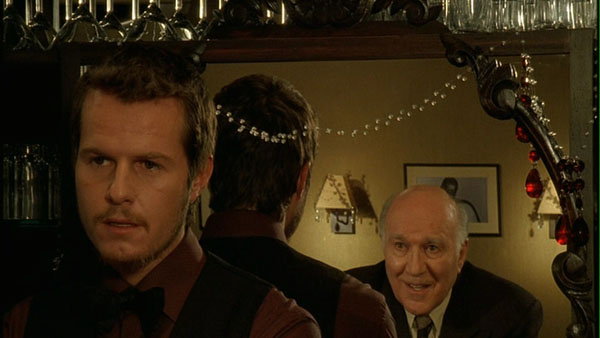
Piccoli (right) with the director’s grandson Ricardo Trêpa
image

Bulle Ogier also acted in Bunuel’s Discreet Charm
image

Piccoli, reprising his Belle De Jour role, was in a pile of other Bunuel films
image

N.D. Carlson of Cineaste has a compelling explanation for every part of the film: why it works and what it means… a wonderful analysis.

Sam, as usual, sees something I don’t see, even when I’m seeing what he saw, since it was his favorite narrative film of the year.

M. Dargis calls it “an act of critical violence.”

J. Rosenbaum calls it a “sequel–or tribute, or speculative footnote … more about class and less about sexual desire”

M. Piccoli: “Very often, cinema is indecent. What characterizes Manoel de Oliveira and Bunuel is their reserve. But don’t get me wrong: this reserve allows them to explore the most secret gardens of our existence. They are very modest but very immodest when it comes to shaking the imagination of the audience.”

image

Tags: , , , ,

Comments

La Belle Captive (1983, Alain Robbe-Grillet)

“Do you know, sir, that most of the people you see in the street are dead? That’s why it’s crowded everywhere. And to avoid making a fuss they dress like us.”

Pretty-looking Daniel Mesguich (of Truffaut’s Love on the Run and a mid-70’s Kafka movie) works for motorcycle-drivin’ Cyrielle Clair (Tusk, Triple Agent). Goes off on an assignment one day but the client turns up dead and Daniel gets himself mixed up with Inspector Daniel Emilfork (the dream-snatcher in City of Lost Children) and often-nude vampire ghost Gabrielle Lazure. Movie gets increasingly dreamlike and plot gets increasingly Twilight-Zone-ish, guy starts seeing himself executed at the order of his boss, then he wakes up next to his wife (the boss). It was all a dream! But he’s still stuck in it, sees the girl again, gets executed again, etc.

“The angel of death. Nobody can guess what it looks like. And when you see it for the first time you can’t tell. It has a sweet and caring face. But when you know what’s behind it, it’s already too late.”

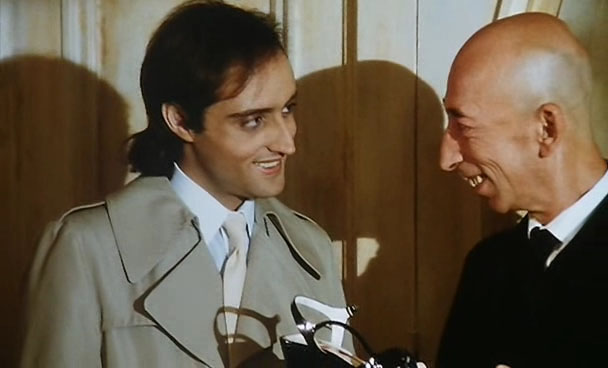
The two Daniels. Left: our sleepy-eyed hero in his just-pressed coat, right: mad scientist Emilfork gleefully presenting the Bunuelian shoe/foot motif that will run throughout the film.
image

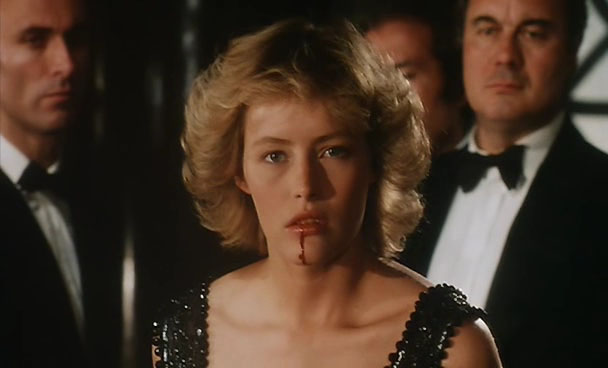
Our vampire, looking a little tired.
image

The angel of death, aka our hero’s wife/boss.
image

I liked the Schubert music a lot. Cinematographer Henri Alekan shot Wenders’s Wings of Desire and Cocteau’s Beauty and the Beast. For the most part, movie looked very good, though the dreamy artificiality and theatrical lighting gave it a made-for-TV look at times. Came out the same year as Sans Soleil, Stranger Than Paradise, Resnais’s Life is a Bed of Roses.

Seems that Robbe-Grillet’s lofty ambitions for a new cinema were let down by his own limitations as a filmmaker - the sets and costumes look cheap, and the low-rent actors don’t give the movie enough energy. Sometimes, like one moment when the screen fills with horrid video effects, you feel that it looks cheap on purpose, that it’s some weird French commentary on cheap-looking movies. And if it’s all a dream, it’d make sense that the actors are sleepwalking. Found a great article online by J. Clark explaining more about the author, his inspirations (movie is based very loosely on his own novel, almost a sequel to it, in posthumous “collaboration” with the painter Magritte) and collaborators and failures. Clark also makes some Twilight Zone comparisons. But I don’t want to beat up on it too much. Alain R-G might not have created a masterpiece, but the movie was cool and worth watching - for the tableaus, the nudity, the atmosphere, the moments of WTF acting/story/imagery. Witness below.

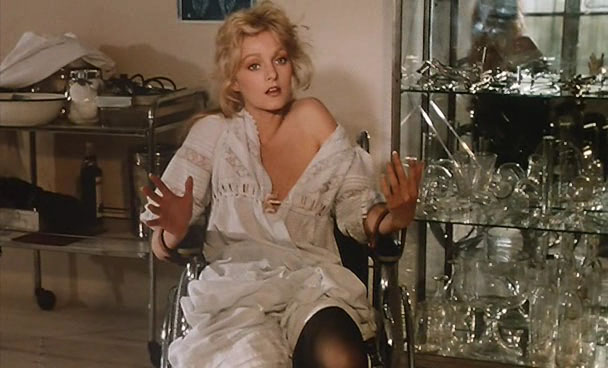
The aforementioned nudity.
image

Along with more footwear, our hero finds the source novel in a cabinet.
image

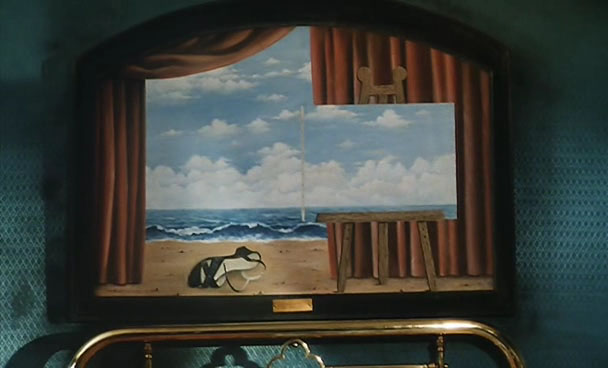
A Magritte original (?)
image

A Robbe-Grillet original (?)
image

Firing squad on the beach
image

One goofy actress.
image

Some kinda Terry Gilliam greenscreen/video lunacy takes over for a minute.
image

Sight & Sound explained:
“It shares its title and intent with his 1975 experimental novel, co-credited to surrealist painter René Magritte, which reworked texts originally written for two earlier novels, Topologie d’une cité fantôme and Souvenirs du triangle d’or, into a new narrative, illustrated by 77 Magritte paintings reproduced in black and white. Whereas the book could be read as a dialogue between Magritte’s surrealist canvases and the author’s imagination, the film tells a different story, in which Magritte’s paintings also figure, though not exclusively: Goethe’s telling of the Greek legend of the Bride of Corinth and Manet’s The Execution of Maximilian also intrude into its dream weaving, as does Jean Cocteau’s depiction of the Angel of Death as a motorcyclist in Orphée, an earlier work of cinematographer Henri Alekan.”

B. Stoltzfus:
“What characterizes [Magritte's] La Belle captive series of paintings is the undecidability of the image. Each one of the six canvases contains an easel that holds a painting within a painting, a procedure that establishes specular duplication with mise-en-abyme effects. The painting on the easel replicates the landscape beyond it and the internal frame breaks the continuity of the image while accentuating it. Although the background and the foreground overlap, the perspective is impossible. Is the canvas transparent or opaque? Are we looking through it at images in the distance or are these images in front of us. This ambiguity sets up a visual paradox that cannot be resolved and the undecidability of the perspective elicits epistemological and ontological concerns in the mind of the observer.”

J Clark:

Explanation: “The world of his novels and films eschews plot and conventionally ‘well-developed’ characters in favor of recurring images of surfaces and objects, which his narrators incessantly catalog almost everything around them.” Sounds almost Greenaway-esque.

Judgement: “Cumulatively, this is a failure of Robbe-Grillet providing himself with the essential materials of his art: performance, image, sound, design. Instead of transforming the real world into something enigmatic, as he does in his novels or in Last Year at Marienbad, everything just looks ordinary, under-dressed, and with no resonance. Although Robbe-Grillet seems to be going for an interesting amalgam of pop culture (film noir, vampire movies) and high art (the New Novel aesthetic), neither is realized with sufficient depth.”

And my favorite single-sentence summary: “Robbe-Grillet transgresses ‘realistic’ narrative by eliminating character, story, and chronology.”

Ouch, this just in, Aug 2008 from A. Tracy at Moving Image Source:

“To discover Robbe-Grillet for the first time… is simply to uncover yet another little niche of world cinema: not uninteresting, more than a little entertaining, and entirely removed from that grandness of intention that even the most jaded cinephiles secretly thrill to.”

Tags: ,

Comments

Manufactured Landscapes (2006, Jennifer Baichwal)

Incredible movie that I feel terrible for not having seen in theaters. So many wide shots with super-fine detail of masses of people or rock or industrial waste, and that detail is wasted on my ridiculously outdated 480-line interlaced TV screen. Affordable hi-def can not arrive quickly enough.

Watched this right after Derrida, and it seems they had some of the same intentions with the music in the two films (Derrida had music by Ryuichi Sakamoto, who scored Tony Takitani and various De Palma films, and won an oscar for The Last Emperor), but I loved the music far better in this one (music by first-timer Dan Driscoll, so that shows what I know). As for the image, well it’s unquestionably great, and fascinating. The filmmakers follow photographer Edward Burtynsky, who shoots monumental landscapes that have been formed by human interaction - factories, strip mines, the Three Gorges dam. Unlike 99% of documentaries about artists, the rest of the film is just as nice as the photographs, as the filmmakers have an eye for composition and are more interested in learning about the subject matter of the photographs than asking the photographer dumb questions about his art. Political and conservation issues are obviously brought up, given the scale of manmade environmental change visible in the film, but we don’t spend too much time debating those with talking-head experts - movie is mostly content to show us the landscapes (in places that most people never see - not exactly hot tourist spots) and let us see for ourselves. The result is a constantly surprising and gorgeous work, which I will gladly watch again when we can get a higher-res copy.

Katy was disappointed because she thought this was the movie about the guy who shoots whole bunches of naked people (that would be Naked States and Naked World, both about photographer Spencer Tunick). But she liked it anyway, just not as much as I did.

Tags: , ,

Comments

Derrida (2002, Kirby Dick & Amy Kofman)

Derrida seems like a very interesting guy who does very interesting work. Directors Dick and Kofman, however, do not. The Singing Revolution may have been a mediocre movie about a thrilling topic, but this was an outright bad movie about a topic that’s only interesting if properly explained. Derrida getting dressed for work and refusing to answer interview questions doesn’t give us great insight into his philosphy and only reflects badly upon filmmakers who only have 80 minutes to tell us about this supposedly documentary-worthy, world-renowned thinker. Reading excerpts from Derrida’s books is a good start, but having the excerpts read dryly by a narrator over unrelated images wasn’t the way to go. In the interview included on the disc, Derrida doesn’t seem to know why he’s there, and his first statement is that he never wanted to be involved. The music wasn’t great either. Ultimately, this movie should’ve been a pamphlet or a magazine article… its value as cinema is pretty low. I’ll take Zizek any day.

Tags:

Comments

The Mystery of Picasso (1956, Henri-Georges Clouzot)

Music by Georges Auric, who also scored Cocteau’s movies. Shot by Claude Renoir, who also shot a handful of his uncle Jean’s films and also Barbarella. Director Clouzot made this between a mystery thriller and a spy parody.

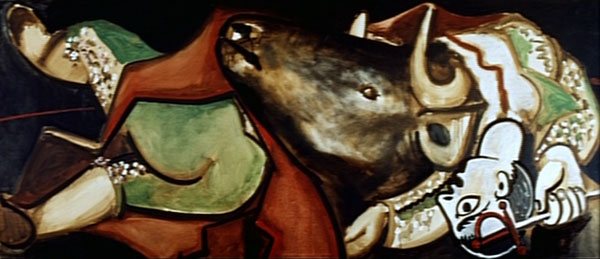
A nice companion movie to La Belle noiseuse, another one where we actually watch a painting being created in real time. The movie introduces Picasso, then cuts to a full shot of a transparent canvas, Picasso’s brush (or pen, whatever) on one side, the camera on the other, so there are a few over-the-shoulder shots but mostly we’re seeing (a mirror image of) the canvas with the painting magically appearing upon it. There are edits and time-lapse too - areas of wet paint dry in an instant, whole areas of color or pattern suddenly appear. Sometimes we’re clearly watching a painting from start to finish in real time, and sometimes they’ll tell us in voiceover how long it actually took.

There’s no narration - rather what little verbal information we learn is in the form of (obviously staged) conversations between artist and camera crew. My favorite bit is when Picasso asks for a very large canvas and suddenly the movie goes into Cinemascope ratio (’scope was less than three years old, so still a cool novelty).

It’s a suspense/art film as you watch the work in progress and try to wonder what PP is planning, where the painting is heading (even he doesn’t seem to know half the time), and when it’s “done”. The wonder of this film is that the paintings exist through time - most of them look great when complete, but the process and intermediate steps are just as great… you’re not just waiting for good art to appear at an unknown end point, you’re watching it all along. The filmmakers keep it short (<80 minutes), the music styles vary greatly between paintings, and there are some bursts of crew participation, like the time they pressure PP to finish a painting before their reel of film runs out.

What a great movie! My favorite of documentary month. Katy and Jimmy liked it too.

image

image

image

image

Tags: , ,

Comments

The Singing Revolution (2006, Maureen & James Tusty)

Estonia was invaded by Russia, then nazis, then Russia again. It sucked for them, but they had music in their hearts and joined for an annual concert to celebrate their heritage. Eventually they became free again, hoorah!

Katy has been listening to me whine about film technique for so long that it’s gotten to her. Even though this is a heartwarming documentary about strong, likeable people fighting and winning back their rights and their country through nonviolence and music, we had to grudgingly agree that it was a kinda crappy documentary, made with passion but made by amateurs.

One awesome scene, especially after having just watched Grin Without a Cat, a movie full of global violent protest, featured the Estonian congress building surrounded by anti-independence Russian groups, residents who had grown up in Estonia after being forcibly relocated there a generation earlier by the USSR to more fully integrate their empire. The government sent out a call for help on the radio, and the Russians found themselves surrounded by absolute hordes of Estonians, at which point they gave uo their quest for revolution and just wanted to escape. The Estonian crowd parted, the Russians left. No screaming or hitting, no rocks or bombs thrown, just piles and piles of people coming out to demonstrate for their independence.

Tags: ,

Comments

Casablanca (1942, Michael Curtiz)

Ahhh, Casablanca at the nearly-packed 4600-seat Fox Theater. Katy liked it!

Ingrid Bergman had been in Hollywood three years, and it’d be eight more before she met Robert Rossellini. Bogart owned the 1940’s, had already done Maltese Falcon and High Sierra. Police chief Claude Rains would play Bergman’s evil husband four years later in Notorious. Her husband in this movie, underground war hero Paul Henreid, didn’t appear in many other interesting films, but directed a whole bunch of Alfred Hitchcock Presents episodes. Nazi chief Conrad Veidt died a year after this came out. Dooley Wilson (Sam), would’ve been higher than tenth-billed if he was white.

Opened with Rabbit Seasoning from 1952, a full decade later. What, Blitz Wolf and Tulips Shall Grow from 1942 weren’t available? Or one of the Bogart-parody Looney Tunes? I have more imagination than the Fox programmers. A one-joke short, but it’s an enjoyable joke. The crowd loved it.

Tags: , , , , ,

Comments

Mr. Death (1999, Errol Morris)

Engineer Fred, who spent his whole year around prisons (his father worked there), offers to design a better electric chair. He does, it works. Fred proclaims himself an electric chair expert, makes more chairs for other states. Soon he’s got contracts for a gallows, a lethal injection machine, and a gas chamber. Fred proclaims himself an expert at all execution apparatuses. Soon he is asked to join the legal defense team of a holocaust denier and travel to Auschwitz to determine whether there were gas chambers present. Not knowing a goddamned thing about history or chemistry, Fred goes to Auschwitz and looks around, does some severely flawed chemical tests looking for arsenic, and notes that these buildings (in their ruined 1990’s state) don’t even have DOORS! You can’t very well expect to contain poison gas without doors. So Fred decides that since he is an expert at all matters concerning execution, and since he doesn’t see how there could’ve been gas chambers here, the holocaust must’ve not happened. Suddenly nobody wants to be associated with Fred, so he stops getting engineering contracts and instead gets lawsuits and offers to speak at neo-nazi gatherings.

Kind of a sad movie, about death and denial. Morris uses re-enactments to dramatize Fred’s career, provide some visuals to all the interviews… which is fine, but I could’ve done with about ten minutes less slow-motion footage of chiseling bits off walls at Auschwitz. I liked it - Katy did too.

Tags: , , ,

Comments

Grin Without a Cat (1977, Chris Marker)

“Why sometimes do images begin to tremble?”

From the film:

1967 saw the arrival of a rather peculiar breed of adolescents. They all looked alike. They would immediately recognize each other. They seemed to posses a silent but absolute knowledge of certain issues but to be totally ignorant about others. Their hands were unbelievable skillful at pasting up posters, handing paving stones, spraying on walls short and cryptic messages which stuck in the memory, all the while calling for more hands to pass on the message they’d received but had not completely deciphered. Those fragile hands have left us the mark of their fragility. Once they even wrote it on a banner. “The workers will take the flag of struggle from the fragile hands of the students.” But that was the following year.

image

Watched the 3-hour 2008 edit with English narration. There are so many versions of this out there… maybe next time I can watch the 2008 or 1977 French with subtitles.

I thought I’d have more to say about it… three hours’ worth of Chris Marker’s most celebrated film, but I don’t really. Marker is mainly credited as an editor here, arranging others’ footage to show a bigger picture. There’s no wall-to-wall narration, just pops up occasionally. And I’m starting to notice a real sadness beneath many of Marker’s films… the same feeling in Chats Perches is present here. Glad I prepped a little by watching Sixth Side of the Pentagon and Battle of Chile, but I still had to check on wikipedia to see what exactly happened in Bolivia (Che Guevara killed Oct. 1967) and Prague (Jan-Aug 1968, attempted reform of Czech socialism led to 30 years of Soviet military occupation). The movie isn’t here to teach basic history of revolution - assumes you know something already, and since I quit reading The People’s History of the United States before it reached the 1900’s, I do not. Still, was able to follow the movie, thought lots of the footage was excellent, enjoyed watching and learned a little. Some segments have little gems of Marker wit in their editing or narration, but much of it is making connections between different scenes of revolution, both real and wishful, and thinking about what has been achieved, what might have been achieved. Really have to watch again sometime.

image

Either this was an early use of the electronic soundtracks that Marker would use in Sans Soleil and beyond, or the sound on my copy of the movie was pretty badly distorted. Or, more likely, both. The sound got worse during part two - there were some sections when I couldn’t make out any of the (English) dialogue.

image

Video and audio footage by: Pierre Lhomme (Mother and the Whore, Le Joli Mai, Army of Shadows), Etienne Becker (The Spiral, Le Joli Mai, Malle’s Calcutta), Michele Ray (Latcho Drom), Francois Reichenbach and his crew, Harald & Harrick Maury (The Owl’s Legacy, Day For Night, In the Year of the Pig), Théo Robichet (Band of Outsiders), Pierre Dupouey (Silence… on tourne), Raymond Adam (Jodorowsky’s Tusk), Paul Bourron of the Dziga Vertov Group, Willy Kurant (Far From Vietnam, Masculin-Feminin, Pootie Tang), Peter Kassovitz (Jakob the Liar), Paul Seban (Welles’s The Trial), Michel Fano (Rivette’s The Nun), Fernand Moskovitz (Last Tango in Paris), Yann Le Masson (Je t’aime moi non plus), Mario Marret & Carlos de los Llanos (À bientôt, j’espère), Jimmy Glasberg (Sans Soleil, Shoah), Robert Dianoux (Africa, I Will Fleece You), Jean Boffety (Thieves Like Us, Je t’aime je t’aime, Adieu Philippine), Robert Destanque (Joris Ivens’s The Threatening Sky), Hiroko Govaers (Terayama’s Fruits of Passion), Michel Cenet (Celine and Julie Go Boating), and an excerpt from Volker Schlöndorff’s The Lost Honor of Katharina Blum. That is quite a list of collaborators, though you never hear anyone talking about them.

image

English voices: Jim Broadbent (Brazil), Cyril Cusack (Fahrenheit 451), Robert Kramer (dir. Ice, Against Oblivion), Alfred Lynch (The Hill), and numerous British 1970’s TV actors.

“You can never tell what you might be filming.”

Quotes and other reactions:

Icarus Films calls it an “epic film-essay on the worldwide political wars of the 60’s and 70’s: Vietnam, Bolivia, May ‘68, Prague, Chile, and the fate of the New Left.”

image

J. Hoberman: “Marker begins by evoking Battleship Potemkin, and although hardly agitprop, A Grin Without a Cat is in that tradition—a montage film with a mass hero. Unlike Eisenstein, however, Marker isn’t out to invent historical truth so much as to look for it. (The untranslatable French title, Le Fond de l’air est rouge, is a play on words suggesting that revolution was in the air but not on the ground.)”

Paul Arthur: “In its rhythms and editing structures, Grin tries to embody the very shape and textures of historical transformation, rendering the abstraction of change as an amalgam of rapid, plurivocal, uneven, and, at times, contradictory forces aligned in provisional symmetries encompassing past, present and future perspectives.”

image

Y. Meranda: “The editing de-emphasizes the narrative structure and instead stresses the poetical interrelationships of the sequences by putting almost all of them out-of-context. … Paralleling the visual editing, the sound editing is more based on poetical considerations than on intellectual ones. … Because there is very little attention paid to the intellectual arguments and because the style goes beyond making statements about a political ideology, A Grin Without a Cat becomes much more than a left wing documentary about the left: It achieves to be a poem about revolting against the system (and not just the political system), the conformity and the order. It suggests that it is an eternal struggle that is supposed to fail (as was in the case of the New Left) most of the times. This universality, achieved by Marker’s distinctive style, is what makes the film great.”

image

Excerpts from the Lupton book:

“Marker explicitly pitched the film against what he saw as the historical amnesia surrounding the period promoted by its treatment on television, where ‘one event is swept away by another, living ideals are replaced by cold facts, and it all finally descends into collective oblivion.’”

Movie is partially composed of outtakes from other projects. “Introducing the published script, Marker wrote that he had become curious about all the material that had been left out of militant films in order to obtain an idealogically ‘correct’ image, and now wondered if these abandoned fragments might not yield up the essential matter of history better than the completed films.”

“As a groundbreaking work of visual historiography, Le Fond attempts nothing less than to give cinematic form to the chaotic and contradictory movement of world history during the tumultuous decade that it covers.”

“The reappearance of cats, even in this thoroughly politicized context, is a signal that Chris Marker was beginning to re-emerge from the anonymity of unsigned militant productions and to reintroduce into his work the familiar tokens of his own distinct presence.”

image

Chris Marker:

Scenes of the third World War 1967-1977

Some think the third World War will be set off by a nuclear missile. For me, that’s the way it will end. In the meantime, the figures of an intricate game are developing, a game whose de-coding will give historians of the future - if they are still around - a very hard time.

A weird game. Its rules change as the match evolves. To start with, the super powers’ rivalry transforms itself not only into a Holy Alliance of the Rich against the Poor, but also into a selective co-elimination of Revolutionary Vanguards, wherever bombs would endanger sources of raw materials. As well as into the manipulation of these vanguards to pursue goals that are not their own.

During the last ten years, some groups of forces (often more instinctive than organized) have been trying to play the game themselves - even if they knocked over the pieces. Wherever they tried, they failed. Nevertheless, it’s been their being that has the most profoundly transformed politics in our time. This film intends to show some of the steps of this transformation.

More images:

image

image

The Chairman:
image

Funeral in Prague:
image

Last footage ever shot of Salvador Allende:
image

Allende’s daughter, who would commit suicide in 1977:
image

Fidel in Russia:
image

Enormous cats (no owls):
image

Nixon looks on:
image

Tags: , , , , , , , , , , , , , ,

Comments

2046 (Wong Kar Wai, 2004)

image

My pick for film of the decade, so far.

image

Tags: ,

Comments

Elizabeth 2: The Golden Age (2007, Shekhar Kapur)

The latest bit of historical bio-pic entertainment from Kapur (dir. of Bandit Queen, ugh). And it’s not great. One huge weakness is the writing. The writer of the original was here joined (very unsurprisingly) by the writer of Gladiator, so we’ve got very fakey-Hollywood-period-pic dialogue. Katy says this movie defeats the ending of part one, which showed Elizabeth’s transformation into the powerful virgin queen, by having her act all girlish and weak and man-crazy over the (admittedly dreamy) Clive Owen. Owen plays Sir Walter Raleigh, and Abbie Cornish (Stop-Loss) is a lady of the court who ends up with Owen after being practically thrown towards him by the Queen who wants to vicariously experience love, but the queen flies into a rage when Raleigh and the court girl marry. Most of the movie is concerned with this love triangle, but Spain also forms their Armada and attempts to conquer England before being singlehandedly defeated by Clive Owen. We also get a miniature version of the Mary Queen of Scots story (first filmed in 1895, updated in ‘71 with Vanessa Redgrave, soon to be updated again by Phillip Noyce & Scarlett Johansson), played here by the great Samantha Morton.

So yeah, we’ve got Clive Owen, but all he does is look dreamy and act cool, even during battle scenes. We’ve got generic loud symphonic music, some bad CG effects and some confusing storytelling. But there are also very good performances (Blanchett, Morton) and some plain-good ones (Geoffrey Rush, Spanish ambassador William Houston), awesome (oscar-winning) costumes, great set design, but nothing tying it all together. Katy didn’t like it either, so I’m free to complain all I like.

Apparently the same love-triangle story was previously filmed as 1955’s The Virgin Queen with Bette Davis and Joan Collins.

Tags: , , , , ,

Comments

Flight of the Red Balloon (2007, Hou Hsiao-Hsien)

My third feature by the celebrated Hou. I only half enjoyed/understood the other two, Goodbye South, Goodbye and Flowers of Shanghai, both seen on video, but I appreciated his short The Electric Princess Picture House. So I didn’t know what to think going into this, and neither did anyone, probably, seeing how it’s in French and a semi-remake of a 30-minute children’s classic. Hou’s pacing seems more suited to the big screen than home viewing, so I’m glad it played the Landmark, and Jimmy and I (who saw The Red Balloon together in the same theater earlier this year) both enjoyed it.

Juliette Binoche is a harried puppeteer mother, Simon Iteanu is her son, Hippolyte Girardot (Lady Chatterley, La Moustache) is the downstairs neighbor, and Fang Song is the kid’s new nanny. Song is an aspiring filmmaker with a handicam who loves the film The Red Balloon. Bleach-haired Binoche once worked as an au pair, feels abandoned by her husband, wants to kick out her downstairs neighbor so her older daughter can visit this summer (but can’t find the lease contract), and does marvelous voices for the Chinese puppet show she is directing. Simon seems like a happy kid, takes piano lessons, plays pinball, has a loving relationship with his absent older sister (seen in flashback, she cancels her annual summer trip to Paris late in the movie).

Then there’s the balloon. Simon sees it at the beginning and it follows him on the subway, then to his home and on a class field trip. Song sees it at one point, also… but neither of them ever touches it. It may just be a symbol of imagination, and not a real balloon at all. The camera moves slowly, fluidly, always seeming to hover balloon-like instead of resting, and blobs of red (clothing hanging to dry, a lamp) are often hanging in the frame when the balloon itself is absent.

Just as I was noticing the long length of the shots, a bus with a large Children of Men advertisement drove by - nice. Shot by the cinematographer of most Hou films, Pin Bing Lee, who also did In The Mood For Love with Chris Doyle. Score is light piano music (all staticky on our print), and it closes with the Bobby McFerrin-sounding song from the trailer.

None of these descriptions do justice to the film, which I’m starting to think is one of the few great films I’ve seen this year. Peaceful and calming to watch despite being set mostly in a cluttered, loud, claustrophobic apartment, there’s just enough story/character/action to play upon every emotion in the book without leaning too hard on any of them, leaving me feeling like I’ve experienced & felt so much within such a minimal framework. The characters aren’t desperate, but they don’t have an easy time either. One review described Binoche as a mother under siege, and with all that’s going on around him, Simon’s childhood is under siege too. But even while portraying conflict, the movie manages to ooze joy - so much joy that it’s put a major dent in my plans to watch all the commerce-driven Hollywood product out this summer. How could The Incredible Hulk compare?

Tags: , , , , , ,

Comments

Eraserhead (1977, David Lynch)

“Look at my knees. Look at my knees!”
image

Things I’d forgotten about Eraserhead:

The curled insect-ring Henry gets in a tiny box in the mail and puts in a cabinet:
image

The sequence of events leading to the eraser factory. Henry enters the radiator, stands behind a railing, the baby’s head pops out of his neck, knocking his adult head on the checkered-floor ground. Blood pools, head falls into the pool and splats onto the street outside. A bum looks interested, his arm outstretched, but a boy grabs the head and runs, enters the factory. A man (Paul, below left) anxiously presses a buzzer until a bearded man (below right) comes out pointing his finger “OKAY, Paul!” Bearded man takes the boy into the back room where the eraser technician tests the head. “It’s okay.”
image

Kinda felt like I was going through the motions as cinephile and Lynch-fanatic going out by myself to watch Eraserhead on 35mm on the big screen… but WOW was it ever awesome. Such beautiful dark, dark imagery, and amazing to see it as intended sitting in a dark theater away from the comforts of home. Movie is a nightmare - that’s the most accurate description I can think of. Sure it’s a “horror film” among other things, but more importantly it is the closest thing I’ve seen to an actual filmed nightmare. There are no “dream sequences” because there’s no reality… the whole film follows a fascinating dream logic.

Made 30 years ago now. Mary’s mother Jeanne Bates (who also appeared in Mulholland Dr.) died last year. Sound man David Splet (who also worked on Days of Heaven and four other Lynch films) died in ‘95. The actor who played Paul at the eraser factory, also in two John Carpenter films around the same time, died in ‘98. Everyone else seems to be doing fine, but I also learned that assistant director Catherine Coulson later played the Log Lady on Twin Peaks, and co-cinematographer Fred Elmes (also shot five other Lynch movies and films by Cassavetes, Jim Jarmusch, Albert Brooks, Ang Lee, Mira Nair, and Charlie Kaufman’s new Synecdoche New York) is the only person listed on the whole IMDB to be born in Mountain Lakes, NJ. A hometown celebrity - and it’s a GOOD one!

Jack Nance was murdered Dec. 30, 1996. His final film was Lost Highway. Despite the IMDB’s claims, he’s not the same Jack Nance who co-wrote “It’s Only Make Believe” with Conway Twitty… wake up, IMDB.
image

Jack Fisk (below), alive and well and married to Sissy Spacek, has been production designer / art director on all four Terrence Malick films, two by De Palma, two by Lynch, and There Will Be Blood - an impressive career!
image

Tags: , , ,

Comments

Sex and the City (2008, Michael Patrick King)

As Katy said, it’s like a whole new season packed into 2.5 hours. I liked the mexican vacation / food poisoning episode, and the Christmas one where Carrie watches Meet Me In St. Louis, but the others were ehhh. Not any better or worse than sitting down with the series for that long. Of course this means that the S&TC Movie is less damaging to the S&TC legacy than the new Indiana Jones movie is to its own series legacy. Jennifer Hudson was shoehorned into the plot, so now I’ve seen half of her movies.

Tags:

Comments

« Previous entries