A pretty simple story. Charles Farrell goes to the city to sell the family wheat before the harvest, falls in love and marries Mary Duncan on his way home. Father on the farm is pissed about the low wheat price his son got, and is a huge grouch about Chuck’s lowly waitress wife. Storm is rolling in, destroying crops in other states, so Father works the reapers all night, but slimy Mac sees the family discord and aims to run off with Mary. She leaves, Chuck follows, Dad shoots at them, then everyone forgives everyone else and continues to harvest.

Thing is, it’s just one of the most beautiful films, definitely up with Sunrise and Lucky Star.

The city girl’s hair reminds me of the question-mark on the head of a guy in Sweetie, only in this case, hopefully unintentional, her forehead reads “666”

Chuck Farrell is his usual winning, unmemorable-looking self. I wasn’t sure about Mary Duncan in The River – she seemed a little one-note – but she’s wonderful here and extremely different from her River character. Seems like she could’ve gone further than Farrell’s usual sweet-faced co-star Janet Gaynor in the acting business, but Duncan retired in ’33, five years before Gaynor.

Murnau’s second-to-last film before Tabu. Murnau wanted to title it Our Daily Bread, and had scenes and scenery in mind which the studio denied him. The movie came out in a now-lost sound version and in a version similar to this – not sure exactly how similar, or how much is known about its history, but the booklet with the Masters of Cinema DVD would probably explain some things. Production-designed by Edgar Ulmer, and based on a stage play with a funny title which everyone online mentions as if it’s still important.


Murnau dwarfs the family, hunched at bottom of the frame when father first enters. The little girl, Anne Shirley, had been in pictures since she was four, would be oscar-nominated for Stella Dallas seven years after this.

The workers, L-R:
– Guinn “Big Boy” Williams of Lucky Star, here a pretty good guy with a pretty small part
– creepy-looking Jack Pennick of every John Ford film, whose only role here is to look creepy
– baddie Richard Alexander, who kept busy playing tough-guy extras for the next 30 years

Father: David Torrence is best known, well, for having a more famous brother. Ernest Torrence had some major silent roles (Steamboat Bill Sr., Captain Hook), played Moriarty in an early sound Sherlock Holmes the year before he died. David was in some Michael Curtiz films, anyway.

A Danks:

City Girl’s bond to Sunrise is one of its most fascinating elements. In its opening movements it is as if the film evokes a key plot element of Sunrise (an innocent country boy, Lem (Charles Farrell), is approached by a “vamp” on a train ride to the city) only to then diverge from and invert it (he immediately rejects her). As in Sunrise, the city is presented as a dynamic entity defined by and constructed around movement and a curious modernity; but it also projects a subtle desperation and palpably melancholy quality new to Murnau’s cinema. It is also the home of Kate (May Duncan), the “city girl” of the title who longs for a romantically idealised country life and who subsequently emerges as one of the strongest and most clear-eyed female characters in American silent cinema (presenting a clear reversal of the moral universe – and characters – of Sunrise). It is through Kate that we experience the continuity of the city and country in City Girl, the archetypes of perception and oppression, and the parallel social structures and prejudices that fuel both worlds.

Everybody mentions Days of Heaven as a comparison, and Danks throws in The Wind.

Impressive revenge flick, building slowly to an excellent conclusion. Mostly static camera, no music at all, but these things don’t call attention to themselves like they do in, say, In Vanda’s Room, because of the propulsive drama.

Alex, a mustache ‘n sideburns-wearing ex-con who’s not as tough as he acts (according to his boss, who runs a brothel) has a secret love affair with Ukranian prostitute Tamara. Things are heating up, both of them are in debt and her boss is trying to move her to an apartment to cater to politicians and others who consider themselves too important to visit a brothel. When the boss hires a guy to beat up Tamara it’s the last straw, and Alex scoops her up to leave town, stopping in the small town where his grandfather lives to rob a bank he’d “staked out” (located an alley as an escape route, not very careful planning). But a cop notices the car and asks questions, then shoots as Alex drives away, killing Tamara.

Thus begins the revenge portion. The cop, Robert, is depressed over the death and only gets worse as he gets suspended from work while they investigate the shooting. They’ve got no leads, so Alex is safe, stays in town chopping wood for his grandfather and plotting how to kill Robert, eventually having an affair with the cop’s wife and deciding not to kill the guy after all. Oh and the wife has been trying to get pregnant but can’t manage with Robert, so guess what happens. Kinda sounds cheesy when you write it down, but I liked it an awful lot.

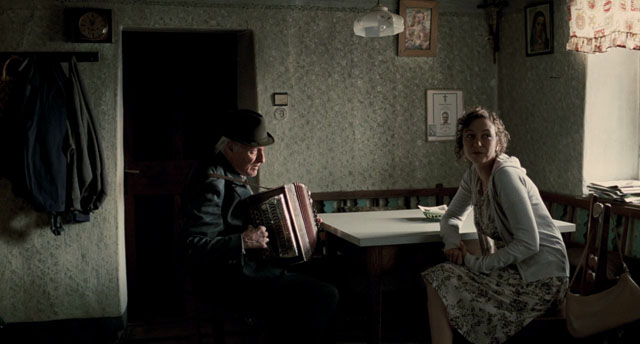
Accordian lover Hauser with Robert’s wife Susi:

A rarely moving camera, and zero music. The brothel meister was in Fassbinder’s Querelle, otherwise cast and crew are unknown to me. The combination of the young cop and the lead guy’s relationship with his decrepit father reminded me in flashes of Hunger, and the backlit wood-chopping scenes recalled flashbacks in Cache.

Criterion scares up comparisons to Kieslowski, Antonioni and Bergman in reviews.

A. White:

Although Revanche is Spielmann’s first film to be released in the United States, it is actually his fifth overall, so his style and tone come to us fully developed. He began his career as a playwright, yet Revanche is thoroughly cinematic in story, look, and pace.

Spielmann’s arrival on the American film scene is exciting for the way Revanche opposes the contemporary trend toward dark pessimism with a vision that contemplates light and, conditionally, belief. At one point, a repentant character is asked, “What would your God say?” and she answers, “He’d understand.”

White quotes the director: “Loneliness is probably an inextricable part of our modern lives, and yet I consider it an illusion. We always think of ourselves as being separate from the world, and in this way we deceive ourselves. This separation is just an invention of our imagination; in many ways, we are constantly and directly interwoven in a larger whole. Loneliness is an attribute of our limited awareness, not of life itself.”

Romero is just making mediocre genre movies and putting zombies in ’em now. This one’s a dumb 80’s actioner (buncha dudes act tough and spit bad dialogue punctuated by explosions) crossed with a silly-ass Irish family-feud revenge drama… with zombies in it. Shamus Muldoon is warring with Patrick O’Flynn on a small island off Ireland Delaware. One wants to kill all the local zombies, the other wants to keep ’em around attached to chains, like the last few minutes of Shaun of the Dead turned into a pretend-serious idea… “pretend” because whenever the drama threatens to get heavy, the movie throws in some cartoony business to show it’s all in good fun. The comedy destroys the drama since the drama wasn’t so good to begin with. At least Land of the Dead had new ideas (the zombies starting to communicate and organize) and kept some of the satirical edge of the first three. The last couple have felt like GA Romero’s Cash-in of the Dead… funny, since they barely played theaters (but they look cheap as hell so surely still made a profit for someone).

The O’Flynn gang:

Oh yeah, so a four-man army-deserter group are in search of money (why?), team up with a mysterious teen (who turns out not to be mysterious), and follow an exiled O’Flynn back to the island (of the dead) to look for his twin daughters and fight Muldoon, who’s trying to make the dead learn to eat animals instead of people (why?). At the end, the lesson (told to us in voiceover) is that people fight each other for stupid reasons.

The only shot I really liked:

More than one actor in this was also in Boondock Saints II and the Saw series. Mysterious Teen appeared in Land of the Dead and played Rodrick in Diary of a Wimpy Kid. Our beardy hero was also in Land, and I’m pretty sure there’s a plot reference early on to Diary, but any connections to the other films seem like an afterthought. In competition at Venice, either because of that European tendency to fake-appreciate poor American genre flicks, or because they hadn’t seen the finished product when they allowed it in.

Hilarious cartoon explosion-aftermath:

Hilarious cartoon burning-head-used-as-cigarette-lighter:

Interlacing! Surly women argue over heroin. Nhurro takes a shower. Vanda sells lettuce. Bunch of one-shot scenes, disconnected from each other – I mean, they’re in the same neighborhood with some regular characters, but one doesn’t narratively follow the last. Sometimes the movie seems to be challenging me not to watch it, like when a man with a needle in his arm compares awful blood-clot stories with a friend, or when a girl will not stop scraping a tabletop with a razor.

S. Hasumi: “All of Pedro Costa’s shots have a vertical power that breaks the viewer free from the story’s linear cause and effect. The pleasure of exposure to that liberation has, ever since F.W. Murnau, been a privilege allowed only to film.”

It’s Carrefour!

Caught references to Cape Verde and to a woman who either sold, killed or abandoned her baby (the story is not well remembered – nothing around here is). Other than that, no Jacques Tourneur film-love or even a Wire bootleg on a boombox, just pure miserable reality. Of course it’s not exactly reality, as pointed out by the commentary – shots are staged, there were retakes, dialogue was thought out before the scene.

More than two hours in, Soon after the girls talk about their childhood in this neighborhood, when drugs weren’t around, or at least were better hidden, the song “Memories” is playing on a TV, cutting after the line “I remember the time I knew what happiness was.” What, is the movie belatedly remembering that it’s a movie? I didn’t enjoy the first half, thought it was getting worse, then felt increasing sympathy for it during the final hour.

Cyril Neyrat sees revolution while I struggle to stay awake and not to get annoyed:

Costa bought a Panasonic DV and went to Fontainhas alone, every day. Vanda and Zita had invited him into their room: “Come, you’ll see what our lives are really like. You used to ask us to be quiet; now we’re going to talk, you’re going to listen. That’s all we do, talk and take drugs.” Over six months, alone with his DV camera, a mirror he found on-site, and cobbled-together reflectors, Costa reinvented his cinema: facing the bed, he looked for frames and strove to master the light that came in through a single tiny window, as in a Dutch painting … After the six months, a sound engineer came to lend a hand from time to time. He recorded the girls’ speech, the murmur of Fontainhas, the sounds of the bulldozers and the mechanical diggers tearing the condemned neighborhood’s houses down one by one. The miracle of In Vanda’s Room is that of a new agreement between the world and the film, of a recovered equality between the two sides of the camera.

Costa reinvented a solitary, craftsmanlike cinema, operating at the pace of everyday life: going into the neighborhood each morning, looking, working, doing nothing, picking from the stream of life and energy flowing before the camera something that might give rise to a scene. And then repeat it, do it over—up to twenty times—until the beauty and the intellectual and imaginary power of a sculpted reality made dense and musical are revealed. With In Vanda’s Room, Costa strips cinema bare, but far from wallowing in an aesthetic poverty that would add to the humiliation of the underprivileged of Fontainhas, he rediscovers in this subtraction the aura of the great primitive and classic cinemas, and their ability to reveal and celebrate the beauty of the world, the beauty of sounds and colors, of a ray of light passing through shutters to illuminate three bottles set on a wood table.

“It looks like a film, it is a film in some sort of way,” opens Pedro defensively in the DVD commentary, before proceeding to tell us about the difficult sound work they did in post-production. “It’s a bit pretentious but the ambition with Vanda in sound, image, everything, was to recompose, offer, unveiling the secret that really doesn’t exist, going against the cinema-machine…” it’s a rambling commentary, but it’s a three-hour movie so there’s no hurry. It rambled me straight to sleep, twice in the first hour, so I finally gave up halfway through.

I figure since Zombie made the already kinda boring Halloween series even more boring by going nuts on the psychological back story, this sequel was his chance to cut loose, to make a proper slasher picture. But no, more psychological crap, more fuckin’ Dr. Loomis, and another undistinguished movie. This time instead of Michael’s background and trauma leading to his becoming an indestructible serial killer, we focus on sister Laurie’s Michael-caused trauma leading to her becoming a serial killer (one assumes – I’m not gonna watch part three).

Dourif, an island of cool in the horror-movie muck:

I’m glad to see Sheri Moon Zombie as Michael’s mom, but I’m not glad that she’s dead, appearing in Michael’s mind along with his own child self and sometimes a white horse (the psychological significance of which is spelled out by the opening titles). Also glad to see Brad Dourif, but I spend the whole movie feeling bad for him, since it’s bookended by the torture and almost-killing of his daughter two years earlier, and the final torture and killing of his daughter. Not even slightly glad to see Malcolm McDowell, but only because he’s playing Samuel Loomis, the least appealing regular character in any horror series.

McDowell admiring himself:

Picks up right where Halloween left off. The coroners truck carrying Michael hits a cow in the road, Michael wakes up and kills the surviving coroner, disappears for two years before rampaging back to Sunnydale or wherever on Halloween night to torment Laurie, who finally goes over the edge and kills (I hope) egomaniac Dr. Loomis.

Oh right, Haddonfield:

There’s an awfully long dream sequence (or WAS it) in a hospital where pretty much everybody is killed except Laurie. Lois Lane plays Laurie’s therapist, with a giant extremely-white-horse-looking inkblot painting on her wall, saying things like “he’s objectively dead, but he’s living in your mind and he’s living in your heart and your emotions.” Some movie talk: Brad Dourif gets excited over Lee Marvin and Cat Ballou. A dude gets his head stomped, and lotta people get killed from brutal, brutal pounding and knives aplenty. The girls’ slutty friend is predictably killed. Lots of unmotivated camera angles. And as Halloween night approaches, the movie starts getting boring right when it should not be getting boring.

The girls work at an indie coffee shop, a rare look at Rob Zombie the junkman collector who I’ve been missing ever since his first movie:

Scout Taylor-Compton (who filled time between Halloween movies appearing in a direct-to-video horror called April Fool’s Day) returns as Laurie and Danielle Harris (no stranger to crap horror videos herself) is her buddy Annie (Dourif’s daughter). Sabretooth returns as Michael. “Love Hurts” plays over the final scene, the final dumb nail in the stupid coffin.

Michael and his imaginary friends:

I began to watch this, trying to remember what the filmmaker said about a song he misused in the film, but all I could think of was the magic Rolling Stones LP in Royal Tenenbaums that plays two songs in a row which never appear in that order. Then I hear a Rage Against The Machine song in the background of Ossos, so I thought about that for a while. Then gradually I realized there’s a movie playing and I should pay attention, but it was still a while before I figured out what’s going on.

Basically, this is the direction I’d feared Costa’s movies would take, after reading a bit about his career and watching the other two. It’s L’enfant with better camerawork (that’s good!) and slowed down (that’s bad). Nuno Vaz (we’ll call him Nuno – IMDB doesn’t know his name either) eventually comes home to check on his girl Tina and their new baby, but she decides to gas herself in the living room, and he lays down oblivious to sleep. She wakes up and saves him, instead of vice versa. Or I think that’s what happens. Tina (actress Mariya Lipkina) helps her sister Clothilde (non-actress Vanda Duarte) as a house cleaner. So Nuno goes off to sell the baby and/or use the baby to elicit sympathy from passers-by to get money/food while Tina turns on the gas at her employer’s place and tries again to kill herself.

Mostly static camera setups (and of course the celebrated minutes-long tracking shot of Nuno walking with the baby in a trash bag) showing suicidal, baby-selling poor people – not my thing. But it gets better. And the music bit finally comes when Tina blasts a killer live version of Wire’s “Lowdown”, Costa’s problem in hindsight being that her character wouldn’t actually have the access or inclination to obtain Wire bootlegs in the slums of Lisbon. Costa: “Definitely they didn’t all listen to Wire. What was playing all the time was hip hop, rap or Metallica and Pantera, things that I will never put in my films. So I brought the CD first to the community, and I played the track “Lowdown” before the shoot, and everyone who heard it wanted a copy of the CD. After that, they all had CDs of Wire and the Buzzcocks.”

Ines:

Anyway, Nuno seems to be pretty helpless – Clothilde is the strong one of the trio. Nuno is feeding his baby like a bird, pre-chewing its food, when it’s taken away from him and sent to the hospital. He hangs out with a nurse who wanted to help (Nurse Eduarda: Isabel Ruth, in bunches of Oliveira films), stays in her apartment, but gets surly when he’s offered too much, still got his pride. Eduarda meets the girls through Nuno, and I think has sex with Clothilde’s husband while excitedly slumming in their neighborhood. Meanwhile, Nuno tries again to sell the baby, this time to local prostitute Ines de Medeiros (returning from the last two movies). Clothilde eventually catches Nuno sleeping (without the baby), turns on the gas and leaves, possibly murdering him.

Clothilde’s husband with Nurse Eduarda:

More weirdness: the girl with strong eyebrows from Casa de Lava, whose real name is Clotilde, shows up as a neighbor. Eduarda has her privacy (until she starts handing out apartment keys to everyone she meets) but the slum dwellers do not – Clothilde is having sex with her husband when Tina shows up at the open window over their heads to visit. And Nuno keeps lying to the girls, telling them the baby is gone, that it’s dead.

Ossos played in Venice along with Chinese Box and Zhang Yimou’s Keep Cool, but Takeshi’s Fireworks took the prize, although this won best cinematography for D.P. Emmanuel Machuel (returning from Casa de Lava). I warmed up to it, eventually digging the mystery, the characters’ shifting connections, and the sweet camerawork – all things Costa would work to eliminate from his next movie, damn him.

Inexactly quoting Costa from his English-language interview with Jean-Pierre Gorin, about his early, mostly discarded script for Ossos: “I felt that I should start with my feelings, not their feelings, even if these feelings are very obscure, very dark. It was my feelings about that place, things that had to do with my sensibility, political things, moral things, observation. So I didn’t have the dialogue for this film, and for that, I needed time.” He mentions Cloverfield at one point, which threw me, unable to keep the idea of Cloverfield and Ossos in my head at the same time.

In the DVD extras, Jeff Wall talks about the unknowability of the main characters, points out minor actors who open up the film’s world, and discusses parallels to Bresson. A very useful little essay, the one extra that most convinced me that I might want to watch this movie again sometime.

Joao Benard da Costa:

Whereas Pedro Costa’s two previous films were liquid works, referencing blood and lava, this one, with its very title, ushers us into a new reality, precisely the one that gave the film its title: Bones. Pedro Costa has said somewhere “Bones are the first thing one sees of bodies,” and indeed without bones the body would not exist. It would collapse. Yet bones are also the last part of the body to perish. … Whereas flesh is a luxury, a pleasure – hence the so-called “pleasures of the flesh” – bones are what you throw to the dogs. Bones are what animals gnaw at, what remains, the tough part. This film, which is extremely tough, is a film about toughness itself. … But this film by no means wallows in misery. It couldn’t be further from a pessimistic film. It isn’t even an offshoot of neorealism, or even a realist film where we observe the poor and feel sorry for them. On the contrary, here we find people with a startling sense of dignity and a remarkable toughness, an almost tangible grit.

A “live-action” children’s hyperactive candy cartoon full of dick and boob jokes. When you consider the American alternative (poop jokes) you stop minding so much. Ultra-energetic bright super-CG-assisted silliness, and mostly quite watchable (altogether better than Zombieland, or Miike’s own Sukiyaki Western Django).

Good guys standing in front of their underpants-looking symbol:

Baddies in disguise:

Based on a 70’s TV show, and flaunting it (a short TV-style credit open, dialogue referencing weekly occurrences). The titular team is #1 (pop star Sho Sakurai), his girlfriend #2 (Saki Fukuda) and their crew of robots, including a giant dog that gets beaten up more than it helps out. The baddies (more interesting than the bland heroes, as usual) are dazzling dominatrix leader Mistress Doronjo (Kyoko Fukuda of Kamikaze Girls, Dolls, Ring 2), pudgy pig-nosed Tonzra (Kendo Kobayashi), and carrot-nosed Boyacky (Katsuhisa Namase of the Japanese remake of Sideways) who is in love with his boss. It seems there’s a magic skull, and the two teams are scrambling to collect its pieces – team Yatterman by request of a sad girl, and team Doronjo by orders from “the god of thieves,” a skull-totem spirit which has possessed the girl’s father.

Spirit-possessed father: Sadao Abe, a Great Yokai War veteran:

Saki Fukuda busts up a split-screen:

Seems like a cross between Miike’s Great Yokai War, Pokemon, the Gundam/Robotech giant-robot series and all the other Japanese cartoons I don’t watch (plus rip-offs of Indiana Jones and who knows what else)… nothing too original, but it’s all so winningly performed, keeping a light tone despite the overpacked story, that originality hardly matters. There are musical numbers, dream sequences and increasingly absurd robots. Defeat comes accompanied by giant mushroom clouds. Not knowing the show, I have no idea how much of this pre-existed and how much is Miike’s contribution. The whole thing was well-shot and edited to make sense, which is not a given when it comes to hyper kids shows – would be interesting to see how it stacks up to the Wachowskis’ Speed Racer.

Pigman dream sequence:

Kitty sphinx head a’splode:

From the acclaimed director of Girls Guitar Club and Between Two Ferns, and the writer/producers of a reality prank show. Supposedly there was uncredited script doctoring by the writer of Dreamcatcher. So it wasn’t going to rival Shaun of the Dead for quality, but it was lightly amusing.

I’m not familiar enough with recent teen-sex comedies to recognize stars Jesse Eisenberg (Adventureland) and Emma Stone (Superbad and The House Bunny). I might’ve known Jesse – he’s the older brother in The Squid and the Whale, someone or other in The Village and the main dude in Roger Dodger – but mainly he just reminded us of Michael Cera. Jesse is our nerdy rule-following narrator who meets badass Woody (really a sensitive guy who has experienced loss, and who loves Caddyshack) and then scam artist sisters Emma and Little Miss Sunshine (of Little Miss Sunshine). The movie’s world is impressively empty – no other packs of survivors except for a lone Bill Murray (and incidentally, I haven’t seen a celebrity-playing-himself get shot to death in a comedy since Harold & Kumar 2) and a cameo by Mike White in flashback.

Opens with low-light shots of lava. Close-ups of thickly eyebrowed women! From the start it’s cutting faster than O Sangue. The color isn’t as self-consciously gorgeous as the black-and-white in the other movie but we still get some heavy shot compositions and strange moments.

Construction worker Leao (the intimidating Isaach De Bankolé of Limits of Control) fell, putting himself in a 2-month coma. The hospital got an anonymous letter along with a check, so he is discharged to fly home to Cape Verde, joined by nurse Mariana (Inês de Medeiros of O Sangue). She stays a few days, is almost raped on the beach, saved by a dog.
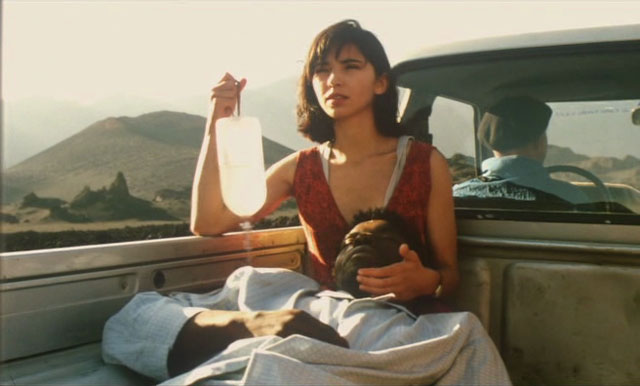
Edith (Scob, of Summer Hours, Comedy of Innocence) is the local white woman and owner of the dog. Her son (Pedro Hestnes, star of O Sangue but unrecognizable to me) is confrontational to Mariana. A boy named Tano, possibly Mariana’s attacker, maybe kills the dog? Leao finally wakes up, his first words being “my land.” A grey-haired local guy named Bassoe plays the violin, as Mariana glows in the sunset, falling more in love with this island. But many scenes are in very low light, relationships and plot points are undefined, and the movie is becoming more oblique into the second half.

Connections! Edith’s friend says “juventude em marcha!” (the original title of Colossal Youth), and when Mariana asks Leo to “try to remember something,” his first word is “sangue.”

Tano is drunk? How old is he, anyway? Is Leao the son of the violinist? Didn’t Bassoe say he was going to Portugal – why is he still here? Why is Mariana? I started to find it all more annoyingly frustrating than deliciously mysterious, but apart from the plot I enjoyed the visual experience until the end.

Fred Patton: “An arsenal of symbolism, audio-visual disjunction, and insinuating edits work to paint a portrait of the social landscape.”

R. Brody: “a politically savvy homage to Jacques Tourneur’s 1943 horror film, I Walked with a Zombie, in which postcolonial decay is invested with both metaphysical and erotic allure.”

I’d heard about the Zombie connection, and so watched it a day earlier. I suppose Mariana/Ines is Nurse Betsy and Leao/Isaach is the zombie wife, but then neither of the two brothers exist, just their mother Edith Scob. The connection gives critics something to talk about, at least, but the director seems to have thought better of the idea.

from the marvellous Cinema Scope interview:

I had this idea—which was a stupid idea—of doing a remake of a film called I Walked With A Zombie by Jacques Tourneur, who made a lot of films here [in America] like Cat People, Anne of the Indies, Way of a Gaucho. He was a great artisan. I decided to make something around my memory of that film; a film that has zombies, volcanoes, ghosts, crazy women, dogs, various strange nights, a lot of confusion and mystery. You will see that it’s not at all like I Walked With A Zombie; it’s something else.

M. Guillen [note that the film’s English title was Down To Earth – and he disagrees with me over which Zombie character Edith Scob is performing]:

Scob accepted Costa’s strange invitation to reconfigure the role of Tourneur’s entranced Jessica; the lost, White woman under the spell of the island.

Costa cautions that Casa de Lava is a confusing film that leaves the viewer a bit lost. He attributes this to the fact that he himself started losing himself consciously during the shoot, sharing Mariana’s role in the narrative. The story revolves around the arrival of a young nurse on the island who has accompanied the comatose body of an injured laborer Leão. As Costa previously specified, the body of Leão supplies the “dead weight” that thematically runs throughout his films. Mariana’s inability to find anyone willing to claim the body creates the film’s texture of gravitas. The film’s narrative slows down for having no immediate resolution.

Describing [the island of Fogo, where this film was shot], Marker [in Sans Soleil] writes: “I saw it immediately as a setting for science fiction: the landscape of another planet. Or rather no, let it be the landscape of our own planet for someone who comes from elsewhere, from very far away.” This underscores Mariana’s own “alien” quality among the islanders. Perhaps, after all, there is some sense to the translation Down to Earth? As Daniel Kasman summizes: “Inês Medeiros’ existential experience on the island is the film’s primary grounding.”

Long Pauses:

Costa’s own description of Casa de Lava reads like a ghost story:

“In the beginning there is noise, desperation and abuse. Mariana wants to get out of hell. She reaches out her hand to a half dead man, Leao. It’s only natural, Mariana is full of life and thinks that maybe the two of them can escape from hell together. On the way, she believes that she is bringing the dead man to the world of the living. Seven days and nights later, she realises she was wrong. She brought a living man among the dead.”

Like a mash-up of Jacques Tourneur’s I Walked with a Zombie and Claire Denis’s Chocolat, Casa de Lava concerns a young woman, Mariana (Ines de Medeiros), whose exotic notions about the Other are tested and refuted by first-hand experience.

Mariana can’t help but be seduced by the Otherness of Cape Verde. … The music is one more seducer that tricks Mariana into believing that she is the object of desire. It’s also one more language that she invariably misinterprets. Mariana only realizes her mistake — that she has “brought a living man among the dead” — in the film’s closing sequence. Appropriately, the final images in the film resist simple interpretation. Without spoiling the plot, I’ll say only that Mariana witnesses two events that shatter the illusions that had sustained her during her week in Cape Verde: that she was a source of health and healing for the wounded people there, and that she held sexualized power over them. At her moment of awakening, Costa frames Mariana in a still close-up and, for only a few seconds, brings back the non-diegetic viola music. When the music ends, so does her story.

Pedro Hestnes at right:

Edith Scob at right:

J. Rosenbaum:

There are at least four other Andrades listed in the cast of Casa de Lava, all of them playing children of Bassoé [Raul Andrade] – one of many factors that suggests that the film, like all of Costa’s other films, is an intricate mixture of fact and fiction. Costa told Mark Peranson in Cinema Scope (issue no. 22) that the film was originally scripted, but “at one point I just left the script behind, because I thought that if I’m going to try to shoot this girl in this new place that’s foreign and dangerous, then I have to shoot it from her point of view,” and “There was a lot of improvisation each day” – one indication among many that Mariana (Inês Medeiros), the lead character, largely functions as Costa’s surrogate in the film. Nearly all the ethical questions and ambiguities posed about her involvement with the islands’ residents are those raised by Costa’s involvement – that is to say, his filmmaking – as well. And improvisation is perhaps the most obvious way of raising the existential stakes of these issues. As Costa notes, he and Isaach De Bankolé even came to blows over the latter’s objections as a professional actor to his character Leao having to remain in a coma for most or all of the film. (It’s also my impression – gleaned from the account of a friend who attended Costa’s discussion of the film in Los Angeles – that Leao, like his rough counterpart in I Walked with a Zombie, never would have come out of his coma at all if it hadn’t been for Bankolé’s objections.)

Casa de Lava may be the film of Costa’s that poses the most constant and furious tug of war between Hollywood narrative and the nonnarrative portraiture of both places and people, staging an almost epic battle between the two. These warring modes become almost magically fused whenever there is a landscape shot with one or more human figures; every time this happens, the film moves into high gear. … Typically, … we’re either told too little about what’s happening in order to be able to follow the story or everything we could possibly want to know – in both cases in a rather mannerist fashion.

Much later in the film, the son (Pedro Hestnes) of a white islander, Edite (Edith Scob), gives a similarly telegraphic account of his mother, himself, and the allotment of funds, again to Mariana, over his father’s grave: “She came after him. She was 20 years old. She was half his age. I never met him. He was a political prisoner. Afterwards, she never went home. She’s been here for years with me. People help her. She likes them, they like her. We live here. Now we get a check every month, his pension, to pay everyone back. They know, they all wait. They all want to leave.”