A story of hot-blooded foreigners who come to France to work, getting in torrid love affairs then killing each other. Renoir beginning on a rare burst of pessimism that would lead to La Bete Humaine.

Toni (Charles Blavett of Stormy Waters and Manon of the Spring) is sleeping with his landlady Marie (Jenny Helia of La Bete Humaine), but has the hots for Josefa. She seems to like him too, but ends up sleeping with Albert, a supervisor at the quarry where Toni works.

Toni and Marie:

Toni and Josefa:

Two years later, Josefa has a kid, her husband Albert is cheating, and Toni still lives noncommittally with Marie. Josefa’s uncle Sebastian, a friend of Toni’s dies, and after Toni gets in a fight with Marie over whether he’s attending the funeral, she tries to drown herself.

Josefa can’t deal with her husband anymore, so plots to escape with her cousin Gabi (“Andrex” of Hotel du Nord), with whom she’s been cheating for years. But the escape goes wrong – Josefa kills Albert, Gabi flees on his own and Toni takes the fall, gets shot down as a train full of new immigrants arrives to take his place.

Eureka provides context:

Based on a police dossier concerning a provincial crime of passion, it was lensed by Claude Renoir on location (unusually for the time) in the small town of Les Martigues where the actual events occurred. The use of directly-recorded sound, authentic patois, lack of make-up, a large ensemble cast of local citizens in supporting roles, and Renoir’s steadfast desire to avoid melodrama lead to Toni often being labeled “the first ‘neorealist’ film”. Renoir himself disagreed. Although Toni is acknowledged as a masterly forerunner of neo-realist preoccupations and techniques he wrote: “I do not think that is quite correct. The Italian films are magnificent dramatic productions, whereas in Toni I was at pains to avoid the dramatic.”

M. Campi:

Renoir continues his investigations of depth of field and the moving camera and makes painterly use of the natural landscapes to counterpoint the drama. He delights in establishing landscapes from foreground to the distance with his characters weaving through diagonally. The organization of the movement within the frame is breathtaking but never straining for effect or obvious. Like nature itself, these elements flow effortlessly, belying the care and attention that has inspired them.

T. Milne:

Toni is not a shapeless mass of observed reality – in fact it is as strictly formalised as any Renoir film. It has a circular construction – the arrival of a batch of immigrants is repeated at the end. This suggests that the events we have just witnessed, though shattering to the lives immediately touched by them, have left no lasting mark on the social milieu. … The fundamental structuring element is the way Renoir contrives to impose the slow serene rhythm of Provence on each scene, so that the urgency of passion or despair – Josefa and Toni laboriously pushing a handcart down a leafy lane while, she tries to make him act upon his love for her, Marie drifting across the lake to stage her suicide – is absorbed by the tranquil, passive landscape.

“Tommy is the only rock opera ever made” – Ken Russell

Sad Ann-Margret’s husband is killed in the war. Some time later she goes on vacation and meets Bernie (Oliver Reed) at a resort. He moves in, but one night the husband returns, disfigured from a plane crash, and Bernie kills him in front of little Tommy, who’s told that he didn’t see anything, didn’t hear anything, won’t say anything. And so he doesn’t ever again.

Tommy grows up to be curly-haired space-cadet Roger Daltrey. He’s not healed by attending Eric Clapton’s church of Marilyn worship, nor when Bernie gives him a night with extreme drug fiend Tina Turner (filling in for David Bowie), nor when he’s left with psychically abusive babysitter Paul Nicholas or sexually abusive Uncle Ernie (Keith Moon), nor from a visit to Dr. Jack Nicholson (filling in for Christopher Lee).

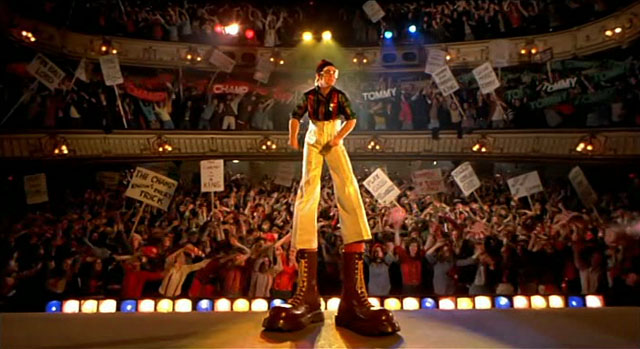
But one day Tommy finds something he’s good at. After defeating Elton John (who agreed to be in the movie provided he got to keep these boots) at a pinball championship, he becomes famous and attracts hundreds of groupies.

At home, mom celebrates their new wealth by throwing a bottle of champagne through the television and writhing in the bubbles, baked beans and chocolate that pour forth from the damaged set.

Tommy breaks through his mom’s mirror and starts speaking again, becomes a messiah to kids everywhere, his symbol a cross with a pinball on top. Mom is his biggest supporter, and stepdad Bernie is the financial wizard, plotting to set up Tommy camps everywhere and sell merchandise everywhere else. But their prefab religion backfires and the kids revolt, killing Tommy’s parents. But he lives to bathe in waterfalls and climb mountains with a big cheery grin.

It’s a ridiculous story, a twisted excuse for lots of music and celebrity cameos. Russell was never a huge fan of rock music (I’m not a big Who fan myself, really only enjoy “I’m a Sensation” from this soundtrack), had written a follow-up to The Devils called The Angels about false religion, which he couldn’t get off the ground. When offered to direct a movie with sympathetic ideas to his own, which Russell could help mold (he got Pete Townshend to write additional scenes and change plot details) with a pre-sold celebrity cast – a batshit-crazy musical story that needed visual accompaniment – how could Ken say no? It might not be Ken’s purest personal vision, but I double-featured it with Song of Summer as memorial screenings when I heard he’d died.

Unsurprisingly produced by Robert Stigwood, who produced Jesus Christ Superstar (and later Grease). Oliver Reed (of The Devils, of course) was doing Richard Lester’s Musketeers movies around the same time. Daltrey would be back with Russell on Lisztomania, which I need to see. And Ann-Margret needs to be much more popular – she was fantastic in this.

Jean Gabin (the year after Port of Shadows and La Bete Humaine) lives atop the Seventh Heaven apartment building. He shoots a guy, the cops arrive and shoot back. Barricaded in his room, Gabin embarks on a 90-minute flashback while waiting for the sunrise.

Gabin through a fractured window:

He was a factory worker, met lovely Francoise. But she’s sneaking away to see Valentin (Jules Berry of Renoir’s Crime of Monsieur Lange), a stage performer. Jean follows her to the theater, meets Valentin’s disillusioned girlfriend/sidekick Clara (Arletty, star of Children of Paradise) who quits both those positions and hooks up with Jean instead.

Francois and Francoise through the mirror in happier times:

But Jean still wants Francoise and vice-versa. Valentin says he’s not Francoise’s lover but her father. She says that’s bullshit. Valentin just wants the girl but he can’t have her because she’s in love with Jean. He comes to Jean’s place with a gun, gets plugged instead. Back in the present, a hopeless Gabin kills himself to end the standoff. Sad movie.

Gabin and Valentin, another mirror:

Notable for its long flashback dissolves. Remade with Henry Fonda and Vincent Price eight years later.

Antonio Banderas (first movie of his I’ve watched since Once Upon a Time in Mexico) invents an insect-and-heat-repellent artificial skin, which he’s tested on a beautiful woman who seems to be imprisoned in a room of his house. But the artificial skin is a distraction from the real story – the fact that the girl may be fireproof is sadly not integrated into the plot. Mainly the movie wants to tell us more about Vera, the woman in the room (Elena Anaya of Mesrine), and how she got there, with bonus sub-plots about Dr. Antonio and his family.

Firstly, his housekeeper/chef (Marisa Peredes, star of Flower of My Secret) is secretly his mom, and her misfit son Zeca comes to the house dressed as a tiger, ties up his mom and rapes the girl upstairs before Antonio comes home and shoots him to death, while mom watches on the monitors downstairs. Some of the most intense shots in the movie involve those monitors, Antonio, his mom and Zeca interacting with Vera’s image.

Backstory: Antonio became obsessed with artificial skin after his wife was disfigured in a burning car (crashed by Zeca, with whom she’d been cheating) then threw herself out the window to her death in front of their young daughter, who became a psychological wreck from the experience. Years later Antonio takes his daughter Norma on a rare trip outside her mental hospital to a party, where she’s nearly raped by party-crasher Vicente in the garden. Soon the daughter commits suicide and Antonio kidnaps Vicente, gives him an unwilling sex change and alters his whole body to resemble that of Antonio’s dead wife before her accident.

So, back in the present, it’s no wonder that soon after Antonio starts letting Vera/Vicente leave her room, she starts planning revenge – grabs a gun from his desk and kills Antonio and his mom. Movie ends with a tearful reunion, the beautiful Vera in her family’s shop for the first time in six years telling her mother “I’m Vicente.”

Almodovar will never top the Caetano Veloso interlude in Talk To Her, but he gives us a couple of passionate performances by Concha Buika, just one of the details that lifts this movie above its sordid story.

I meant to rewatch Eyes Without a Face before going to this, but forgot.

A movie Katy says could not have been made in the last decade, which is possibly why I enjoyed it so much. You don’t often see a comedy about high school social strata that includes so much gleeful murder. Christian Slater (same year as Name of the Rose) is the dreamy psycho-killer who drifts into town with his dad, and Winona Ryder (between Beetlejuice and Edward Scissorhands) is a new recruit to the prom-queen-level social class shared by three girls named Heather. Ryder falls for Slater and semi-unwittingly helps him kill some people, but when he plots to blow up the school, staging it as a mass suicide, she fight back and Slater blows himself up instead.

Writer Daniel Waters went on to help ruin the 1990’s with Hudson Hawk and Demolition Man and director Lehmann (also responsible for Hudson Hawk) did his part with Airheads and My Giant, dragging it out into the 2000’s with 40 Days and 40 Nights and Because I Said So. Lately he’s worked on about ten different well-liked TV series. One Heather, the one who made a brain tumor joke, died in 2001 of a brain tumor, and another costarred in Mallrats. One of the murdered footballers appeared in Ghoulies III and the other in Night of the Demons. So, not a supporting cast that went on to fame and fortune. Good to see Otho from Beetlejuice as a preacher presiding over the wave of teen funerals.

Kind of like Sideways – a good-enough (but never great) drama about cheating (and now death) with an immensely appealing lead actor (was Giamatti, now Clooney). A very emotional journey for the characters involved, if not for us.

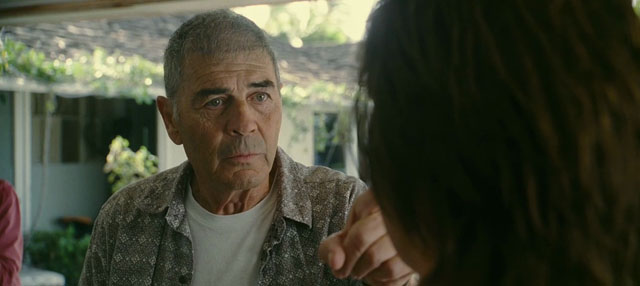
Robert Forster is going to hit you:

Hawaiian one-percenter Clooney takes care of 17-yr-old misfit daughter Shailene Woodley (star of an ABC Family drama) and 10-yr-old budding-misfit daughter Amara Miller (plus Shailene’s surfer-grinning friend). While his wife is dying in a coma, Clooney tries to find the realtor (Matthew Lillard of Hackers and 13 Ghosts Remake) who’d been having an affair with her. More wackiness as Clooney deals with a father-in-law (Robert Forster) who never liked him, and work with his co-inheritor cousins to decide what to do with a huge plot of unspoiled land (obviously they’ll keep it in the end). Except none of these things are wacky – it’s all played for sadness and empathy, which is fine if I’d been feeling it.

Large-faced actor Jason Segal had a dream to resurrect the Muppets on the big screen, full of celeb cameos and musical numbers so he called up Flight of the Conchords (not Jemaine – he must’ve been busy on Men In Black 3). Proven cutey musical lead Amy “Enchanted” Adams is a love interest, Chris Cooper a villain, and Jack Black an unwilling celebrity guest.

And it worked! Good movie, full of the same self-referential humor and silliness as the originals. Plot revolves around Segal’s friend (brother?) Walter, who is a muppet, idolizes the 1970’s Muppets and convinces them to reunite to hold a fundraiser to save their old studio from an evil oil baron. Two of the voice actors/puppeteers are from the original Muppet Show (and Fraggle Rock too) – including Gonzo. So why is Gonzo barely in the movie? (edit: oh it’s because of Muppets From Space) This one was Kermit and Fozzie-heavy, so maybe they’re saving the others for the next movie.

My favorite bit from the IMDB trivia: “Bret McKenzie taught Chris Cooper how to rap.”

We open on five mumbly hoodie youths mugging a white woman – and the youths turn out to be the protagonists. So I was on the movie’s side from the start, but it only gets better. After an alien from a freshly-landed meteorite claws Moses, the mini-gang-leader, he kills it and takes it to Nick Frost’s weed room. But a hundred more meteors land, carrying far more dangerous creatures – pitch-black hairy wolf-bears with glowing teeth, looking for the slain female. So the kids mount a defense against rampaging aliens using knives, swords and fireworks, joined by the still-irritable white woman (Jodie Whittaker, title character in Venus) and opposed by cops and a mad drug dealer.

Despite all the bloody death, the movie is mostly an action/comedy – the rare successful one. It builds to one of the sweetest minutes of film I’ve seen all year, Moses carrying the group’s full arsenal racing towards a gas-filled apartment, leaping over the blind beasts under a shower of slow-motion sparks.

Luke Treadaway (one of the twins from Brothers of the Head) plays a stoner nature-channel enthusiast who helps figure out the aliens’ motivation. Writer/director Cornish goes way back with Edgar Wright and just cowrote Spielberg’s Tintin movie, so this is his big year.