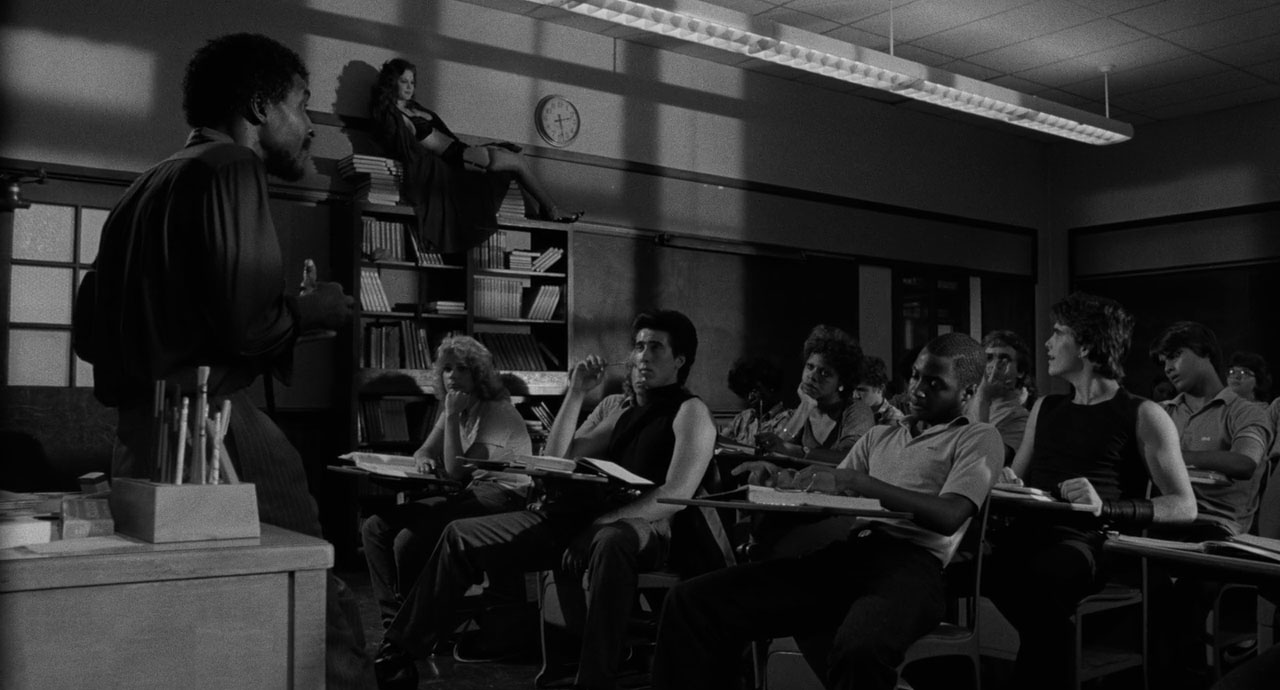
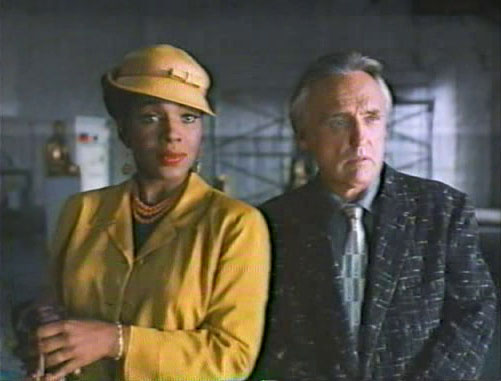
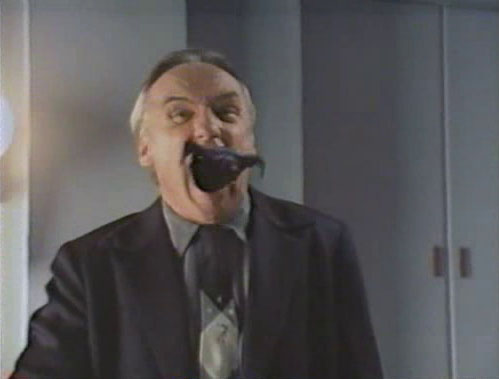
“You underprivileged bastard!”
Iconic Hopper, slightly blurry:
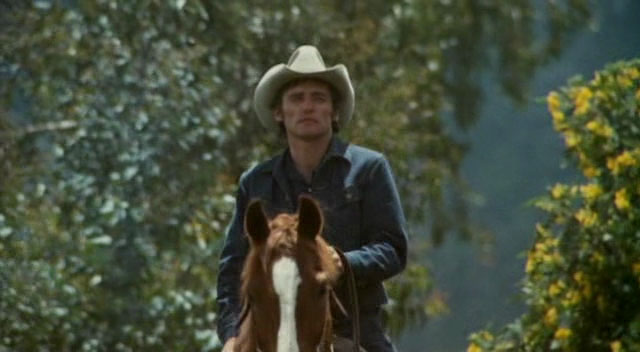
A strange movie in many ways. For instance, no opening credits then after 12 minutes it says “a film by Dennis Hopper”… then after 12 more minutes we get the title. Hopper plays a different sort of hippie drifter loner. He’d like to get married and have a steady job, but on his terms. He worked as a stunt man on a film about Billy the Kid (under director Sam Fuller, in a cameo) in Peru, but seems alienated at the wrap party, only comfortable in smaller groups.
When the production leaves, he stays behind with local girl Maria, idyllic until a priest tries to get Hopper’s help when locals pretend to be making their own movie, with real violence, not understanding the Hollywood fakery. Maria also starts getting him down – turns out she’s not satisfied with the natural paradise that Hollywood Dennis had envisioned. She wants all the American conveniences, which an out-of-work stuntman can’t afford. He turns to the elusive fast-buck by helping his shady friend Don Gordon (Bullitt) try to strike gold, but that ends in failure and embarrassment.
Don Gordon and Donna Baccala, whose only other film was Brainscan:

From what I’d heard I was expecting a rambling incoherent mess of a film, a drugged-up slog making no real sense. But it’s a right proper movie, and a good one. There’s much more to it though; more plot and characters than I’ve mentioned, events sliding out of order, flash-backs-and-forwards. Reference to someone who died during the film shoot. At the end there are “scene missing” cards and a slate onscreen, we see a retake of a scene we just watched, and people start breaking character as the movie winds itself down.

Nice garfunkly folk music throughout. Maybe they’re pushing it when they play a Jesus song while Dennis is dazed and wounded. After the gold mine idea goes bad he rampages through the old movie set and is imprisoned by the local “filmmakers” with their wicker camera. “They want me to die in the movie like Dean did” – so he named his dead friend Dean. “That’s what’s wrong is we brought the movies – that’s where we made our mistake.”
The priest: “They didn’t want to come to my church anymore. They got carried away by that game. So I just wanted to show them that the same moralities that exist in the real church can exist here in the movie church. I hope that after this game is over, morality can be born again.”
Priest Tomas Milian of Traffic, also starred in an Antonioni film and a Django movie:

Mubi explains it all:
The success of Hopper’s Easy Rider gave many young filmmakers the opportunity to work in Hollywood under the studio system. In 1970, Universal hired five “young genius” directors to make pictures for them. Hopper was one of these and developed a script with Steward Stern, the writer for Rebel Without a Cause, about the process of moviemaking and its effect on the natives of a remote and primitive village in Peru where it is being shot.
The Last Movie was the result – an amazing milieu of cinema and the decade it was created in. Hopper is a stunt man and wrangler on a big budget western, with which Hopper infused the presence of Sam Fuller, Sylvia Miles, Toni Basil, Henry Fonda, Kris Kristofferson, Michelle Phillips, Dean Stockwell and the cinematography of Laszlo Kovacs. After the production leaves town, Hopper’s life starts to get a little insane, torn between a new movie producer in town, a buddy (the great Don Gordon) and his quest for gold, and the incredible, ritualistic movie being “shot” by the locals using a wicker camera and boom mike. Under the surface bubbles the genius of the film, dealing with friendship, loyalty, the superstitious nature of filmmaking and the notion of film genre.
Although it received the only award given at the 1971 Venice Film Festival, Universal refused to distribute the film unless Hopper re-edited it. Hopper was intransigent, and Universal gave The Last Movie only token distribution and the picture was shelved.
Sam Fuller:

Only two user reviews on Mubi. One says “it’s wildly textured, emotionally intense, covers a lot of thematic ground, but its all of a piece-it works.” and the other, “a truly loathsome work of self-pity and self-aggrandizement, whose charms include smug, playful racism, and casually brutal misogyny.”
Peruvian “director” frames up a shot:

Wicker-cam:

MZ Seitz on Hopper’s filmmaking:
Although he directed just seven features, his style is quite distinctive. It’s ragged and intuitive, more sensual than logical, intoxicated by drugs, sex and music. And to greater or lesser degrees, all of his films address the individual’s struggle to survive within a machine without becoming a cog — the central narrative of Hopper’s long and strange career, with its youthful promise, adult madness and autumnal wisdom.

Z. Campbell:
The Last Movie is the only film I’ve seen that makes me think that it well and truly is an ‘anti-Western.’ (Though: this much-maligned genre that I love so much didn’t actually need ‘post’ or ‘neo’ updates–it had a strong critical component to it from the classical era onwards.) The Last Movie is quite possibly the only true and intentional avant-garde feature film I’ve seen from Hollywood. It shatters its own sense of fiction, of narrative illusion, it’s just celluloid material projected, and in so doing foregrounds the personal & cultural situations which constitute these fictions. Apocalypse Now? Child’s play–everything Coppola tried to do in his film on violence and imperialism and cinema, Hopper has already done–better–by 1971.
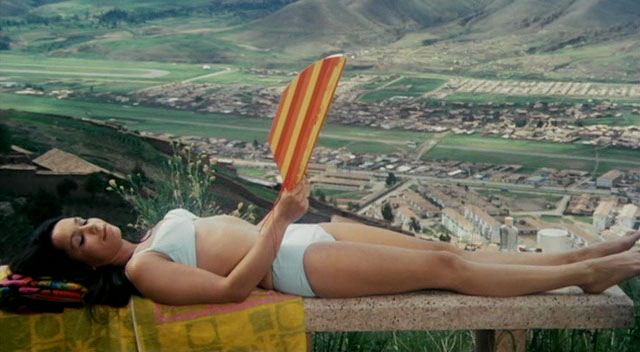
Maria and the city: Stella Garcia was also in a Clint Eastwood western called Joe Kidd.
Mrs. Anderson: Julie Adams was great in this. Hopper cast her in Catchfire twenty years later, and twenty years earlier she’d starred in Creature from the Black Lagoon.

–
The American Dreamer (1971)
“A camera is always a questioning instrument”
Also watched a washed-out old VHS of a truly ridiculous documentary on Hopper made during the editing of The Last Movie. Not about The Last Movie at all, just a portrait of a hippie for people fascinated by the Easy Rider freakshow. It’s everything that Lions Love was accused of being. Hopper gives his views on spirituality but mostly talks incessantly about sex. The movie takes up plenty of time showing him shooting guns and getting naked, and even writes him a theme song.

“There’s no honest men in the movie business except me.”
An hour in, the movie gets more interesting when Hopper starts to question and criticize the filmmakers methods, and to their great credit they left this in there. The doc is made by L.M. Kit Carson – David Holzman himself, who’d later write the terrible Texas Chainsaw Massacre 2 starring Hopper – and Larry Schiller, who later made not one but two JonBenet Ramsey movies. I’d heard that The Last Movie was a disaster and that this intrepid documentary shows why, but I found the opposite to be the case.
“I don’t need to have people make movies about me.”
“This movie, it’s a nice idea, whether it’s damaging or whether it isn’t,
it doesn’t really matter to me.”