End-times movie, as our characters drive through the desert of Morocco from one rave to another while WWIII appears to be starting offscreen. The main Spanish guy (from Pacifiction and Pan’s Labyrinth) loses his son while searching for his daughter, movie randomly ends up in a minefield where we lose half the remaining characters. Filipe calls it stupid and evil, I rather liked it but couldn’t figure out its point.

Opens with multiple plane landings from the same angle, almost some Same Player Shoots Again repetition but you can tell they’re different flights from the changing patterns of birds on the ground. The heat-haze over runway connects this to the desert scenes that follow, featuring some beautiful dune photography. Desert cities and very dead animals. A voiceover sometimes breaks in to read some biblical-sounding earth-formation text, which I could do without.

Part two, new narrator and text, not as archaic, plus some nice Leonard Cohen songs, and German researchers with sync audio. And part three, I don’t even know what to tell you. This all starts out as a photography demo, then becomes a collection of eccentricities and natural phenomena – Herzog in a nutshell. Dave Kehr: “Every shot has a double edge of harsh reality and surrealist fantasy.”

Christoph Huber in Cinema Scope 94:

Initially conceived as a sort of science-fiction film, Fata Morgana ended up closer to what today is labelled as an essay film, although it still seems to be rooted firmly in the realm of the fantastic, or even psychedelic. The film’s title is a perfect encapsulation of Herzog’s filmic universe, conjuring a desert mirage that can be filmed, although it does not exist – a reflection of reality, like cinema itself … There’s both a strange beauty and a barren, seemingly eternal sadness to Fata Morgana that bespeaks the ineffable, metaphysical qualities and intensity of experience Herzog tries to wrestle from visible reality.

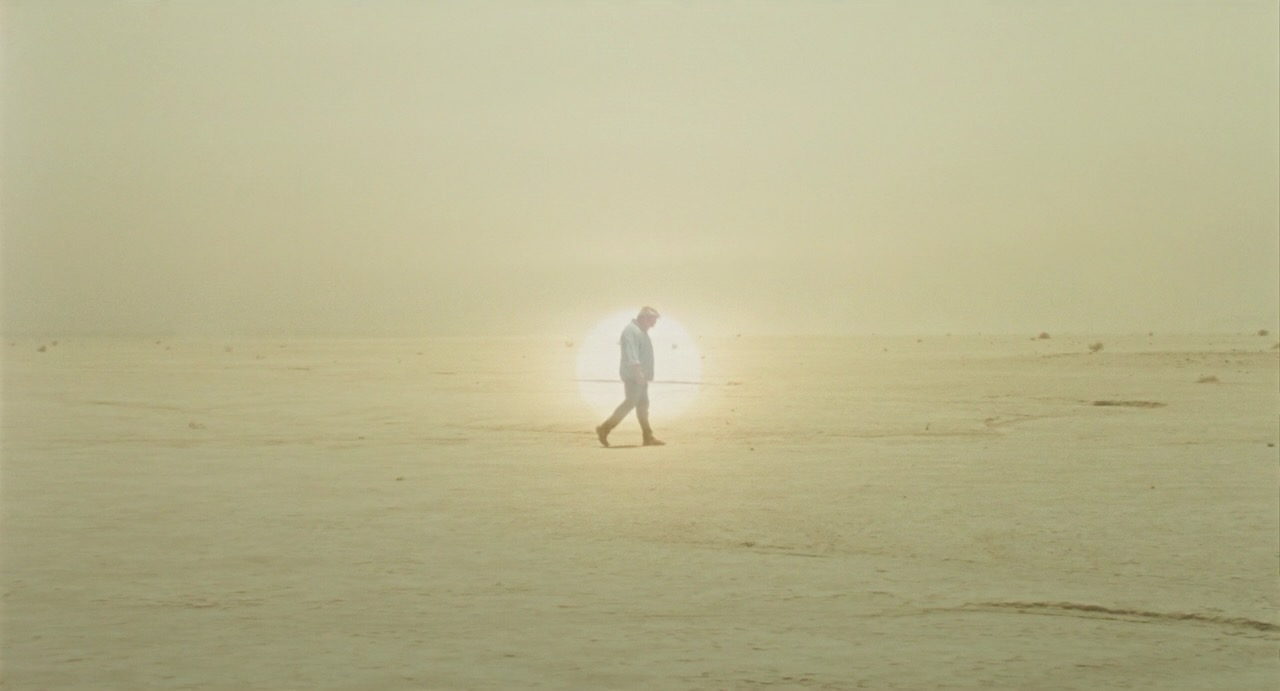
After Paris Texas I was in the mood to watch more people wandering the desert. I’d long assumed this would be a slow-cinema endurance test, but it’s absurd and wonderful. When lost idiots Matt Damon and Casey Affleck ever speak, it’s in-joke code. The movie mocks them, changing terrain and teleporting them from California to deserts in Utah and Argentina, and they make a mockery of their terrain, stranding Affleck on a way-too-tall rock, which he gerries down unharmed.

Apparently a Bela Tarr homage. Gerry-liker Mike D’Angelo only complains about “an abrupt ending that serves up an unwelcome dose of cheap irony,” while the only nice thing Tarr-o-phile Rosenbaum could say is that it’s less phony than Finding Forrester.

I remembered Red Hat Harry walking though the desert in the opening minutes, and the climax where he talks to estranged wife Nastassja Kinski through the one-way glass, but not the entire hour of movie in between. His brother Dean Stockwell has been raising the estranged couple’s son with wife Aurore Clément (a regular Akerman star) after both parents disappeared. Harry is mute and keeps walking out of situations, even gets kicked off a flight, but Dean wrestles him home and he finally softens up and tries to connect with the kid, usually acting like a kid himself, watching home movies of the parents in happier times. He borrows the truck and enlists the kid in trying to track down his mom via the drive-thru bank where she makes monthly deposits, then they follow her car and that’s how they find the peep show where she’s working for John Lurie. Lurie, Stockwell, Kinski and Stanton have all appeared in David Lynch movies – he might be a fan. After the German road movies I thought I’d rewatch this one in glorious HD before tackling the “ultimate road movie,” Until the End of the World.

I’m not above giving you the overused screenshots:

Claire Denis assisted… I’m not above the most obvious trivia either.

The kid is my age, Kit Carson’s and Karen Black’s son, later starred in a Tobe Hooper movie.