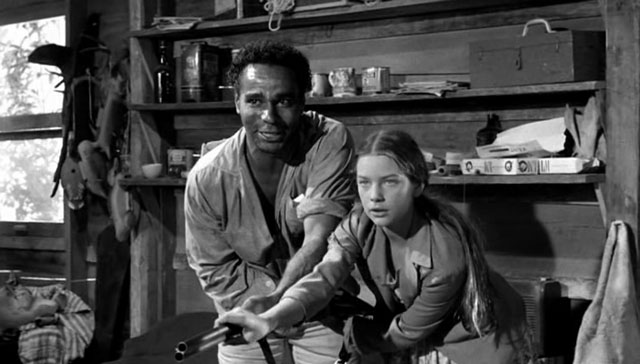
Great movie, not badly dated except for Kristy’s 1980’s headband and boyfriend (Jameson Parker of Prince of Darkness). Written by Romain Gary, based on a true story (his wife Jean Seberg found and took home a “white dog”). After Kristy McNichol finds the “insane” dog and bonds with it, she realizes she’s got a racist killing machine on her hands and gets an obsessive Keys (Paul Winfield, couple years before The Terminator) to deprogram the dog. Things go wrong: a man is killed at church, finally the dog injures Keys’s partner Carruthers (Burl Ives) and has to be shot. Best scene is when Kristy confronts the original owner, a pleasant old man with two sweet daughters, the deceptively gentle-looking face of racism.

Cameos by Sam (though there are also Sam-surrogates, cigar-chomping old men), Christa (as a capitalist veterinary nurse) and Dick Miller (as a trainer working for Carruthers and Keys). Nice, long interview on the DVD with cowriter Curtis Hanson (L.A. Confidential), producer Jon Davison (a Joe Dante and Paul Verhoeven associate) and Christa.

J. Rosenbaum:

As in the fables of Aesop and La Fontaine, the hero of Fuller’s parable may be a dog, but the subject is the human race. .. The dog is a tragic scapegoat, neither racist nor antiracist in any human sense. .. Close-ups and subjective camera movements repeatedly place us in intimate proximity with the physical world as the dog perceives it, so that he’s not merely “a four-legged time bomb” (as Julie’s boyfriend puts it, in characteristic Fuller-ese) but also an animal whose perceptions we’re invited to share. .. Like the children in Fuller’s war films, he’s the ultimate metaphor for the world we engender and nourish and ruin and try to redeem, a cause for some hope as well as despair.

An extremely by-the-numbers account of a girl named Sandra born with black skin to white parents and what that means in apartheid-era South Africa. A couple of surreal moments (after a law change, Sandra’s dad Sam Neill proclaims that his daughter is white again) but mostly a straightforward story with oscar-wannabe production (no dice, but won two major awards at the Pan-African festival in L.A.) and no particular interest.

Young Sandra grows into Sophie Okonedo (who had hands-for-feet in Aeon Flux). She and her mom Alice Krige (star of Institute Benjamenta) are the powerhouse actors of the film (that’s not Sam Neill’s fault – he just has to be a bitter ol’ racist, and does a fine job at it). The movie is (of course! apartheid!) full of easy-target racist characters calculated to inflame audience emotion. Surprisingly, Sandra’s older brother becomes one of them late in the film. She gives up on the white life, runs off with a black man (Tony Kgoroge of Invictus) and has two kids, but leaves him after a beating, moves to Jo-burg and gets a factory job. Dad never gets a reconciliation, but mom (with decent old-age makeup) does.

Superficially, this is closest to The Adventures of Robinson Crusoe than any other Bunuel movie. Voila: it is set on an island, features a fight for survival, and is in English. But psychologically, it’s most similar to early Mexican film Gran Casino because of… oh ha, I’m just kidding – I have no idea. In fact, it seems not even vaguely like anything else I’ve seen of Bunuel’s, not even Robinson Crusoe. It’s an American South civil rights drama set in isolation, so you’ve got lynch mob threats but no mob. Very good movie, excellent writing, I just can’t reconcile the Bunuel connection (not that it’s bugging me).

image

Traver, a black musician, flees to a small island, falsely accused of raping a white woman, and runs into Miller, the suspicious racist white dude who runs the place. Miller, meanwhile, is plotting to marry his young ward Evalyn, who’s really too young so he’ll be in trouble if people find this out. The irony that he’s helping capture Traver for sexual crimes (and the suspicion that Traver is actually innocent) isn’t lost on him, so despite his threatening poses, he eventually helps Traver escape after the arrival of a priest and a super-racist friend threatens to call attention (and that mob) towards the island.

Miller, introduced sneering with a dead rabbit in the foreground:
image

Has two of the same writers as Robinson Crusoe (aha!) and thrilling cinematography by Gabriel Figueroa of Simon of the Desert, Los Olvidados, Nazarin and Under The Volcano. Filmed in Mexico, and looks awfully dubbed at times. In the original short story, Traver gets killed at the end.

image

Senses of Cinema:

…though slow-paced and rather stilted, is nevertheless interesting in the way it frames racism and sexism as parallel discourses. … The Young One, unlike Robinson Crusoe, didn’t do well at the box office. Buñuel commented in My Last Sigh: “one of the problems [with it] was its anti-Manichean stance, which was an anomaly at the time, although today it’s all the rage.” Nevertheless his tone suggests that he is quite proud of these American productions, as if to say he could have been a Hollywood filmmaker like other European exiles, had chance not sent him to Latin America.

image

Slant:

Framed by a monophonic rendition of “Sinner Man” by Leon Bibb, the film has the scorching emotional urgency of a black spiritual. … In the constant frustration of Traver’s escape and Miller’s inability to play nice with him, Buñuel evokes the face of humanity repeatedly peeking out from and retreating into the steely shell of a racist comfort zone. To this already unnerving gumbo of feelings and ideas, the director adds a white supremacist hellbent on lynching Traver and a priest whose compassion has limits: he makes a case for Traver’s innocence but has Evalyn turn a mattress over so he won’t have to sleep on the same side Traver did the night before.

image

Main white dude Zachary Scott, facially Gary Sinise-like, had starred in Mildred Pierce and Renoir’s The Southerner in 1945. His final film appearance would be two years after this in Tashlin’s It’$ Only Money (I didn’t see that coming). Bernie Hamilton went on to play cops and convicts, a chauffeur, a “negro,” then in the 70’s had parts in Hammer, Bucktown and Scream Blacula Scream. I’m guessing this would be his career high point, then. The girl appeared two years later in another island drama, then IMDB loses track of her. Crahan Denton played the super racist guy, turned up appropriately enough in To Kill a Mockingbird two years later. And the priest, Mexican Claudio Brook, would star in Simon of the Desert, later in horrors Alucarda, Mansion of Madness and Cronos.