Archive for May, 2009

Unfaithfully Yours (1948, Preston Sturges)

Rex “Henry Higgins” Harrison is a famed conductor. His brother-in-law (radio star and megaphone crooner Rudy Vallee, naive rich dude in The Palm Beach Story) hires a private detective to spy on Harrison’s wife (Linda Darnell, recently starred in My Darling Clementine), so Rex, against his own hatred of spying and his belief in trust, accidentally finds out that his wife may be cheating on him. While conducting that night’s three symphony movements, he has three fantasies in which he murders his wife (aided by a sound recorder gismo) and frames her illicit lover (Rex’s secretary) Tony, then he forgives her and writes her a giant check while making her feel small and unworthy, then he confronts the couple and kills himself in russian roulette. After the symphony Rex rushes home and bungles about in a painfully protracted slapstick sequence – he can’t make the recording gismo work, can’t find bullets for his gun, and spills ink all over his checkbook. Finally she casually explains away the circumstances that led detectives to suspect her of cheating, and we have our happy ending.

Recommended listening: Mad at a Girl by Robbie Fulks.

image

In the shot below, on right is secretary Kurt Kreuger (this must’ve been a relieving change of pace for him, after playing nazi flunkies all during the war), middle is brother-in-law Rudy Vallee, and left is Lionel Stander (Katy was appalled at his accent).

image

Caught some Sullivan’s Travels actors: valet Robert Grieg (here a butler, doing a different voice I think) and bus driver Frank Moran (here a fireman). There were more whom I didn’t recognize, but the standout scene was with a relative Sturges newcomer Edgar Kennedy (former Keystone Kop who starred in his own long-running shorts series) as the private detective who spied on the wife, confronted in his office by Rex. It’s one of my favorite scenes in any Sturges movie – beautifully written and acted, sharp dialogue becoming softer as the men bond over their love of music and hard truths they wish they hadn’t learned. William Demarest was around in ’48, acting in four films and voicing a cartoon character for Walter Lantz, so I don’t know why he couldn’t make it onto Sturges’s set.

Don’t think I ever realized that Sturges’s cinematographer is Victor Milner, who worked with Lubitsch in the 30′s and shot Trouble In Paradise. Both Paradise and this one have far more interesting camera work than your average comedy. This one is notable for the looooong zooms into Rex’s eye before each of the fantasy sequences.

Full of wordy dialogue like “August, what happy updraft wafts you hither?” and “You handle Handel like nobody handles Handel,” which enriches the movie to no end, but makes it wearying over its almost two hour runtime (and that’s after having a half hour cut by the producer).

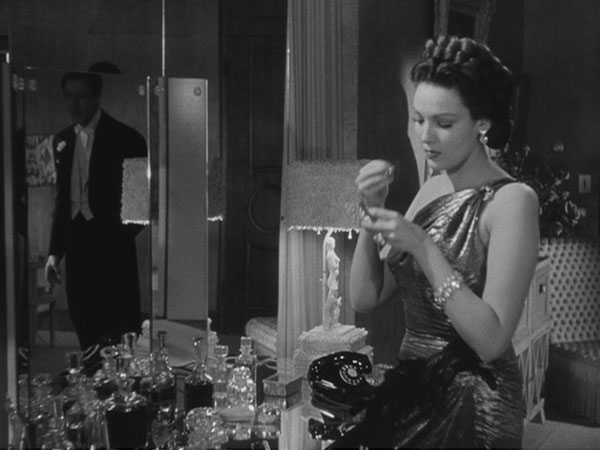
Linda Darnell, unaware that Rex is behind her with a razor in his hand:
image

Nice DVD extras – Terry Jones says it’s a satire of the masculine self-image and Sandy Sturges tells of a romantic scandal involving a girl killing herself over Rex Harrison which made this movie impossible to promote. Commentary points out that this came out the year after Monsieur Verdoux, obviously similar in a few ways.

Meaning of Harrison’s line “my family’s product has kept England on time since Waterloo” is that the real conductor on whom the character was based inherited a family fortune from laxative pills.

This was a script from the early 30′s that Sturges considered as his directorial debut, but the studio didn’t want it at the time. It’s the subject of Sturges’s only remake to date, a flop 1984 version with Dudley Moore, Nastassja Kinski and Albert Brooks, scripted by the writers of And Justice For All.

Tags: , , ,

Comments

Achilles and the Tortoise (2008, Takeshi Kitano)

The final film in one of the most enjoyable and satisfying trilogies of the decade, following the somewhat-rough Takeshis’ and the glorious Glory to the Filmmaker. Unfortunately, nobody else seems to enjoy these movies. When I searched online for info on this film, the most positive sentiments I could find were along the lines of “hooray, now that this nonsense is over, Kitano can get back to making movies worth watching.” And nobody I know personally will even watch them so discussion is nil… they are just my own private joy.

image

Totally different from the previous two, this one tells a linear story about a single character, Machisu, a painter. Constants in his life are a complete lack of critical or financial success, and people in his life dying (usually of head trauma), all of which Machisu tolerates silently with an impassive expression. Very self-deprecating (portrait of the director as a lifelong failed artist, a slack employee, a bad father), but I see some value in Machisu’s persistence, his single-minded refusal to stop painting, even the persistence in his suicide attempts at the end, which he finally combines with his painting. Maybe the movie was trying to show that this persistence is stupid, ridiculous, but I’m gonna read it my own way.

image

Starts out sometime post-WWII, maybe the 50′s, classically shot with your standard orchestral movie score, with Machisu the grade-school son of a rich banker father (Ren Osugi of MPD Psycho, Charisma, Fireworks) and his younger wife (Kanako Higuchi). Everyone from the parents to the teachers to the bus drivers indulges the boy’s painting whim and let him do what he likes. Bank crisis leads dad and mom to kill themselves (separately) and Machisu is shipped off to uncle Akira Nakao (of a buncha Godzilla movies) and aunt Mariko Tsutsui (of One Missed Call). Now uncle wants him to do housework, teachers want him to pay attention in class, and bus drivers won’t stop and let him paint them (as he’s leaving town, a bus kills a fellow painter, Machisu’s only friend).

image

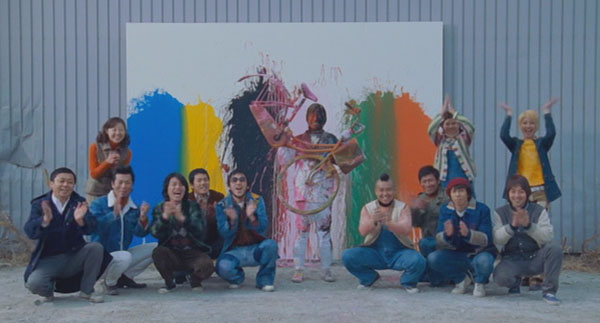
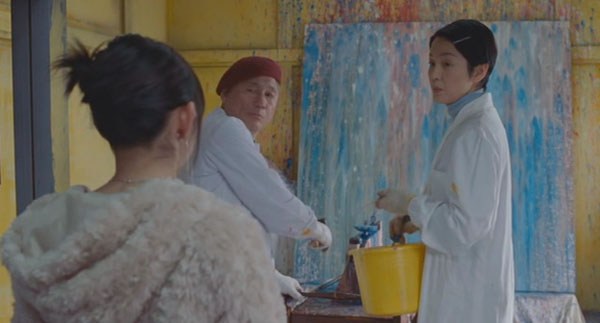
Years later, Machisu is older and working at a newspaper press – now played by Yûrei Yanagi (of the Ju-on and Ring movies, but probably cast because he starred in Boiling Point, Takeshi’s first film as sole writer/director). Not sure how old he’s supposed to be – I’d assumed 20′s, but the actor is in his mid-40′s. Anyway, at his art dealer’s suggestion (he takes all his art dealer’s suggestions), he starts attending art school. He also hangs out with a group of over-enthusiastic classmates who try outrageous art projects, and dates a co-worker at the paper plant (Kumiko Aso, lead girl in Pulse). Two classmates die – one in a painting-by-car-crash experiment and one from suicide – and another goes on to fame (called “the Japanese Basquiat”, leading Machisu to study and imitate Basquiat). Machisu’s work is all imitation. He copies the styles of every artist he studies, one at a time, and if he manages to get a compliment on a painting he makes a pile of similar paintings. The dealer assures him none of this is worthwhile, and Machisu’s apartment becomes cluttered with his failed work. Meanwhile, some of his childhood paintings show up around town, sold by the dealer to gullible rich men as the work of unknown foreign master painters. It’s all a funnier and less shrill takedown of the art world than Art School Confidential.

image

image

In the third section, Machisu is finally played by our man Kitano, married with a daughter. His wife is an accomplice in his art projects, but the daughter is deathly embarrassed, finally leaves home and becomes a prostitute. People in general seem to have less patience for Machisu and his painting than ever before, and after the daughter’s death, his wife leaves him and Machisu attempts suicide – first by monoxide poisoning, then by sitting and painting in a wooden shack which he has set aflame. Rescued and bandaged from head to toe, he tries “found” art, picking a can off the street and trying to sell it until his wife comes by and picks him up.

image

image

The hundreds of paintings are by Kitano himself, which seems pretty monumental, even if they’re all supposed to be bad art. A cartoon intro (which explains the title) sets us up for disappointment, our hero never catching up with success because he’s always chasing it instead of setting his own path. The humor is dark when there is any. I think it’s a wonderful ending… just the sappy standard “walking into the sunset with girl on your arm” ending, but it’s a deserved bit of uplift after the last 15 minutes of failure and death that came before.

image

Kitano: “After my last two films, I’m approaching this one more seriously. Sometimes I want to make movies that pack audiences in.”

image

Recommended listening: Art Class by Superchunk

Tags: ,

Comments

I’m a Cyborg, But That’s OK (2006, Chan-wook Park)

“Sympathy is the worst of the seven deadly sins.”

image

Title credits built into the opening scene shout: “I Know Where I’m Going!,” but the cartoonish situations, lively editing and bright colorful cinematography reply: “Amelie!” Maybe Park was afraid of being typecast as a grim downer of a filmmaker, a Korean David Fincher, and so like other grim young typecast filmmakers before him (Danny Boyle, Robert Rodriguez) he set out to make something light and lively to prove that he can – but maybe not as light as conceivably possible since it’s set in a mental institution.

image

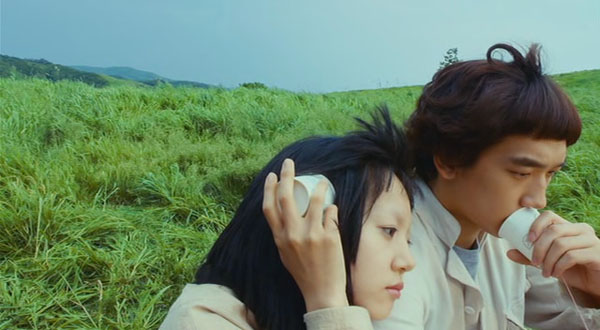
Our girl Young-goon is a bit of a sociopath and likes to talk to machines. Cute boy Il-soon is a thief, but steals intangible things: a ping pong serve, someone’s appetite, Thursday. Other colorful patients include a fat girl obsessed with her skin, a super-polite guy who walks backwards and spends all day apologizing, a girl who only looks at her hand mirror.

image

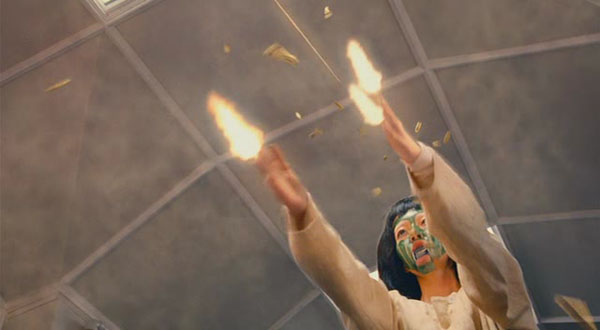
Park includes a violent kill-all-authority-figures fantasy into his light mental-illness comedy when the girl (who is, of course, a cyborg) fantasizes her hands becoming guns, blowing away all the nurses. She very nearly starves herself to death (cyborgs do not eat human food) but she’ll be okay in the end, thanks to the cute boy who truly understands her.

image

In true Amelie style this has got wonderful visuals so those who aren’t enchanted by the story and characters can delight in the cinematography (and accordian music, hmmm) – Park’s got all his bases covered. His filmmaking genre versatility proven, the typecast of dark sadistic violent films safely behind him, it sounds like Park has just turned in a dark sadistic violent vampire movie at Cannes 2009, heh.

image

Recommended listening: Become a Robot by They Might Be Giants

Tags: , ,

Comments

Amarcord (1973, Federico Fellini)

Set over one year in the mid-to-late 30′s, mostly follows high-school-aged Titta and his family but leaves breathing room for the rest of the town and its inhabitants. The rare ensemble movie that gives everyone a memorably distinct identity without resorting to stereotyping.

On one hand, it would be worth renting the Criterion DVD and poring over the hours of extras. On the other hand, there’s no outside explanation needed for Amarcord. Need to watch this again and again… I’m pretty sure Katy would like it.

The title is slangy for “I Remember.”

I can’t account for why this won an oscar one year (best foreign film) and was nominated for more oscars (writing, directing) the following year.

I always think of “fascism” as a bad word, an insult thrown at your government by foreigners, forgetting that once Italians were screaming their support of fascism in the streets. Nutty buggers.

I don’t think this was packed with movie stars. Red temptress Magali Noël had been in Satyricon, Titta’s mom would appear in Cinema Paradiso 15 years later, and mad uncle Teo would direct a parody of The Exorcist.

So, another great Fellini film, combining the circus-film group atmosphere of 8 1/2 with touches of the tragedy of La Strada, with fortunately no La Dolce Vita influence to be found. I didn’t let the dubbing get me down, but I’d thought a new print of a new restoration of an only 30-year-old film would have more vibrant color than it did.

Tags: , , , ,

Comments (1)

In the Realm of the Senses (1976, Nagisa Oshima)

“If you strangle me, don’t stop midway. It’s too painful afterward.”

image

Kichi runs an inn, makes explicit advances on one of his workers. They begin passionate secret, explicit, OH-so-explicit sexual affair. Eventually he leaves his wife, the girl (Sada) and he move in together having continual sex, the sex gets more dangerous and starts involving knives and choking, and finally he lets her strangle him to death.

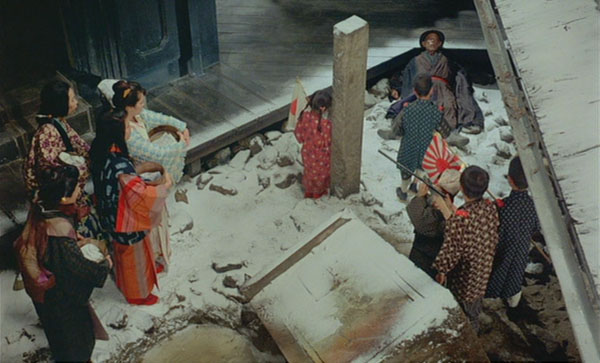
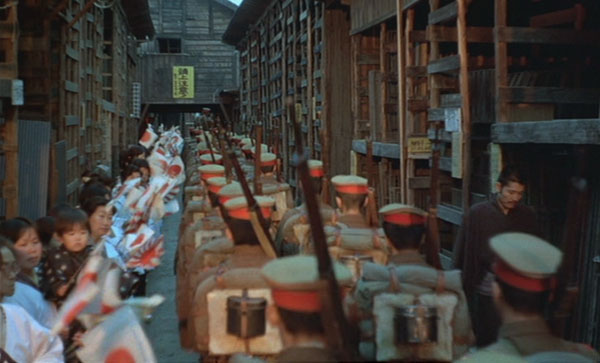
I liked Empire of Passion so I thought I’d like Oshima’s celebrated, scandalous arthouse porno even more, but was surprised not to. It’s got less cinematic flair than Passion, and less of a story too. I hate to say it, but all that sex gets boring after a while. Okay I take it back – there’s interesting stuff in here… some cool high shots (see below), a wildly fucked dream sequence where the woman grabs a naked six-year-old’s penis and won’t let go, a geisha gang rape, and some political business (nationalism on the streets, an army march – this is the year before the bombing of Shanghai) completely ignored by our sheltered protagonists, making me think this is a predecessor to Bertolucci’s The Dreamers.

image

Finally, a ridiculous closing voiceover tells us this happened in 1936 and she was arrested a few days later. I thought this was wedged in by the producers, but in his excellent commentary, Tony Rayns tells us that’s Oshima’s own voice.

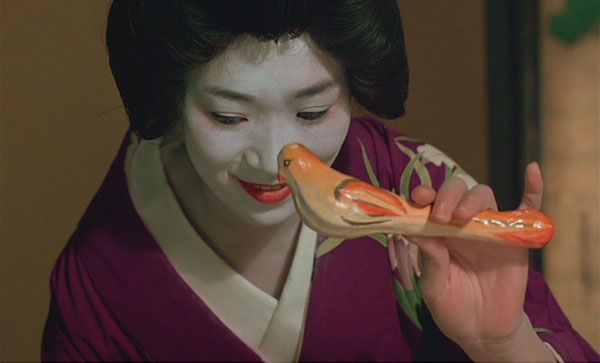
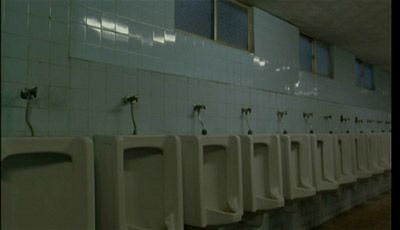
There’s more weirdness involving an egg, pubic hair consumption, fantasies of Sada killing Kichi’s wife, and a quirky dancing man. The girl has a scorpion tattoo on her ear – Tony didn’t tell us the relevance of that, so perhaps it has no relevance, because Tony knows all. The two have a fake marriage ceremony at an inn (not his inn, this is after they’ve run away) which leads to the geisha gang-rape and the quirky dancing man (below). I am already out of things to say… it’s a pretty simple movie for something so controversial.
image

Produced by Wakamatsu Koji (United Red Army), produced and suggested by Anatole Dauman (Hiroshima mon amour, Masculin Féminin, some Walerian Borowczyk features, Fruits of Passion, La Belle captive, Wings of Desire and Marker’s Level Five – wow).

Original title was Empire of the Senses. I assume the Mekons song Empire of the Senseless, with its lyrics about censorship, is referencing that. Oshima’s chosen Japanese title Ai no corrida (translated: Love’s Bullfight) looks to me like Spanish for Hey! No Running.

image

Tony Rayns:
“Oshima sees himself as standing apart from the consensus. For him, anybody who breaks the bounds of convention, anyone who dares to think for him or herself is in some sense an admirable figure,… hence an overall focus, I think, on the figure of the outlaw in many of his films.”

Most of the people in the film are women, including all the voyeurs (and there are many voyeurs). At the very beginning, a woman tries to initiate some lesbian sex with our hero and is rejected outright. Tony tells us these things explicitly delineate Senses from standard porn films.

image

More Tony:
“No two Oshima films look alike – there is no thing as the Oshima style.”

The geishas all falling upon each other as Sada has painful menstrual sex is “not a realistic detail.”

image

Girl who played Sada appeared the next year in a Kinji Fukasaku film with Sonny Chiba, otherwise not too many acting roles, while Kichi became a fairly successful actor. Typical. Although he was also a known actor before this, while she was just starting out in movies (previously in Terayama Shuji’s theater group). The actor playing an old tramp (glimped in the top screenshot) played the father in Kaneto Shindô’s Naked Island. Oshima didn’t finish his l’amour fou trilogy, and only made three more features and a couple documentaries over the next twenty years.

Tags: , , , ,

Comments

Fist of Legend (1994, Gordon Chan)

“Men don’t have to tell women everything.”

I love Jet Li but I think he’s been in about two good movies since the mid-90′s, so thought it was time to rent some of his early good stuff. Thought this was just okay though – an action flick given importance by tying in some historical drama. From the director of King of Beggars, Royal Tramp and The Medallion, but not as goofily comedic as those (and fortunately not as drab and dry as Jet Li’s Fearless either). This could still afford to be more fun, but I think it had a political point which I mostly missed.

image

Jet is Chen Zhen, disciple of a respected Shanghai fighting school gone to Japan to study. This is the mid-30′s and China is occupied by Japan, so when Jet starts the film by kicking the asses of thirty Japanese dudes who belittled his country, you know what direction the movie is going. Turns out his master was killed at home by a new school of rude Japanese guys so Jet returns home (followed belatedly by his Japanese girlfriend; you see Jet is beyond racism and just wants everyone to get along).

So Jet teams up with the master’s son and new clan leader Ting’en (Siu-hou Chin of Twin Warriors and the Mr. Vampire series) and cool-headed elder guy Uncle Nong (Paul Chun of Peking Opera Blues, played a king in Royal Tramp II). They talk peace and strategy, challenge some guys to some fights, and so on.

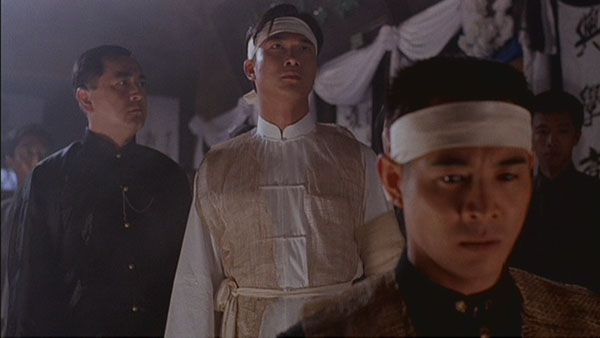
Uncle Nong, Ting’en, Jet:
image

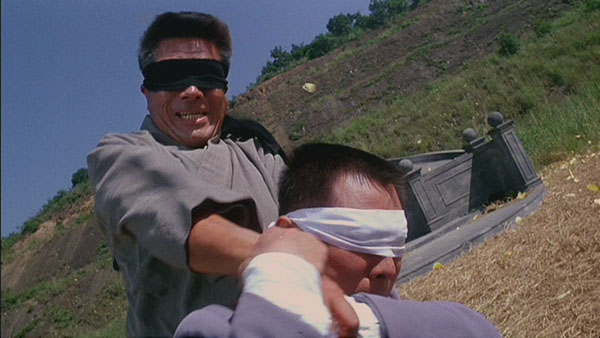
Hmmmm, I’m thinking… okay, Jet kicks the ass of the guy who killed his master and figures out that the school’s chef poisoned the master to make him lose the match. A Japanese general kills the guy who Jet beat and takes control of the other school. Somehow involved is this guy Fumio Funakoshi (Yasuaki Kurata, also of Fist of Hero, Fist of Vengeance, Fists for Revenge and Fist of Unicorn) who challenges Jet to a blind match, which ends in a draw then Fumio respectfully bugs off. The general is not so graceful about losing, pulls a sword forcing Jet to fight back – with his belt! – and kill the guy.

image

There was also some racism business, a thing about a brothel girl who Ting’en hangs out with, a court case, and Jet pulling boxing moves in the middle of his kung-fu fights. At the end, Jet is “executed” by the Japanese, but really he’s secretly shuttled out of town with his girl. Some extremely cheesy parts – if this is better than Fearless, it’s not an awful lot better. Filmmaking seemed pretty standard, with too much editing but some good fight choreography by Yuen Woo-ping, who himself directed a Brigitte Lin movie and a Michelle Yeoh movie the same year. After Black Mask (1996) he’d start bouncing back and forth to Hollywood to help with Matrix sequels and Tarantino flicks.

image

Movie is apparently considered one of the greatest martial arts films ever (I preferred Royal Tramp) and contains references to Bruce Lee’s Fist of Fury.

Tags: , , , , ,

Comments

Woman in the Dunes (1964, Hiroshi Teshigahara)

Two years after The Face of Another and Pitfall, and seven years after I first fell asleep trying to watch it, I finally make it to/through Woman in the Dunes. I know that sentence makes moviewatching seem like a chore, but this was one I’ve been really looking forward to – a movie I knew I would totally love, so it might as well be saved for a special occasion, like staying home from work unable to sleep from painful poison ivy.

image

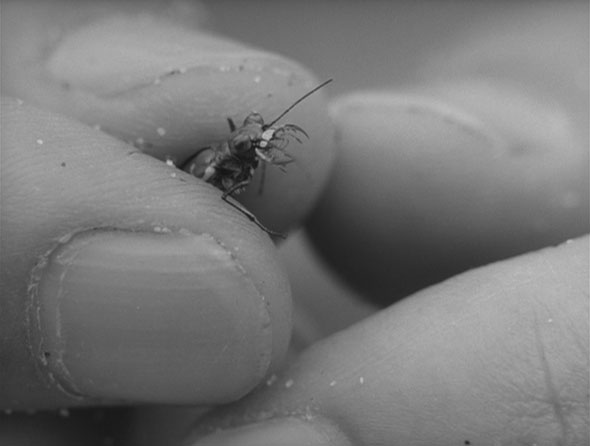
This was made in between the other two, and shares their shining, silvery black-and-white cinematography. An entomologist is allowed to stay at a woman’s house in a sand pit but is not allowed to leave. He rages against his situation, declares the sand illogical, tries to escape through cleverness and trickery, and finally (over months, years) resigns himself to it, living with her and helping to fill buckets with sand to be sold by the villagers for building material.

image

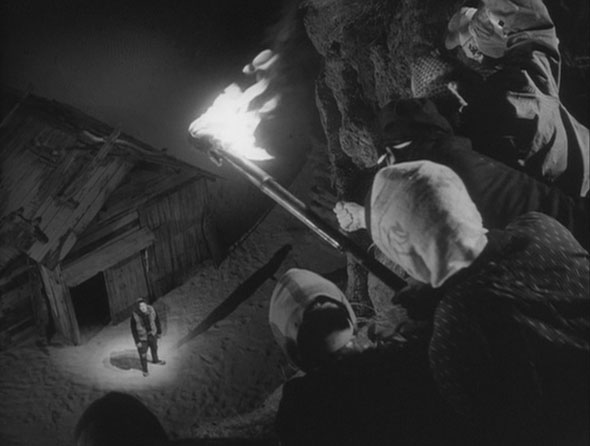
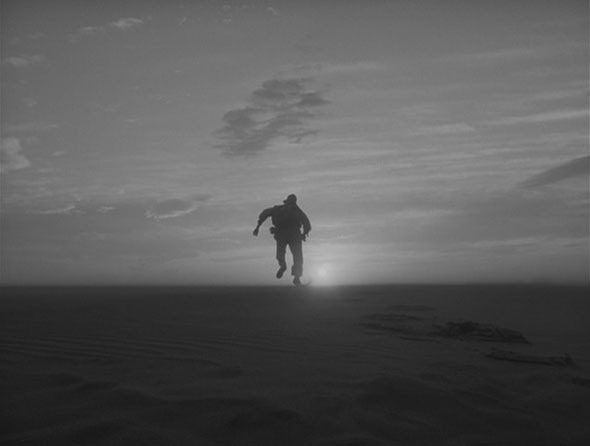
At first he doesn’t trust the woman, then he wants to help her get out, then the villagers gather around the edge of the hole offering him favors if he’ll have sex with her in front of them, and finally they’re an acting married couple, and she’s being lifted out of the hole with pregnancy complications, leaving him a chance to escape which he doesn’t take.

image

Funny enough, the same week I watched this, Criterion put out a Japanese movie from a year earlier called Insect Woman, a title this film could’ve stolen.

image

James Quandt’s essay points out the common theme of breaks in identity from Pitfall and Face of Another – the teacher gives up his life of collecting, identifying and documenting and accepts his captive life in the desert. And hey, Quandt saw the same parallel images of sand-flecked bodies between this and Hiroshima mon amour that I was noticing – good for us.

image

The man, Eiji Okada, is the same actor from Hiroshima mon amour, which is probably why that occurred to me. He later appeared in The Face of Another, Crazed Fruit, Samurai Spy, and in the last year of his life, Stairway to the Distant Past. I’m not sure who the dune woman, Kyôko Kishida, played in Ozu’s An Autumn Afternoon, but she also starred in Manji which I’d like to see.

image

image

Tags: , , , ,

Comments

The Good, the Bad and the Weird (2008, Ji-woon Kim)

I don’t know why I sat down with a Korean spaghetti-western-influenced comic action flick from the director of A Tale of Two Sisters after the disappointment of Miike’s Sukiyaki Western Django, but I’m glad I did. This was a hot pile of fun, more true in spirit to its source material than the Miike but plenty contemporary in its staging of action. Some of the most exciting (fast-cut yet spatially-coherent) editing I’ve seen in a while, certainly better than in Star Trek or Fist of Legend and great characters (the prototype super-cool good guy and super-evil bad guy are here, but the hero is an amoral thief, the comic-relief character) excuse the failure of the story to ever come together.

Action takes place in Manchuria (so truly in “the west” from Korea). Unlike Sukiyaki but like the Leone flicks, there are practically no women. A prostitute here, someone’s aged aunt there, but the wild west is a man’s world. And wild it is – ruthless and brutal, killing hundreds without hesitation, but maybe in reference to the old westerns it avoids lingering on dead bodies or showing grievous wounds, so it’s ultraviolent but more in the Sam Peckinpah body-count manner than in modern Tokyo Gore Police fashion.

image

Kang-ho Song, star of The Host, is our thief, and it’s great to see him playing a more lively soul than the dimwitted Host hero. The “Good” bounty hunter, fastest draw in the west, is secretly out for revenge on the goth-haired bad guy (Byung-hun Lee, star of Chan-wook Park’s segment of Three Extremes and soon to play Storm Shadow in G.I. Joe). A couple older guys and their men are tracking these three, but I never figured out who they are exactly, following after a mythical treasure map in the thief’s possession, and everyone is being followed by the Japanese army (Japan occupied Korea from pre-WWI through WWII). Everybody seems to be in a different underground independence movement, and the map has political ramifications that I didn’t puzzle out.

image

The bad guy dies in the end, as he would have to, in a brutal shootout with the good guy… but not before the movie strangely decides to reveal our comic thief’s past life as a finger-snatching serial killer. So the chase continues in epilogue with the bounty hunter after him. Strange choice, like at the end of For a Few Dollars More suddenly declaring Clint Eastwood is a wanted criminal in another state, Lee Van Cleef chasing him into the sunset with guns blazing.

image

Like any Leone movie it has its slow drawn-out character parts, but the movie seems well aware of what it’s doing with pacing and editing, if not story – and maybe I’ll figure that out when I see it again. Jimmy, we should’ve watched this one instead.

image

Tags: , ,

Comments

Goodbye Dragon Inn (2003, Tsai Ming-Liang)

Briefly in 2004 I thought I’d like to be a film reviewer. It didn’t work out – I’d just go on and on like I do now, but instead of writing my own thing for my own self, I was aiming to describe why You, The Reader should be interested in each movie. Ugh. I just read through these again, and the only one I enjoyed was this piece on Goodbye Dragon Inn, though it worked better with white text on a black background.

-
What does Goodbye Dragon Inn want from me?
image

What do I want from Goodbye Dragon Inn?
image

Some reviewer on the IMDB calls it “spectacularly dull… limp… smitten with its own stasis”.
image

Stylus Magazine calls it “yet another masterpiece… starkly minimal… sublime”.
image

Who is right?
image

They are both right.
image

Tags: ,

Comments

« Earlier entries Next Page » Next Page »