Found in my email archive: my movie lists for 2005. The “most forgettable” category near the bottom was a primary reason for starting this movie journal. I was annoyed that there were movies I’d watched less than a year earlier which I already couldn’t remember having seen. As much as I love making lists, collecting things, completism, I started wondering what’s the point in having watched movies only to immediately forget them.


Best New Movies In Theaters:

1. 2046
2. A History of Violence
3. The New World (150-minute cut)
4. Land of the Dead
5. Sin City
6. Million Dollar Baby
7. Wallace & Gromit: Curse of the Were-Rabbit
8. Munich
9. Kung Fu Hustle
10. Grizzly Man

11. The Devil’s Rejects
12. King Kong
13. 3-Iron
14. The Real Dirt on Farmer John
15. Henri Langlois: Phantom of the Cinematheque
16. Kiss Kiss, Bang Bang
17. Broken Flowers
18. Serenity
19. March of the Penguins
20. Mirrormask

Runners-up: 40-Year-Old Virgin, Howl’s Moving Castle, Three Extremes, Yes


Best Old Movies Seen In Theaters:

1. Phantom India (Louis Malle, 7-part documentary on video at Emory)
2. Yumeji (rare seijun suzuki, beautiful color, on film at Emory)
3. Charisma (kiyoshi kurosawa, film at Emory)
4. The Freshman (part of the damaged Harold Lloyd retrospective, hilarious)
5. Mother Joan of the Angels (film at Emory)
6. Out of the Past (film at Emory
7. Kenneth Anger Series (at Eyedrum, his newest one and three classics)
8. Elevator to the Gallows (Louis Malle, amazing B&W photography)
9. The Conformist (Bertolucci, only Italian movie I enjoyed all year?)
10. His Girl Friday (Nashville Film Festival)


Top 25 Movies Seen On Video (for the first time):

1. The Compleat Tex Avery (67 cartoon shorts on laserdisc)
2. The Big Red One: Reconstruction (samuel fuller)
3. The Miracle of Morgan’s Creek
4. Spalding Gray: Terrors of Pleasure / Monster in a Box
5. Fixed Bayonets (samuel fuller)
6. The Same River Twice
7. The Man Who Fell To Earth
8. The House is Black
9. House of Bamboo (samuel fuller)
10. Not on the Lips

11. New Rose Hotel
12. The Red Shoes
13. Drowning by Numbers
14. The Kid (charlie chaplin)
15. I Am Cuba
16. Day of Wrath
17. Naked (1993)
18. Straw Dogs
19. The Village (m. night)
20. Nazarin (bunuel)

21. Tropical Malady
22. Prospero’s Books
23. Closer (2004)
24. Rivers and Tides
25. Bird


Most Forgettable Movies of 2005:
(maybe it’s not the movie’s fault, but I barely remember watching these)

1. Exorcist: The Beginning
2. Crossfire
3. Unknown Pleasures
4. Chronicles of Riddick
5. Live Flesh


Worst Movies Seen In 2005:

1. Richard Kern Collection (neither sexy nor funny nor anything)
2. The Heart is Deceitful Above All Things (xxxtreme “squid/whale”)
3. 9 Songs (lots of sex + lousy concert footage = not a good idea)
4. Godzilla: Final Wars (where’s godzilla? why all this kung-fu?)
5. Zombi 2 (amazing shark scene plus 85 tedious minutes)
6. Bad Guy (a movie that hates you and itself)
7. Melinda & Melinda (woody allen is terrible now)
8. The Edukators (politically idiotic, just standard indie fare)
9. Incident at Loch Ness (felt embarrassed for Werner Herzog)
10. Haute Tension (didn’t see the point in all this)

In 2004 I had a different idea for this website – instead of tracking every blasted movie I’ve ever seen, I’d write focused reviews of “obscure” movies, the idea being to develop myself as a film critic without covering all the same titles everyone else was talking about. Later I’d decide I didn’t want to be a film critic or to write for any audience besides myself, and this movie journal was born. To flesh out the old site since I hadn’t written many reviews yet, I made some top-ten lists of my favorite obscure films of recent years (“obscure” mathematically defined as anything with fewer than 3,000 votes on the IMDB). Those lists (from early ’05) follow, unmodified.


2004
1. A Very Long Engagement
2. Zebraman
3. Primer
4. Dig!
5. She Hate Me
6. Cash Flow (Argent Liquide)
7. The Fourth World War
8. Move
9. Criminal
10. Dumplings


2003
1. The Saddest Music in the World
2. Bright Leaves
3. A Talking picture (Un Filme Falado)
4. Cowards Bend the Knee
5. The Return
6. Doppelganger
7. Rocks (Das Rad)
8. Long Gone
9. Masked & Anonymous
10. The Five Obstructions
Runners-up: Code 46, My Architect, The Singing Detective, Pan With Us


2002
1. Dracula: Pages from a Virgin’s Diary
2. Amandla! A Revolution in Four Part Harmony
3. Populi
4. Infernal Affairs
5. Demonlover
6. Dark Water
7. Cremaster 3
8. Mt. Head
9. The Trilogy (Lucas Belvaux)
10. Ken Park
Runners-up: Dolls, The Cuckoo, Horns and Halos, The Weather Underground


2001
1. Pulse (Kaïro)
2. Winged Migration
3. Ichi the Killer
4. No Such Thing
5. Pootie Tang
6. Autumn Spring
7. The Happiness of the Katakuris
8. Pistol Opera
9. Wet Hot American Summer
10. Human Nature


2000
1. The Heart of the World
2. Rejected
3. George Washington
4. The Circle
5. Camera
6. Steal This Movie
7. Time and Tide
8. The Gleaners & I
9. The House of Mirth
10. Trade Off
Runners-Up: Dark Days, Uzumaki

Reasonably paced at 70 minutes. This was part of some made-for-TV or direct-to-video series of Maiku Hama stories. I think there are 12, written/directed by the likes of Alex Cox (Repo Man) and Tetsuya Nakashima (Kamikaze Girls), but this is the only one I can find…

image

I’ve had Aoyama’s critically-acclaimed, award-winning Eureka for years, but instead of finally watching it, I rented this. I’ll try not to judge him too harshly by it. Apparently shot or once presented on film (can see dirt on the print and reel-change marks), Facets proudly presents us a letterboxed, non-anamorphic, hard-subtitled, interlaced video with poor color. Thanks for that, Facets.

Mike travels to a retreat in the woods to retrieve a rich man’s daughter who has this weird idea that she’s free to marry whoever she wants. He gets slightly mixed up in the tree-worshipping new-ageyness of the place and intimidated by the woman in charge, but hey, it all turns out fine in the end.

image

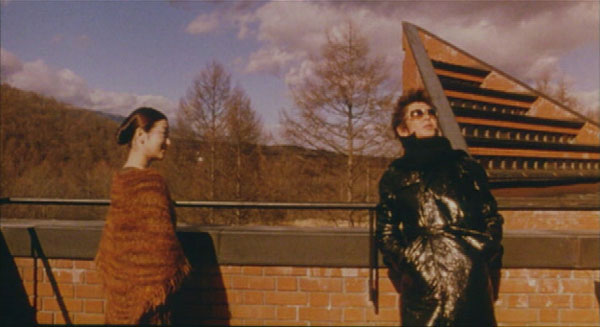
I wasn’t exactly looking for a slam-bang action flick, given the slow strangeness of the last two movies in the series, but I don’t think watching Mike pad around getting in touch with his inner self is exciting enough to justify watching this. Mike is the same actor as before, Masatoshi Nagase (additionally of The Hidden Blade and Suicide Circle), and we know he can be funny, so I’m blaming the D.O.A. humor in this one on Aoyama. Kyoka Suzuki (above left) of Bullet Ballet and Zebraman plays the mysterious camp leader.

image

Fabulous action thriller, visually stylish with wild acting and a great, complicated script. According to Masters of Cinema it was the “year’s largest grossing film at the Hong Kong box office.” According to IMDB, it made nearly $5,000 at the U.S. box office. This is why a remake is inevitable (thanks to the producer of Rush Hour, can’t wait).

image

Ho (Andy On of Black Mask 2 and New Police Story) is new on the police force, investigating the disappearance of another officer. Bun (Ching Wan Lau of Black Mask 1 and My Left Eye Sees Ghosts) is the unhinged “mad” detective, actually an ex-detective fired from the force for cutting his ear off but still an utter master of deduction through his unusual methods of instinctually empathizing with killers and victims. It’s part Training Day (crazy partner) and part Silence of the Lambs (dangerous non-cop assisting investigation), except that Bun is a good guy.

Bun visits a crime scene and imagines himself participating:
image

image

image

In fact, he begins to emerge as the only good guy, as he gets deeper into the conspiracy (the disappeared cop was killed by his partner Chi Wai (Ka Tung Lam of Election 1 & 2), who is going on crime sprees with his murdered partner’s gun) and Ho reveals himself to be a useless coward. Bun claims to see people’s inner personalities (including “Fatso” and a strong violent dude, both Breaking News vets, and “the calculating woman” who makes all of Chi Wai’s decisions) – in the shot below, Chi Wai’s many personalities ride in the back seat while Ho appears as a scared little boy.

image

So in the end it’s less Training Day meets Silence of the Lambs than MPD Psycho meets Herman’s Head. May (Kelly Lin of Boarding Gate) exists as two characters – she’s Bun’s tough ex-wife, an inspector on the force who warns Ho about his erratic behavior, and in Bun’s mind she’s still his loving wife, always by his side at home and at dinner parties with Ho and his worried girlfriend Gigi.

Inspector May:
image

During the shootout finale in a hall of mirrors (of course there are mirrors), Ho becomes the new Chi Wai, displacing guns and covering up who shot whom to keep himself out of trouble, controlled by his brand-new commanding woman inner-personality, a terribly good, scary ending.

image

Looked to me like To and his cinematographer were using whichever camera Mann shot Miami Vice with, but IMDB says it’s 35mm so I’m way off.

image

AUGUST 2021: Watched again in HD, still great. Guess that English-language remake isn’t gonna happen.

APRIL 2024: And again with Maria, who said at least the first ten minutes was good before it went straight into the deep end.

Seki (Kazuko Yoshiyuko of Lady Snowblood 2, Kikujiro) is married to a decent guy, the town’s rickshaw driver Gisaburo (Takahiro Tamura of 24 Eyes, Seisaku’s Wife), but young Toyoji (Tatsuya Fuji, the killer’s father in Bright Future) falls in love with her and ruins all that. One night, in an unexpectedly frank bit of sexuality (later note: not frank at ALL after watching In the Realm of the Senses), he’s going down on her and orders her to shave. A couple hours later he matter-of-factly tells her that since she’s shaved, her husband will suspect them, so they’d better kill him. So they do, strangling the guy and dropping him down a well. Three years later the townspeople haven’t seen their taxi driver around but his ghost has been spotted, Toyoji seems to spend an awful lot of time at Seki’s house and is seen lingering at the well, Seki’s daughter is asking questions and nobody doubts what’s going on… only a matter of time before the cops (led by Takuzo Kawatani of The Burmese Harp and Battles Without Honor & Humanity) catch up and hang ’em. But things get worse before that – Toyoji kills the young master of the property where he works and Seki goes blind.

As with Senses, this is based on a true murder from 1896. This one has more town life in it, more theatrically heightened colors, maybe more traditionally studio-looking shots. A very Japanese (pre-Ring) ghost, Gisaburo dressed as he was when he died with an all-white face, wordless. Some wonderful shots from inside the well, as seen on the box art. I failed to get screen shots, so I’ve stolen a couple from DVD Beaver. I liked the movie a whole lot… not a groundbreaking story, but well told with a nice visual style.

image

If I may quote heavily from Tony Rayns’ great essay:

What intrigued Oshima so much in the story of Gisaburo and Seki? First and foremost, the fact that it bore witness to an eruption of amour fou in a social setting where such passions were previously unrecorded. Western literature from the Middle Ages to the nineteenth century—from Geoffrey Chaucer to Émile Zola—had acknowledged and explored the sex lives of the rural peasant class, but there was no real Japanese equivalent; the bawdy fiction of the Edo period had dealt exclusively with the love lives of the samurai and merchant classes. Oshima responded to the factual account of a torrid affair between a married mother of two and a recently discharged soldier twenty-six years her junior. … He recognized the story as an interesting counterpoint to the one he had told in In the Realm of the Senses. Sada and Kichi had retreated from the increasingly militarized Japan of 1936 into a private world powered by their own sexual fantasies; Seki and her lover, Toyoji, lived out their adulterous passion in a world circumscribed by the laws of nature and the rural traditions of village life. For Oshima, the key element in the story was their defiance: the realization that their affair and their murder of Seki’s husband would be exposed rekindled their passion and made them recklessly indifferent to their punishment.

Oshima has said that he reads the tradition of vengeful spooks as a phenomenon related to the militarist code of Bushido—which he has always vehemently rejected. He sees Gisaburo’s ghost as coming from somewhere very different; he once told me, “The ghost in Empire of Passion is a farmer’s idea of a ghost, not a samurai’s.” Gisaburo, in fact, accepts his sad fate as passively as Kichi succumbed to Sada’s murderous fantasies in In the Realm of the Senses. He doesn’t return to the village as a ghost because he wants revenge but because he’s an unquiet spirit; he appears beside his old rickshaw because he wants to go on serving his wife and the villagers, and beside the hearth in his old home because he still wants the comforts of a pot of warmed shochu liquor. He represents, of course, the guilty conscience of his murderers, not assuaged by emptying dead leaves into the well where his body was dumped, and the collective disquiet of the community that a crime has gone unpunished.

Where is Oshima himself in all of this? … The figure he is closest to is the village’s young master, who also represents the author in Nagatsuka’s novel; he’s the most educated person in the community, the most clear-sighted, and the most ineffectual. First seen at his wedding ceremony, he’s played by Kawarazaki Kenzo, the same actor who stood in for Oshima in the tortured family saga The Ceremony. The young master stands for modernization and “progressive” ideas, but he’s fated to be silenced by an ex-soldier who can think no further than self-preservation. The character’s death suggests that the pessimism that led Oshima to abandon filmmaking in the early 1970s was undimmed.

image

Oshima:

The space in Senses was delineated by the different rooms of love. It was artificially created, completely designed for voluptuousness. On the other hand, in Passion it is all about nature. Seki has a house where she lives with her husband, and Toyoji a small hovel that he shares with his young brother. Neither of these places is artificial. The two lovers live in fear because they constantly feel threatened by nature. I am trying to depict the human condition in its primal stage. In that sense, my new film goes back to the roots of all life, much more deeply than Senses ever did. The lovers seem cast into hell because of their sexual urges, but in my opinion, the rumbling of the earth, the murmur of the wind, the rustling of the trees, the songs of the birds and insects, in short, all of nature, is guiding the couple into hell. And the ghost itself is part of nature. Neither sex nor love has any meaning. Life itself has no meaning. And if it doesn’t have meaning, isn’t it hell? All I can do is express and project before you this human life devoid of any meaning, this hell that for me is always beautiful.

I found, several years after directing my first films, that I was very attracted to these two topics, sex and crime. Subsequently, my films have addressed them in a very analytic way. Today, I’m at a stage where I simply like to project the naked reality of sex and crime before the spectator’s eyes.

I guess I’ll count this as a movie, even though it’s just footage from Planet Earth, which we’re gonna catch soon on video. We watched the U.S. version narrated by a coddling James “Earth” Jones. The UK version is reportedly more environmentally to-the-point, sort of how our cigarette packs say “cigs are known to the state of california to contribute to cancerous growth of the blah” and UK packs say “these will kill you.” Anyway, animals are pretty cute and wonderful, so we liked this a whole lot.

These Duplass fellas made The Puffy Chair and are somehow involved with Ryan “Half Nelson” Fleck, Joe “LOL” Swanberg and Andrew “Mutual Appreciation” Bujalski.

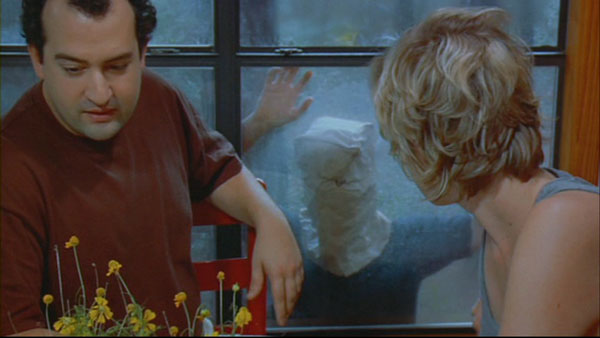
Four movie extras go to a cabin in the woods to script their own indie movie to kickstart their careers. The girls want to make a relationship drama and the guys want to make a horror about a killer with a bag on his head. Meanwhile, they themselves are having relationship drama and being stalked by a dangerous bagheaded dude. So sorta like Behind the Mask: The Rise of Leslie Vernon, except the movie tries to bring its own humor instead of deriving all fun from geeky references to horror movie tropes. Naw, it’s still pretty geeky, and instead of playing with two filmmaking styles (handheld doc / slick studio horror) like in Behind The Mask, this one goes all the way shaky-cam. I am glad I watched it in a window on my computer or it would’ve driven me batshit… when the cam isn’t shaking enough, the cameraman (a Duplass himself) plays with the zoom lens to keep us from getting comfortable. Jerk.

L-R: dude who is appearing in new Amy Poehler show, Baghead, Hannah from Hannah Takes the Stairs
image

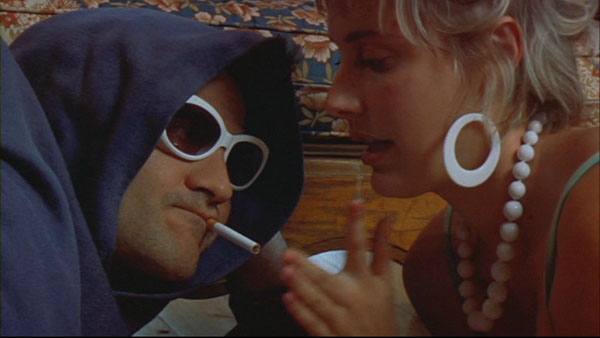
L-R: appeared in the Prom Night remake, appeared in Vampire Lesbian Kickboxers
image

Okay I totally liked it but I’m not sorry I didn’t watch it fullscreen.

See, used to be I’d go to the video store and rent anything that looked interesting, and I’d come home with wild, awesome, insane movies. But one Tetsuo The Iron Man and a pile of Richard Kern films later, I start to get wary of the weird stuff. It seems the few weird, random films I rent these days are crappy movies trying too hard for cult success (Sukiyaki Western Django, Tokyo Gore Police). Eventually I get this crazy idea that I should seek out good movies instead of bad ones, and become obsessed with lists of great and important films and magazines like Cinema Scope. So imagine my surprise when C.S. did an article on Craig Baldwin, one of those purveyors of cult-reaching found-footage hyper-weirdness peppering the video shelves. Bug had been a C.S. recommendation and that wasn’t so bad, so I finally overcame my angry memories of Baldwin’s Negativland documentary Sonic Outlaws and I rented this.

And wow is it a mindblowing pile of awesomeness. Footage from ALL sources (godzilla/molemen/cartoons, star trek scenes played as news footage, actual news footage superimposed with sci-fi business) combine to form a tell-all exposé of aliens from planet Quetzalcoatl who landed on earth in the year 1000 and live underground for centuries, waking after nuclear bomb tests to affect global climate change and politics in South and Central America and the U.S., leading to annihilation of the planet in the future year of 1999.

Movie is a wild, hilarious masterpiece of montage, with the nutty stuff woven into actual history, then 45 minutes in, after I thought it had just ended, it refocuses on Africa and becomes kind of dull. Turns out this was the short RocketKitKongoKit (1986), with no opening title so I didn’t know what was happening. Story is more news reporting with less fanciful writing, with stuff on Mobutu (evil ruler of Zaire/Congo) and others I already can’t remember, and I think there was stuff about Germany in there. Loved the conspiratorial half-whisper of the narrator in the first film, so the dull, accented narrator of this one lost interest in comparison.

Next up on the DVD: Wild Gunman (1978), apparently featuring scenes from a dragon’s-lair live-action cowboy video game, but I guess they didn’t have laserdisc players in ’78. Clever montage of advertisements, cowboy shows, repeated bits back and forth (not quite Martin Arnold-obsessive, just for fun). All three movies are divided into numbered sections… the last one used reverse-images of a girl holding up numbers and this one’s got film countdown leader. Playful and fun, brings back the energy the middle film lost.

Internet says Baldwin is a Bruce Conner devotee – no surprise there.

Video distributor says:

Baldwin’s “pseudo-pseudo-documentary” presents a factual chronicle of US intervention in Latin America in the form of the ultimate far-right conspiracy theory, combining covert action, environmental catastrophe, space aliens, cattle mutilations, killer bees, religious prophecy, doomsday diatribes, and just about every other crackpot theory broadcast through the dentures of the modern paranoiac… a truly perverse vision of American imperialism.

T. Maloney in Senses of Cinema:

On the surface RocketKitKongoKit is the true story of a German rocket firm leasing land in the Congo (then called “Saire” under Mobutu’s reign), for testing rockets. The larger implications, that of Europe’s colonial attitude towards Africa in the 1960s and the exploitation of its people for a program the Europeans didn’t want in their own backyard, is not an entirely inaccurate one. History is, of course, highly malleable, and interpretations of any event can continue for decades – especially with relatively recent and well-documented events. The direct links between the ESA’s rocket program and deteriorating conditions in Africa are made more forcefully than would a more conservative historian, and the information is presented with the authority and integrity the documentary form affords.

and on Trib 99:

Organised into 99 chapters, each with a terrifying title screaming out in full screen capital letters, (9) the structure of the film invokes both conspiracy theories and biblical texts. And yet a great deal of the narration in Tribulation describes a readily verifiable history of American intervention in Central America from the 1960s through the 1980s. It is mixed in with vampires, voodoo and killer robots, but it is there.

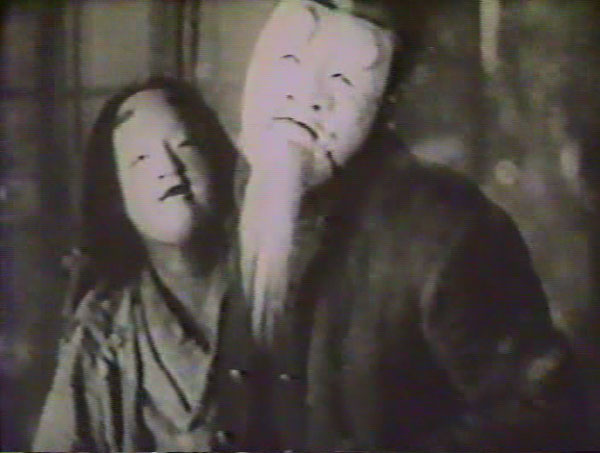
Oh man, I don’t know what happened plot-wise, but clearly (dimly) we’d have an expressionist madhouse classic to beat Cabinet of Dr. Caligari on our hands here if we had a better print copy.

image

No intertitles, and I guess I was paying more attention to images and technique than trying to puzzle through the story, so even the one-line IMDB plot-blurb “a man takes a job at an asylum with hopes of freeing his imprisoned wife” is news to me. I thought he might have always worked there, maybe he imagines she’s his wife, but he’s either hallucinating – crazy enough to be at the asylum, but gentle enough to be given menial jobs – or maybe he becomes mad from hanging out there too long, or perhaps the ending is a dream… so either Caligari or Shock Corridor.

image

Watched it with Superchunk’s score playing on the stereo. Now Superchunk are heroes of mine, but they wouldn’t be my first choice to score a bonkers dream-logic silent film… worked pretty well, but maybe next time I’ll cook up a mix CD for the occasion.

Based on a short story by Yasunari Kawabata, who has other titles with interesting names to his credit and film adaptations by Naruse, Shimizu, and Kon Ichikawa.

Kinugasa made Gate of Hell, which I think I’ve heard of, and some 100 other films. I hope somebody has looked into this.

An IMDB user: “the film makes use of every single film technique available at the time: multiple exposures and out of focus subjective point of view, tilted camera angles, fast and slow motion, expressionist lighting and superimpositions among others.” V. Petric via Midnight Eye: “These devices… are used not for their own sake but to convey complex psychological content without the aid of titles.”

Silents Are Golden has a plot description: “An elderly man, a former sailor, works voluntarily at odd jobs in a lunatic asylum where his wife is confined after having attempted to drown her baby son in a fit of madness many years ago.”

Excerpts from M. Lewinsky’s well-informed interview on Midnight Eye:

The strongest direct influence was certainly Murnau’s Last Laugh. There was much debate in Japanese film magazines about this film – it was released in Kyoto in January and in Tokyo in mid-April 1926 (A Page of Madness was shot in May 1926) – and its having no intertitles. In a published enquiry “My Favourite Film”, Kinugasa chose Last Laugh saying he had seen it five times. If you compare the two films you will find many elements and images from the German film used in A Page of Madness, but transformed and integrated in a different structure.

The comparison with Dr. Caligari is quite pointless I think. This German film from 1919, despite being popular in Japan, is too different in its mood and making, and its treatment of madness has nothing in common with A Page of Madness.

There are many instances in A Page of Madness where the film relies on benshi narration to furnish crucial information. Without narration, without dialogue, the film at times is nearly incomprehensible.