Three love stories with the same actors in different eras. Can’t think of an apt comparison to another film (haven’t seen Resnais’ Smoking/No Smoking) but it’s sort of the opposite of Hal Hartley’s Flirt). I’d avoided this despite the acclaim because I thought it’d be long and boring (flashback to two Hou movies I didn’t enjoy/understand, Flowers of Shanghai and Goodbye South, Goodbye) but lately I’ve decided that those two required more attention than I gave them, so I watched this one twice (err, six times).


1966: A Time for Love

image

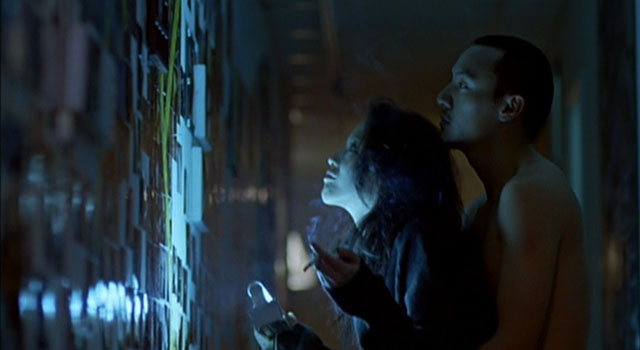
A perfect mini-movie, and it ends so simply and beautifully. He meets her by accident at a pool hall, looking for a different girl. Writes her letters while on his military duty, returns one day and finds her gone. This time, instead of just writing to the next girl, he tracks her down, spends his last few hours of leave with her. Repeated settings, actions and songs (“smoke gets in your eyes” and “rain and tears”) along with the period setting and romantic atmosphere unavoidable evoke Wong Kar-Wai.

image

Girish draws connections:

The original Chinese title of the film is Best Of Times. Hou, like a popular musician, is drawing from his “discography” of films for these three stories. The first reminds me in look and mood of A Time To Live And A Time To Die or Dust In The Wind; the second is set in a brothel like Flowers Of Shanghai; and the third clearly recalls the modern neon-smeared interior spaces of Millennium Mambo. So, Hou has created a sort of compilation album, only he has “remade” the ideas and memories behind his previous films into new stories.

image


1911: A Time for Freedom

image

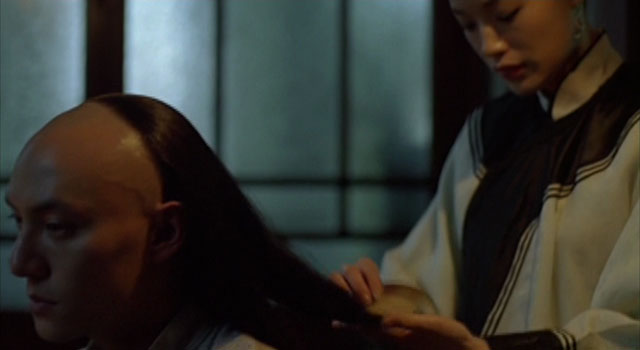
Silent with piano music and intertitles for dialogue most of the time, traditional twangy vocal music a couple of times (performed, it turns out, by our woman). She is a geisha and apparently in love with her man, though he seems to pay her little mind, focusing on poetry, national politics and the fate of another geisha. He pays for the other girl to be freed when she becomes pregnant, leaving his own girl stuck and alone when he leaves town for Shanghai. Such slow, fluid, measured movements I am sometimes not sure if Hou’s movies are in slow-motion.
image

Stylus:

Of course, the principal subject of both “A Time for Freedom” and Flowers of Shanghai is liberation—from a life of service for the long-suffering geishas, and from foreign rule for Hou’s homeland. Examining the dichotomous relationship between a wealthy activist (Chang) protesting the Japanese occupation of Taiwan and a geisha (Shu) longing desperately for a life outside the brothel, this is Hou’s most explicitly political work since his trilogy on 20th Century Taiwanese history (City of Sadness, The Puppet Master, Good Men, Good Women) and, arguably, his most resonant feminist statement to date.

image


2005: A Time for Youth

image

A confusing one – multiple girls with multiple problems, little explicit story but more detail information than ever. He’s a motorcycle-driving photographer and she’s a throat-tattooed, epileptic lounge singer with a scary website. Seemed to me the usual commentary on modern disconnection through overload of technology, not adding much besides superior cinematography, but the second time through I enjoyed it more (and figured out more, like the fact that He and She both have other girlfriends). Her girl says she’s committing suicide from neglect (touchy) towards the end. Still doesn’t have the emotional impact of the first two – I might’ve switched the order of the segments.

image

Senses of Cinema:

Hou represents this state of freedom by a narrative near-chaos transmitted with a calm and almost casual-looking inscrutability that makes the story impossible to comprehend to any satisfactory degree in just one viewing. It is ironic, though, that while an initial impression might well have been that many of the scenes are presented in a chronologically rather random order, careful examination seems to establish that the story is actually told in a scrupulously linear way.

image


Qi Shu (The Eye 2, Transporter and Sex & Zen 2) has got nothing on the career of costar Chen Chang (Red Cliff, Breath, Crouching Tiger, Happy Together and A Brighter Summer Day), but they’re both wonderful here. Story and characterizations are pretty minimal, movie gets by on weight of emotion, similar to Friday Night and In the Mood for Love – and it shares ITMFL’s co-cinematographer Pin Bing Lee, a Hou regular who also shot Air Doll and Norwegian Wood. Would look even more lovely, I’ll bet, if the DVD wasn’t all interlaced and non-anamorphic.

Won all the Taiwanese film awards. Played at Cannes with A History of Violence and Cache, Battle In Heaven and Broken Flowers, all unfairly beaten by that Dardenne movie.

Scenes from movies in the silent era, cut together to flow nicely. Music that alternates between pleasantly ambient/minimal, and sharply attention-grabbing, including cuts by Fennesz and David Grubbs. Lots of graphic, sometimes deviant, sex. Pointless quotes from ancient poetry on intertitles connect and divide the piece into sections.

image

Seemed, to me, more valuable as a collection of scenes to peruse, to marvel at these unknown early films (didn’t recognize a single shot, but then I’m no silent film scholar) than as an original piece of editing/filmmaking. It didn’t wear out its welcome, but neither was I impressed by the connections made between scenes. Maybe with access to the original footage one could better appreciate Deutsch’s contribution, besides as curator of some damned interesting old movies. Still excited to see his earlier Film Ist pieces composed of footage from scientific films.

image

More wonderful screenshots:
image

image

image

image

image

Different from the other Curtis docs I’ve seen in that it’s not assembling semi-obscure facts to analyze human/political behavior, but assembling well-known facts to create a mood, and lead to an understanding through experience. Of course I’m missing part of this experience, since the film was part of a multimedia show inside a deserted office building set to music by Damon Albarn and the Kronos Quartet.

Traces a semi-chronological historical path through key events (chimps in space), tragedies (kennedy assassinations, manson family) and future tragedies (WTC construction) but mostly uses pop songs as history, letting artist bios (tina turner, lou reed) and the lyrics themselves tell the stories of disenchantment.

image

What results has Lynchian overtones with its dark seeds beneath 1950’s suburban pop, and shades of Craig Baldwin, using newsreel montages to create new stories, to confuse and not inform. But it’s still got Curtis written all over it, in the pacing and clip selection, that old familiar typeface, and the sense that the film makes your brain understand things in ways not explicitly told by the narration, making covert connections. Most importantly, when it was over I had the same urge to immediately watch it again that I got after The Power of Nightmares and The Trap.

C. Brooker:

Where his preceding works have occasionally been a touch eccentric, this one takes the piss. It is completely and utterly demented – in a positive way. I’m not saying it doesn’t make sense; if anything, it forges its own new brand of coherence whether you like it or not. This is a documentary running on alien software. I’m at a loss to describe it. For starters, the trademark Curtis voiceover has gone completely, replaced instead by occasional, simple captions. Music is at the forefront. Ominous soundscapes and bubblegum pop weave their way around the images: archive news, Hollywood movies. It’s hypnotic.

image

Brooker also gets us some Curtis quotes. I’ve brutally edited so as not to copy his entire article:

I wanted to do a film about what it actually felt like to live through that time … Where you could see the roots of the uncertainties we feel today, the things they did out on the dark fringes of the world that they didn’t really notice at the time, which would then come back to haunt us. … The politics of our time are deeply embedded in this idea of individualism, which is far wider than … consumerism or anything like that. It’s how you feel. … But it’s not the be-all and end-all. It’s not an absolute. It’s a way of feeling and thinking which is a product of a particular time and power. The notion that you only achieve your true self if your desires, your dreams, are satisfied … It’s a political idea. … What you desire is the most important thing. But a great paradox of our time is that what you desire may not be coming from within you. … The iPhone is a good example. People really feel they want one – to express themselves. But they all want one, at the same time. Where does that come from? From within or without? Because we live in an age where the individual is paramount and everything is seen from the perspective of ‘you’, we’ve lost sight of the bigger forces at work. Which has limited us. Not only in our understanding of the world; it’s made us very powerless. I think that’s what I’m really trying to get at in this.

Curtis keeps a blog, which I need to start reading, and I’ve been watching Mr. Brooker’s own TV series, to which Curtis has recently contributed.

The Box (I)
by Richard Kelly, director of Donnie Darko

Cameron Diaz and Cyclops from X-Men are happily married with a kid in the 1970’s. Cyclops is a rocket scientist. They get The Box delivered to them by a fire-scarred Frank Langella. Should they push the button, winning themselves a million bucks and dooming a random citizen, “someone you don’t know,” to death? They do. Someone, somewhere, shoots his wife. The Box is then given to a new family, “someone you don’t know.” Movie should obviously end here, but now their son is kidnapped, made blind and deaf, and Cy can only save his son by shooting his wife. He does, as someone new pushes the button. Okay.

image

image

The Box (II)
by Richard Kelly, director of Southland Tales

Over at NASA, Cyclops takes time out from astronaut training to make his wife a false foot. He finds out Frank Langella was hit by lightning years before and replaced by a psychic alien from a society big on punishing the selfish and forcing people to make arbitrary, life-changing decisions, like the series of watery doors (cue The Abyss/Darko effects team) which lead to either hell or Cy’s own upstairs bedroom. NASA seems unconcerned with investigating any of this. Movie seems unnecessarily complicated and expensive, and parts make no damned sense.

image

Donnie’s dad!
image

I way did not notice that Arcade Fire did the music!

image