Took a van trip to Filmstreams and watched with Katy’s class. Set in Mali but shot in Mauritania, Sissako continues in his style of portraying a central character conflict (a murder over a dead cow) while frequently cutting away to daily life and smaller events in the surrounding town. In this case, the daily life segments involve their own, larger conflict: an invasion of the town by militant islamists attempting to impose their own laws. Inevitably these things collide as the invaders’ court decides to execute the herder who killed a fisherman, as well as the herder’s wife and another guy who seems to have simply given her a ride.

Promo screenshots stolen from Film Comment:

Wonders and horrors abound. An adulterous couple is buried then stoned to death. A Rooster Lady does inexplicable things. The local imam engages the invaders in futile discussion. Music and soccer and smoking are outlawed and punished with whippings, though the invaders are shown to be hypocrites in many of these cases, enjoying the same past times on the sly. Sissako makes them seem absurd, and could’ve made a comedy with some of the same material (a man is ordered to shorten his pants so he removes them; a jihadist can’t get through his propaganda video), but their frequent, meaningless acts of violence maintain an air of menace. As in Bamako he stages a song as an act of rebellion.
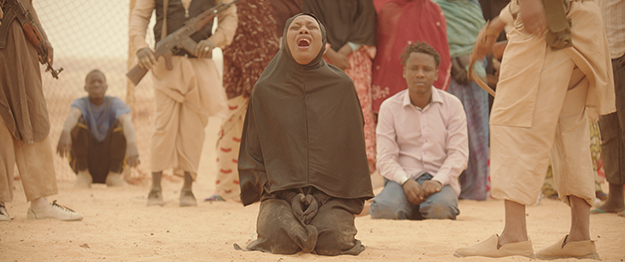
The movie keeps returning to the doomed herder and his beautiful family. Despite the repression and crime of the jihadists, it’s the herder Kidane’s murder of a fisherman who killed his prize cow which is shot as a cosmic event, ending with surely the greatest wide shot of the year as Kidane runs across the waist-deep water leaving a trail of silt, the mortally wounded fisherman struggling to his feet on the other side.

Cinematographer Sofian El Fani shot Blue is the Warmest Color, which had a very different look. The only actor I think I’ve seen before is Fatoumata Diawara, a star of Genesis, as the lashed singer pictured above.

G. Kenny:

The really killing thing about all the conflict that tears this place and its people apart is how calm everyone is about it. Nobody raises his or her voices; nobody raises a hand in impulsive anger. Violence, when it occurs, is done in a very deliberate way. The jihadists need to conduct themselves “properly,” as this conveys their rectitude. But their stance only barely disguises their old-fashioned bullying. The treatment of women in particular is just misogyny with unconvincing window dressing. The jihadist who wants the young woman in marriage expects no argument; the girl is his right. And the fact that he asks for her politely, in the logic he lays out, only underscores his alleged right. It doesn’t matter anyway; if he is refused, he calmly states, “I’ll come again in a bad way.”

Peter Labuza on The Film Stage:

There is a critique here, and it is the failure of jidhadism as a cultural translator. This comes in literal form, as numerous scenes feature the jihadis having to work through translators to make their demands. … Numerous sequences feature characters simply trying to explain their point of view to one another, but the sides clearly aren’t listening. When one man confesses his deepest and most personal want to the jihadi leader, the leader asks his translator to stop. He knows that in order to continue his fight, he cannot listen. These jihadis only see prey.

“This is a film about objects. It refers to another film about objects.”

“Negritude is an anti-racist racism. It is memory and imagination.”

We used to have this bowl!

“Western countries routinely deny Africans access to these artworks through enforced localization – no western country will grant an African a visa merely to visit a museum in Europe or America.”

Wanted to like this because of the Marker connection – it’s a response film to Statues Also Die. But it’s not for me (it’s for others!). Perhaps these others are people in the art world or postcolonialist academics with a high tolerance for black screens and long pauses.

And whatever this is:

The movie devises itself as it goes, lists off its theories and experiments. Not as elegant as a Marker film. Wonder what Campbell thinks of the opening of Timbuktu.

The least well-restored Criterion movie I’ve seen, maybe because it’s the least-worthy, mainly included in the Paul Robeson set for historical reference. Even the movie’s own DVD extras call it “embarrassing.” But Jomo Kenyatta (future president of Kenya) and Robeson were behind it at the time, believing it would turn out much better. It seems semi-competently slapped together by today’s location-shoot standards, though it was the biggest-budget British film of its time.

Robeson hails his unimpressed white rulers:

Leslie Banks, evil hunter of The Most Dangerous Game, now reduced to pleasant englishman, is Sanders, the local colonial ruler, bringing peace to multiple formerly-embattled tribes. Sandy is against slavery, but also against African self-rule, acting the father to his “misguided children”, with second-in-command Lt. Tibbets, never realizing that names like Sandy and Tibbets diminish their authority. He sounds like Dr. Moreau saying things like “I am Sandy who gives you the law. I will punish with a great punishment all those who break the law.” A smiling Robeson is one of the tribe leaders, or at least its representative to the white powers.

McKinney:

All is going smoothly until Sandy comes down with malaria and leaves town for a moment and his replacement Ferguson proves not a strong-enough father-figure to keep his misguided children from fighting. Evil King Muffuletta kidnaps and kills Fergie, and intends to do the same to Robeson’s wife Lilongo (gorgeous Nina Mae McKinney, star of Hallelujah), sending Sandy scurrying back to Africa to make peace. The music is nice, anyway, and there are nude-breasted dancing women (because Africa).

King Muffeletta gets speared:

The Trap and The Power of Nightmares felt like they presented central points (clearly expressed in the open of each episode), then assembled evidence in an orderly fashion, supporting their points in a complex, sometimes roundabout way. This one presents a number of points with related themes. Each episode opens with different titles and explores different events which don’t directly relate back to each other. During episode 2 I was wondering when the Ayn Rand story would come back, but during #3 I realized it had been there all along, that this time Curtis is drawing the connections without explicitly calling back to previous subjects all the time. The movies are starting to link together in interesting ways. At this point, you could fill an “art and world politics” course just by running all his movies and assigning his blog as the textbook.

Episode 1 “begins with a strange woman in the 1950’s in New York,” connects Ayn Rand with Alan Greenspan and Silicon Valley, tracing the failures of her personal life and lack of acceptance in her philosphies, comparing to their massive influence decades later among people in power over the global economy. Rand rejected altruism and supported rational egoism, so surprisingly there’s no relation to the RAND Corporation discussed in The Trap, which worked on game theory, positing human behavior as perfectly selfish.

Part 2 is about natural ecosystems, and the myth that they remain perfectly in balance – Curtis says more recent, complex models show them to be in constant flux. Loved the ecology discussions, the scientific project that attempted to precisely measure every detail of a particular field. This is shown alongside early communes (humans trying to live in perfect balance without power structures) and recent national revolts (glorious-looking uprisings by “the people” against authoritarian power, only to see it replaced by new authoritarian power a year later).

Part 3 discusses the social tendency to view people as individually unimportant parts of a large, self-balancing system. We get stories of a game-theory biologist and his colleagues who theorised that all behavior of living creatures is a result of the needs of their genes – more depowering thoughts. We close in Africa where another animal behaviorist, Dian Fossey, was working, showing how false theories on human behavior and evolution combined with the desires of technology companies led to disaster for the people of Congo/Zaire and Rwanda.

So the movie’s often-mentioned “rise of the machines” isn’t literal so much as a social-control concept, caused by simplifying models of natural behavior. It seems perfect that I finished watching this the day before seeing The World’s End, which is about the rise of actual machines that aim to simplify human behavior.

I also read a bunch of articles from Adam Curtis’s amazing blog – sadly without the video segments since I was sitting at the airport sans wifi. Essay called “You think you are a consumer but maybe you have been consumed” about Texas oilman HL Hunt, caricatured in Ken Russell’s Billion Dollar Brain. “The roots of so much of the distrust of the media today lie back with him and his ideas.” One called “Paradiabolical” on Somalia and Algeria, one on England’s history of bumbling spies, and one on animal shows before the rise of David Attenberg Attenborough.

A prologue, long first section, long second section – with only the middle part having sync sound. Bookend segments have spoken narration and certain (probably dubbed/foleyed) sound effects from the scene and seem better/more magical than the talkie half of the movie.

1. In Africa, depressed widower colonialist hurls himself into the crocodile-infested river. “You may run as far as you can, for as long as you like, but you will not escape your heart.”

Ghost of the colonialist’s dead wife:

2. In Lisbon, aging activist Pilar (Teresa Madruga of Silvestre) would seem to be our main character, but the possibly-senile gambling-addicted woman next door takes up much of her attention and curiosity. Aurora isn’t so nice to her maid Santa, is never visited by her children, who support her via a monthly check. Aurora takes a bad turn and sends Pilar to find a man called Ventura (Henrique Espirito Santo, a producer of Doomed Love and Magic Mirror) who arrives too late. After the funeral, he has lunch with Pilar and Santa, begins to tell them his story, after which we never see anyone from the movie’s first half again.

Aurora and Ventura:

3. We spend a year in Mozambique, with month-by-month title cards. Young Aurora (Ana Moreira of Teresa Villaverde’s films) was a famed hunter, a lone wolf who finally married, but soon started an affair with neighbor Ventura (Carloto Cotta, who played Father Dinis’s father as a young man in Mysteries of Lisbon).

Aurora and Ventura:

Their affair gets more passionate and reckless, until finally they run away and she kills the man who discovers them together. She’s dragged back to her husband. Ventura tries to claim that he shot the man, but an anti-colonialist movement takes credit for the murder, so they’re both off the hook – but they never see each other again.

Reverse Shot:

Gomes, even from his earliest shorts (which he’s dubbed musical comedies, though the music is generally piped in rather than sung, the humor dry as a bone, rather than broad) has evinced a willingness to prioritize images over dialogue, songs over the spoken word, and, above all, has maintained a sense of play entirely his own. … Tabu steals its name and chapter titles from the mystical South Pacific feature directed by F.W. Murnau, another filmmaker in thrall to the magic of movies, and produced by Robert Flaherty, the other guiding pole of Gomes’s cinema. That he’s reversed the trajectory of that earlier film, moving from “Paradise Lost” to “Found” suggests that this new Tabu is up to more than just simple homage.

He plays in a band, she listens on the radio, both crying

Slant:

This is a film in which a sullen colonialist transforms into a reptile in a tone-setting prelude. This is a film that answers its hour’s worth of affectingly humdrum urban drama with a lulling, marvelous, deeply dreamy backend. Yet Tabu’s surrealism—like its romance, its comedy, its historicism, its everything—is retained with a light touch. For all its wistfulness, Tabu never feels like a formalist, postmodern, post-cinema put-on. Gomes never feels like he’s trying to pull anything off. And so, in turn, he manages to pull everything off.

Pilar and Santa:

Gomes:

I think I make films to play music. For instance, Tabu starts with Pilar watching a movie. But that sequence was only put at the beginning in the editing room. That story of the explorer and the ghost was like a radio soap that Aurora was doing. I shot her in the studio doing Foley effects (sounds synched to the action) and the sequence was supposed to come in the second part of the film. I didn’t know where, because we didn’t have a script for the second part. I shot many sequences not knowing if they would fit in the film or which part they would fit into. In fact, when Pilar was going to the cinema—and in the script, she went three times, in the film only two—it was intended that you would never see the screen but would hear a song. Maybe this is my emotional link with cinema, that I wanted to materialize it by not showing whatever Pilar is seeing, only portraying it as a song. For me as a viewer of cinema and a listener to music, I wanted to have the same response to the sequence as I would if I were hearing a great song, not being moved by the lyrics but by a more abstract feeling one has in response to music.

Immediately reminiscent of early Spike Lee movies in style. Weirdo comedy from Cameroon. I didn’t follow all of the plot threads, but would have followed even less had we not read up on the movie ahead of time. The characters all helpfully introduce themselves to camera at the beginning, but there may be subtitle problems (“Call me GOOD FOR IS DEAD”). Somewhere in this jazzy intro, a young woman called Queen of the Hood apparently expresses a desire to experience life as a man, and so Mama Thecla transforms her into “Myguy” in a scene reminiscent of The Terminator (Myguy appears naked inside a fog-blanketed truck).

Myguy starts dating Saturday, the sheltered daughter of hard-ass local boss Mad Dog. I lost track of a couple other characters, but Mama Thecla had also transformed herself into Panka, a man who can cause other men’s penises to disappear with a handshake. She does this apparently for the hell of it, and it’s treated more as a hilarious prank than a source of terror in the community. After Saturday falls in love with Myguy, he meets Panka again and they transform back into their female selves. No word on where this leaves poor Saturday or the local men’s disappeared genitals. Audio commentary on the DVD would definitely be interesting, but alas, it’s in French.

Acquarello:

[Panka] becomes My Guy’s guide and protector to the social and sexual politics of the quarter: a self-made man who reinforces his stature by taking on a second wife, the subtle inculcation of Christianity into daily life, even as the people continue to practice traditional – often conflicting – customs, the marginalized role and maltreatment of women that sharply contrasts with their real roles as family nurturers and community builders (and, as in the case of Mad Dog’s exiled first wife, literally feeds society when she sets up a vending stand near a high traffic street). As in [Spike] Lee’s films, Bekolo uses archetypal characters, informal fourth wall address, jaunty camerawork, and integral incorporation of pop music to illustrate the paradox of social and gender inequity and anachronism of contemporary life in post-colonial Cameroon.

Katy liked that it referenced American culture (Denzel Washington, Michael Jackson’s African influences) and America’s view of Africa (starving children).

Or, Django Chained… and raped and tortured, branded, starved and left for the vultures, raped some more, and whipped and whipped and whipped.

A desperately unpleasant slavery movie with a slight framing story (present-day photo model shooting on a historic slavery site gets sent back in time by a meddling drummer named Sankofa to experience slavery). At least it has a happy ending, as the remaining slaves (after some are killed or sold) attack their masters with machetes. It’s all very well-shot for an indie movie, and the actors are playing their hearts out. But Gerima is trying to make an Important Statement Here, and so the story becomes a humorless exercise in tedium.

A young white woman named France (Mereille Perrier of Boy Meets Girl) hitching rides through Cameroon flashes back to when she was young and Isaach de Bankole used to feed her ants. Her dad (Francois Cluzet of Chabrol’s L’Enfer) was a colonialist governor and Protee (Bankole) their house servant.

Protee and mom:

When dad attends to local and distant affairs, France and mom (Giulia Boschi) and Protee stay home showing each other displays of power and hidden attraction. A nearby missionary is having a difficult time because lions have killed all his farm animals. The house chef pretends to consult his cookbook, but can’t read.

Young France:

Finally a Big Event: a plane crash-lands nearby and the pilot and passengers stay with the family while getting parts and repairs. Their stay causes all sorts of racial tension. A self-important coffee-grower has a weird relationship with his black housekeeper. One of the white passengers works on the plane with the black locals, eventually starts sleeping and bathing outside, getting on Protee’s nerves. Some of the passengers are more blatantly, vocally racist than the family is used to. Protee is kicked out of the house, plays a weird trick on the little girl where they both end up with their palms burned.

Older France:

Senses of Cinema: “a semi-autobiographical film that functions as a political allegory examining gender, age and colonial relationships.”

Raised by missionaries into a white colonialist culture, removed from his cultural and racial heritage and emasculated by the domestic duties he performs, Protee is a liminal figure trapped between two cultures. This is clearly signified by the arrival of Luc (Jean-Claude Adelin), a young lapsed priest who lives, eats and showers outside like the native servants. Luc threatens Protee, upsets the fragile equanimity, and induces Aimee’s betrayal of Protee and in turn Protee’s betrayal of France. This moment of betrayal explains the transformation in France’s gaze from the innocence and intensity of a child to the cynical wary gaze of an adult remembering and re-examining a complicated past.

A simple story with just a few main characters, which Denis lovingly photographs, obscures and abstracts. Unlike many of her others, it’s almost immediately easy to grasp this one’s character relationships, which may account for its higher reputation than her later films, or probably it’s just this one’s timing, exploding her international festival/critical reputation. Not that I mean to be ungenerous to Beau Travail – it’s terrific, and must have one of the best film endings of the 90’s.

Based on Herman Melville’s story Billy Budd. Commandant Michael Subor (The Intruder) leads a French foreign legion camp in Djibouti. Denis Lavant (Lovers on the Bridge) is training a bunch of men. But Lavant feels that he’s losing authority to new guy Gregoire Colin (35 Shots of Rum), so he looks for an opportunity to strike back. That was my interpretation anyway, but looking through comments of other filmed versions of Billy Budd, it seems that his motivation is never quite clear. Either way, he sends Colin on a doomed hike through the desert. Presumed to have killed the recruit (we later see Colin gettin rescued), Lavant is dismissed from the armed forces and set to be court-martialed. And just when you’re wondering why cast the great Denis Lavant as an immobile authority figure, he breaks out into a crazy awesome fantasy-sequence dance.

Doesn’t seem to follow the novel’s plot too closely – in the book, Budd is executed for accidentally killing a superior officer, while here he saves a man and kills nobody. The book was turned into a famous opera, and Denis uses songs from that instead of her usual Tindersticks. Mostly, she turns the story into an abstract dance of bodies in the desert, with emotions felt rather than explained.

J. Rosenbaum:

The fact that [Subor] is named after the hero of Jean-Luc Godard’s Le petit soldat and played by the same actor almost 40 years later adds a suggestive thread… Most of all, Denis, who spent part of her childhood in Djibouti, captures the poetry and atmosphere — and, more subtly, the women — of Africa like few filmmakers before her.