I probably shouldn’t say I watched this at all, since I was focusing more on cutting out CD tracklists than on the screen, but I looked up often enough for this to remind me of Chop Shop. Seemed like one of the modern indie movies that are trying to outdo each other with their raw realism, with traces of The Wrestler follow-cam. I’m not so into the gritty Dardenne school, but this didn’t overdo it. Sugar dreams baseball, makes furniture, gets into the U.S. major-league farm teams, is the next big thing, then thinks he’s losing his edge so runs off to NYC to work on furniture, play small-time ball in his spare time.

Regular collaborators Fleck and Boden are both credited as director, but Fleck took sole director credit on breakthrough Half Nelson so Boden doesn’t get as much mention in the reviews. I don’t know who either one of ’em is, so it’s all the same to me.

Cinema Scope liked it, said they “pared down the dialogue, kept the plot off to the side, and invested everything in looks, gestures, space, and atmosphere.”

Pol Pot’s Birthday (2004, Talmage Cooley)
In 1985, the scrappy dictator’s men throw him a super-weak budget surprise birthday party, with grey cake and music on an old tape player. Awkward conversation ensues… P-P gets peed on by a dog and “Walking On Sunshine” plays over the credits. Kim Rew got paid?
image

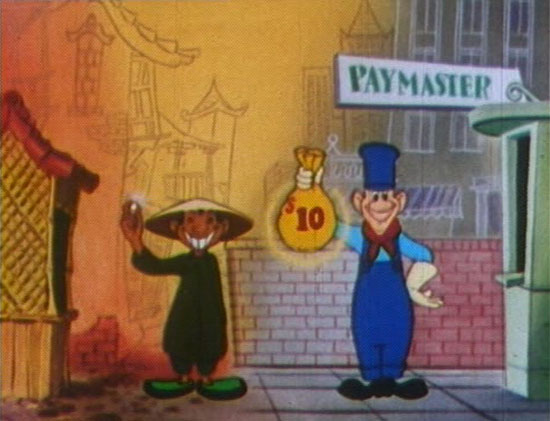
Meet King Joe (1949, John Sutherland)
More generic propaganda with no direct sense of purpose. Joe is “the king of the workers of the world” because here in America, competition and investment in infrastructure make our jobs easier with more disposable income than anywhere else. Take that, dirt-poor chinaman! Statistics to be proud of: “Americans own practically all the refrigerators in existence. Bathtubs? We’ve got 92% of them.”
image

Hymn to Merde (2009, Leos Carax)
I agree that Merde/Lavant is wonderful to watch, but Carax doesn’t seem to know what to do with him. Protracted death-sentence courtroom drama wasn’t it, nor is a lo-res music video of him singing a Kills song translated into his own head-slapping language.
image

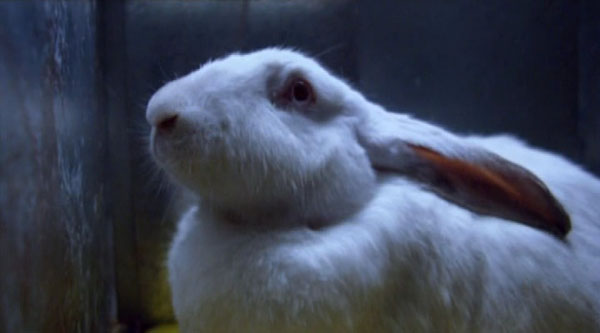
.tibbaR (2004, Leo Wentink)
Eerie music and nervous sound effects accompany time-remapped footage of lab rabbit breeding. I never know why anything is happening in short films anymore.
image

Go! Go! Go! (1964, Marie Menken)
So damn jittery it gave me an eye-ache, exactly what I was getting away from the computer in order to avoid. All nervous time-lapse footage shot around the city. Some real nice high-angle shots of construction sites and traffic patterns, superimpositions on a wedding, lots of boats and bridges. Color/picture looked perfect on my tube TV.
image

The Spook Speaks (1940, Jules White)
Not-at-all-good short full of corny sound effects and sub-stooges gags, but it’s better than the others I’ve watched on these DVDs since it has a roller-skating penguin. Buster’s costar Elsie Ames (she was in most of these shorts, then showed up 30 years later in Minnie & Moskowitz for some reason) is terrible, but then, Buster is terrible too. Thanks Sony for slapping warnings and disclaimers and legal shit before every short on the disc. They must’ve known it wouldn’t get tiresome because we’d only watch one before quitting.
image

Who Am I? (1989, Faith Hubley)
Things morph into other things, illustrating the five (or six or seven) senses. Short!
image

Blake Ball (1988, Emily Hubley)
Didn’t love the narration in this one. The woman who says “some are born to sweet delight/some are born to endless night” (without the preceding lines) has got nothing on Nobody. I guess all the lines are the words of William Blake, but they’re not making much of an impact, and I never figured out Blake’s connection to all the baseball stuff. There’s more five senses stuff anyway. A bit too laboriously new-agey, but some great moments (like below).
image

O Dreamland (1953, Lindsay Anderson)
Boy did I ever botch the Free Cinema box set, buying it then deciding I didn’t want to watch it after all and letting it sit on the shelf for years. Finally checked this out and I kinda really like it. Could do without the evil laughing clown all over the soundtrack. Kind of like Jean Vigo’s À propos de Nice which, given If….‘s resonance with Zero For Conduct, proves Anderson saw a Vigo retrospective at some point.