Bead Game (1977, Ishu Patel)

Stop-motion beads create a series of creatures devouring each other until inevitably, as most animated films do, it becomes a cautionary tale about senseless human violence. Really impressive work, fast and complex, synched to a percussion soundtrack, and I don’t know how they got that 3D light effect in the final minute. Up for the oscar that The Sand Castle won.


Paradise (1984, Ishu Patel)

A completely different kind of thing, bright 2D animation, frames fading into each other to create a slow dreamy blur-motion on everything. All very bird focused. A black bird flies into a magic castle made of a million points of light and sees a human king and a parade of colorful exotic birds. Back in the real world he brutalizes all the local birds and flowers, stealing colors and patterns and props to make himself look prettier, does a crazy dance for the king who locks him outdoors in the cage of shame. After escaping, I guess he lives in harmony with his fellow wild birds. Lost the oscar to a shorter British thing I haven’t seen.


Labirynt (1963, Jan Lenica)

This is exciting since I’ve watched the Lenica & Borowczyk shorts but not any of his solo work. Man in a wingsuit descends into the city and hides from various beasties and sees different animal-based horrors. Surreal low-motion clip-art animation, full of birds and moths and traps. He’s finally captured, scanned and identified, rescued by his hat-bird, then shredded when he attempts to escape in the wingsuit. Verdict: cool. This won a prize at Annecy, where Borow also won for his Concert de M. et Mme. Kabal.


The Cameraman’s Revenge (1912, Wladyslaw Starewicz)

One-ups the Lenica by using actual dead bugs (with wire legs) as stop-motion puppets. A cheatin’ movie, a couple of beetles make out with other bugs and get caught. A jealous grasshopper films the husband with a hot dragonfly – including through their hotel keyhole – and projects it when the beetle couple go to the movies, causing a riot that ends with the beetles in jail. Robert Israel soundtrack on the now-rare DVD.


The Frogs Who Wanted a King (1922, Wladyslaw Starewicz)

Clay frogs, a hundred times more expressive than the insect cadavers. Fed up with democracy, the frogs pray to the gods to be sent a king. He sends them a stone idol and they get pissy, so he sends a stork which eats all the frogs it can find. An original Aesop fable (he sent a water snake instead of the stork).


Little Bird Gazouilly (1953, Wladyslaw Starewicz)

I can’t resist watching another bird short and catching Starewicz forty years later. It’s a beautiful one, adding camera movement to the complex stop-motion. Baby birds are born in the trees over the city, and the bulk of the story follows their first day in the human world, getting into hijinks. A bird gets mad at a mirror, just like my birds did earlier today. Wladyslaw had moved to France after 1917, and this film and many more were co-credited to his daughter Irene.


There Will Come Soft Rains (1984, Nazim Tulakhodzhayev)

Opens with an egg, but it’s not another bird movie, it’s a breakfast-making machine. The humans have disintegrated but the household automation carries on. The concept (by Ray Bradbury) and illustration is cool, but the animation is nothing much. Aha, it’s a bird movie after all, as a bird flies in the open window while the automation is celebrating the new year 2027, and the anti-intruder robot arm tears the house apart. It doesn’t end great for the bird either.

Symphonie Diagonale (1924, Viking Eggeling)

Patterns of curved and diagonal lines rhythmically shift and unmake themselves. Good modern soundtrack by Sue Harshe.


My Childhood Mystery Tree (2008, Natalia Mirzoyan)

A Russian kid whose main fear is that hawks will steal his teddy bear has an intricate dream of human-held cities of junk collectors atop a giant tree. After a dogged chase, he refuses to give up his bear when asked, leading to the collapse of their entire owl-bug society.


Kitty Kornered (1946, Robert Clampett)

Porky has too many cats, tries to put them out for the night but they revolt and take over the house. I like that the red-nosed cat’s whole personality was “the drunk one.” Their leader is a proto-Sylvester. A shadow-puppet dog and a martian invasion get involved.

We’ve been watching bird movies. Here’s a final roundup.


Alone Among Birds (1971, Janusz Kidawa)

Ornithologist Jerzy Noskiewicz lives on a nature preserve on a West Polish lake, watching and tagging the local and migrating birds. Beautiful and very birdy short, divided into chapters, with big doom music.


Ptaki (1963, Kazimierz Karabasz)

Much more bird-appropriate music here, with light guitars and woodwinds. Doc of a homing pigeon competition – the pigeons are trucked away from their starting point then fly back and get ranked on speed. After the birds’ release the movie flies back home itself, showing a birds-eye view via aircraft. All their legbands are removed by the judges, so how does any breeder get their own bird back?


Ptak (1968, Ryszard Czekala)

Opens with a beautiful animated bird made of free-floating triangles before following a lumpy crosshatch man with weird fingers who runs the public toilets. The man is in trouble with the government, and either the toilet job is his punishment or he’s paying the fine with toilet money. He frees the bird in the end. I didn’t get it. I saw Czekala’s The Roll-Call a few years ago, and he’s kind of a depressing dude.


Birds (1968, Frans Zwartjes)

Trix is bobbing a toy bird on a string, but every five seconds the camera flash-edits to her bare legs instead, and back, and again, until despite the film’s short five-minute runtime, even Trix gets tired and goes to sleep.


Los Pajaritos (1974, Antonio Mercero)

Air pollution montage then a bunch of dead birds, oh no. Royally costumed dude trades his getup for one of the last living birds, a woman with finely sculpted hair gets the only other bird in town, and they both lose their birds and give chase to recover, until they meet up at the park with two birds, making plans to flee the city. A silly dystopia, everything over-punctuated – I guessed it was by the Telephone Box guy pretty easily. Her bird chase is fun, using ever-larger chase vehicles, recruiting everyone she sees to help, and apparently having a grand time. Both leads also appeared in Luis García Berlanga’s Placido.


Birds (2012, Gabriel Abrantes)

Meeting scene in a Haitian forest with halting dialogue. Second movie of my Birds series where someone’s spouse is transformed into an animal – this time a goat. Good closeup of a buzzard, then into town where everyone is jumping and shouting in full bird costumes. Meta-conversation accusing Abrantes of using “shitty theory.” Maybe it’s an arthouse/festfilm parody, I dunno.


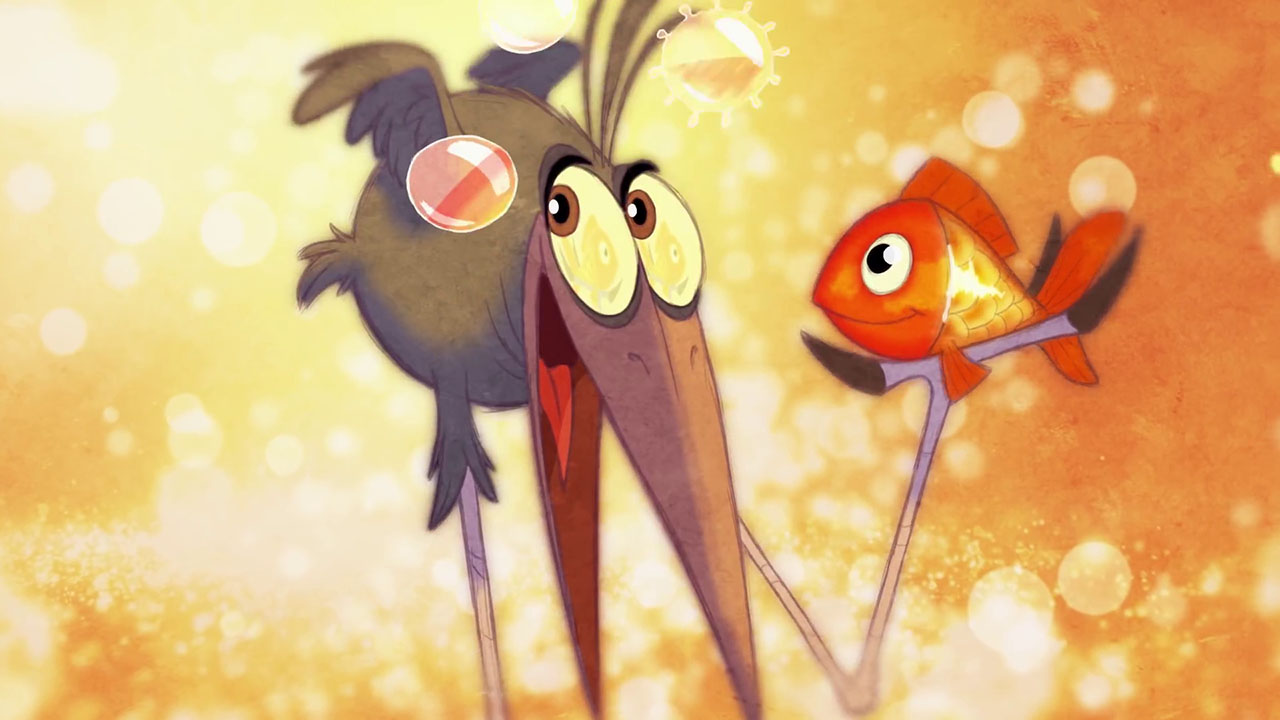
Bird Karma (2018, William Salazar)

Short, snappy and cartoony, produced by Dreamworks. Water bird has all the fish he can eat, but goes after the magic golden rainbow fish. Salazar worked on this year’s oscar short winner The Boy, the Mole, the Fox and the Horse.

The Emperor’s Nightingale (1949, Jiri Trnka)

Live-action, a pent-up litle kid prevented from going outside or ever having fun gets a mechanical bird, then has a fever dream that all his toys come to stop-mo life. He proceeds to imagine that the emperor of China feels the same way, lives in a house of riches but never gets to have any real experiences. When the emp hears of the existence of nightingales, he demands one. The most accurate part of the story is when the emp gets into birds, so at his next birthday everyone gives him bird-related things – including a mechanical nightingale which glitters and sings so perfectly that he has no need for the real bird, but eventually the machine’s perfect unchanging song has the emp decrying “music without life, without meaning,” getting physically ill over the idea, until the real bird returns and heals all with its song.

Some motion and interlacing problems on my video copy – the English version adapted by Pulitzer-winning children’s author Phyllis McGinley and read by Boris Karloff. The music, by Trnka’s regular guy Václav Trojan, had a theme that sounds like “My Country ‘Tis of Thee.”

best bit is the court scientist, interrupted while counting stars, has to start over:


Water Birds (1952, Ben Sharpsteen)

You had me at “naked baby pelicans.” Disney setting nature scenes to wild music, synched to the picture like a cartoon. I disagree with the narrator calling flamingos “awkward and grotesque,” otherwise this is good, and at the end it stitches various bird movements into a ballet montage.

Narrator Winston Hibler had been a writer on Disney animated films since the late 1940’s and both Sharpsteen and composer Paul Smith had worked on Pinocchio and shorts since the early days. Editor Norman Palmer (later The Shaggy D.A.) was the new guy on the team. A ton of credited photographers, at least two of them from Wisconsin, which is where I’m writing this now. Won a two-reeler oscar against a whale hunt, a traffic safety film, and a British short that absolutely nobody remembers.


Ballet for Birds (1975, Beryl Sokoloff)

There are plenty of gulls, a piper or two, but Beryl is equally interested in the crashing waves and in passing jets. Without a zoom lens or any sustained interest in a single creature or group, we don’t get too close to any bird (or jet). Editing isn’t especially to the music/rhythm. At the end the camera gets distracted by the distorted reflections of passing humans in a curved mirror.

Set to Stravinski’s 1945 “Ebony Concerto” (which has been used in ballet). Sokoloff had been making 16mm shorts since at least the early ’60s – a Time writeup says he was “sympathetic to the aesthetics of excess.”

AKA the Egyptian chicken movie. A guy setting himself on fire is quite a prologue. During a birthday party magic trick, the husband goes into a box, chicken comes out, embarrassed magician can’t undo it. The wife then mutely chases after the magician, getting screwed over by her landlord and friends and associates. When the chicken gets sick, she helps it recover. When she reports her husband missing so her son can take his factory job, the cops give her a comatose homeless man. We get more than enough shots of her standing perfectly still looking dead inside, and not enough exploration of the chicken-ness of the husband – it’s less a bird movie than a missing husband movie.


Birds of a Feather (1931, Burt Gillett)

Significantly better and more chicken-focused than the feature, one of those early Disneys where all the woodland creatures move and sway in time with the soundtrack, doing little species-specific actions. Belated drama of banding together to rescue a stray chicken from a hawk, including a great POV-attack shot. Minor message that polluted lakes harm the geese, thanx. IMDB says Eisenstein was a fan.

Daniel Fienberg in Hollywood Reporter:

Depending on your level of investment, All That Breathes could be a documentary about climate change and the crucial need to understand how animals are adapting and how humans need to adapt. It could be a spiritual piece about the webs of synergistic connectivity between, well, everything that breathes. It could be a humanist meditation on how we treat each other, how we tear people down by comparing them to animals, but how really we should treat everything and everyone just a bit better. Or it might just be 91 minutes with a couple of brothers who really like birds.


Bird Suite (1994)

Semi-anonymous Australian VHS, following our bird theme. A solid hour of birds doing bird things, with no titles or narration, just symphonic music. Great work showing birds hanging in the air, a good segment showing different species in apparently natural environments in close-up then zooming out to show they’re in a human city. It also made pelicans look graceful, which is an achievement.

Hands flipping through archival media, yep.

Postapocalpytic framing story, check.

Much of the movie is people holding up objects, more exciting stuff than D’Ambrose.

People singing bird songs in resonant rooms.

In chapter 1 we only hear birds… in chapter 2 we finally see some.

I liked this better than most people did. It’s the rare bird movie that follows through on its title. We are celebrating the video release of All That Breathes with a festival of bird movies, beginning with this one.

First movie of 2023, if anyone is keeping track, and off to a shaky start. This was on the Sight & Sound list, and of course I’ve always been curious about the movie where a boy befriends a hawk. But I also know about animals in movies, and assumed the hawk has to die in the end, which it does. At least, per imdb trivia, it’s the favorite film of both Krzysztof Kieslowski and Karl Pilkington.

British adults are authority-obsessed obstructionists, and Billy is a smart, resourceful kid who gets into kestrels, then steals a chick and raises it. He steals something in every scene, so the adults have reason to be suspicious of him. Billy gets brief fame at school, the others impressed by his pet hawk, until his older brother kills the bird. If the movie is about anything, it’s that institutions fail us and birds are beautiful. I hope England sinks into the sea (but slowly enough for the birds to relocate). The kid kept acting, was in an All Quiet on the Western Front remake with Donald Pleasence and Ian Holm.

It’s taking a while to get through SHOCKtober writeups, ain’t it?
Here’s the rest of the Guillermo del Toro series.


Pickman’s Model (Keith Thomas)

Handsome Christian-Bale-ish lead guy Ben Barnes (of a Dorian Gray movie) is intrigued when older Crispin Glover joins his art class, drawing unspeakable horrors in cemeteries and saying stuff like “suffering is living.” Years later, Ben is still hanging around drawing rooms boring people about the values of modern art, visits the insistent Crispin’s studio, discovers the guy didn’t have a wild imagination but was realistically drawing the beasties emerging from the well-to-hell in his basement.

Keith Thomas? Hardly a master of horror, he made this year’s Firestarter remake (Filipe review: “very uninspired product… cheap and ugly looking.”) Here he makes every actor look foolish, and overdoes the sound design, though the subtle motion in the drawings was neat.


The Viewing (Panos Cosmatos)

I knew who directed this one as soon as the Oneohtrix music kicked in. Four TV talk-show guests are invited to rich Peter Weller’s new age bunker: music producer Eric Andre, alien astrophysicist Charlyne Yi, novelist Steve Agee, and ESP expert Michael Therriault (of a recent Chucky movie). Sofia Boutella is there somehow, and a henchman from Books of Blood. They enjoy their host’s special whiskey, magic joint, cocaine and fairy dust, and sinister alien meteorite… then some of them melt or explode, and the rest fight for their lives to escape. Fuckin’ cool.


Dreams in the Witch-House (Catherine Hardwicke)

Sharp-eyed readers will notice that I’m tagging these posts “Masters of Horror,” because really, what’s the difference between the two series? This is a special crossover episode, since we saw Stuart Gordon’s version of the same Lovecraft story in 2006. That was the end of practical effects creativity, and though the 2006 rat-person wasn’t brilliant work, it’s miles better than the lazy bullshit computer-rat in this version.

But I get ahead of myself – first Rupert Weasley grows up caring about ghosts after seeing his sister die, works at a brokedown spiritualist society, checks into a house where a woman who claimed dimensional travel once lived. There he has sleep paralysis and is visited by a cool witch and the aforementioned bullshit rat. Second episode this week about otherworldly paintings, as Rupert is warned the witch will kill him by sunrise, and this proves to be true, but I think he manages to resurrect his sister in exchange. Some good cursing, at least.

I was not hoping to be reminded of The Blazing World:


The Murmuring (Jennifer Kent)

As someone who rarely goes a day without singing “Murmuration Song” to my birds, a story about a bird-watching couple would be right up my alley. The pair (Essie “Babadook” Davis and Andrew “Walking Dead” Lincoln) are haunted by the ghost of their past (their kid died) and also by literal mother/son ghosts, with increasingly intense visits (not Jennifer Kent with a parental trauma movie). They’ve brought portable recording equipment to an island (reminiscent of Fire of Love) to study sandpipers when Essie starts sidetracking into ghost drama. It’s my first shocktober in our new old house, and all the stories seem determined to tell us that old houses are full of harmful vibes.

Invocation (2013, Robert Morgan)

Robert Morgan is back, baby! Or rather I’m back at his vimeo, watching some recent-ish stuff. Incredible couple minutes here of meta-stop-motion. The animator bleeds into his camera, inadvertently causing the filmed frame images of his stuffed bear to become flesh, birthed from the camera, which then destroys the animator and stop-motion-animates the human body before the camera (and before the animator’s flesh-birthed in-camera avatar). Takes less time to watch than to explain. The actor-animator Robin King has made some intriguing-sounding shorts himself.


The Ossuary (1970, Jan Svankmajer)

Time to rewatch some ancient Jan Svanks which I’ve completely forgotten. He sets up the scene outdoors, then goes bananas when he gets inside this church made of bones. The photographer was alone, but the audio is a tour guide explaining it all to a group of unseen kids… one of whom is coughing incessantly in a confined space full of the bones of plague victims, argh. The tour is broken up the the sounds of a squeaky bicycle. Rating: 10 out of 10 bones.


The Fall of the House of Usher (1980, Jan Svankmajer)

A decade after the Ossuary but the same idea – Svank alone in an empty old place, no humans are seen as we hear dramatic stories on the audio. This time it’s a rushed narrator reading the wordy Poe story while Svank’s camera reels seasick around a house, and the objects inside are less ancient and precious, so the animators can destroy them in stop-motion (a hammer’s wood handle, and in the final seconds a stuffed raven) or cover the floor in mud and make fun patterns. Poor Usher apparently buries his sister alive then dies of shock in front of his narrator friend.


Belial’s Dream (2017, Robert Morgan)

“Belial, the deformed conjoined twin from the Basket Case series, has a strange dream.” More stop-mo monstrosities, this trounces the original movie.


Down to the Cellar (1983, Jan Svankmajer)

Girl goes to the cellar to get a basket of potatoes, but she’s haunted by a cat in the walls, self-propelled potatoes and shoes, and coal-obsessed basement-dwelling neighbors. She almost makes it back upstairs, too.


The Pendulum, the Pit, and Hope (1983, Jan Svankmajer)

Dual adaptation, stitching stories by different authors. First-person narrator is tied beneath the pendulum blade, frees himself by smearing delicious glop on the ropes for the rats to chew through, defeats the flaming clockwork demon walls from closing in and forcing him into the pit, flees down the halls and escapes through a hole to the outside, where he’s accosted by an evil monk.

Pendulum:


Tomorrow I Will Be Dirt (2019, Robert Morgan)

An authorized, stop-motion sequel to Jörg Buttgereit’s 1993 film Schramm. That is by the guy who made Nekromantik, so I never planned to watch it. The feature must end with Schramm dead, because this short follows his hellish afterlife, smashing himself in the face and dick with a hammer before getting eaten by a vagina dentata. Verdict: cool.


The Flat (1968, Jan Svankmajer)

A more pranksterish version of Pit/Pendulum/Hope, a man in an apartment full of traps, nothing as solid as it seems, trying to have a meal and a rest. One of Svank’s best live-action/stop-motion blends. Threatens derailment when a man enters with a chicken and a hatchet, but the chicken survives.


A Quiet Week in the House (1969, Jan Svankmajer)

Man is hiding, surveilling house, then breaks in with his equipment to spend the week, each day drilling a hole in a different spot and observing stop-motion antics.

1. screws escape from their candy wrappings to sit atop typewriter keys
2. sentient tongue grinds itself into bullet casings
3. wind-up bird eating beans causes the cabinetry to shit in revolt
4. pigeons fly into offscreen shredder, feathering a chair
5. suit jacket siphons water from potted plant then pisses itself
6. spool of wire picks lock to cabinet of body parts and winds itself horribly around them

Then the man wires the six holes with dynamite, sets a timer and runs for the hills. Technically, his segments have amateur-looking editing and projector noise, like he’s being followed by a guerrilla crew. The six animation pieces have weirdly blended frames, like someone screwed up their pulldown settings in handbrake, and that someone may well have been me.