This is the real stuff, pre-Lynchian eccentricity (even art directed by Jack Fisk) with rich color, good eerie music and some quirky sound editing.

Marianna Hill (Blood Beach, Schizoid) is seeking her missing dad, finds a hotel room throuple (Joy Bang of Night of the Cobra Woman; Anitra Ford of Invasion of the Bee Girls; Tiresome Tom) in the middle of interviewing freaked-out Elisha Cook, who says she’d better kill and burn her dad if she finds him. Anitra ditches the group now that Tom is slobbering over the new girl, she flees a rat-eating albino then comes across a gang of locals eating raw meat at Ralph’s, so they grab and eat her instead.

Marianna finds dad’s house and his diary entries about gradually turning into a zombie. She’s not doing so well herself, vomiting up bugs and lizards. Tom hasn’t adequately explained himself, claims to be just an art dealer, but knows that the bleeding eyes indicate a transformation is starting. Sometimes zombification takes long enough to leave behind an entire diary, sometimes it happens real fast (a cop changes sides mid-shootout). Dad Royal Dano (Gramps in House II, the farmer in Killer Klowns) finally comes home to provide an 1870s backstory flashback about a dark priest hiding in the sea. But it stays compellingly mysterious because none of these things exactly come together – even the DVD commentary guys agree that it’s never clear exactly what’s the deal in this town. The directors getting kicked off the movie before the editing couldn’t have helped.

Royal Le Fou, he blue himself:

All sorts of weirdos show up in this. The first victim is Walter Hill, a rude art gallery guy is Morgan Fisher, a murdered mechanic was the killer Santa from Silent Night Deadly Night. Huyck directed Howard the Duck, which I’m not keen to revisit even though I enjoyed it when I was ten, and with Gloria Katz he wrote Radioland Murders and Temple of Doom. Elisha was prolific – it’s exciting to think I’ve got 100 more Elisha performances to go.

A follow-up to last year’s program, with some non-’73 films added for context.


Heavy-Light (1973, Adam Beckett)

Video ghosts pong across the screen then engulf it, again and again with different RGBs and forms, sometimes in sync to the electro-spectral music. Adam seems cool – he was an animation pioneer who worked with the Hubleys and on Star Wars, and died young in a fire. Music by Barry Schrader, president of the electro-acoustical music society, who has recently worked with Wadada Leo Smith.


Evolution of the Red Star (1973, Adam Beckett)

After a Chairman Mao intro we get rippling pen and paper red/blue line worms slowly blobbing across the screen, the shining red star and other geometrical pulsars holding fast in their spots. In the second half someone seems to be tweaking the settings on their tube TV until the rich color of the red star is restored and takes center stage again. Music by another electro-acoustical pioneer, Carl Stone, whose last few albums made some major top-tens.


Diary (1974, Nedeljko Dragic)

Man is walking, then driving, going through as many transformations as the animator can dream up. Party and city scenes, mouse chasing cat, wild color shifts. English words and letters threaten to transform all people into language, but abstract forms win the day, and the man looks miserable about it. Better music than usual, always changing forms to suit the visuals. Won the grand prize at Zagreb.


Production Stills (1970, Morgan Fisher)

Simply a film documenting its own making in real-time. We hear the crew working and discussing and see flashes as someone takes polaroids then pins them to the wall in front of the film camera. Reminds me of Michael Snow’s book.

P. Adams Sitney on Fisher: “Very quickly he became the most academically reductive practitioner of minimalist filmmaking … steadfastly resisted the sublime. Instead, he invented cinematic paradoxes.”


Picture and Sound Rushes (1973, Morgan Fisher)

Fisher gives a a film technique lecture about picture and sound sync, reading from notes at a desk while an 11-miute timer counts down. We keep losing either sound or picture or both, as he explains why this will happen, breaking down the film’s structure – we lose sound and can’t hear the full description, but we’re also seeing it in action, so we can piece together the missing information. Self-reflexive structural pranksterism – the film is a lecture on itself and a demonstration of its own techniques.


The Wilkinson Household Fire Alarm (1973, Morgan Fisher)

One-minute take of a rotating fire alarm which starts spinning then loses momentum like a wind-up toy.


De?licieuse catastrophe (1970, Piotr Kamler)

Very blobby 3D scenarios. Person wearing bootleg liquid-engorged optical-illusion sweater engages with the Q-Bert bouncing sphere and plays his horn for a dust sprite until the electro-score gets stuck in a loop and the whole world overflows. The music is by – you’re not gonna believe it – an electro-acoustical pioneer, Robert Cohen-Solal. Kamler was Polish but his whole film career was in France


Cours de secours / Heart of Relief (1973, Piotr Kamler)

Ornate cut-out cyclist balancing act upon a tug-o-war rope. Chess players atop the circus stack escape via light-balloon to correct imbalance caused by clockwork romantic pursuit so they can return to their game. Score by Francois Bayle, a “major figure” in electro-acoustical music.


Le Pas (1975, Piotr Kamler)

Papery sheets peel off from the gleaming pink surface of a cube and land neatly in a new spot until the entire cube is transposed. A couple sheets stay airborne caressing each other in a film-edit lock-groove but eventually rejoin the cube. The sound is ethereal shimmers by Bernard Parmegiani, whose diverse body of work is mainly dedicated to electro-acoustical music.


Orb (1973, Larry Jordan)

Following up Our Lady of the Sphere, more play with cut-out illustrations. Epilepsy-sun becomes balloon, ancient statues join an RGB disco, everything kinda floats away into space.


Once Upon a Time (1974, Larry Jordan)

The same colors from the last movie with more direct music and less direct visuals. Narrated story about hearing a bird. Another voice, now it’s a radio play with a woman asking a bird for help finding the missing prince – she locates him in the bardo and says he must be born again.


World (1970, Jordan Belson)

Sphere-lens smoke, the universe in a crystal ball. Sunflower spot patterns, TV static eyes, ink-blot anemone. A really good one. Wiki says Belson and Harry Smith got their start at the same time, but it’s Larry Jordan who reminded me of Smith… also says Belson did effects for The Right Stuff, that movie keeps coming up lately. P. Adams Sitney says this one is constrained “by a banal musical soundtrack,” says the abstract geometry recalls Allures.


Meditation (1972, Jordan Belson)

Symmetrical spark shower, crashing waves, a human diver, then back into the ether, sphere-blobs slowly becoming other terrains and galaxies, the audio striking bells ringing long notes.


Light (1973, Jordan Belson)

Piano score, very water-surface-looking light patterns, then wind, then rising sun. Blooming patterns as the music turns dark and electronic, harp with abstract forms in outer space, finally lens flare leading to fiery apocalypse. Can’t figure out how he did any of this.

As I said, reading the Canyon Cinema book just made me want to see more of their films, and so I held a solo screening of some video reproductions of films from their archives.

Notes on the Circus (1966, Jonas Mekas)

Doc footage from his seat at the Ringling Bros. circus, edited to a pulp after the fact, divided into four sections.

1. nervous, jittery views of circus acts: trapeze, clowns, animal acts.
2. more of the same, but towards the end of this section the editing goes hyper and adds superimpositions.
3. picks up where the end of 2 left off. This is likely more fun than an actual circus.
4. all energy, focus be damned.

The guitar/harmonica folk music worked pretty well alongside the images. Mekas repeats songs just as he repeats shots (the same woman doffs her white coat and ascends the trapeze at least three times).
Canyon claims “no post-editing of opticals,” so was he rewinding and re-exposing the film while sitting at the circus?

Here I Am (1962, Bruce Baillie)

A pre-Wiseman verite doc on a local school for mentally disturbed children. Why is the caretaker giving the kids cigarettes?!? Non-sync sound (no narration) with added cello. Nicely paced, and very well preserved. Canyon called it “never before released,” but before when? The DVD notes say it was part of a homegrown newsreel program. “Like the school itself, the camera gives the kids center stage and moves at their pace.”

Fake Fruit Factory (1986, Chick Strand)

Shaky, handheld doc of women who work at the titular factory, talking about sex and food and work, interrupted in the middle by their annual picnic. Non-sync sound, I think – hard to tell since close-ups of hands and bodies and fake fruit are favored over faces. Canyon gets the title wrong on their website and botches the description. Wasn’t Strand one of their founders?

SSS (1988, Henry Hills)

Oh wonderful, a dance film. Many dancers in many locations, all wearing hilarious clothes, rapidly edited in a pleasing way, punctuated by a few seconds of black every once in a while. Best part is the music, orchestral then cartoonish, sounds like a DJ with some electronics, all by Tom Cora, Christian Marclay and Zeena Parkins (and recorded by Kramer). Canyon says “filmed on the streets of the East Village and edited over three years.”

Money (1985, Henry Hills)

No music this time, but lots of musicians and some dancers. Seems like a hundred people on the street were interviewed about money (some were given scripts to read) then their every word was chopped out of context and edited against everyone else, sometimes forming new sentences or patterns from different sources, sometimes just spazzing out all over, interspersed with the musician and dancer clips. Somewhere in there were John Zorn, Fred Frith, Tom Cora, Eugene Chadbourne, Ikue Mori, Bill Laswell, Christian Marclay and Derek Bailey. I’ll bet they play this at every Tzadik party. Hills would seem to have a love for music, a sense of humor and tons of patience. Canyon: “thematically centered around a discussion of economic problems facing avant-garde artists in the Reagan era. Discussion, however, is fragmented into words and phrases and reassembled into writing. Musical and movement phrases are woven through this conversation to create an almost operatic composition.” Good poster quote by J. Hoberman: “If time is money, this 15-minute film is a bargain.”

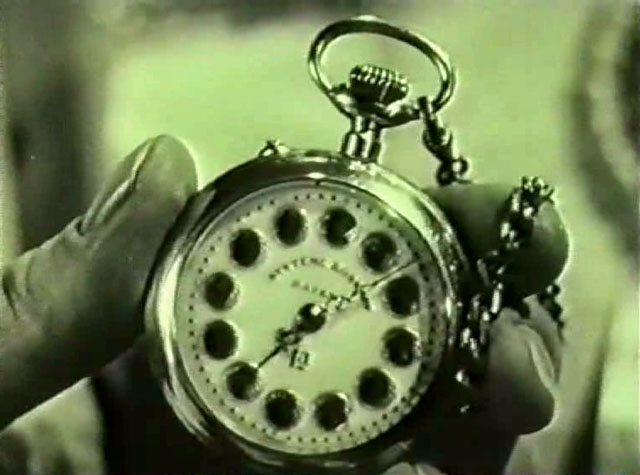
( ) (2003, Morgan Fisher)

Composed entirely of insert shots from other films. Could be the most intricate murder/conspiracy film of all time, what with all the plots and notes and watches and gambling and guns and knives and secret goings-on. I wish it’d had music. Didn’t recognize a single film, and I couldn’t even find any of the sources by searching character names spotted on notes and letters with IMDB. Shadowplay would be ashamed of my b-movie image-recognition prowess. I really want to do a remake, but the logistics and time involved would be hefty. Fisher is only glancingly mentioned in the Canyon book, but I had this and wanted to watch it.

Thom Andersen:

Fisher appreciates inserts because they perform the “self-effacing… drudge-work” of narrative cinema, showing “significant details that have to be included for the sake of clarity in telling a story,” and he made ( ) to liberate them… to raise them from the realm of Necessity to the realm of Freedom,” to reveal their hidden beauty.
Oh Dem Watermelons (1965, Robert Nelson)

Much talk about this one in the book. A silent, still shot of a watermelon lasts an age, then a singalong with an old racist song – or is it an ironically racist new song? – then some melon smashing with pioneering use of the shaky-cam. The song starts repeating and becomes irritating, as must all avant-garde film soundtracks. This time, Steve Reich is to blame. There’s stop-motion and Gilliam-style cut-out animation. My favorite bits are the dog that appears to poop out a watermelon, and the melon slowly crushed by construction equipment. Made as an intermission film for a theatrical racial satire, Nelson claims to have been inspired by Louis Feuillade.
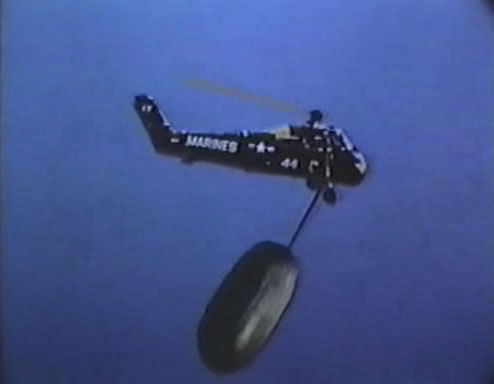
Samadhi (1967, Jordan Belson)

Eclipses and auroras, perhaps the eyeball of a wizard, five spherical minutes with a blowing, groaning soundtrack.


Samadhi (c) Jordan Belson

The Way To Shadow Garden (1954, Stan Brakhage)

The camera stalks creepily around an empty room. A clean-cut young man comes home, struggles with a glass of water and the bed, dances, reads a book. The camera continues its subtly creepy assault, lingering on light bulbs, but otherwise I’m thinking this is Brakhage’s most performance-based film that I’ve seen, a wordless narrative episode. But then the man claws his eyes out, the film stock reverses, and he seems to find the shadow garden, all blind light and shubberies. The first half makes me think Brakhage could’ve made some killer Sirkian dramas if he’d had the urge.

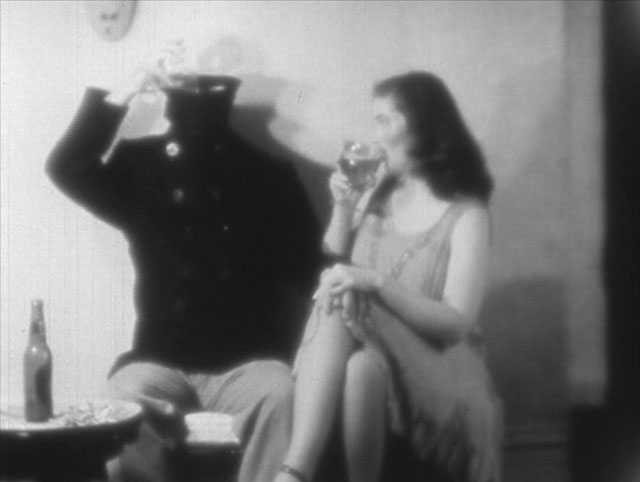
The Potted Psalm (1947, Sidney Peterson & James Broughton)

Shots of people and things. A graveyard. A snail. An accordion. A funhouse mirror. Dolls suicide. A woman eats a leaf. The cameraman has a beer and a cigarette.

Not the first Sidney Peterson movie I’ve watched, and I still don’t get what he is on about. Kino made an interlaced transfer, hired a woman whose Casio can make neat sounds to record a horrible score.
I had a bunch more in mind to watch, but I suppose I’ll get to them another day.