Thought I’d watch some shorts tonight, starting with the Guy Maddin shorts listed in the previous post. Unintentional theme: none of them had any spoken dialogue!

Film (Emend) by Deco Dawson
Crazily-edited scratched, grainy black-and-white silent footage of hands? If I hadn’t already known that Dawson was involved with Guy Maddin (as editor and camera op on Dracula and Heart of the World), I easily would’ve been able to tell.

Film (Luster) by Deco Dawson
image
Same thing, except now it’s a boy shining shoes instead of a woman sewing. Some peephole photography and scary closeups of the bootblack-mascaraed boy. As far as falsely-aged avant-garde films go, this is thankfully closer to Maddin than Merhige, although it’s less captivating than it means to be. Good music.

Din of Celestial Birds by E. Elias Merhige
image
Some Begotten image manipulation meets the time tunnel from 2001: A Space Odyssey accompanied by minimalist music and too much MPEG artifacting. Merhige fans may ask “HOW does he do it?” but I’d like to know “WHY does he do it?” Did jobs dry up after Suspect Zero? Some cool time-lapse of plant life for a second there. Made in collaboration with Haskell Wexler’s grandson. There was a “visual philosopher” involved, ha! The actor who played “son of earth” in Begotten (the dude who gets dragged around by druids through the second half) played “son of light” in this (seen above).

Begone Dull Care by Norman McLaren
image
Handpainted film cut to jazz music, excellent in every way. I could watch this all day. First half is full explosive color, multiple layers, second half starts out all slow white scratch lines and finally gets crazy after a couple minutes.

Bread and Alley by Abbas Kiarostami (his first short)
image
Opens with a prolonged shot of a boy kicking a can down an alley to the Beatles “ob-la-di, ob-la-da”. Boy can’t figure out how to get down the alley without being chased by a dog. Puzzles it out for a long while, follows an old man but he only goes halfway. Finally braves it by himself and accidentally makes friends with the dog by feeding it. No dialogue. A very happy little movie.

The Running Jumping & Standing Still Film by Richard Lester & Peter Sellers
image
A jolly bit of madness out in a field. Not the funniest ten minutes of cinema I’ve ever seen, but worth watching. Some of these guys had a radio program called The Goon Show, which I’ve heard somehow led to this film which somehow led to Petulia and Strangelove and Steve Martin’s Pink Panther remake.

EDIT 2021: Watched The Running Jumping Etc. again in slightly improved picture quality, which didn’t elevate the comedy any – nothing new to report.

Guy Maddin: “My editor John Gurdebeke and I, hoping to release the powerful nectars of remembrance, have attempted to cut the film using a facsimile of the way we visit memories: We skip past the drab routines and the overly familiar events of yesteryear in our haste to arrive at our favorite and still potent recollections; once there, we rock back and forth over the cherished imagery, penetrating its pleasures, like a DJ scratching back and forth over the same sample of music, until we’ve used up what we need from that episode; then we race on to the next greedily consumed tableau of the distant past.” Glad to hear Maddin mention Martin Arnold in the commentary… the above sounds like something Arnold could have written.

The same editor worked on Brand, Dad, Caboose, Winnipeg, but not The Heart of the World, done by Deco Dawson, whose short-films dvd I will have to check out soon.

More bits from Maddin’s commentary below – all quotes are his.

“It’s the only one of my movies that I can actually re-watch with any degree of comfort.”

Louis Negin as Dr. Fusi [below] – cast because he reminded Guy of certain silent actors, particularly a guy who was cut from Greed. Also because of his hands, of course. Appeared in Rabid, played Truman Capote in 54, and returned as the blind seer at the intro/outro of Saddest Music.
image

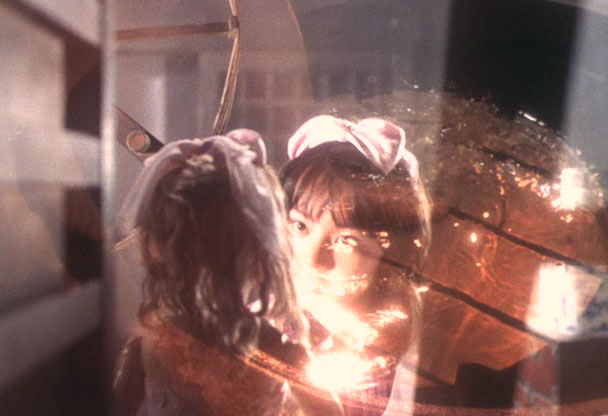
Amy Stewart as Veronica/The Ghost [bottom screenshot] – “the ultimate child brunette.” She returns in My Winnipeg as a Maddin.

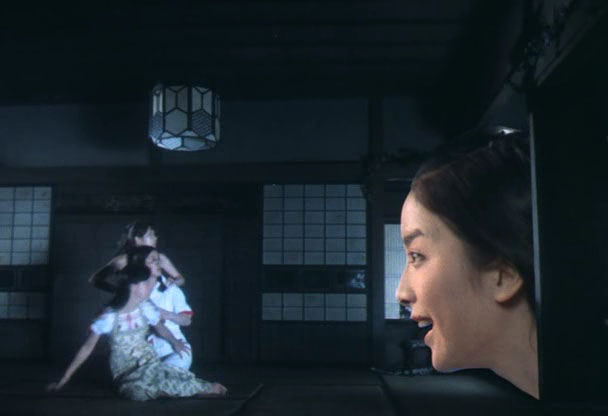
Tara Birtwhistle, replacing Alice Krige who got sick at the last-minute. Wearing “the same cheap wig I had Isabella Rossellini wear a few weeks later”. Tara played Lucy in Dracula, here portraying Guy’s aunt Lil and renamed Liliom, “a name I obviously borrowed from Fritz Lang’s Liliom, not even knowing that Liliom was a male name until I watched the movie after filming this.” On aunt Lil: “I thought I would give her a character in this movie that she never got a chance to be… In real life she’s just a sweet, bridge playing, tea-sipping spinster.”

Melissa Dionisio as Meta [below], “the result of some kinda local star search here”
image

“Sorry for all the blurry intertitles. I forgot to focus the camera. … I usually use intertitles to clarify the plot, but here they seem to be just giving everyone an eye-ache.”

Darcy Fehr, playing “Guy Maddin” [below], appeared in Hospital Fragment.
image

Chas, the impotent patriarch. “I’d been reading a lot of Euripydes, which I devoured like Mexican comic books”.

“That’s my mom, by the way.” [below] She was made to wear blacked-out glasses so she couldn’t see the autobiographical shame on display. “We filmed this scene without my mom really knowing. I have yet to explain it to her”.
image

David Stuart Evans, as semi-evil police/hockey captain Shaky, also appeared in Clive Barker’s The Plague.

Mike Bell as Mo Mott, of course played the engineer in Nude Caboose. Mo Mott is the name of an actual Winnipeg hockey player.

Victor Cowie as Maddin Sr. [below], appeared in Careful and Archangel. “The first actor I ever hired.”
image

Premature Maddin biographer Caelum Vatnsdal (the awesome fake Jesus in Heart) has a bit part somewhere.

“I like it when stories artificially tie up loose ends.”

The DVD also has a behind-the-scenes bit on Brand Upon The Brain! and a bunch of new shorts. FuseBoy, a 2005 short set at a fuse box starring Guy, Shaky, Mo and Dr. Fusi from Cowards. Dr. Fusi’s performance is actually edited in from his audition tape, also included here. Rooster Workbook (aka The Cock Crew), a mental blend of female nudity and roosters, the closest thing spastic Maddin has done to porno (closer than both Sissy Boy Slap Party and Nude Caboose). I don’t know who played the nude girl because he lists 13 actors in the credits. Zookeeper Workbook (aka Maldoror: Tygers) involves a man getting eaten by a tiger and a woman juxtaposed with a dog. Chimney Workbook has a girl welding, bunch of birth metaphors and I couldn’t tell you what else. Somehow related to Rooster Workbook.

Holy intense movie, gave me a major headache. Or maybe that was dehydration. Very good cast (IMDB links them all to the other 3-4 Romanian movies I’ve heard of). Some nice looong takes. Awesome dinner table scene plays out in a single take with just a ton of dialogue, mounting tension from both onscreen and off. An impressive movie for sure, glad I saw it.

NPR gives some background:

In 1966, Romanian dictator Nicolai Ceausescu sought to boost his nation’s population by criminalizing abortion, declaring, “The fetus is the property of the entire society… anyone who avoids having children is a deserter who abandons the laws of national continuity.” 4 Months, 3 Weeks and 2 Days, a new film by director Cristian Mungiu, explores the ramifications of Ceausescu’s ban two decades later. … Mungiu won’t go into personal details but says his film is based on the experience of someone he knows. He says half a million women died getting illegal abortions during the reign of [Ceausescu].

Practically a horror movie, in fact it builds tension and suspense better than almost any horror movie I’ve seen. Almost lands in the Lars Von Trier / Gaspar Noe camp of terrifying movies that you feel worse for having watched and never want to watch again… but not quite. Stays on the Michael Haneke side of the fence with the movies that make you feel upset but interested. I mean, it has a happy ending, I’m not saying it’s Last House on the Left. The horror isn’t from having evil characters (the abortionist is the worst of the bunch), and their behavior (unlike most by Haneke, Noe, Trier) isn’t just movie-believable, it’s completely convincing. These are real people in a tense situation in a totalitarian state, in the same situation that many Americans would be in if abortion was illegalized.

A rarity in this movie: a weapon (the switchblade) picked up but never used.

Reverse Shot makes the point that this is not simply “the Romanian abortion movie,” in part because “Otilia [the blonde woman] — and not Gabita — occupies the film’s narrative and moral center.” Instead they call it “a tense, riveting thriller (of a sort) that subtly evokes the experiences of women in a society that fiercely regulates their lives and bodies, often reducing them to commodities to be bought, sold, and bartered, no different at the extreme from the Kent cigarettes and orange Tic Tacs traded on the Bucharest black market.”

From an interview with the director:

Whenever you have to live in a period that is complicated, you have to learn your way. Nothing is very clear or simple or on the surface. You have to understand how things [work]. This kind of generates the feeling of negotiation. It’s difficult to say, by the end of the film, which of these two girls is better served by this society: the girl who apparently makes the decisions and negotiates with everybody, or the girl who doesn’t seem to do much, but will have her problem solved by the end of the day. It was a way of talking about compromise. When you live in a closed society and don’t expect this society will come to an end — people never thought the communist system would end — you tend to compromise more. They don’t anticipate any kind of judgment. They naturally think, “This system is abusing all the time, so I can be abusing with some other people because of this.”

The beginning of the film [is about] the ability to find your way over there by compromising and negotiating your way out of things. There’s another scene which is related to this — the dinner scene where you see a different generation of people who are not guilty of anything else but adapting to the system. They had to survive, they had to raise children. They are people who adapt to that society. For me it’s the meaning of all these objects. It’s about what it meant [to have] that symbol of a free world: bar soap, a pack of cigarettes. They represented much more than you can see.

A bright-looking city movie about a single family, nice contrast to the dull-colored medium-shot rural Emitai. Rapid escalation of Sembene’s feminist filmmaking that would lead to the glorious Moolaade. Kine at first seems too harsh and rough to be a likeable lead, but after hearing her story and experiencing her kids’ party and meeting her ex-husband, she looks very much like a hero and deserves the happy ending she gets. Cool movie – I’d watch it again.

S. Gadjigo:

Faat Kine is a chic, sexy, and “liberated” woman. She is a forty-year-old single mother, born at the same time as Senegalese independence. From her humble beginning as a gas-station attendant constantly being harassed by male customers, Faat Kine has climbed a ladder reserved for men to become a successful station manager of a multinational oil company. She is financially in control, well-connected in the business world, and adept at manipulating the banking system. Le Credit Lyonnais keeps no secrets from her. When she needs it, she can afford boy-toys. She owns a car and a stylish villa littered with posters of Sembene’s revolutionary icons. She has adopted all the fetishes of the moyenne bourgeoisie, including telecommunication knickknacks, modern appliances, and, best of all, a servant who draws her a warm bath when she comes home from work.

The double success of her children is yet another achievement for Faat Kine, one which stirs memories of her own youth in 1981, “when Sanghor left and handed power to Abdou Diouf.” So, Sembene’s pendulum swings back to the time when Faat Kine was twenty, in her last year of secondary school, just months before her final exam. She had dreamed of becoming a lawyer. But this was not to be. Immaturity, perhaps, and weak social and educational safeguards conspired against her. She was instead seduced by Gaye, her philosophy professor, and left alone pregnant.

The foolishness of the past exacts its brutal price, Sembene reminds us, in the crippled form of Mammy who lives on in the present with Faat Kine, Aby, and Djib. She is Kine’s mother and another of Sembene’s pillars of strength. For once she was expelled from school, Faat Kine’s only protection at home came from her loving but powerless mother. When Kine’s conservative father wanted to kill both his daughter and her newborn, it was Mammy who shielded the children with her body from her husband’s vicious blows.

Crippled Mammy, ambitious Faat Kine, the fatherless Aby: Three generations of women, who have only each other for support in a world shaped by feudal and neo-colonial values, hold the keys to Sembene’s moral. At first to survive, then to succeed, Faat Kine entered a world forbidden to women. By breaking taboos, she unabashedly took control of her life. She faced the world, was rewarded with a degree of financial independence, and moved steadily toward the center of Dakar’s middle-class. What does it mean then, when Sembene lets the pendulum loose once more? Faat Kine becomes pregnant and is abandoned again. Her lover strips her of her savings and their son Djib of his paternity. Apparently, one lesson Kine has yet to learn is that independence can never be a gift. It is hard won.

California Newsreel:

In a film permeated by commercial transactions, Faat Kine exemplifies a model of economic self-reliance tempered with charity; she frugally refuses to take bank loans at usurious rates or accept foreign currencies in clear contrast with African nations’ growing indebtedness to Western banks and lending agencies.

Yet Faat Kine may have become so accustomed to relating to people through money her children fear she has cut herself off from deeper emotional attachments. In Djibril Diop Mambety’s Hyenas, for example, Linguère Ramatou, another businesswoman scorned by male society, retaliates by bribing a village to kill her dishonorable former lover in exchange for an international line of credit. Here, in contrast, Faat Kine decides to marry her male counterpart, Uncle Jean, a widower and businessman who has raised three children on his own.

This will finally be a marriage between equals as the unexpected last shot indicates. Held for a disquietingly long time, it shows only Faat Kine’s feet curled in pleasure. In contrast, to pornography where the woman’s body is fully exposed for the man’s pleasure, here we see only Faat Kine’s anticipated satisfaction. In fact, the audience could be seen as being placed in the unaccustomed position of the provider of that pleasure. This seems like an appropriate ending to a film which, after all, has been a tribute to women who for to long have had to do everything for themselves.

I won’t be very good with details on this one – I was struggling to stay awake. Had no problems with Faat Kine though, which we watched next. Can’t say I liked this very much. Instead of blurrily remembering things about it, below are a bunch of quotes from other people.

One of the soldiers in charge, the commandant, was the main white actor in Black Girl.

image

Harvard:

Sembene’s third film launched his international reputation, reaching an audience far beyond Senegal’s Diola community, to whom he had directly addressed the film. Emitai takes place in the period at the end of the World War II, as West African veterans are returning to their homes in the French colonies. General De Gaulle, the hero of the trench resistance, is now the leader of the newly liberated France, yet forced conscriptions and massacres of Diola villages continue, some of them led by former members of France’s Vichy government. With Emitai, Sembene realized his statement “film should be a school of history.” When the film was released in 1971, it was immediately banned in Senegal, and throughout Africa.

WBAI’s explanation:

Sembene returns to village life in “Emitai.” It is in the early days of WWII and the French Vichy government is rounding up African youth to fight in their war. A village has been occupied by a company of native soldiers who are ordered about by a white Frenchman. Not one given to romanticism, Sembene depicts the lower-ranking African soldiers as passive servants of white rule.

Not satisfied with dragooning young men in a kind of neo-feudal tribute, the French demand rice as well to feed their army. With this demand, the villagers decide they have had enough. Not only is rice necessary for their physical survival, it is their link with their gods. Rice, like the rain that nourishes it, is sacred. To retain their links to the sacred, they hide the harvested rice from the soldiers.

In retaliation, the soldiers force the village women to sit in the brutal sun. They will only be released when the rice is turned over. In order to decide how to save themselves and their people, the village elders convene a series of meetings in a secluded altar to their gods beneath an enormous baobab tree. The gods, including Emitai, the god of thunder, instruct them to make sacrifices. So, in an obviously futile gesture, the elders sacrifice a rooster and then a goat, sprinkling the blood on the earth beneath the tree, after which the carcasses are heaved into a hollow in the trunk. Obviously there is an implied criticism of one aspect of traditional life by Sembene. Animism is no defense against French rifles.

image

From the NY Times:

The villagers don’t exactly need the rice; it is to be used in religious ceremonies, not for sustenance. And the French don’t really need it either. Halfway through the movie, deGaulle replaces Petain, the above-ground battles are ended, and so is the demand for overseas food. But everyone remains inflexible, and the story of “Emitai” continues to a fatal standoff in its bitter conclusion.

Just before the village chief dies—from French rifle wounds — he utterly renounces the gods, wherupon he is gotten up for a marvelous funeral, so he may rest with them in eternity. This juxtaposition is typical of the spirit “Emitai.”

It is a cool, balanced, proportionate spirit, affectionate but unillusioned, and wonderfully suited to the intricacies (and the idiosyncracies) of the subject matter. Sembene does not grab you; he engages you. Much of the time he photographs his action in the middle distance—not for the sake of distance but for the sake of an inclusiveness that keeps surprising you with its ironic sophistication.

“Emitai” isn’t a very complicated movie—in the abstract, little more than a tragic vignette. But for its purposes it is very complete; and considerate of the puzzles faced by its gods, its victims and its killers.

S. Axmaker likes it:

Emitai (1971) remains, to my mind, Sembene’s greatest masterpiece and his most important achievement. His angry attack on colonialism was inspired by the real life resistance of a Diola tribe who stood against the French soldiers that conscripted their men and took their rice during World War II. Sembene tosses out the conventions of western filmmaking and creates a style that arises from the storytelling traditions of rural Senegal. The contemplative pace, performances more ritual than realistic, and formal “call and response” dialogue create a world from the outside in, giving western audiences a culturally unique perspective and African audiences a sense of their own voice.

A reasonably good movie, charming and sweet with a very good ending, but… with all Gondry’s warm-hearted dream fun, why did I feel a bit cold from both this and Science of Sleep? I don’t know the answer.

Jack Black lives in a junkyard and is full of energy and ideas but is childish and doesn’t think things through very well. Mos Def has simple dreams (to help manage the video store, to stay out of trouble), Katy said he seems slow. Store owner and fake-historian Danny Glover is behind the times, takes a bizarre week “vacation” to spy on a blockbuster-like competitor. And Mia Farrow alternately seems addled, impatient or understanding & motherly. The tape-erasing “sweding” business is an excuse for a life lesson (that what you create yourself or what is created by low-budget neighbors with good intentions can be superior to mass-market entertainment) and to unite a community (for a fundraising community bio-pic about “local” legend Fats Waller), with lessons learned from Gondry’s Dave Chappelle concert movie.

Paul “Jellineck” Dinello and Matt “Upright Citizens” Walsh showed up with Sigourney Weaver at the end but I only recognized SW.

A great Bright Lights After Dark article talks about racial harmony in the film:

Jack Black, in blackface with pencil moustache and bowler, is clearly the perfect choice for Waller. It’s not just that he’s fat, but he looks like Waller as well, and could probably sing just like him after studying a few records. Danny Glover has to take Black outside to wordlessly imitate a minstrel softshoe to spell out why despite these assets, even a painted light brown face is too close to the shameful racist past.

One imagines a similar explanation perhaps being needed for Gondry at one point and it’s sad to think of anything standing in the way of his good-hearted vision. Black can’t go nuts as Waller as his showboating nature would permit, but must defer to the much thinner but blacker Def. Now, Waller was very light-skinned. Why couldn’t Black play him instead of Def? The question is rhetorical of course, dating back to antebellum bullshit about one one hundreth of a drop of black blood or whatever. But rhetorical or not, it’s clearly worth asking, and Gondry gives us a safe space in which to ask it. We may not get an answer, but even better is Gondry’s indication that, if our shared culture should one day become our shared property, we may not need one.

Medvedkin:

[working on the film train] I came across a very interesting type of peasant, the sort who’d entered a kolkhoz [communal farm] but didn’t feel the true power of it and wasn’t happy there. For such a peasant, life was hard. No one liked him much, he was laughed at, and he was very unhappy. I was thinking of him when I made Happiness. Every man is seeking happiness. Some see it in wealth, but the Russian peasant who struggled in poverty dreamt of it in his own way. … I tried to show the tragedy of such a man, and the effort he makes to find his ideal life. His dreams couldn’t be very elaborate, of course, they were on his own scale but in his own way he was looking for happiness. And in this film I tried to tell a story that’s funny, sad and tragic, the story of a peasant like him, Khmyr, for whom nothing goes right. His life is a struggle… and totally unexpected to him, at the end of the film he finds that there are others who care about him, friends, neighbors, the government too. And in a collective farm he comes close to happiness.

Funny movie, with good performances by the lead actors (first screenshot), some real surprising moments (second screenshot), some scenes that deserve to be well-known Classic Moments in film-school montages (third screenshot) and a good Ivan The Terrible beard shot (fourth screenshot).

image

image

image

image

One of those documentaries that I don’t think I should be celebrating because it seems deceptive, hiding facts in order to heighten the drama… but on the other hand – a classic video game competition with scores pursued over a period of years and the players not even competing at the same time – this is drama that needs heightening. What they’ve done is made an awesome, exciting movie with equal parts pathos and comedy, and a portrait of two really interesting guys, hot-sauce mogul Billy Mitchell and science teacher Steve Wiebe (and one really awful guy who the camera mostly avoids). A simple, boring premise, but somehow pulled off sooo entertainingly. I wanted to clap and cheer but I was alone in my room and Katy would think I was weird.

Excerpts from the Criterion essay:

[Ichikawa is] one of the preeminent figures in the golden age of postwar, “humanist” Japanese cinema

Few war films have ever had the courage to wallow so directly in the offal of man’s inhumanity to man, or to render so bleakly and so bluntly the emotional carnage that festers long after the battle’s end.

Based on Shohei Ooka’s award-winning 1952 novel, drawn from the writer’s own experiences as a soldier and prisoner of war, Fires on the Plain seeks to detail the increasingly desperate conditions endured during the final days of World War II by what remained of the 65,000 members of the Japanese forces who had so brutally conducted a three-years-plus occupation of the Philippines. Set on the Philippine island of Leyte, in 1945, the film is told largely from the perspective of a battle-harrowed and sunken-eyed foot soldier named Tamura, who, suffering from tuberculosis, has been ordered to blow himself up with his last remaining grenade should the Japanese field hospital refuse him admittance. Fires on the Plain’s ever more oneiric visions of everyday wartime atrocities (landscapes strewn with stinking corpses, feral dogs so ravenous that they seem to have slipped the surly bonds of gravity, rigor-­stiffened hands clawing up at the heavens black with swarms of feces-­maddened flies) serve to emphasize a single abiding point: the innately human will for survival can sometimes seem a fate far worse than the certainty of death. And yet Tamura—played with a sense of dissociated bemusement by Daiei Studio’s genre stalwart Eiji Funakoshi (a familiar face to fans of both Yasuzo Masumura’s pressure-cooker social satires and the Godzilla-come-lately rampages of Gamera the giant turtle)—keeps on living, if only to set himself apart from the soldiers all around him who, in their desperation, have begun to regard the mortal remains of their fallen comrades with hungry eyes.

Ichikawa was apparently pretty well disliked by Japanese critics and industry types until a few years later when Masumura and the Japanese New Wave came along to back him up with their even harsher and crazier films.

Movie has a few moments of humor, and a few vaguely moral scenes, like when our hero (who later played the title role in Blind Beast) shoots a Japanese soldier who just killed (and plans to eat) another soldier, but mostly it’s just “horrors of war: the movie,” beautifully shot. Emory showed Peeping Tom the following week, warning us that PT was a horror movie, but this one certainly has more horror in it than PT does. Very good, but not easy to watch.