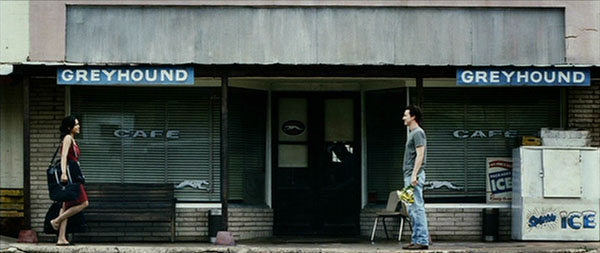
So I’ve shown Katy two post-9/11 movies with downer endings in a row, and now I realize that I was about to show her a third. Unintentional, but can’t be a coincidence. Current theory is that 9/11 hit in the middle of my exploding cinephilia and I was angry that nobody wanted to talk about it in film, so the few films that dared to discuss it stuck in my mind… and it’s been about five years since I’ve seen ’em, the perfect amount of time to watch them again? Does that make sense?

Malkovich is still deliciously distracting as the captain. I’d forgotten how BUNUELIAN the whole thing seems. From one ancient landmark to another, having slightly unreal meetings and conversations with people along the way, then a huge narrative jump and we’re at dinner with the captain and his famous friends, then another dinner conversation, this time with the mother and child, Malkovich standing the whole time, a song in Greek, then terrorist attack!

A very unusual movie. I kinda love it, but never quite knew what to make of it. I remember this M. Dargis piece:

As the two stop at ports from France to Turkey, the film takes the shape of a genial history lesson, one that grows progressively darker when you realize the message Mr. Oliveira has been delivering alongside all the seemingly benign tourist shots. The film begins, rather prophetically, with the image of people waving goodbye. … As they stand in the shadow of the Acropolis, Maria Joana wonders, “What did people do here?” Her mother replies, “They worshipped their gods.” In a sense, who those gods were and what they meant is at the center of “A Talking Picture,” which takes the measure of Western civilization for good and for ill. Although the mother-and-daughter exchanges purposely recall the discourses that once echoed throughout the Acropolis, their sightseeing also has the flavor of everyday life. … The metaphor of privileged tourists blithely afloat on a luxury ship – and embarked on a circle tour of that crime scene known as Europe and its colonial-era environs, no less – is at once blunt and brilliant. In both its intellectual reach and the elegant simplicity of its form, “A Talking Picture” bears resemblance to Andrei Sokurov’s “Russian Ark.” … this is the only film I can think of that, in the aftermath of Sept. 11, has so directly addressed the war on liberal democracies. Maybe it takes an angry old man who can cede the sins of the West without also sacrificing its ideals.

N. Vera:

On one hand it’s a young girl’s education on the world and its ways; on the other it’s a meditation by three godlike women (godlike for their high status in the film and higher status in world cinema), representing at least two of the most prominent cultures in Europe, holding forth on their views of love, life, and human history.

France and Italy are, if not the most prominent, easily the most graceful of European powers (odd–or maybe not–that Germany, Britain, and Spain are not mentioned); both countries owe much of what they are to Greece, a fact Helena points out, lamenting at the same time the subsequent loss of status of her country (French, Italian and especially English are spoken everywhere; Greek is spoken mostly in Greece, and at most as borrowed words in other languages). America, the single biggest Western power in the 20th and 21st centuries, is represented by a fawning buffoon of a captain (played with selfless enthusiasm by Malkovich)–who is, it must be noted, Polish (all Americans except the natives are, of course, immigrants). Portugal as represented by mother and child is invited to the table, but the invitation is politely refused (the mother capitulates on the second offer, which included a gift of a lovely little Muslim doll to the child). France, Italy, Greece together at a table with the party hosted by America, and Portugal a reluctant but desired guest.

What’s missing from the table and from much of the picture, of course, is the true (truer, anyway) cradle of humanity, basis of much of even Greek civilization, the Middle East. Iraq, Iran, Syria, Egypt among others are not represented, and while Egypt’s monuments are shown and discussed, they’re discussed not by an Egyptian but by a Portugese. The silence is overwhelming; we hear secondhand about Muslim civilizations, usually as it relates to and clashes with Western civilizations (the Hagia Sophia, Napoleon visiting the pyramids, the Arabs burning the library at Alexandria (a historically disputed event)). Suddenly the Middle East speaks out (or at least we assume it’s from the Mid-East–Oliveira leaves even this ambiguous), in the form of a ship’s officer with an urgent message, and the entire ship is forced to react to a neglected culture’s startling response.

In an article by Z. Campbell, he says the film “is often if not exclusively interpreted as a conservative lament,” but he praises Oliveira’s other works and says “This is an artist concerned with, among other things, the representation of unrepresentable experiences the source of which exists in some unspoken spaces of social structure (hospitality, companionship, family ties, tradition).”

The mother, Leonor Silveira, has appeared in just about every Oliveira film I’ve heard of. Captain Malkovich will be in the next movies by the Coens and Clint Eastwood and also a thriller about vampire mutants. French entrepreneur Catherine Deneuve was in a few Raoul Ruiz movies I’ve gotta see. Greek singer/actress Irene Papas starred in Costa-Gavras’ Z and previously The Guns of Navarone. Italian model Stefania Sandrelli was in a bunch of Bertolucci movies including a starring role in The Conformist.

The box art takes the one looking-into-camera close-up of Leonor Silveira and nests it inside the one shot where she is dwarfed by the monuments she visits. A nice idea, but then of course it’s cluttered up with titles and floating heads of the other stars.

As Katy says, just because it has a comic premise doesn’t mean it’s a comedy. No real jokes or laughs, at least not at our house. Pretty good movie, light entertainment with better acting than anything else (writing, camera work, etc). Blends a mental-illness drama with a small-town feel-good movie. Very little conflict… two times someone makes fun of the “real girl” or tells Lars it’s just a doll, and he pretends not to hear them. Brother and brother’s wife play along, whole town and psychologist play along, finally Lars has the girl get “sick” and “die” and then he meets an actual real girl and they go for a walk.

Producer John Cameron (no Mitchell) has worked on most Coen movies since Fargo, and also Rushmore. Oscar-nom writer Nancy Oliver worked on Six Feet Under. And our director also made the Billy Bob Thornton movie Mr. Woodcock, which I’m starting to suspect is also not a comedy. Cinematographer (also did Capote and Jesus’ Son) gives us basic, uncluttered compositions and moves subtly to handheld camera whenever there’s tension in a scene.

I liked the line when someone gives flowers to “Bianca” and Lars leans over and tells her it’s nice that they’re fake because they’ll never die. But one great line does not a best-writing oscar-nom make.

Lars: Ryan Gosling from the Half-Nelson movie I didn’t see. His brother: Paul Schneider from the Assassination of Jesse James movie I didn’t see. Brother’s wife: Emily Mortimer played Rufus Sewell’s girlfriend in the worst segment of Paris je t’aime (the one at Oscar Wilde’s grave). Lars’s co-worker and living love interest: Kelli Garner from starmaker film Bully, also in The Aviator. And the psychologist: Patricia Clarkson played leads in The Pledge and Station Agent, also in Far From Heaven and Dogville.

This post brought to you by Real Doll and Ask.com.

1982: the year of Blade Runner, White Dog, Poltergeist, The Thing, Gandhi, Britannia Hospital, Fitzcarraldo, Fanny & Alexander, Tron, the Sting version of Brimstone & Treacle… and this, the legendary Worst Kurt Vonnegut Adaptation Ever. From young hotshot Steven Paul, one of the producers of Doomsday, and I know I just said I wouldn’t waste my time watching anything created by anyone involved with Doomsday, but the Vonnegut connection combined with this movie’s reputation for being one of the worst comedies of the 80’s forced me to watch it out of morbid curiosity.

Laurel and Hardy? The book was dedicated to them.
image

Opens with narration by Orson Welles, surely giving even less effort than he did as the voice of the planet in Transformers: The Movie. You can immediately tell that the movie has no comic sense whatsoever. It looks cheap despite the big-name cast, and every “joke” is dead on delivery. The comedy is mostly people falling down, moving fast, talking funny (slapstick, I guess) and it’s badly staged… for instance, the twins are giant-sized, but only when convenient.

I don’t think Vonnegut was as mean-spirited towards the Chinese. And of course, Noriyuki “Pat” Morita is not of Chinese descent, but better him than Mickey Rooney I suppose. He plays the shrunken thumb-sized ambassador, a reference only understood by readers of the book since it’s unexplained during the movie. Other bits from the book are also rethought and bungled, and the twins are from SPACE now (and return to space in the ridiculous ending). All traces of Vonnegut’s trademark sadness and humanity are lost, unless you consider the sadness of the cast and the releasing studio and the audience. Rogue Cinema points out that the movie’s cast (Khan, Feldman, even Welles) and poster and title (and renaming the doctor “Frankenstein”) aimed to make audiences think that this would be a Mel Brooks Close Encounters parody. That particular advertising lie is probably the most well-thought-out part of the whole film.

Lewis!
image

Khan!
image

Madeline Khan and Jerry Lewis double-star as both the super-genius twins and their rich, detached parents. Marty Feldman is the butler in the twins’ secluded home. John Abbott plays a guy with a cool beard and Samuel FULLER is the colonel at the Military School For Screwed-Up Boys.

Feldman!
image

Fuller!
image

One of the last films of Jim Backus (Mr. Howell on Gilligan’s Island, voice of Mr. Magoo), John Abbott, Marty Feldman, and even Jerry Lewis (had starring roles in 6-7 more movies, most of them bad) but Jerry recovered in time to make Arizona Dream. Yes, Slapstick was a mega-career-killer, destroying the respectability of everyone involved! It ruined cinematographer Anthony Richmond, who previously shot the beautiful Man Who Fell To Earth and Bad Timing but went on to shoot Dane Cook movies and Dumb & Dumber 2. And – little known fact – it contributed to the death of Orson Welles and was directly responsible for his never completing Big Brass Ring, The Dreamers or Other Side of the Wind. Orson’s female co-narrator’s career was so thoroughly demolished that the internet has no record of who she was. But on the bright side, the movie helped launch the film career of Pat Morita, who would star in The Karate Kid two years later.

Morita! (he’s the one not looking at the camera)
image

Music by Michel Legrand and a song with lyrics by Vonnegut were edited out of the movie after the original release – why?? Assistant-directed by Michel’s son Benjamin Legrand, ending his short career as assistant-director (begun the year before on Rivette’s Merry-Go-Round).

Everybody wants prosthetic foreheads on their real heads? The incest scene doesn’t go very far, because we need a “PG” rating.
image

Released around the same time as Scorsese’s awesome King of Comedy, also with Jerry Lewis, though I think this was shot first and shelved for a while. Gene Siskel calls it “shockingly bad” and Ebert calls it offensive but makes a point of not blaming Vonnegut or Lewis. I heard one detectable Jerry joke: “You know, do as the romans do… when in rome, that is – I had it backwards” (it’s all in the delivery). There’s an occasional passionate line-read by Madeline or Jerry, the occasional animated bit of action, but mostly the movie moves mechanically from one laborious scene to the next, a simple motion illustration of a screenplay written by a guy who knows a guy who talked to a guy who once read the Vonnegut novel (which wasn’t one of KV’s best stories to begin with). I would looove to say that Fuller, Lewis and Feldman were excellent and the movie was slightly worth watching, but they weren’t and it wasn’t. I’m not in any hurry to rewatch Breakfast of Champions to decide whether this one is worse, but I think it probably is.

Close Encounters of the Dumb Kind:
image

UPDATE DEC. 2008: Wow, check out these stills from the new restoration. DVD box set will be out soon – check http://www.ivens.nl/ for updates.

image

image

image

—————
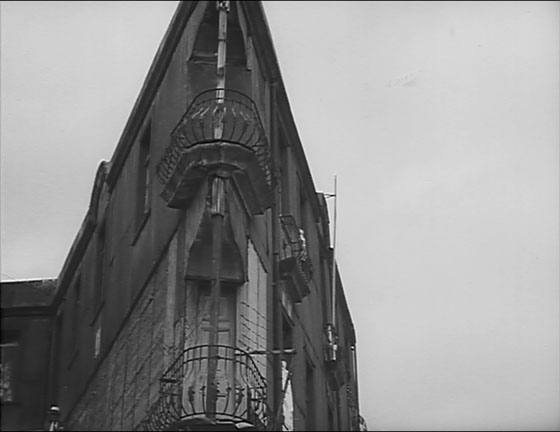
Directed by Ivens, narration written by Chris Marker, assistant camera by Patricio Guzman. Wow! Not to discount Ivens’s achievement, but this plays just like Marker’s travel documentaries. Definitely belongs with that group in some imaginary DVD box set, hopefully with far improved image quality over the awful version I just watched. I want to say this had better camera work than the Marker docs, but in this state, it is hard to tell.

image

A decade before the Battle of Chile events would begin, Ivens and crew give us an overview of life in this port city built on a series of steep hills. Focus is on things that affect the residents (like the funicular system) and events they participate in (huge annual fireworks show, a kite flying festival), not the popular tourist sites and historic buildings mentioned on wikipedia. Or maybe Ivens just hired a local tour guide and didn’t check wikipedia before going over there. A humorous tone to the commentary (when appropriate), shots of penguins, seals, pelicans and cats (no owls in town), a fire, some jump-cutting in line for the funicular. One very non-Marker-esque bit when a staged (I assume) bar-fight shatters a mirror and leads to a splash of blood, audio dissonance, a kaleidoscopic shot cutting to a burning pirate flag to introduce a history of colonialism in the state… awesome.

buildings that look like ships:
image

Wikipedia: The opening of the Panama Canal and reduction in ship traffic dealt a staggering blow to Valparaíso, though the city has staged an impressive renaissance in recent years.
image

Senses of Cinema gives a shout out to Ivens:

… à Valparaiso has regularly been regarded as more of a Marker film than one truly belonging to Ivens. This reading prioritises and favours sound over image – a common mistake even when reading Marker’s wholly “owned” work – and fails to recognise the range and often explicitly lyrical nature of Ivens’ broader filmography.

“Popular unity against the criminal bourgeoisie!”
image

Other street protest chants:
“Bourgeois shit, the street belongs to the left!”
“We need an iron hand!” (?!)

I alternately see this referred to as an epic 1979 movie, a long two-parter with a third-part postscript, or three separate movies. I guess they were presented theatrically in different ways in different countries. The 2/1 split seems right to me, as I’ll explain.

Part one drops me into the middle of an election in March 1973, which I didn’t understand until towards the end of the movie. I wondered why nobody was saying Salvador Allende’s name – turns out it was a senate election, and either the pro-Allende party lost, or they just did not gain enough seats in congress to prevent the opposition from holding a majority. So for the rest of Allende’s short reign as president, the country’s senate is mostly against him, undermining his authority. Movie is on the street, taking opinions from everyone, kind of slow at the start since I don’t know what’s happening, but excitement is in the air, and things straighten out soon enough. Cameraman is terrific, patient but curious, always looking for the best thing to shoot even if it means wandering off the person talking. I can’t believe the sound guy can keep up with him, but he does.

Salvador Allende:
image

A politician:
image

image

image

Part two picks up right where the first one ends, with an attempted military coup on June 29 1973, and part two ends Sept. 11 1973 with the successful coup that killed Allende and instated General Pinochet as ruler. In between those dates, Guzmán covers everything that happens in the whole country, it seems, with access to the marches, the debates, worker meetings, everything but the secretive military that turns against its country (with help and provocation, it turns out, from the U.S. government). This is by far my favorite of the three parts, and could easily work as a standalone movie… I see the Film Forum in NYC thought so as well. The events themselves, a democratic country swerving communist then falling military-dictatorship, is the best movie material you could hope for and Guzmán and his crew make the best of it, watching from ground zero as history is made, producing one of the best docs I’ve ever seen.

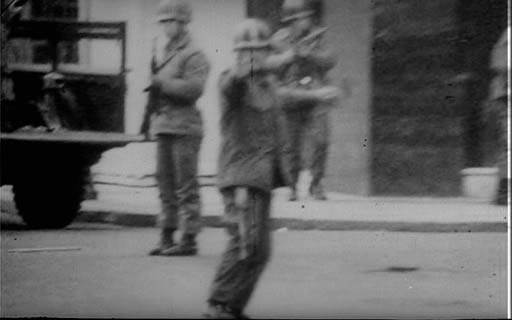
Military man who shot and killed Argentine cameraman Leonard Hendrickson at the end of part one:
image

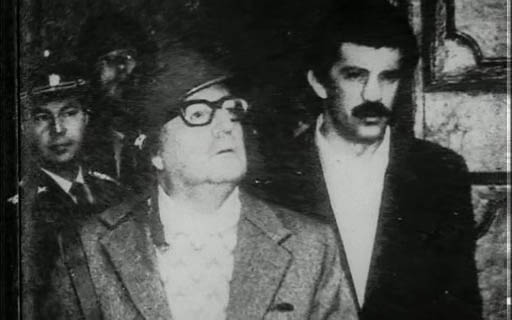
Salvador Allende, file photo:
image

Bombing of the presidential palace:
image

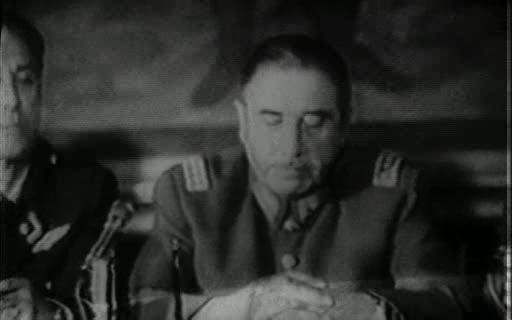
Pinochet addressing the nation on TV:
image

Military rule:
image

Pinochet: “After three years of support for the Marxist cancer we have been given a disaster that is economic, moral and social, that could not continue to be tolerated by the sacred interests of the mother country.” (or something like that – I think it’s all amateur-translated)

Guzmán: “From the 11th of September, all resources of the Chilean army are mobilized to repress the popular movement with the compacency of the North American government. The first armed resistance offered by some industrial cords, agricultural populations and student centers are squashed quickly in unequal fight. Thousands of people are killed and the main sport fields become concentration camps. The longest democracy in the history of Latin America ceases to exist.”

I don’t exactly wish I’d skipped part 3, but it would’ve made a nice recap six months later instead of watching it right after 1 and 2. Filmmaking in Chile wasn’t easy during Pinochet’s rule, since Pinochet was killing and imprisoning everyone who disagreed with him, including the cameraman of Battle of Chile (to whom the completed work was dedicated), so Guzmán backs up and shows further details of the workers’ movements during Allende’s presidency, not again mentioning Pinochet or the violence. The many worker meetings and the creation of multi-factory blocs and the attempted attack on Allende’s credibility by the “Christian Democrats” (his primary opposition) via a U.S.-funded transportation strike had all been covered in the previous films, but now we see them in greater depth… “depth” meaning lots of guys with sideburns talking into microphones at meetings. Since I’m not personally interested in creating a communist worker’s paradise in my own neighborhood, part three wasn’t of much use to me, but I’ll bet it’s exactly what Chris Marker was hoping for when he helped fund Guzmán’s efforts to document what was happening in the country. Marker’s own angry reaction to the coup is documented in his short Embassy, which I’ll have to watch again now that it’s on a new, clean DVD.

The transportation strike:
image

The people:
image

The sideburns:
image

The revolution:
image

“This life came so close to never happening.”

A movie about sadness and mourning, loss and bad decisions, real friends and sham friends. Picked this as the first of my Seven Favorite Movies To Show Katy but forgot to mention to her that it’s my favorite heartbreakingly sad movie and that I can start crying at work just by thinking too hard about it. Oops! Still, a little sadness can be good for you and once she stopped crying Katy said it was a good movie.

Came out late 2002 and proceeded to be pretty much ignored. Won two awards for best music score and some film festival in Barcelona gave Edward Norton “best foreign actor”. I guess it was nominated for a golden bear in Berlin, beaten out by Michael Winterbottom.

image

D. Edelstein doesn’t think the 9/11-WTC connections belong in the film: “The story of 25th Hour is fueled by the threat of anal rape: It’s what preoccupies Monty, and it’s the heart of the sexual-panic motif that runs (subtly, mischievously) through the screenplay.”

Where Are They Now: writer David Benioff put an X-Men reference into his “25th Hour” script (which starred two X-Men movie vets) and is now writing the Wolverine movie. Good job. Spike’s doing a TV movie with Amy Ryan and a WWII movie set in Italy, and I still feel bad for never watching When The Levees Broke. The “sheeeeeeeeeit” detective was on The Wire, Rosario Dawson may or may not be in Sin City 2 or 3, Anna Paquin’s starring in a TV show and Ed Norton is HULK.

Cowritten by Lawrence Block, longtime mystery writer once adapted by Oliver Stone for a film directed by Hal Ashby! This is his first screenwriting credit. Cinematography by Iranian Darius Khondji, who shot a lot of other visually-distinctive stuff like the Caro/Jeunet films, The Beach and Panic Room.

Norah Jones is dumped by her boyfriend, leaves her keys at the cafe for him in the hands of Jude Law. Talks to JL every night over blueberry pie, starts to like him, one night she takes “the long way” across the street to his cafe and goes on a year-long trip across the country, getting waitressing and bartending jobs, saving up for a car and writing poor Jude Law lots of postcards but never giving a return address.

First major stop is in a Memphis bar where cop David Strathairn (Good Luck and Good Night, Mother Night) pines for his separated wife Rachel Weisz (The Fountain) and drinks and drinks. Violence escalates, he dies in a car crash, Rachel is sad and Norah is outta there. Then somewhere in Nevada, a casino where Norah gives all her money to Natalie Portman with NP’s nice car as collateral. NP tries to teach a convoluted lesson about mistrust by faking that she lost all the money, giving up her car and having Norah drive them both to Vegas to see NP’s dying (oops, dead) father, but the lesson doesn’t come off very well.

With both of her extended stays in foreign cities and attempts to make new friends having ended in death and sadness, Norah comes home to NYC, where Jude has decided to let go of his ex-girlfriend Cat Power (on account of her being an unconvincing actress in her only scene) and the two are free to fall in love in their own distinctive way (bonding over security-cam videos, eating too much pie, Norah falling asleep and Jude kissing her without permission). A sweet ending.

So the story is kinda muddled, though the characters are all pretty strong (if a bit unbelievable and cliched) but the movie flows more or less like a WKW film, with slow-motion and emotional edit/flashbacks, a dreamy pop soundtrack (Ry Cooder, Otis Redding, “The Greatest” played three times, and a touch of Yumeji’s theme when Jude first falls for Norah). Strong colors, close-ups without establishing shots, the camera like a hazy memory lingering behind glass and slowly creeping behind obstructions, but focus always sharp. Glad I was warned not to expect too much, but I ended up liking it a whole lot.

Katy showed me this Bollywood movie to wash away the pain of Partner. This one wasn’t hateful, loud, empty, an extended music-video ripoff of an already-bad Hollywood film, but I didn’t love it either. Katy said the camera work was very good and often beautiful, but I found it uninspired, generic. Music was unmemorable but not bad. One nice music segment when a couple is at the movies seeing themselves onscreen reminded me of Pennies From Heaven. Story is alright, a light romance about three buddies and their love lives.

Akash (Aamir Khan – ice candy man in Earth, main dude in Lagaan) has a little beard patch under his lip, kinda arrogant but becomes a Good Guy as movie progresses. Gets sent to Australia and falls for a girl his parents previously tried to set him up with.

Sid (Akshaye Khanna – played Gandhi’s son last year) has an uneven hairline, is an artist and a Good Guy to begin with, falls for an alcoholic older woman with a kid and an ex-husband but she dies in the end.

Sameer (Saif Ali Khan – once played a character named Jimmy, but not THE Jimmy) has no distinguishing features or characteristics except that he falls in love with every girl he sees.

Also some women with names like Preity and Dimple, but don’t confuse me here.

Was nominated for 13 Indian academy awards, but got trampled by Lagaan.

What a wonderful coincidence that I watch You’re Never Too Young, and then find out the next day that the film it remade is on Turner Classic.

Robert Osbourne introduced as a screwball comedy, but the only thing screwball here is the premise. Movie is played as a straight, semi-romantic comedy. Same story as the Lewis flick but minus the jewel thief and with a sex reversal (and predictably there’s no equivalent to the Dean Martin character). So Ginger Rogers is the scalp-massager lured to an apartment under a false premise which gets her to leave town and have to pose as a kid to afford a ticket. She hides out in Ray Milland’s room, same thunderstorm and morning discovery scene, then has to keep up the ruse so Ray won’t get in trouble and kicked out of the military. Again, a happy ending with Ray getting his wish to be sent on active duty (makes more sense in the nationalistic war-ragin’ 40’s than in the 1955 remake) and happening to meet a finally-acting-her-own-age Ginger on the train platform (where she gives him a Katy-disapproved line about how all some girls want is a letter from their husbands-abroad every couple weeks).

Cute movie, with some major Creepiness Issues (Ginger cuddling up to Ray, wanting him while pretending to be a little girl and calling him “uncle”). Not the madcap funhouse of the remake, though… no Dean songs (they’re not missed) or speedboat chases, choral performances or marching band shenanigans. Turning the all-girls school into a military academy surprisingly doesn’t change much. Some scenes are very similar, like the long-distance call at the phone switchboard (though Jerry ups the humor with his nutty dancing and a voice-dubbing stunt). I’m sure there’s some auteurist reason why I should prefer the original to the remake, but sorry, I sorta don’t.

This came out a full decade before Ginger Rogers had a lot more fun playing a little girl in Monkey Business (another movie comparison which does this film no favors), and TWO decades before Ray Milland acquired his X-RAY EYES. Back in the 40’s he was cast not for the x-ray eyes but because he is an effective leading man, and an exact cross between Jimmy Stewart and Cary Grant. Wilder sez: “I wrote the part of the major for Cary Grant. I always wanted him in one of my pictures, but it never worked out.”

15-year-old little Lucy would grow up to play the love interest in the remake. Ray’s meddling fiancee (and Lucy’s big sister) was Rita Johnson (The Big Clock, Here Comes Mr. Jordan). The strict colonel (Lucy’s father) was Edward Fielding, who managed to portray military men, doctors, ministers and shopkeepers in over 70 films in the 1940’s despite a fatal heart attack halfway through the decade. Ginger Rogers’ mom, in her only screen appearance, played Ginger Rogers’ mom. Guy who gets a scalp massage at the beginning was Robert Benchley, the Jaws author’s grandfather. The young high-school age kids were actually 22, 21 and 16 (x2). That’s more accurate casting than the remake managed to get. The one familiar-looking boy had played Rudy in Shop Around The Corner, the kid the shop owner takes out for Christmas dinner in the final scene.

And what do I know about Billy Wilder? Not very much! Just enough to see plot parallels between this and Some Like It Hot. Saw none of the cynicism for which he’s known, but Wilder explains: “I was very careful. I set out to make a commercial picture I wouldn’t be ashamed of, so my first picture as a director wouldn’t be my last.”

Internet says the screenwriter invented the bad pickup line “Why don’t you get out of that wet coat and into a dry martini?”.