My mind is a blank.

Only thing I can say for this movie is that it cast a guy as GW Bush who doesn’t really look like GW Bush and gave him a full scene, instead of only showing the back of his head dubbed by a pro voice impersonator or any of that shady stuff. Here’s a guy, he’s playing Bush, get used to it. I appreciated that.

Otherwise the movie’s not so bad that you wish it was never made, nor so good that you’re glad you saw it. It mostly says “hey, remember what we did in part one? Remember most of the jokes? Here they are again – remember that?” Kinda like Indiana Jones 4.

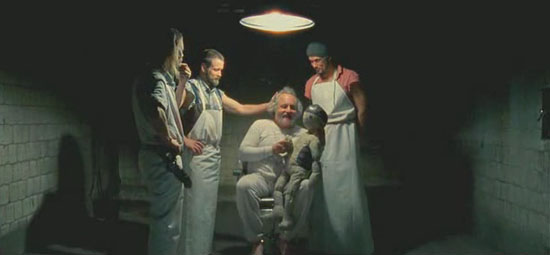
Rare Exports Inc. (2003, Jalmari Helander)
One of those one-joke comedy shorts. The joke is that this elite group of skilled hunters are capturing wild “father christmases” and training them to sit at mall displays listening to children request gifts. It’s got a nice visual style (if you dig watching naked old men get captured, hosed down and beaten), and I guess besides the Eija-Liisa Ahtila short it’s the only film I’ve seen from Finland.
image
–

The Official Rare Exports Inc. Safety Instructions (2005, Jalmari Helander)
And since I didn’t like it much, I watched the sequel and didn’t like that much either. Like all sequels, it’s longer with more effects and new characters. This time the santa-hunters teach safety and behavior lessons and execute an unrehabitable santa.
image
–

OïO Cinepainting (2003, Simon Goulet)
Took over a decade to make with the participation of 100+ Canadians. Looked like gloopy claymation swamp monsters wrecking countless painted glass vases.
I liked it, would watch again.
image
–

Workers Leaving The Factory (1995, Harun Farocki)
A catalogue of scenes of workers leaving factories, including the Lumiere film shown about ten times along with Intolerance, Red Desert, Clash By Night, I think Modern Times, Man of Iron, Metropolis, some German movies, and an industrial advertisement for heavy-duty equipment to protect your factory from attackers. Female narrator tells us that there oughtta be more scenes of workers leaving factories, or that there are too many, or that we need to see inside the factories instead of staying out at the gates? I dunno, because she speaks with all the excitement of a hired narrator reading academic text from a translated script, and it put me to sleep twice – impressive for a 35-minute movie. Saves its poetic deep-thought summary for the end: “If we line up 100 years of scenes of people leaving factories we could imagine that the same shot had been taken over and over… like a child who repeats its first word for 100 years to immortalize its pleasure in that first spoken word… or like far-eastern artists who repeatedly paint the same picture until it is perfect and the artist can enter the picture. When we could no longer believe in such perfection, film was invented.” Cute, but I prefer Kaurismaki’s take on the Lumiere short, and all these shots of people leaving work make me want to see Joe vs. The Volcano again.

From the director’s article on the film:

I have gathered, compared, and studied these and many other images which use the motif of the first film in the history of cinema, “workers leaving the factory,” and have assembled them into a film, Arbeiter verlassen die Fabrik (Workers leaving the factory, video, 37 minutes, b/w and color, 1995). The film montage had a totalizing effect on me. With the montage before me, I found myself gaining the impression that for over a century cinematography had been dealing with just one single theme. Like a child repeating for more than a hundred years the first words it has learned to speak in order to immortalize the joy of first speech. Or as though cinema had been working in the same spirit as painters of the Far East, always painting the same landscape until it becomes perfect and comes to include the painter within it. When it was no longer possible to believe in such perfection, film was invented.

In 1895, the Lumières’ camera was pointed at the factory gates; it is a precursor of today’s many surveillance cameras which automatically and blindly produce an infinite number of pictures in order to safeguard ownership of property. With such cameras one might perhaps be able to identify the four men in Robert Siodmak’s The Killers (1946) who, dressed as workers, enter a hat factory and rob the payroll. In this film one can see workers leaving the factory who are in fact gangsters.

The first camera in the history of cinema was pointed at a factory, but a century later it can be said that film is hardly drawn to the factory and is even repelled by it. Films about work or workers have not become one of the main genres, and the space in front of the factory has remained on the sidelines. Most narrative films take place in that part of life where work has been left behind.

–

The Phantom Museum (2003, Quay bros.)
Starts with John Carpenter-style music, setting up the camera and lingering too long on each shot, but it picks up the pace soon. Don’t think they were being modest with the post-title card calling this a “random” trip through the museum of medical oddities. Showing off items they thought were interesting, bringing them to life with stop-motion whenever possible. Nothing much revelatory in the hospital (except the spiked chastity belt, ooh) or the film, but it’s nice that the Quays are still out there.
image

Made thirty years ago, opened at the New York Film Festival when I was two weeks old. Director Truffaut died in the 80’s, cancer got star Denner in the 90’s, AIDS got DP Almendros in the 90’s, co-writer Suzanne Schiffman (Out 1 colllaborator) died in 2001, aged cameo-appearers Jean Daste and Roger Leenhardt are dead, but most of the actresses are alive except for Nelly Borgeaud, who died only recently.

Movie seems a teeny bit dated. Charles Denner is a man who works in a wind tunnel, lives alone, and loves women. He wanders around loving women for a while, finally gets the idea to write a book about how much he loves women and all the women who he loves. His book gets published, but due to a woman-love-related car accident, our man doesn’t live much longer. Movie opens and closes on his funeral and the long line of lovely women attending:
image

Our guy Bertrand at his wind tunnel – Charles Denner of Chabrol’s Bluebeard, Costa-Gavras’s Z and two or three other Truffauts.
image

Our guy’s mom in flashback. She used to walk around in her underwear ignoring her son and dating lots of men. Could this have somehow contributed to our man’s uninhibited love of women? Marie-Jeanne Montfajon, no other movie credits, alas.
image

Mistaken identity girl whom Bertrand chases down at the start of the movie, to set the whole woman-loving theme: Nathalie Baye (Le petit lieutenant, Truffaut’s Green Room and Day For Night, Godard’s Slow Motion, Chabrol’s Flower of Evil)
image

After the whole mistaken identity thing, Bertrand takes home the rental car girl as a consolation prize. Sabine Glaser hardly appeared in anything after this.
image

Lingerie store woman (Geneviève Fontanel) has always been flirty with Bertrand, so he asks her out to dinner and is shot down. She only likes younger men.
image

Former waitress (Nella Barbier) who loses her job while Bertrand is around, so he gets her hired as his company’s receptionist. Never makes a play for her, for some reason.
image

Wakeup-call girl: Aurore. Bert has to convince her to go out with him without ever seeing each other first. Doesn’t work.
image

The typist who transcribes Bertrand’s novel, until she quits for moral reasons.
image

The publisher who stands up for Bertrand’s book, and later lies down for Bertrand: Brigitte Fossey (the little girl in Forbidden Games 25 years earlier)
image

Sad girl on the stairs who gets cheered up by Bertrand. At first seems like a scene to gain our not-always-totally-likeable lead man some sympathy, but later we revisit it as Bert edits his novel to tweak details. Rather than making himself look better, he changes the color of this girl’s dress.
image

Ex-girlfriend who dumped Bertrand years ago: Valérie Bonnier, of Madame Claude (a Just Jaeckin call-girl movie with Klaus Kinski) and Spermula (a “sci-fi/horror sex comedy” with Udo Kier).
image

Another ex-girlfriend who he runs into at a restaurant: Leslie Caron, star of Lili, Gigi, An American In Paris, Is Paris Burning?
image

Married woman who has a not-so-secret long-term affair with Bertrand, attempts to kill her husband, goes to prison, is released a few years later, and shows up mysteriously in Bert’s apartment for a menage-a-trois: Nelly Borgeaud of Truffaut’s Mississippi Mermaid and Resnais’s Mon oncle d’Amerique
image

The last pair of legs our man ever chased.
image

Special appearance by Jean Daste:
image

Katy and I both kinda liked it!

A different kind of movie than the other Marker works I’ve seen. Really this is what I’d been waiting for: the politically-engaged street filmmaking of the 60’s and 70’s combined with the travelogue gaze and personal essay style (with distancing commentary) of Sans Soleil. Didn’t fill me with joy like most of Marker’s movies do, however… more contemplative and sadder, takes more time to think about each section and let them all sink in. Uses public artwork of cats to weave from Sept. 11th reactions to political situations in France to the death and imprisonment of friends and entertainers in such a way that, like Sans Soleil, I don’t realize what the film is about until I watch it again. Two versions of the film… first time I played it with English narration, then a couple weeks later I ran the French version with live sound and no narration, just scattered intertitles. Shockingly (since I usually love Marker’s narrations) I liked the second way better. But then, I got more out of it having just seen the English version. So I’d recommend both as a double-feature!
image

Quotes below are from the English commentary.

Opens with a flash mob in Paris. People mill around opening and closing umbrellas, to music from Alfred Hitchcock Presents.
image

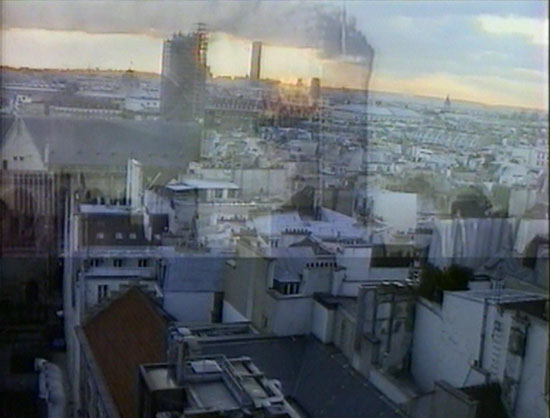
November 2001 Paris. September 2001 New York.
image

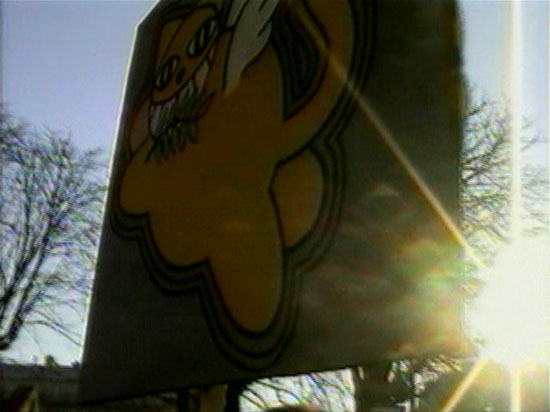
Cats on a roof, on buildings high and low, hidden in a tree.
image

The metro, a bridge, signs of Paris from long ago. Presidential election at the end of year… the left is split, so the far-right candidate Le Pen comes close to challenging the incumbent Chirac, who is defensively re-elected after protests in the streets against Le Pen.
image

“Let’s face it: these girls with their war paint are lovely, but the fascist legions are not besieging our gates. And if Le Pen is a dictator, it’s mainly against his own people. Yet what we see here coming onstage is an entire generation that was spoken of as being apolitical.”
image

More about the cat, appearing in the evening news and all over the internet.
image

March 19th, Bush (backed by Blair) declares war on Iraq, but UN inspectors find no weapons. More street protests in Paris, but as with the American protests of the time, they’ve splintered into hundreds of mini-demonstrations. “Why should the streets of Paris be less chaotic than the rest of the world.”
image

The plundering of Iraqi museums in April, a “die-in” for the victims of AIDS in June. “In these times, we the people gathered to watch eleven billionaires kicking a ball. What about the French team? Stalinesque-sized posters, as we had never seen the like of in Paris – and not one goal recorded.” More about street demonstrations with “a certain fuzziness in the symbols.” “It’s a great asset in life, not to know what you’re talking about. Marker follows political and popular developments with great interest but without total enthusiasm, removed from it all. Seems like he’s either saying “it’s nice that they’re trying, but their struggles are shadows of the struggles I lived through” or “this is what I was once like, with the same futility and wasted energy.”
image

Sees a personal friend (below) in a street crowd, then records news footage relaying that friend’s death at age 79 soon afterwards. Flashback to 1999, at a concert benefitting a cause that same activist friend had supported, Marker had filmed a young singer, who five years later had become famous for accidentally killing his actress girlfriend. “And you wonder why the Cats abandon us?”
image

What if they left us for good?”
‘We were the Freedom Cats. If you didn’t catch the message, just move on!’
And then – comes a sign.
The same unknown hand has painted circles of Cats on the sidewalk, to watch over our sleep.
Thank you, Cats.
We will badly need you…
…wherever we go.

image

This film is dedicated to M. Chat and those who, like him, are creating a new culture.
image

Embassy, 1973
When I first watched Embassy in February, I didn’t like it very much, and never dreamed I’d be watching it again in three months on a commercial U.S. DVD… but here we are! Nice of First Run/Icarus to release it, but it would’ve been even nicer to provide a translation for the opening titles that claim the film was found in an embassy. Maybe it’s mentioned in the packaging. Anyway, clearer image for this not-clear-at-all film, and after watching The Battle of Chile this one is making more sense, since I know what Marker was reacting to. It’s still never gonna be a favorite film, but it’s a cool idea to make something that immediate as a reaction to current events.

image

image

image

The Sixth Side of the Pentagon, 1967
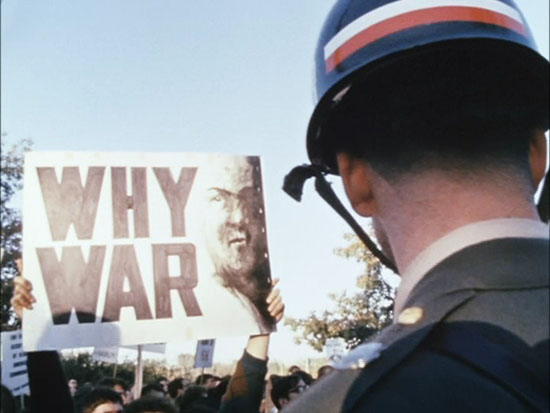
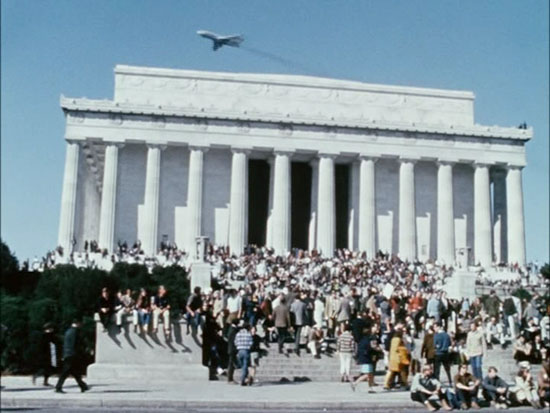
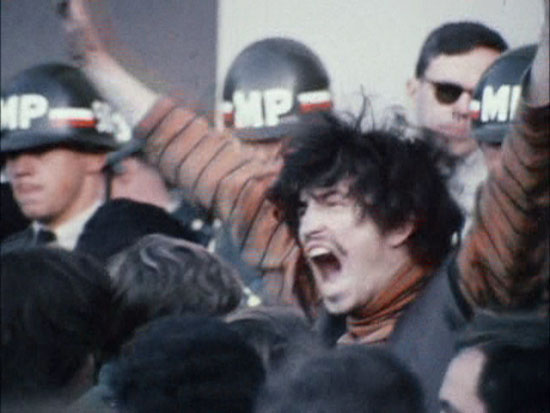
Filmed during “World War III: Vietnam, Bolivia, Israel” on October 15-16, 1967, a recording of the anti-war march on the Pentagon in which Abbie Hoffman and the Yippies participated. Marker gets to combine his budding obsession with anti-authoritarian political protest with his love for filming faces of people on the street. One of his most famous images was in here – an angry man shouting, his head covered in blood – I always thought that was from Grin Without a Cat. Co-director François Reichenbach would later act as cinematographer and producer on F For Fake.

image

image

image

image

image

image

Vive la baleine [Long Live The Whale], 1972
A short film about and against industrialized whale-hunting using mostly illustrations with some archive footage, saving the gruesome modern footage for the last few minutes.

Petit bestiare
Cats and owls! In and out of zoos, off and on pianos. Bullfight and the reminder that these animals are behind bars bring a touch of darkness to otherwise straightforward set of nice animal shorts.

I am pleased to say that the movie never quite dives into gritty, depressing realism. It seems like it will… I mean, the second scene is set in a horrible homeless shelter with our hero lying half dead on the floor, his leg smashed after a car ran over it, being dragged unconscious into the showers by the shelter’s other miserable-looking occupants. But forty minutes later he is motoring down the Seine towing Juliette Binoche on waterskiis, surrounded by fireworks in what must’ve been one of the most exuberant film sequences of the decade. When he’s sick of it, he throws away his crutch and in the next scene his cast is gone too. The movie reminds us of real-world problems but its heroes are above them… homeless, sick, injured, lonely, hungry, fighting with each other, but never so bad that the next scene can’t fix everything.

Guy with the busted leg is Alex, resourceful homeless guy who lives on the under-construction bridge with his scary mentor Hans (who dispenses whatever drug Alex needs to sleep at night). Binoche is heartbroken Michelle who was a painter before she started going blind and ran away from her treatment. After they fall in love, Alex rebels when he hears that a search is on to find and cure Michelle, preferring her to be dependent on his care. But she finds out and gets the cure, while he inadvertently lights a guy on fire and goes to jail for a couple years. Very romantic-comedy-like, they make a date to meet on Christmas on the repaired bridge and end up together. Sounds dreadfully obvious, and it does get a bit indie-film-cutesy, but the love story and the ballsy storytelling pulled me right in… loved the movie.

Binoche was nominated for a best actress Cesar, but running against Emmanuelle Beart for La Belle noiseuse and Irene Jacob for Double Life of Veronique, the “brave young actress in awesome art film” vote was split, and the award went to elder Jeanne Moreau for a comedy I’ve never heard of. But up against a completely different group of actresses, Binoche took the European Film Award that year. Denis Lavant, also star of Carax’s Bad Blood and Denis’s Beau travail, unsurprisingly (because he’s funny-lookin’) later appeared in A Very Long Engagement. Hans was Klaus-Michael Grüber, previously a director for television, who has appeared in nothing else.

image

Learned some stuff on other sites. Everyone wants to talk about the movie’s huge spiraling budget as Carax, unable to use the bridge itself, built a new bridge (and the surrounding buildings!) over a lake for a movie set. And everyone wants to talk about the movie being a flop upon release in theaters. And Americans want to gripe about the nine-year-delayed release to theaters here. And everyone makes a point of mentioning that Leos Carax is a made-up name, but I only saw one mention that the character Alex is a stand-in for the director (real name Alex), who was dating Juliette Binoche while this was in production. Also found plenty of comparisons to other films:

Titanic – for the ending (“king of the world” bit on the barge), fact that it’s a super-expensive movie but plot is a simple two-person love story.

One From The Heart – for the romantic tone, but mostly for the huge, awesomely expensive artificial set created for the movie, and the subsequent damage to the director’s career after the movie was not well-received.

City Lights – blind girl, in love with a homeless man, regains her sight at the end. Clearly an influence on the story.

L’Atalante – ahh, there’s the one Carax probably had in mind. Protagonists are poor but resourceful, in love but in a rocky relationship, joined by a moody father-figure old man, end up together on a barge. Perfect.

Nonstop talking for ninety minutes! Nonstop talking for ninety minutes! Nonstop talking for ninety minutes! If someone pauses to take a breath, they quickly cut to someone else so the talking won’t stop!

For some reason I listened to the commentary for a while. Paul and Penn are very proud of their interviewee picks and of their independent filmmaker status. Big Hollywood never would’ve dreamed of filming The Aristocrats!

I guess it was good to see some of my favorite people hang out and talk about The Joke and each other and performing and everything. Jon Stewart, Drew Carey, Richard Lewis, Sarah Silverman, Bill Maher and Rip Taylor were all in there. I didn’t realize how much of a big deal they were gonna make about Gilbert Gottfried doing The Joke a couple weeks after 9/11/01. It’s the dramatic climax of a movie that had no drama or story up to that point, and while it’s true that humor was in a sorry state for those few weeks and it’s true that Gilbert is hilarious, they overblow the whole thing.

Anyway I didn’t mean to write so much because this was hardly even a movie, but here are some fun screenshots I took where you can see the cameraman in something reflective:

image

image

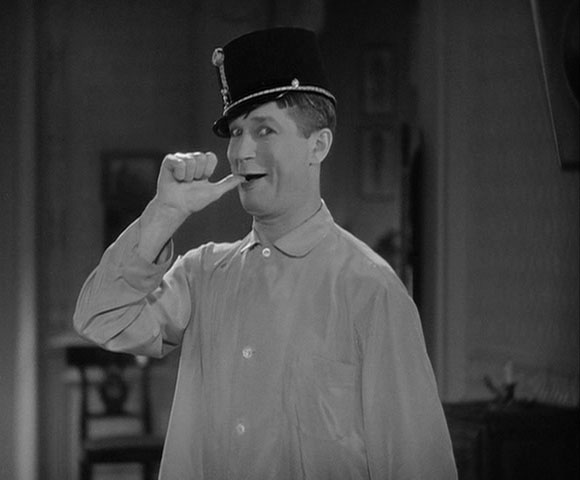
Starring a broooadly overacting, hammy but kinda charismatic Maurice Chevalier as an Austrian lieutenant. Movie opens with a tailor knocking on Maurice’s door vainly attempting to collect on his bill (a year later, Maurice would star in Love Me Tonight as a tailor vainly attempting to collect on an aristocrat’s bill). Nobody answers, and immediately after he walks off, a young girl approaches the door, gives the secret knock and is let in. Yes, there’s actual sex in this movie – offscreen, but it’s acknowledged. It’s that Pre-Code Hollywood that TCM always salivates over before showing tame, dull movies like The Divorcee.

Maurice, a naughty lieutenant:
image

The movie is, as promised, a musical comedy (two genres which encourage broad acting) as well as a romantic drama, and the late 20’s/early 30’s had their share of hugely broad comedy performances in film, so in context Maurice is pretty alright. And he’s got kind of a charming, roguish smile on nearly all the time… sucked me in after about ten minutes. Katy disagrees, but liked the movie despite Maurice.

Maurice joins his friend Max to act as wingman so nervous, married Max can pick up a hot young violinist at the concert, but Maurice falls for the girl (Franzi) and takes her home himself, with some sexy banter about which meals they’ll enjoy together (ahem, breakfast).

Max, left, is Charles Ruggles, the viscount in Love Me Tonight, also in Trouble In Paradise. Chevalier was a big star from 1929-36 – then IMDB says he was falsely accused of being a nazi collaborator and his acting career was derailed for a buncha years, with a big comeback in Gigi in ’58.
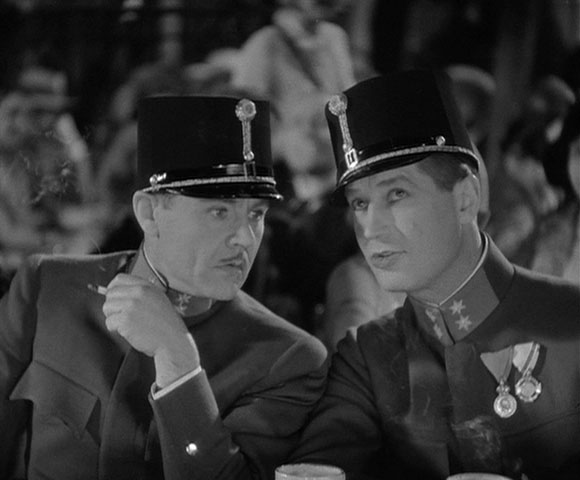
image

Claudette Colbert (Franzi) was later Cecil B. DeMille’s Cleopatra, also starred in It Happened One Night, Midnight, and The Palm Beach Story.
image

The young lovers have a good thing going, but flirting in public brings disaster, when Austrian soldier Maurice winks at Franzi across a street just as the coach carrying the king and princess of Flausenthurm drives between them. The wink and the princess’s appalled reaction are photographed and published in the paper, causing an international scandal, but everyone settles down when Maurice explains that he was overcome by the princess’s beauty and is bullied into agreeing to marry her. So M. is off to Flausenthurm, but won’t sleep with his royal bride, preferring to step out on the town. The moody king gets over the inferiority complex he had in Austria, is now smitten with Maurice and tells his daughter not to worry, playing checkers with her every night as a sad substitute for marital sex.

Princess Miriam Hopkins = Savannah-born star of Trouble in Paradise, who won an Oscar a few years later then didn’t do a whole lot of movies I’ve heard of. King George Barbier was in a ton of stuff through the 40’s, including The Milky Way and The Merry Widow.
image

The movie is a musical, but I don’t remember most of the songs or even where they occur, except climactic number “Jazz Up Your Lingerie.” You see, Maurice still loves the loose, free, totally modern Franzi, and he still has not-too-secret affairs with her since her violin group is on tour in Flausenthurm. So one day Princess Anna sorta kidnaps Franzi to ask her advice… Franzi helps Anna out, giving up on her man with the great line: “You mustn’t worry about me. I knew it all the time. Girls who start with breakfast don’t usually stay for supper.”

image

During the music number, Anna’s frumpy clothes all turn magically into hot things, she learns to smoke and play jazz on the piano, and when Maurice comes home he can not believe his eyes. She takes him to the bedroom and wordlessly suggests a game of checkers, but he keeps tossing the board away… finally tosses it onto the bed, and just look at the expressions on their faces:

image

Everyone who sees it today comments on the sexual freeness, but the original New York Times review in 1931 didn’t mention any of that, called it a “highly successful production” with “charming” music and “splendid” performances, and spoiled the entire plot.

J. Weinman: “The Smiling Lieutenant is based on Oscar Straus’s Viennese operetta A Waltz Dream, though Lubitsch relegated all the operetta’s songs to background music and had Straus write a few new songs in a more modern style. As he usually did when adapting a play or an operetta, Lubitsch kept the basic outline of the story but changed everything else.”
A good comic superhero movie, completely predictable and without anything special to recommend it over all other decent comic superhero movie except having totally likeable lead actors with lots of light humorous banter. Turns out that’s a pretty big deal, because the movie is being very well received. I certainly wasn’t disappointed… it’s a good time at the movies.

Katy appreciated the bits of Lord of War thrown in, with RD Jr’s weapons company making higher profits by selling arms (with STARK INDUSTRIES proudly stamped across them) to evil foreigners under the table. This is the work of transparently evil company man Jeff Bridges, who’s pretty good as a bad guy, and who eventually builds his own iron suit for a showdown that I don’t remember too well cuz it was 2am on a weeknight by then. Gotta hand it to Gwyneth Paltrow, in her best comic role since Sky Captain and the World of Tomorrow. Don’t necessarily got to hand anything to Terrence Howard, who is very good, but keeps appearing in thankless sidekick roles in big movies.

Jon Favreau gave himself a bit part (think he had a couple lines). Funny, I thought he directed Swingers, but that was done by Doug Liman, who also had a big sequel-spawning sfx-action hit this year with Jumper. That’s something nobody saw coming in 1996!