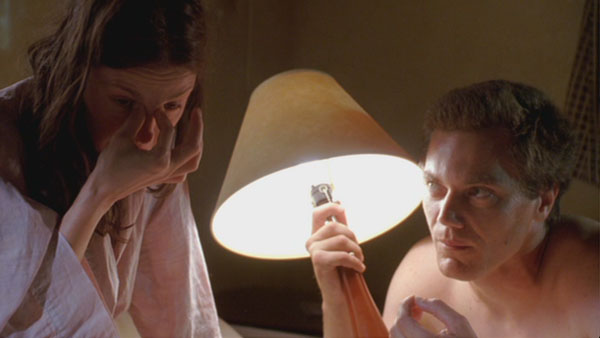
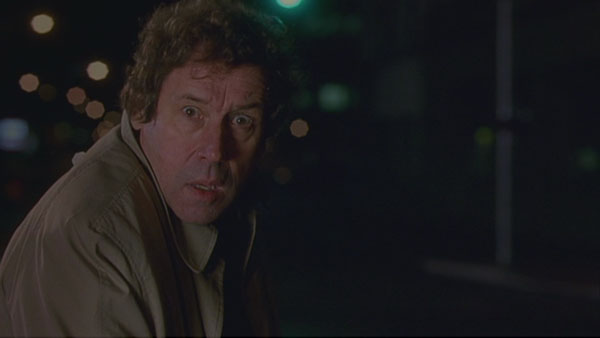
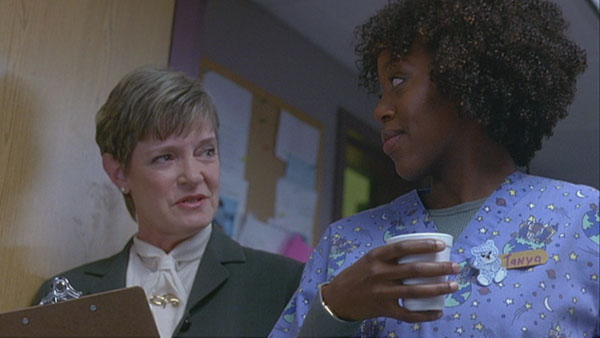
I always feel like I’m missing something when I watch a movie by one of the Great Classic Hollywood Auteur Directors like Hawks. But I didn’t worry about it much this time… worried instead about the mild sexual undertones of a movie where the leading man is helping search for the leading woman’s kitty, while she is helping search for his bone. No wonder they fall in love completely unprovoked in the final scene.

Grant is a timid professor working on his dinosaur skeleton, engaged to marry an uptight girl, and Hepburn is a completely free, intelligent but breezily unaware-acting rich socialite determined to keep Grant occupied enough that he can’t get married. They were both wonderful in this, and the writing is super, and it’s a joy to watch, but as Katy pointed out, it’s a little TOO screwball. Grant stutters nervously and Hepburn talks over everybody and there’s just no stopping or even slowing down. It’s a blessing that there’s no incidental music cluttering up the soundtrack further. So it’s a bit tiring to watch, but still a magnificent comedy.

IMDB says the movie was a flop, and Hawks and Hepburn both lost jobs because of it. A missed reference to The Awful Truth, and I can’t believe neither Katy nor I noticed that George was the same dog as Mr. Smith in that movie. Grant and Hepburn were both terrific, and Charlie Ruggles (again playing a major) was funnier than in the Lubitsch pictures. Also good: a monocled german named Fritz (Fritz Feld played bit character parts in hundreds of movies) and Aunt Random (80 year old May Robson). Among the Hawksian favorite themes (via Senses of Cinema) found in the movie: nicknaming (KH starts calling CG Mr. Bone), screwing with gender conventions (KH has the more masculine, take-charge character) and social norms.

Wikipedia says it was (arguably) the “first work of fiction, aside from pornography, to use the word gay in a homosexual context.”

Didn’t learn a terrible lot from P.Bog’s audio commentary, but gained a greater appreciation for the movie just by watching (actually listening) to it again, with Peter going on about how great everything is. One gem: “It’s easier to watch on a big screen because you see it bigger.”

Resnais’s fourth feature, coming out the same year as Rivette’s The Nun. Watched this once before and have practically no memory of it, so this time I read the screenplay then watched again. By doing so, and by watching it alongside the other Resnais films I’ve seen this year, I’m sure I’ll remember and appreciate it more than I did before, but it also makes me wonder about the nature of Resnais’s art, because he has filmed Spanish writer Jorge Semprún’s screenplay word for word and shot for shot. Semprún describes flashback cuts and actors’ facial expressions, and there it is on the screen. The film isn’t as poetic and dreamy as Resnais’ other films of this period, but it definitely fits in with them, has a similar feel, plays like the work of the same artist. The book felt more tense, and the movie felt more melancholy, like a somewhat lighter Army of Shadows.

Story takes place across just a couple of days (not counting flashes-backs-and-forward) in Paris suburbs, two weeks before a planned protest and strike in Spain. Diego aka Carlos aka Domingo aka The Passenger (Yves Montand, halfway between his starring roles in Let’s Make Love and Tout va bien) returns from Spain to warn his underground anti-Franco activist organization (led by chief Jean Dasté) about the recent police crackdown in Madrid which led to the arrest of some operatives including one good friend. Diego wants to warn his other friend Juan away from returning to Spain, but Juan is already on his way to Barcelona. Diego was himself detained at the border, his false passport inspected by Customs official Michel Piccoli, which leads to complications later. Diego lives (on the rare occasions when he is back in France) with lover Ingrid Thulin (a Bergman regular who is wonderful in this movie) but he also half-heartedly messes around with a young Geneviève Bujold, daughter of the man whose passport he borrowed and herself a revolutionary, but with a younger group that practices impatient and violent means of returning Spain to her mythical (never existent) past Marxist glory. Diego and his group (incl. pro smuggler Jean Bouise, who later played Warok in Out 1) resent that Spain has become a symbol of the radical left but without any definite progress, that they’ve lost more and more comrades promoting these strikes and protests which are never as widespread or effective as intended. They continue their struggle, workmanlike but without much hope… a tone more fitting (in France) for the mid 70’s than the mid 60’s. Interesting that this came out right when Resnais’s contemporaries were about to turn to politics, then he followed it up with the much less political Je t’aime, je t’aime.

Writer Semprún later adapted screenplays for Costa-Gavras and wrote Stavisky for Resnais. He must be the only non-English speaker to receive TWO oscar nominations for writing. Shot by his regular guy Sacha Vierny with music by Giovanni Fusco, an Antonioni regular who died of a heart attack in May ’68.

The movie is called “stylistically orthodox” and “one of his most accessible films.” It’s not reportage-style realism, just straight drama, which never feels heightened by technique even though there are some signature smooth tracking shots and the love scene with Bujold is downright expressionist. I found the look and the camerawork to be more Muriel than Je t’aime, but of course the editing is completely unlike either of those.

Time Out: “Perhaps it is the film’s directness and obviously dated aspects (middle-age male angst faced with effervescent feminine adoration having become such a staple ‘art movie’ subject) that have made it seem a minor item in an often challenging director’s career.”

Harvard: “A series of premonitions told in flash-forward near the film’s conclusion make powerful statements about memory and aspiration, commitment and faith.”

A. Agarwal: “The film ends in inevitability. Thulin, the mistress whose devotion sometimes makes Montand uncomfortable yet at peace with himself, learns Montand is going to be sucked into a trap, and she starts out to let him know and save him from crossing into Spain. The film ends here, yet there’s a shadow of death over it. Either Thulin will not be able to save Montand, or she will be able to save him and Montand will quit this life and spend the remaining part of it trying to make peace with himself and his country.”

Michel Piccoli
image

Jean Daste
image

Warok
image

Genevieve Bujold
image

Thulin & Montand
image

image

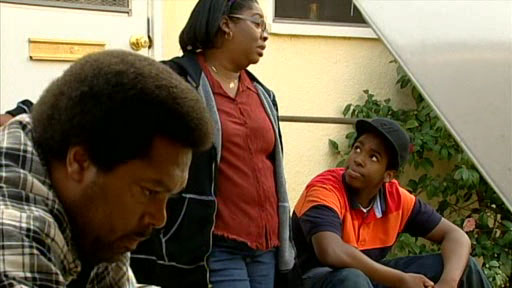
Fast, Cheap and Out of Control was the last movie in my documentary month series with Katy, but now Jimmy is doing his own documentary month. Katy didn’t come to this one (sadly, since it was better than almost any of the movies we watched at home). Story of coal miners in Kentucky who decide to join a labor union. The mine won’t recognize the union, so they strike. Tensions escalate between the old miners and the new scab workers, finally one of the old miners is shot and killed. A day or two later the mine lets them back to work, the union in place. Then a couple months after the year-long strike, another strike, this organized by the union leaders for higher pay and safer conditions.

Wonderful story, engrossing movie, with great bluegrass music. I’ll bet Chris Marker liked it.

Won best doc at the ’77 Oscars. Barbara Kopple went on to co-direct Dixie Chicks: Shut Up and Sing, a movie I was just mocking in the video store the other day. IMDB trivia: “When filming began, the film was intended to be about the 1972 campaign by Arnold Miller and Miners For Democracy to unseat UMWA president Tony Boyle, in the aftermath of Joseph Yablonski’s murder; but the Harlan County strike began and caused the filmmakers to change their principal subject, with the campaign and murder becoming secondary subjects.”

One of my favorite 30’s movies – a sheer delight. Thief meets thief, they shack up, scheme to fleece rich woman, thief shacks up with her, love triangle ensues, thieves get away together in the end. Bookmarking naughty/cute scenes where the thieves impress each other by showing off the stuff they pickpocketed from each other during whatever they were doing together before the camera turned on.

Thieves Like Us: Miriam and Herbert
image

My two favorite people, maybe just out of recognition from The Smiling Lieutenant, were thief Miriam Hopkins (the princess of Flausenthurm) and major Charlie Ruggles (the friend from whom Maurice steals his modern girl). Miriam is really terrific… maybe I’ll check her out in Design for Living, Becky Sharp or Dr. Jekyll and Mr. Hyde sometime. The lead male thief was regular-looking Herbert Marshall (star of Angel and Murder!, later in Angel Face and Duel in the Sun), the duped perfume CEO was dark-haired Kay Francis (of Scandal Sheet and The Cocoanuts), and another duped rich guy who, along with the major, is trying to marry Kay was Lubitsch regular Edward Everett Horton.

Great, sophisticated intro scene when the thieves first meet, both pretending to be some fake rich person in order to steal from each other. Actually I think the very first scene was E.E. Horton explaining to the cops how he got his wallet stolen by a fake doctor – in the end he publically identifies Marshall, now hired as Kay Francis’ assistant and lover. Miriam Hopkins is hired as a secretary so they’re both inside the house, but only get away with $100k and a pearl necklace instead of the intended $800k+.

image

Most interesting part of the movie was when rich (but goodhearted/generous) Kay is offering a high reward for her missing purse, having the forty-some purse-carrying hopefuls gather in her foyer, receiving them one at a time (each announced by the butler) in an upper-class, highly inefficient manner. A crazy-haired Russian-accented Trotskyite waits his turn, then comes in with no purse just to berate a woman who would spend so much on a purse during the depression, shouting “phooey, phooey and phooey” at her. This is when thief Herbert makes his opportunistic entrance, talking to the “radical” (as labeled in the credits) who then leaves peacefully but still angry. The radical is sort of a comic character, with his wild hair and repeated “phooey”s, but the movie seems careful not to ridicule him, and lets him have the last word, owning up to the fact that our main characters are too extravagant for their own good, voicing some of the resentment that audiences at the time must have felt. The Russian was Leonid Kinskey, who ten years later played one of Rick’s employees at the Café Américain in Casablanca.

Kay Francis threatened by communism:
image

Nice, well-researched audio commentary points out the title card (words displayed progressively over shot of a bed = “Trouble In [Bed]”) and tons more. Beginning of 1930’s Month for Katy and myself starts with a bang.
image

Naughty Lubitsch:
image

EDIT 2016: Eight years later, Katy does not remember 1930’s Month, nor this movie, so we watched it again.

IMDB: “What do an elderly topiary gardener, a retired lion tamer, a man fascinated by mole rats, and a cutting-edge robotics designer have in common?” That’s what I set to find out while watching this very fun, good-looking and well-edited movie. Katy got tired an hour in, liked it for the most part but didn’t enjoy my connection-drawing game.

Dave was a lion trainer who traveled with the circus. He seems ambivalent about his career, not talking it up as a great time with his beloved lions or an exhilarating and rewarding experience, mostly going over the reasons for first wanting to be involved (he idolized and eventually worked with Clyde Beatty, animal trainer and entertainer who once co-starred with Mickey Spillane in a weird-sounding mystery called Ring of Fear) and the procedures and dangers involved.

George is an elderly gardener who creates, trims and maintains the topiary sculptures in one estate garden. You get the feeling there used to be one old woman who oversaw the garden, and now there’s nobody, that he’s gardening for himself on someone else’s land. Unlike Dave, who is helping train newcomers, George has nobody following in his footsteps, and dislikes other gardeners’ methods (using electric hedge trimmers, for example).

Raymond studies and “wrangles” insects, and has become a specialist in the naked mole-rat, a mammal that exhibits insect-like behavior. He sets up a museum installation to put their society on display, and talks about their activity and relationships.

Rodney is a robot scientist trying to innovate robotic movement and behavior by putting together bunches of small robots or processes which try to solve common tasks, instead of attempting to control them with one larger intelligent system.

There are plenty of ways to link these four guys and their jobs/interests, not a large hidden theme which is the One True Key to unlocking the film. They all work with non-human life forms, trying to study and control behavior. Some offer insights into human behavior through the lens of their subjects. All but Dave work with arrays of smaller beings (robots/leaves/rats) which work together towards large tasks (or forms). I had more but I’ve forgotten half of them… IMDB commenters mention themes of growth and development, consciousness and death, or the guys as representative of different concepts of god’s existence.

I loved the editing, the music (by Caleb Sampson, who killed himself the following year), the use of stock footage (such as old Clyde Beatty films) instead of the Mr. Death re-enactments, the pacing. The movie’s got heart… these guys are really involved in what they’re doing, care about it, and each is able to express himself and his subject in an engaging, philosophic way. It’s not the connections and differences between these guys which are interesting in themselves, it’s the way Morris encourages the viewer to discover them. Wonderful.

The premiere title of my personally-curated Obscure Movie Sundays monthly film screening programme was well-attended (five persons), the viewers anxious to view what my own invitation tantalizingly called “a 1977 surreal sci-fi comedy from Czechoslovakia. Set in the futuristic 1990’s, the plot involves identical twins and nazis with time machines. An obscure cult classic!” The movie lives up to the letter of that description, but wasn’t as wacky-enjoyable as it would sound. Still an affable, somewhat cheap-looking light comedy with a really good ending.

Rocket scientist Jan has an evil rocket scientist twin brother, who chokes to death on a roll at the start of the film. Jan is hot for his brother’s fiancee (an attractive girl from a family of circus performers), so Jan pretends to be his brother (barely mourned at all, so you’d think he’s a pretty crappy brother even though the two lived together) and goes to work – not knowing that this was the day the deceased brother was to participate in an evil plot to travel back in time to 1944, the turning point of WWII, and deliver a briefcase-sized atomic bomb to Adolf Hitler so the nazis would win the war. Things get fouled up royally, both in the 1990’s “present” and in 1941 (where they accidentally end up, right after Pearl Harbor, instead of ’44 like they’d planned) but finally Jan straightens everything out (easy to do when you’ve got a time machine at your disposal) and has the baddies imprisoned before they can meddle in the past. How to solve the problem of his dead brother? Jan travels back to moments after the brother’s choking accident, incinerates the body and inserts himself in its place. Result: two happy Jans are living together, one of them engaged to the evil twin’s attractive fiancee.

The bunch of baddies (right) in ’41:
image

I thought it was a funny movie, but I was the only one laughing – the others found it a little tedious. Too bad. Delightful inventions of the “future”: time travel exists but is only used for tourism, dishwashing detergent dissolves the dishes instead of bothering to clean them, and a stun-ray gun turns people to green statues (they’ll recover just fine in a few minutes, unless someone tries to move them and accidentally breaks off a limb or two). Also, the A-bomb has been miniaturized to fit in a light briefcase and the military has stopped using such weaponry, so it can only be found in museums. That’s a pretty short time window (from 1977 to 1990) from weapon advancement and miniaturization to obsolescence and declassification. Or you’d think they’d disarm the bomb they put in the museum.

My Two Jans:
image

The movie’s writer (I Killed Einstein, Gentlemen and What Would You Say To Some Spinach?), the composer (Three Nuts For Cinderella) and the director (no other movies with funny titles) all died in the last decade. Three of this film’s lead actors also appeared in What Would You Say To Some Spinach?, which came out two weeks before I was born – will have to seek that one out. The actor who played Hitler died in ’84.
image

Just spectacular… I loved every moment of it. The politics/message are a little heavy, but it was nervy to put such anti-consumerist, green, call-to-action messages into a non-talking robot-love movie in the first place (and to declare in interviews, as Stanton has, there there are no political messages in the film!), so I’m going to forgive. Twenty years ago, Pixar would’ve been shot down as commies for making this movie (and Mike Judge would’ve been quietly executed for Idiocracy). Hopefully I’m going to see this again soon, so no need to go into plot summary.

I caught the bunch of 2001: A Space Odyssey references (evil autopilot is very HAL, some of the same music is used) but I also found myself thinking of Children of Men. Future Earth is void of new life, new life is then discovered in the belly of a female-ish character, everyone freaks out and gets excited but a bunch of sinister characters want to manipulate the situation. It all checks out. Movie is also getting compared to Alien (sigourney weaver’s voice is the “mother” ship) and Silent Running (another post-earth outer-space plant-tending movie), but not Sunshine.

Peter Gabriel, who has a history of song contributions to films about sentient critters (Gremlins, Babe 2) scores the closing credits with an obvious-sounding number about being down in the ground.

Fred “Wha’happen” Willard plays a president stand-in, the CEO of Buy ‘n’ Large. He’s not even animated – just videos of Fred Willard. If he’s the first live actor in a Pixar animation, they picked the right actor.

The opening short was Presto by first-time writer/director but long-time Pixar animator/artist Doug Sweetland. Very good, funny, fast-paced comic short about a magician and his magic hats and rebellious hungry rabbit. More of that Looney Tunes gag-based anything-goes character humor than the usual style of Pixar short (think Geri’s Game, Boundin’).

Not very Herzogian – the great man doesn’t interject any commentary of his own, letting his narrator (journalist Michael Goldsmith) do all the leading and interviewing, and not cutting away when Goldsmith follows up interview subjects’ stories of being imprisoned and tortured for years by order of Central African Republic dictator Jean-Bédel Bokassa with Goldsmith’s own oft-repeated story (“you know, I was imprisoned for a month myself”). Gives the feeling that it is the journalist’s film and Herzog is a director-for-hire, which is probably not true. The movie does, after all, end with a caged monkey smoking a cigarette, which isn’t a typical way to end a journalistic interview-doc. And it opens with Herzog himself reading a letter from Goldsmith over beautiful, otherworldly shots of migrating crabs. It’s just the bulk of the film in between those animal bookends that seems kind of typical.

Bokassa, fallen dictator:
image

Bokassa himself seems sadly typical – a military leader of an African country who took over the government, becoming more corrupt, horrible and bizarre as his rule progressed. We talk with a couple of his (many) wives and some kids, including one who was involved in a fraud/mistaken-identity comedy which led to her having a sister with the same name who got married on the same day as her.

image

Goldsmith survived torture and imprisonment in Central Africa, and returned safely from Liberia (where he had gone missing at the time of this film’s completion), only to die of a hemorrhage in late ’90, shortly before the film premiered.

Fascinating movie. I think Katy liked it too, though we were both a bit upset after she vetoed my triple-feature short-doc selection at the last damned minute.

image

Gymnopedies (1965, Larry Jordan)
An egg floats around on different backdrops interacting with various objects, all cut-out animation a la Gilliam or Borowczyk, set to calm piano music. Feels more like a proof of concept than anything else – if there was a narrative present, I didn’t catch it. Cute, though.
image

Lipstick (1999, Pascal Aubier)
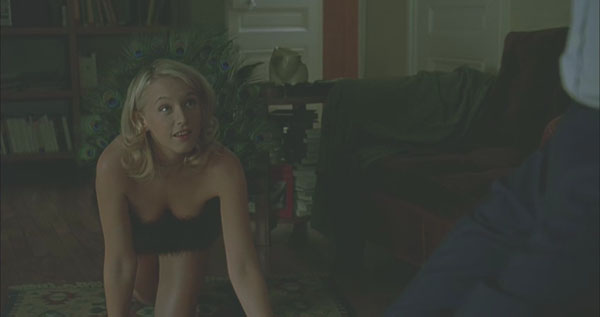
Single 6-minute shot beginning under a bed, unsubtitled. Family is getting ready to leave for a trip, the mother is briefly visited by her lover who comes in through the window. Aubier was assistant director on some French New Wave classics in the 60’s, now an actor and a director of (mostly) comic shorts. Liked this a lot (and not only because of the naked dancing), will have to check out more of his stuff.
image

Ark (2007, Grzegorz Jonkajtys)
Iffy-looking 3D animation tells apocalyptic story with a twist ending. Our guy wasn’t really the lead scientist onboard an ark of the last surviving humans searching the oceans for new land, just a crazy old man in a convalescent home. Ha! Bah.
image

Happy-End (1996, Peter Tscherkassky)
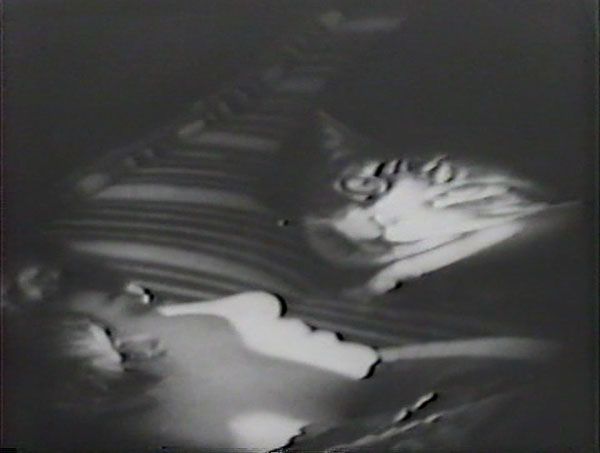
Found footage of a couple sitting down for dinner, toasting the camera, drinking… and drinking and drinking! Dancing, drinking, sitting, more drinking. Different days, different clothes, edited together, eventually with scenes superimposed atop each other, a haunted distortion of a French pop song as the soundtrack.
image

Two Solutions To One Problem (1975, Abbas Kiarostami)
Very short with narrator, two kids get in a fight over a torn book. We tally the damages then rewind, and instead of starting a fight, they help repair the book and remain friends. Nice.
image

Blah Blah Blah (2006, Dietmar Brehm)
Liquor bottles. Close-ups of objects with strong textures, overexposed porno, an action film in extreme-fast-forward, long pause on an ashtray, back to the liquor bottles, etc. Audio is a quietly rainy/windy day with a metronome hit every three seconds. Looks like old 8mm or 16mm color with some monochrome sections. Pretty alright, probably better in a theater surrounded by like-minded shorts instead of following up a cute Kiarostami piece.
image

A Girl, She is 100% (1983, Naoto Yamakawa)
Wow, that wasn’t very good at all. They must’ve thought it’d be the simplest Haruki Murakami story to film. Straightforward, with some good still photography and some bad acting by our IMDB-unknown hero, closing with some rockin’ 80’s music.
image

Foutaisies (1989, Jean-Pierre Jeunet)
Young Dominique Pinon with 80’s hair tells us about the things he likes and does not like. Very Amelie-feeling, with Delicatessen opening titles (and Deli‘s lead actress).
image

image

image

The Hitman (2001, Ruben Fleischer)
Mary Lynn Rajskub decides to be a hitman, but her first mark (Paul F. Tompkins) decides not to go through with it and asks her out instead. Just your typical indie comedy short. From the director of Girls Guitar Club, whose film career didn’t take off, I guess.

What Is That (2001, Run Wrake)
Buncha funny animated business involving insects and meat and ringing sounds. Cute, but only three minutes long and pretty inconsequential… not up to Rabbit level. Guess it’s an early work.
image

Film Noir (2005, Osbert Parker)
Awesome, very short. Like Fast Film but slower. Some After-Effects-lookin’ animation combined with models and lots of cutouts – not trying to tell a story, just cool visuals/mood. Ahhh, the internet reveals that it was all created in-camera – impressive!
image

image

image

Banquize (2005, Claude Barras)
Boyer’s French Dictionary: “banquize – heap of floating ice frozen together in close masses.” Might be called Banquise, actually. Simple animation, fat kid wears his snow clothes in summer, dreams of living on banquize and playing with penguins. One day trying to hitchhike there he drops dead from heat/dehydration. Hmm.
image

Herakles (1962, Werner Herzog)
Herzog’s very first film, six years before his first feature. This was really good, and not like anything else I’ve seen by WH. Pretty simple structure so I’ll let wikipedia take it below.
image

The film relates to six of the twelve labours of Heracles. The film starts with shots of young male bodybuilders working out in a gym, posing on a stage and flexing their muscles. Each of the labours are then announced by on-screen text in the form of a question, followed by related scenes of modern challenges intercut with the bodybuilders. The audio track of the film is saxophone jazz and sounds from a gym.

The question “Will he clean the Augean stables?” is followed by scenes of a garbage dump, “Will he kill the Lernaean Hydra?” is followed by a huge line of stopped traffic on a motorway and people walking around outside their cars, “Will he tame the Mares of Diomedes?” is followed by scenes of car racing and several race crashes including a crash into the spectators and shots of the subsequent disaster and piles of bodies, “Will he defeat the Amazonians?” is followed by scores of young women marching in uniform, “Will he conquer the giants?” is followed by shots of rubble of a destroyed apartment building and men in uniform searching the wreckage, “Will he resist the Stymphalian birds?” is followed by jets flying in formation, shooting missiles and dropping bombs on training targets. The last shot of the film is of a bodybuilder’s buttocks as he goes off the stage through the stage curtains.

image

Matta (1985, Chris Marker)
“What I am showing here is no exhibition. It is an appeal: Come and play with me! It’s a very lively game, but nothing happens.” Simple interview with Chilean artist Matta (not surprisingly an Allende supporter), an original member of the surrealist group, talking coherently about his art and all art, human beings, dimension and meaning. Would be nice to get/make a transcript. Would be even nicer to have been able to see the Matta paintings that Marker frames him against, but my video was too low-quality to make out much visual detail.
image