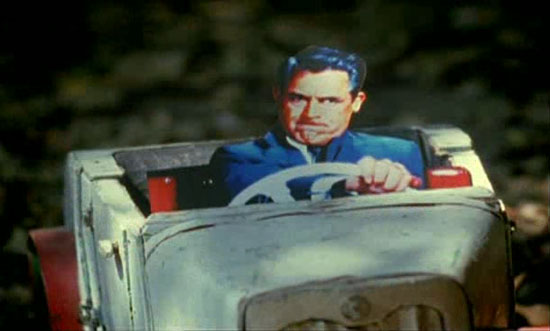
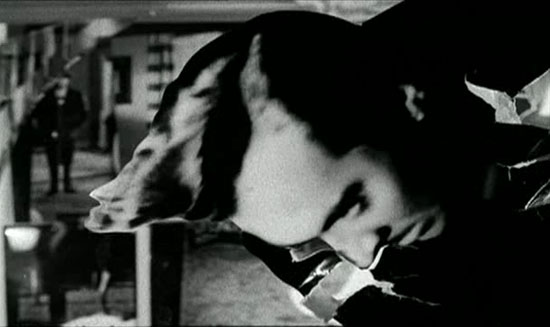
The premiere title of my personally-curated Obscure Movie Sundays monthly film screening programme was well-attended (five persons), the viewers anxious to view what my own invitation tantalizingly called “a 1977 surreal sci-fi comedy from Czechoslovakia. Set in the futuristic 1990’s, the plot involves identical twins and nazis with time machines. An obscure cult classic!” The movie lives up to the letter of that description, but wasn’t as wacky-enjoyable as it would sound. Still an affable, somewhat cheap-looking light comedy with a really good ending.

Rocket scientist Jan has an evil rocket scientist twin brother, who chokes to death on a roll at the start of the film. Jan is hot for his brother’s fiancee (an attractive girl from a family of circus performers), so Jan pretends to be his brother (barely mourned at all, so you’d think he’s a pretty crappy brother even though the two lived together) and goes to work – not knowing that this was the day the deceased brother was to participate in an evil plot to travel back in time to 1944, the turning point of WWII, and deliver a briefcase-sized atomic bomb to Adolf Hitler so the nazis would win the war. Things get fouled up royally, both in the 1990’s “present” and in 1941 (where they accidentally end up, right after Pearl Harbor, instead of ’44 like they’d planned) but finally Jan straightens everything out (easy to do when you’ve got a time machine at your disposal) and has the baddies imprisoned before they can meddle in the past. How to solve the problem of his dead brother? Jan travels back to moments after the brother’s choking accident, incinerates the body and inserts himself in its place. Result: two happy Jans are living together, one of them engaged to the evil twin’s attractive fiancee.

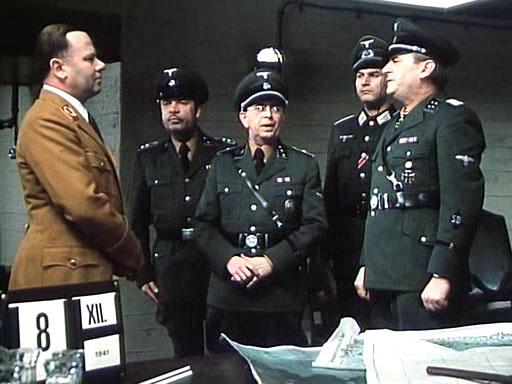
The bunch of baddies (right) in ’41:
image

I thought it was a funny movie, but I was the only one laughing – the others found it a little tedious. Too bad. Delightful inventions of the “future”: time travel exists but is only used for tourism, dishwashing detergent dissolves the dishes instead of bothering to clean them, and a stun-ray gun turns people to green statues (they’ll recover just fine in a few minutes, unless someone tries to move them and accidentally breaks off a limb or two). Also, the A-bomb has been miniaturized to fit in a light briefcase and the military has stopped using such weaponry, so it can only be found in museums. That’s a pretty short time window (from 1977 to 1990) from weapon advancement and miniaturization to obsolescence and declassification. Or you’d think they’d disarm the bomb they put in the museum.

My Two Jans:
image

The movie’s writer (I Killed Einstein, Gentlemen and What Would You Say To Some Spinach?), the composer (Three Nuts For Cinderella) and the director (no other movies with funny titles) all died in the last decade. Three of this film’s lead actors also appeared in What Would You Say To Some Spinach?, which came out two weeks before I was born – will have to seek that one out. The actor who played Hitler died in ’84.
image

Just spectacular… I loved every moment of it. The politics/message are a little heavy, but it was nervy to put such anti-consumerist, green, call-to-action messages into a non-talking robot-love movie in the first place (and to declare in interviews, as Stanton has, there there are no political messages in the film!), so I’m going to forgive. Twenty years ago, Pixar would’ve been shot down as commies for making this movie (and Mike Judge would’ve been quietly executed for Idiocracy). Hopefully I’m going to see this again soon, so no need to go into plot summary.

I caught the bunch of 2001: A Space Odyssey references (evil autopilot is very HAL, some of the same music is used) but I also found myself thinking of Children of Men. Future Earth is void of new life, new life is then discovered in the belly of a female-ish character, everyone freaks out and gets excited but a bunch of sinister characters want to manipulate the situation. It all checks out. Movie is also getting compared to Alien (sigourney weaver’s voice is the “mother” ship) and Silent Running (another post-earth outer-space plant-tending movie), but not Sunshine.

Peter Gabriel, who has a history of song contributions to films about sentient critters (Gremlins, Babe 2) scores the closing credits with an obvious-sounding number about being down in the ground.

Fred “Wha’happen” Willard plays a president stand-in, the CEO of Buy ‘n’ Large. He’s not even animated – just videos of Fred Willard. If he’s the first live actor in a Pixar animation, they picked the right actor.

The opening short was Presto by first-time writer/director but long-time Pixar animator/artist Doug Sweetland. Very good, funny, fast-paced comic short about a magician and his magic hats and rebellious hungry rabbit. More of that Looney Tunes gag-based anything-goes character humor than the usual style of Pixar short (think Geri’s Game, Boundin’).

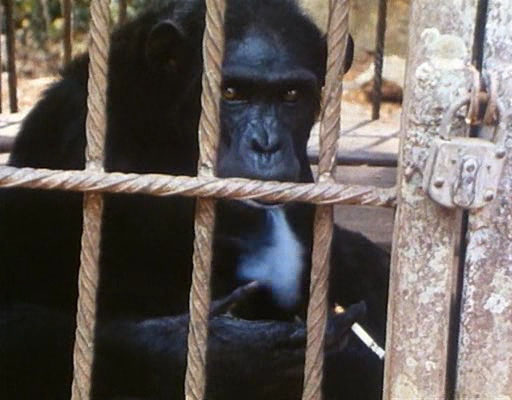
Not very Herzogian – the great man doesn’t interject any commentary of his own, letting his narrator (journalist Michael Goldsmith) do all the leading and interviewing, and not cutting away when Goldsmith follows up interview subjects’ stories of being imprisoned and tortured for years by order of Central African Republic dictator Jean-Bédel Bokassa with Goldsmith’s own oft-repeated story (“you know, I was imprisoned for a month myself”). Gives the feeling that it is the journalist’s film and Herzog is a director-for-hire, which is probably not true. The movie does, after all, end with a caged monkey smoking a cigarette, which isn’t a typical way to end a journalistic interview-doc. And it opens with Herzog himself reading a letter from Goldsmith over beautiful, otherworldly shots of migrating crabs. It’s just the bulk of the film in between those animal bookends that seems kind of typical.

Bokassa, fallen dictator:
image

Bokassa himself seems sadly typical – a military leader of an African country who took over the government, becoming more corrupt, horrible and bizarre as his rule progressed. We talk with a couple of his (many) wives and some kids, including one who was involved in a fraud/mistaken-identity comedy which led to her having a sister with the same name who got married on the same day as her.

image

Goldsmith survived torture and imprisonment in Central Africa, and returned safely from Liberia (where he had gone missing at the time of this film’s completion), only to die of a hemorrhage in late ’90, shortly before the film premiered.

Fascinating movie. I think Katy liked it too, though we were both a bit upset after she vetoed my triple-feature short-doc selection at the last damned minute.

image

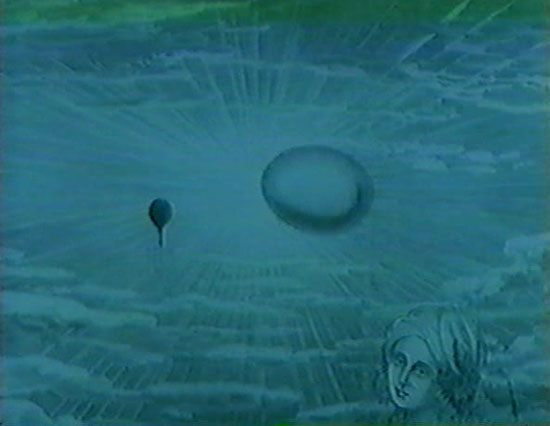
Gymnopedies (1965, Larry Jordan)
An egg floats around on different backdrops interacting with various objects, all cut-out animation a la Gilliam or Borowczyk, set to calm piano music. Feels more like a proof of concept than anything else – if there was a narrative present, I didn’t catch it. Cute, though.
image

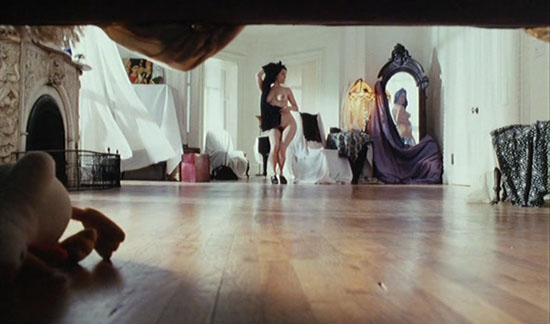
Lipstick (1999, Pascal Aubier)
Single 6-minute shot beginning under a bed, unsubtitled. Family is getting ready to leave for a trip, the mother is briefly visited by her lover who comes in through the window. Aubier was assistant director on some French New Wave classics in the 60’s, now an actor and a director of (mostly) comic shorts. Liked this a lot (and not only because of the naked dancing), will have to check out more of his stuff.
image

Ark (2007, Grzegorz Jonkajtys)
Iffy-looking 3D animation tells apocalyptic story with a twist ending. Our guy wasn’t really the lead scientist onboard an ark of the last surviving humans searching the oceans for new land, just a crazy old man in a convalescent home. Ha! Bah.
image

Happy-End (1996, Peter Tscherkassky)
Found footage of a couple sitting down for dinner, toasting the camera, drinking… and drinking and drinking! Dancing, drinking, sitting, more drinking. Different days, different clothes, edited together, eventually with scenes superimposed atop each other, a haunted distortion of a French pop song as the soundtrack.
image

Two Solutions To One Problem (1975, Abbas Kiarostami)
Very short with narrator, two kids get in a fight over a torn book. We tally the damages then rewind, and instead of starting a fight, they help repair the book and remain friends. Nice.
image

Blah Blah Blah (2006, Dietmar Brehm)
Liquor bottles. Close-ups of objects with strong textures, overexposed porno, an action film in extreme-fast-forward, long pause on an ashtray, back to the liquor bottles, etc. Audio is a quietly rainy/windy day with a metronome hit every three seconds. Looks like old 8mm or 16mm color with some monochrome sections. Pretty alright, probably better in a theater surrounded by like-minded shorts instead of following up a cute Kiarostami piece.
image

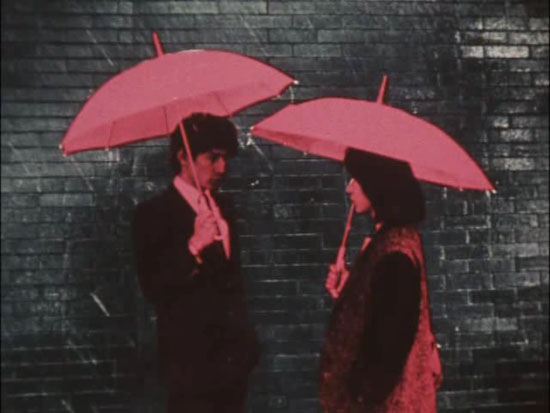
A Girl, She is 100% (1983, Naoto Yamakawa)
Wow, that wasn’t very good at all. They must’ve thought it’d be the simplest Haruki Murakami story to film. Straightforward, with some good still photography and some bad acting by our IMDB-unknown hero, closing with some rockin’ 80’s music.
image

Foutaisies (1989, Jean-Pierre Jeunet)
Young Dominique Pinon with 80’s hair tells us about the things he likes and does not like. Very Amelie-feeling, with Delicatessen opening titles (and Deli‘s lead actress).
image

image

image

The Hitman (2001, Ruben Fleischer)
Mary Lynn Rajskub decides to be a hitman, but her first mark (Paul F. Tompkins) decides not to go through with it and asks her out instead. Just your typical indie comedy short. From the director of Girls Guitar Club, whose film career didn’t take off, I guess.

What Is That (2001, Run Wrake)
Buncha funny animated business involving insects and meat and ringing sounds. Cute, but only three minutes long and pretty inconsequential… not up to Rabbit level. Guess it’s an early work.
image

Film Noir (2005, Osbert Parker)
Awesome, very short. Like Fast Film but slower. Some After-Effects-lookin’ animation combined with models and lots of cutouts – not trying to tell a story, just cool visuals/mood. Ahhh, the internet reveals that it was all created in-camera – impressive!
image

image

image

Banquize (2005, Claude Barras)
Boyer’s French Dictionary: “banquize – heap of floating ice frozen together in close masses.” Might be called Banquise, actually. Simple animation, fat kid wears his snow clothes in summer, dreams of living on banquize and playing with penguins. One day trying to hitchhike there he drops dead from heat/dehydration. Hmm.
image

Herakles (1962, Werner Herzog)
Herzog’s very first film, six years before his first feature. This was really good, and not like anything else I’ve seen by WH. Pretty simple structure so I’ll let wikipedia take it below.
image

The film relates to six of the twelve labours of Heracles. The film starts with shots of young male bodybuilders working out in a gym, posing on a stage and flexing their muscles. Each of the labours are then announced by on-screen text in the form of a question, followed by related scenes of modern challenges intercut with the bodybuilders. The audio track of the film is saxophone jazz and sounds from a gym.

The question “Will he clean the Augean stables?” is followed by scenes of a garbage dump, “Will he kill the Lernaean Hydra?” is followed by a huge line of stopped traffic on a motorway and people walking around outside their cars, “Will he tame the Mares of Diomedes?” is followed by scenes of car racing and several race crashes including a crash into the spectators and shots of the subsequent disaster and piles of bodies, “Will he defeat the Amazonians?” is followed by scores of young women marching in uniform, “Will he conquer the giants?” is followed by shots of rubble of a destroyed apartment building and men in uniform searching the wreckage, “Will he resist the Stymphalian birds?” is followed by jets flying in formation, shooting missiles and dropping bombs on training targets. The last shot of the film is of a bodybuilder’s buttocks as he goes off the stage through the stage curtains.

image

Matta (1985, Chris Marker)
“What I am showing here is no exhibition. It is an appeal: Come and play with me! It’s a very lively game, but nothing happens.” Simple interview with Chilean artist Matta (not surprisingly an Allende supporter), an original member of the surrealist group, talking coherently about his art and all art, human beings, dimension and meaning. Would be nice to get/make a transcript. Would be even nicer to have been able to see the Matta paintings that Marker frames him against, but my video was too low-quality to make out much visual detail.
image