I passed up seeing The Scarlet Empress in 35mm for this, but it was probably worth it [later note after having finally watched The Scarlet Empress: nope].
Meshes of the Afternoon (1943, Maya Deren)
One of the great poetic movies of the 40’s. Love when she’s climbing the stairs, bouncing off the walls as the camera twists from side to side. Love the multiple Mayas sitting at a table in the same shot (technically impressive, too). Love the movement, the plot (avant-filmmakers take note: an actual plot), the look, that iconic shot of Maya at the window.
Fuses (1967, Carolee Schneemann)
Fairly rapidly-edited shots of director having sex with James Tenney, with other scratched and weathered colored filmstrips superimposed over it. The editing and content are exciting for about ten minutes, but the movie is twenty minutes long, and silent. Girl in front of me tried reading from the reflected light of Tenney’s alarmingly red-tinted penis on the classroom wall, then texted people for a while. I sat wondering why there were so many shots of her cat staring out the window. Maybe it was supposed to be boring, and that was the point. Worth watching on pristine 16mm, glad I saw it, just saying it felt long. Schneemann has few film credits, but they’re in collaboration with Andy Warhol, Yoko Ono and Stan Brakhage. The Brakhage influence can plainly be seen here, and the film process work makes for some wonderful images. This was apparently a reaction to the objectification of women in movies, with Window Water Baby Moving named as an example. The director: “I wanted to see if the experience of what I saw would have any correspondence to what I felt – the intimacy of the lovemaking… And I wanted to put into that materiality of film the energies of the body, so that the film itself dissolves and recombines and is transparent and dense – as one feels during lovemaking.” Won a special jury prize at Cannes.
Reassemblage (1982, Trinh T. Minh-ha)
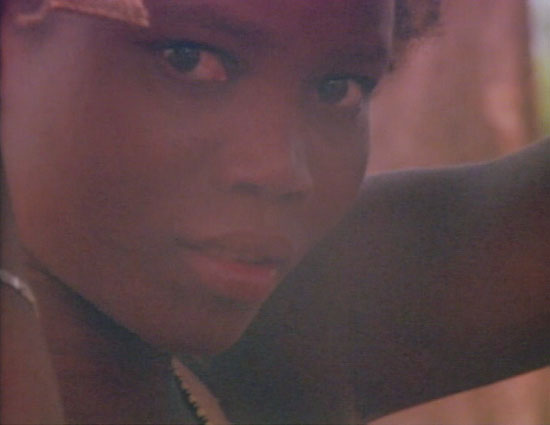
Black with ambient sound. Then shots of a rural scene in Senegal with silence. More shots with narration. More shots with ambient sound. More narration. Eventually, more black. The sound is rarely commenting directly on the visuals, and even the ambient sound rarely seems to line up. Shots of bare-breasted African women, daily chores, kids (two albinos!), youth playing in the river, and so on, with comments about ethnography. The commentary might make sense written down, but as we heard it, all scattered and edited (the sound editing was pretty poor), it seemed to circle around some points without managing to make any. Got nothing against the film, was fine to hang out in Senegal for a while. L. Thielan: “By disjunctive editing and a probing narration this ‘documentary’ strikingly counterpoints the authoritative stance typical of the National Geographic approach.”
Reassemblage:
First Comes Love (1991, Su Friedrich)
Pop music by the Beatles, James Brown, Willie Nelson and more, but someone please get this woman a cross-fader – it’s all so abruptly edited. The songs sometimes work really well with the images, though. Image is of four wedding ceremonies, astoundingly woven together into an ethnographic study of heterosexual marriage ceremony, interrupted by a text crawl of all the countries in which homosexual marriage is prohibited (every country but Denmark). Bell & Zryd: “This simple strategy, which contrasts the lush life of heterosexual ritual with the stark legal and constitutional realities of gay and lesbian relationships, reframes the anthropological text with political rigor.” Rigor isn’t something I look for in a movie, but avant-critics love to proclaim it. What rigor! Anyway, would like very much to see more of her work.
Girlpower (1992, Sadie Benning)
I hear the intro feedback of a Sonic Youth song and all is right in the world. Even though this movie (the shortest of the bunch, I expect) is a half-res crap-quality videotape, the music and narration are clear. About the narration – sounds like either a petulant girl or a woman in performance-art mode… an impressionistic video diary of disaffected youth, comfortable with herself but not with society. Aha, Benning was 30 at the time. Lotta shots of the television. Punk film, but with nicer sound editing than the Friedrich, weird. Short, enjoyed it. Ooh, she’s James Benning’s daughter.