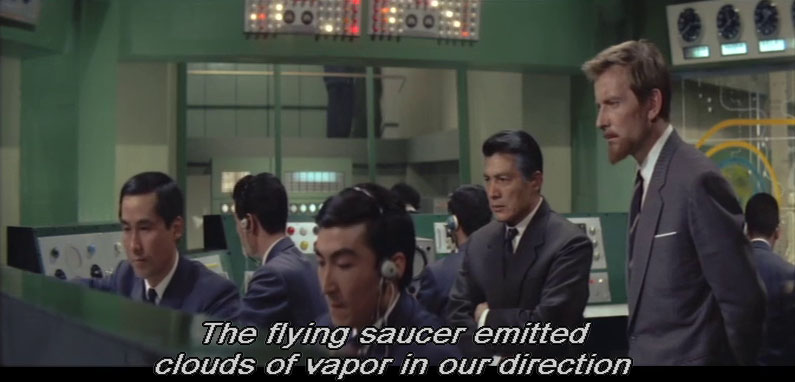
Zeman’s followup to Invention for Destruction is another absolute wonder. Actors filmed b/w and composited somehow with variously tinted objects and backgrounds. Still don’t know how this was done – saving the making-of doc for after I watch the dinosaur feature.

The story opens with astronaut Tony landing on the moon and discovering the Baron (Munchhausen), who calls him a moonman and takes over the narrative (I don’t think Tony speaks in the first half). Baron returns them to Earth, but a fantasy version, the jet planes in the opening scene replaced by flying monsters.

They rescue a kidnapped princess from a sultan, she falls for Tony, and the Baron spends the rest of the movie trying to convince her that he’s more impressive that boring old Tony (true). Along the way they jump their horses off a cliff, create a tobacco smokescreen to confound the sultan’s fleet, get swallowed by a whale and scooped up by a giant bird, ride a cannonball, escape from prison and return to the moon via rocket-propelled castle tower, all in about half the runtime of the Gilliam version.

The Torquays was a successful five-piece band of U.S. soldiers who’d stayed in Germany after their war service, playing nightly shows when two serious German art-school dudes approached them and convinced them to rebrand as The Monks and play a pared-down but forceful new kind of rock music. We spend much time with the band members, leaving no anecdote untold and culminating in a one-off NYC reunion show with celebrities like Jon Spencer in the crowd. Still one of the greatest albums ever made… this two-hour movie has only about 15 minutes of illuminating stories, but it’s nice to spend so much time in a world where the Monks mattered.

Broke mopey people have sullen conversations against plain backgrounds, all referring to some plan but not cluing us in, their relationship swapping getting out of hand. Nihilist movie full of banalities, even in love, some pleasant repeated shots like a couple walking toward camera with different characters every time.

The director plays a Greek who everyone turns on, painting him as a large-cocked rapist, while he just wanted to be friends. Hanna Schygulla and Hans Hirschmüller return from Fass’s debut, which I watched in 2015 – maintaining six years between features, I’ll get to Querelle in the year 2183. But maybe I’ll increase the pace since watching this drab movie improved my drab week – funny how art can work.

A late television inventor’s missing heir is sought, and ends up being TV repairman Jerry Lewis. Unusual for Tashlin that the movie (from the writer of Pufnstuf and Lidsville) is TV obsessed but not in a negative way. Rich aunt Cecilia is Mae “Betty Boop” Questel, easily the highlight of the movie, meant to marry a thin-mustached man (Zachary Scott, sex criminal of Bunuel’s The Young One) who only wants the money. The hot house nurse is Joan O’Brien (Blake Edwards submarine movie Operation Petticoat), and Wait Until Dark baddie Jack Weston a hired killer. Also featuring robot lawnmowers, a classier-looking movie than necessary.

Whoa, big movie… I was hoping for something Tarkovsy-esque, but if anything it was closest to Andrei Rublev. Too plotty, full of unhappy Christians doing desperate things. Choir music, the voices dubbed with a mesmerizing echo effect. Some proto-Hard To Be a God ancient miserablism. The movie is full of birds – generally a good thing, but with a notable bird death.

Catching up on the storyline via wikipedia, and most of this is news to me. I did not realize that Kozlik (the bald guy with a crack in his head) and Lazar (Marketa’s dad) were rival clan leaders, both under assault by the King’s captain. I got the relationship and revenge-killing stuff, with thanks to the descriptive title cards before each chapter, but not that one-armed Adam’s other arm was removed as punishment for sleeping with his sister. The arrows being shot into everyone in the last hour look unnervingly real.

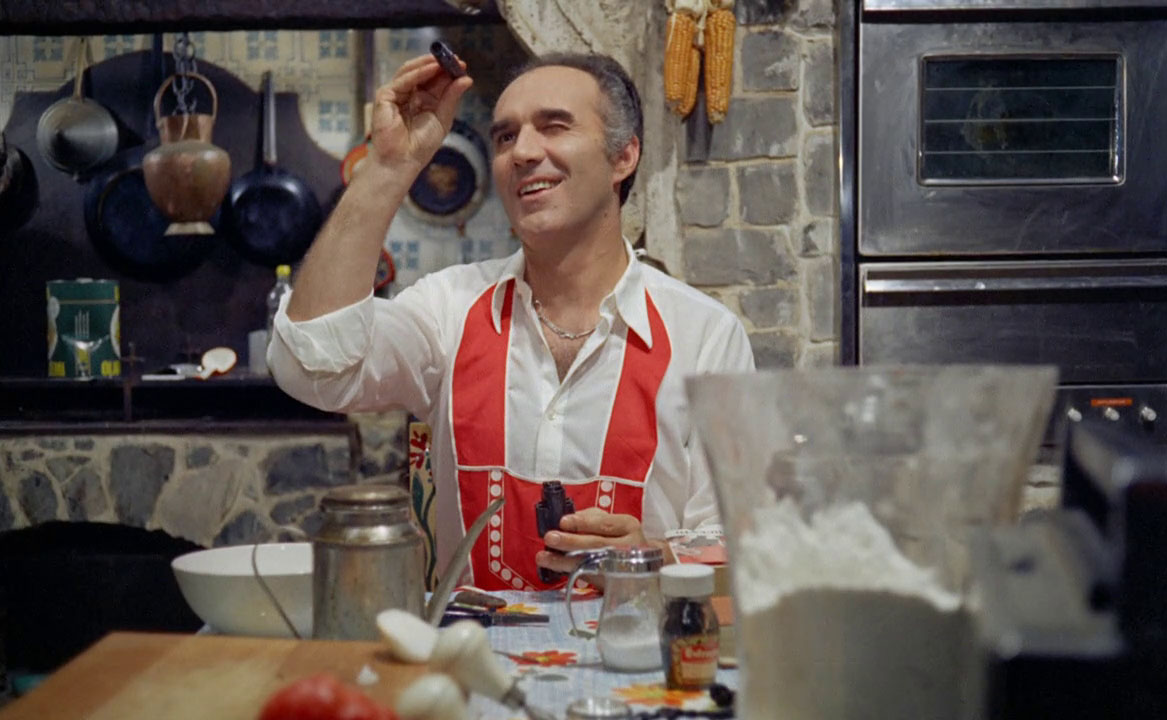
“Profit is the only principle.” Double featuring this with No No Sleep, I was tickled that the lead character is named Walker. During a robbery turned murderous, Lee Marvin’s wife and his partner turn on him and leave him for dead. Years later he’s on a singleminded revenge rampage, demanding his share of what turns out to be a relatively small amount of money from the people involved… I feel like the “I want my two dollars” kid from Better Off Dead was based on Lee Marvin.

After visiting traitorous wife Sharon Acker he beats up a car dealer who leads him to Sharon’s sister Angie Dickinson, who offers to help. He catches up with his killer an hour in (never trust a man named Mal) and the guy’s a whiny bitch who gives up his bosses immediately. Marvin drops him off a building anyway. Instead of paying him to go away, Mal’s organization boss Keenan Wynn uses Marvin’s uncautious killing spree to their advantage, letting him kill off Wynn’s enemies/partners.

Besides being a satisfying Lee Marvin action story, the movie has some of the most baller shots and editing of all time, every bit as good as I remembered. Dispatched crime bosses include Lloyd Bochner (The Dunwich Horror) then Carroll “Archie Bunker” O’Connor. Car dealer Michael Strong looked familiar, but it must’ve been from this since I barely remember Patton. Mal was John Vernon who’d later go up against Clint Eastwood a few times and presumably lose. Big Bad Wynn had recently been in Dr. Strangelove, and I haven’t seen Dickinson or Marvin in enough movies.

Hardworking family lives on hostile island with no water, so they ferry buckets across the sea from the next island. Life just sucks, is hard and unforgiving, then their oldest son dies, but they have to keep going to survive. Beautiful looking movie with really good music, flutey themes that the Criterion calls “modernist,” so I am sure I don’t know what that word means. The first non-ghost story I’ve seen by Shindo, although the Criterion essay calls it a ghost tale out of habit.

Kalat says this was the sixth Mabuse movie, a combination sequel and remake. It has some typical sequel behavior, taking its villain backstory too far by explaining that brain abnormalities cause his evil power. Other than this, it’s a pretty good movie, much better than the 60’s Fantômas update.

Inspector Gert Fröbe (fresh off Fritz Lang’s own 1960 Mabuse movie) knows only one criminal mind could be behind a counterfeiting ring, but Mabuse (Wolfgang Preiss, also from the Lang) is secured in an asylum, so he visits the place and discovers that a doctor (the prolific Walter Rilla, who started out with Murnau’s Finances of the Grand Duke) is being hypnotized into passing along the mastermind’s messages. Corrupt cop Flocke tries to atone by getting into Mabuse’s gang, but is killed… Boxer Johnny joins the gang then finds he and his girl are trapped… the doctor apparently survives to appear in the next two movies.

Harmless Mabuse scribbles away while Gert reviews his notes and the bowtie doctor observes:

Trapped boxer:

Mind-controlled doctor takes a drive:

Maybe they really don’t make ’em like this anymore. Watched on a whim, dunno Michael Ritchie (two Fletch movies and Prime Cut) and this isn’t about anything of interest (Robert Redford is a hotshot replacement skier on the US olympic team coached by Gene Hackman), but visually it’s really well put together. Maybe not the undercranked-looking wide shots of ski races, but everywhere else the editing and movement is very alive. Redford likes a girl, of course: Swedish Camilla Sparv (of The Trouble with Angels), who is working for a ski manufacturer, and of course he has rivalries with his teammates, including good dude Jim McMullan (of a couple Joel Schumacher movies), who gets laid up and misses the olympics. Not running out and recommending this as an example of Pure Cinema, but more watchable than a late 60’s New Hollywood sports movie has any business being.

What skiing leads to: