I can’t believe people took this movie as serious criticism of The Shining and complained about its arguments instead of reveling in Ascher’s technique. He wastes no time showing us the Shining obsessives and conspirators on-camera, or obtaining rebuttals from people involved in the original film’s production – just uses these stories and fantasies to spiral further inside the movie, revisiting and altering footage to suit him, bringing the rest of Kubrick’s films into the mix (one speaker is visualized using Tom Cruise from Eyes Wide Shut). It’s a clear progression from his short The S From Hell to this – can’t imagine where he’ll go next.

Noel Murray says it best:

The Shining can’t be a coded confession by Kubrick that he helped fake the moon landing and a metaphor for the Holocaust and a symbolic representation of the American government’s slaughter of the Indians and a subliminal-message-filled exploration of deviant human sexuality and a complicated structuralist film that’s essentially 2001 in reverse. Or can it? Room 237 joins the ranks of classic documentaries like Rock Hudson’s Home Movies and Los Angeles Plays Itself that encourage cineastes to take a closer look at the secret messages that movies send, and to ask whether they’re intended or not—or whether it matters. What makes Room 237 work so well is that Ascher shows the same Shining clips over and over, with different interpretations, letting only the voices of the theorists and the images from the film (plus a few other relevant movies) tell the story. The effect is intense: a deep dive into the rabbit hole of semiotics, which leaves viewers more alert to what’s really on the screen.

Quintín:

The manipulation of the film material, the juggling of meanings, the associations connecting truth, memory, and film in Room 237 add up to something very enjoyable, as a kind of a fresh pleasure in film viewing, which is not exactly the same as the essay-film format, nor the usual patchwork in the found-footage genre. Made with no clear tradition behind it, Room 237 invites us to a dance with a cinema that is daring and free.

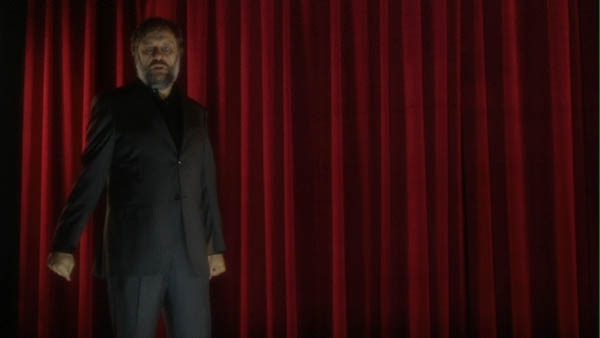
“Cinema is the ultimate pervert art. It doesn’t give you what you desire; it tells you what to desire.”

With his focus on the “traumatic dimension of the voice… which distorts reality”, I must believe that narrator Slavoj Zizek, with his heavily accented voice, is watching and interpreting slightly different versions of these movies than the ones I have seen. After all, I watch films and he watches “fillums”.

image

A few bits: the three levels of Norman Bates’s house representing the id / ego / superego… the power of the voice represented by Dr. Mabuse… “Music is potentially always a threat”… a look at the intersecting fantasies in Blue Velvet, and the related horror themes of Blue Velvet and Mulholland Drive.

Calls a scene in The Piano Teacher “the most depressive sexual act in the entire history of cinema.” To think I once showed that movie to my girlfriend’s parents!

Wish Katy had finished watching this with me, could’ve helped defend my position on David Lynch movies. And for stupid cinephiles like myself, who love Lynch movies (and The Piano Teacher, and Eyes Wide Shut, and Blue) but get lost in their images and atmosphere without thinking too hard about their psychological implications, he handily explains the stories and characters from a psych point-of-view.

“I think that flowers should be forbidden to children.”

The movie might teach the rewards of closely analyzing a few great movies instead of trying to watch every potentially great movie. This is a lesson I will not be following. Maybe one day…

I feel so vindicated that he picks Alien Resurrection as a film worth discussing. When oh when will that gem get its due? Only the second of the series (after the Ridley Scott original) to count as a horror film, plus it’s good sci-fi and an innovative sequel/reboot that hasn’t been matched since (well, maybe those Chucky movies).

“All modern films are ultimately films about the possibility or impossibility to make a film.”

He compares Cecil B. DeMille to the Wizard of Oz to the mystery man in Lost Highway.

“In order to understand today’s world, we need cinema, literally. It’s only in cinema that we get that crucial dimension which we are not ready to confront in our reality. If you are looking for what is in reality more real than reality itself, look into the cinematic fiction.”